Gata: Armenia's beloved sweet bread
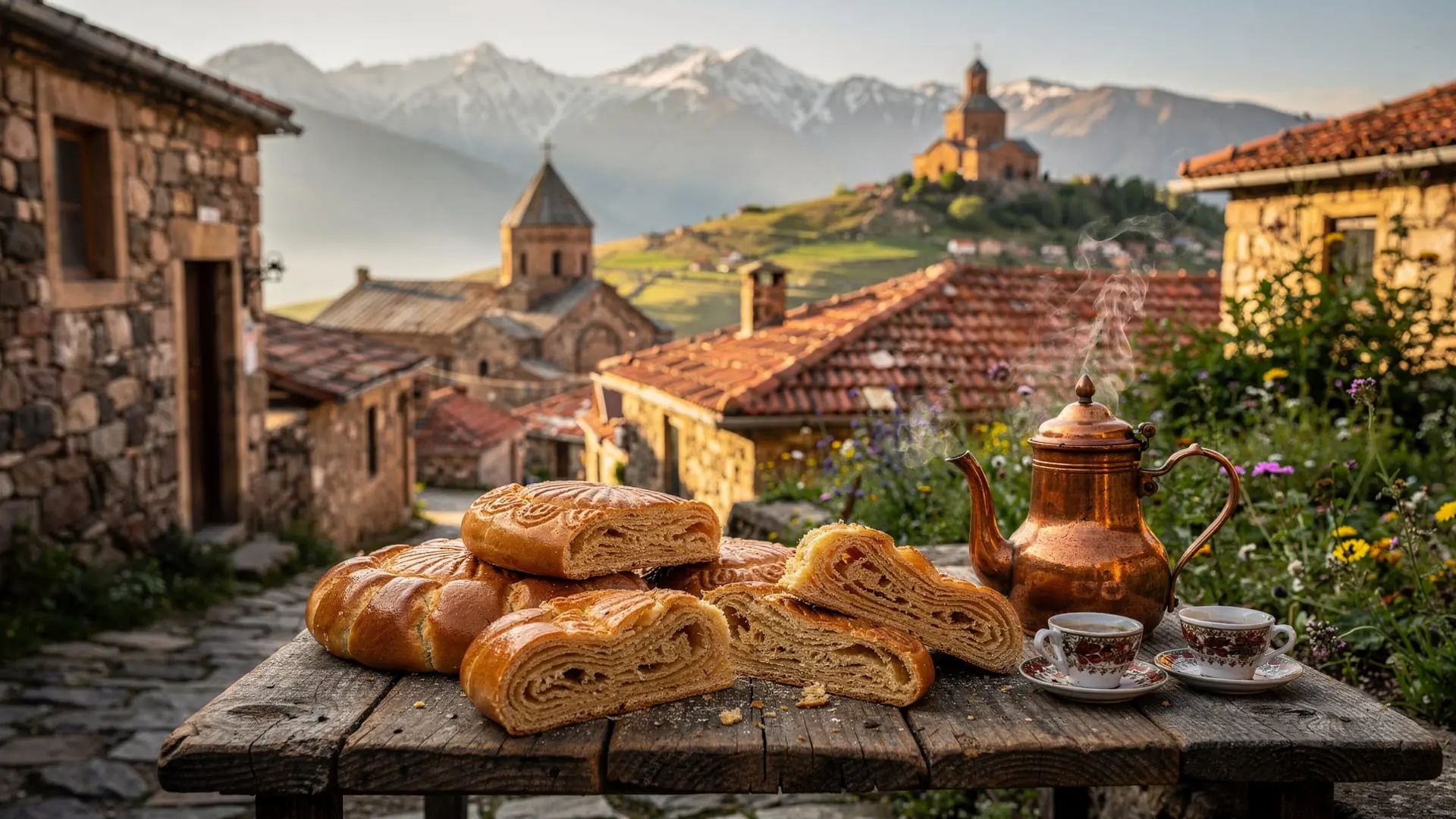
The bread at the monastery gate
Arrive at Geghard Monastery in the morning and you will smell it before you see it. A handful of women set up their folding tables by the entrance road, selling small ring-shaped loaves from cloth-wrapped baskets. This is gata — the sweet bread most closely associated with Geghard — and buying a ring to eat while walking through the 4th-century rock-cut monastery is one of the simplest pleasures Armenia offers.
Gata is not a complicated food. It is a yeasted bread dough filled with khoriz — a mixture of flour, butter, and sugar — folded or rolled into shape and baked until the surface turns golden and the filling melts into buttery layers inside. But like most simple foods, it sits at the centre of a larger tradition: celebrations, monastery visits, family gatherings, the careful gift given to a guest.
| What it is | Yeasted sweet bread with a buttery khoriz (flour-sugar-butter) filling |
| Where to try it | Geghard entrance road, GUM market, Yerevan patisseries |
| Cost | Around 500–800 AMD (roughly 1.20–2 USD) for a small piece |
| Best eaten | Warm, the day it’s baked, with Armenian coffee (soorj) |
| Pairs well with | A Garni and Geghard day trip |
The khoriz: the soul of the filling
The defining feature of gata is its filling, called khoriz. The word does not have a direct English equivalent; it refers specifically to the dry crumble that goes inside gata and nothing else.
Khoriz is made by rubbing together:
- Flour
- Sugar (sometimes powdered, sometimes fine)
- Butter (cold and cubed)
- A pinch of salt
- Sometimes a small amount of vanilla or rose water in more refined versions
The proportions vary by family. The result should be a dry, sandy mixture that holds together when pressed but crumbles when squeezed hard. It is not a wet filling; it is a dry streusel-like mixture that, during baking, absorbs butter from the dough and forms irregular pockets of flaky sweetness within the loaf.
The ratio of khoriz to dough defines the character of the gata. Some bakers use a thin layer of filling for a subtle sweetness; others pack it generously so that every slice reveals thick bands of buttery crumble. The Geghard ring style tends toward the generous end.
Regional shapes and styles
Gata exists in many regional forms across Armenia. Shape is the clearest indicator of origin.
Geghard gata (ring gata)
The small ring (about 15 cm in diameter) sold at Geghard Monastery is the most iconic form. The dough is rolled flat, khoriz spread across it, then rolled into a log which is joined at the ends to form a circle. The surface is marked with a fork in a decorative pattern — diagonal lines or a lattice — which indicates the filling runs through the whole ring. Eaten warm from the basket; reheated the same day still excellent; next-day stale but still acceptable torn and dipped in coffee.
Yerevan café gata (large loaf)
The urban version found in Yerevan pastry shops and cafés: a larger, more refined loaf, sometimes braided or coiled, with a more even distribution of filling and a glossier crust from an egg wash. This version is typically sold by the slice and is closer to an enriched pastry in texture.
Garni and Kotayk village gata
The village version is denser and more rustic, with a darker crust and a filling that sometimes includes walnuts or dried apricots in addition to the basic khoriz. Found at roadside stalls on the way to Garni and Geghard.
Gyumri gata
Gyumri has its own gata tradition with a higher ratio of butter in the filling and a slightly different dough that yields a more layered, flaky crumb. The Shirak province version is richer and less sweet than the Yerevan café version.
Holiday and ceremonial gata
For Christmas (January 6 in the Armenian calendar), New Year, and Easter, families bake large gata with a coin hidden inside the dough. The person who finds the coin in their slice receives luck for the year. This version is usually braided and considerably larger than the everyday gata — it is a centrepiece as much as a food.
The ceremony around gata
Gata is not an everyday snack in the way that lavash is an everyday bread. It carries occasion. Bringing gata when visiting someone’s home is a mark of respect; it signals you did not arrive empty-handed with a supermarket item but with something made. Many bakeries and pastry shops wrap gata in paper or cloth specifically for this purpose.
At monastery visits, buying gata from the vendors at the entrance has a quasi-votive quality — a small economic contribution to the local community maintained by the monastery, a physical token of the visit. The gata vendors at Geghard are the same families who have been there for decades; their presence is part of the site’s atmosphere.
At weddings, gata is baked in quantity and given to guests as part of the traditional sweet spread (alongside pakhlava, sugar-coated almonds, and churchkhela). The scale of the gata baking is sometimes taken as an indicator of the host family’s generosity.
Where to buy gata in Yerevan
GUM market — the most reliable place for fresh gata in the city. The bread and pastry section in the market sells gata by weight; look for it in the morning when it arrives fresh. Expect 500–800 AMD (1.20–2 €) for a small piece.
Nor Zovq patisserie (Mashtots Avenue) — the city’s most respected traditional pastry shop. Their gata is consistently well-made, with a proper khoriz-to-dough ratio. Slightly more expensive than the market but more elegant presentation — useful if you want to bring gata as a gift.
Café breakfasts — Lumen Coffee Roasters and Achajour both occasionally offer gata as a breakfast item, sometimes alongside coffee and matsun. It is not always on the menu; ask.
Vernissage weekend market — food vendors at Vernissage sometimes sell homemade gata alongside other traditional sweets. Quality varies; the homemade-looking versions in cloth bundles are usually better than the plastic-wrapped ones.
Supermarkets — SAS and Yerevan City supermarkets stock packaged gata from commercial bakeries. The industrial version is acceptable but nothing like fresh-baked; useful for taking home as a souvenir given its shelf life.
Gata at Geghard: the pilgrimage experience
The road from Garni to Geghard climbs 9 km through a gorge of basalt columns. Approaching the monastery, the road narrows and the cliffs close in. The gata vendors set up at the edge of the car park and at the main entrance path, usually from 9 am until they sell out (by noon on busy days in summer).
Buying a ring, finding a stone to sit on near the entrance, eating while watching the carved stone church in front of you — this is not a tourist performance. It is what locals do. A bottle of water, a ring of gata, the carved monastery face above: a simple combination that requires no interpretation.
For the full Geghard visit, see the Geghard monastery guide. For getting there, the Garni and Geghard day trip covers transport and timing.
Making gata: the home version
Gata is one of the easier Armenian baked goods to make at home. The dough is a simple enriched yeasted dough (flour, butter, eggs, sugar, milk, yeast); the khoriz requires no cooking. The main skill is rolling the dough thin enough to create layers, spreading the filling evenly, and rolling or folding it without the khoriz falling out.
A cooking class is a good way to learn the shaping technique — the traditional Armenian cooking class in Yerevan sometimes includes gata alongside lavash, dolma, and manti. If you want to replicate it at home, ask the instructor for their khoriz ratio; this is the key variable that defines a family’s gata character.
Gata and Armenian coffee
The pairing of gata with Armenian soorj (coffee) is as natural as croissant and espresso in France. The bitterness and dark roast of soorj plays directly against the sweet butteriness of the gata crumb. See the Armenian coffee guide for where to drink soorj in Yerevan; most of those same cafés serve or can source gata.
For a full Armenian pastry and coffee morning, try: Lumen Coffee Roasters (Saryan Street) for the soorj, then walk to GUM market (10 minutes) to buy gata. Eat in the market or take it to the square outside.
Gata in Armenia’s food culture: context and comparison
Among the rich canon of Armenian sweets — pakhlava, churchkhela, kadaif, sugar-coated almonds — gata occupies a particular place because it is bread rather than pastry. This matters in Armenian food culture, where bread carries a different ceremonial weight from dessert. Gata can appear at the end of a meal but also at breakfast, mid-morning, and as a standalone snack with coffee. Its dual nature — somewhere between bread and sweet — makes it more present throughout the day than any equivalent confection.
The comparison with Georgian churchkhela (walnut-and-grape-must sausages) is interesting: both are foods associated with specific places (Geghard gata, Kakheti churchkhela), both travel as souvenirs, both carry a regional identity. But gata is more tied to ceremony and less to geography than churchkhela — you can find good gata in Gyumri as well as Yerevan as well as Garni; the Geghard version is the most famous but not the only legitimate version.
Where to find gata outside Yerevan
Gyumri (Shirak province): the Gyumri gata tradition is distinct and worth seeking if you visit Armenia’s second city. Look in the central market and the old-town bakeries near the city’s historic stone buildings. The Gyumri version tends toward a richer, more buttery dough with a higher khoriz ratio.
Garni village and the Geghard approach road: the ring gata vendors at Geghard are the most photographed but the village of Garni itself has a small bakery that sells the larger loaf format.
Tsaghkadzor: the ski resort town has bakeries that supply gata to the weekend ski crowd; less celebrated than Geghard but fresh and serviceable.
Areni and Vayots Dzor: wine country hosts a local gata tradition that sometimes incorporates dried fruit (apricot, raisins) into the khoriz filling — an autumn variant worth trying during the September vendange season. See our Vayots Dzor wine route guide if you are heading that direction.
Gata and Armenian coffee: the pairing explained
The chemical logic of gata and soorj (Armenian coffee) is simple: the bitterness of the coffee, which is roasted dark and served strong and unfiltered, needs the sweet butteriness of the gata to balance. The khoriz filling in particular has a toasty, slightly nutty note from the flour browning during baking that mirrors the roast character of the coffee. They work together rather than one simply counteracting the other.
The serving format reinforces this: Armenian coffee arrives in a small cup that takes 10–15 minutes to drink properly (you cannot rush through the grounds). Gata is eaten slowly, torn by hand rather than sliced. The pace of both foods matches. See the Armenian coffee guide for where to drink the best soorj in Yerevan.
Practical guide: eating gata on a Garni day trip
If you are doing the Garni and Geghard day trip — which most visitors to Armenia do at some point — incorporate gata as follows:
Morning: Leave Yerevan early (by 9 am) to arrive at Garni by 9:45 am. The temple site opens from 9 am and the morning light on the basalt promontory is best before 11 am.
Late morning: Walk the Garni gorge to see the Symphony of Stones basalt columns. This takes 30–40 minutes round trip from the temple car park.
Midday: The lavash baking demonstration (arranged in advance; the Garni gastro-cultural tour includes one) typically runs 11:30 am–1:30 pm and includes lunch.
Afternoon: Drive the 9 km to Geghard Monastery. Stop at the gata vendors on the approach road — they are set up by 9 am and sell out by noon or 1 pm on busy days. Buy a ring, find a stone, eat it outside the monastery.
Late afternoon: Return to Yerevan by 5 pm (in time to visit the GUM market if it is open, or a café on Saryan Street for coffee and an additional slice).
Gata compared to Armenia’s other breads
Visitors often confuse gata with the country’s other iconic breads, so it helps to place it on a spectrum. Lavash is the everyday unleavened flatbread, cooked paper-thin against the wall of a tonir oven — no sugar, no filling, and eaten with nearly every meal; it is UNESCO-listed as intangible cultural heritage in its own right. Matnakash sits in the middle: a plain leavened bread, thicker and softer than lavash, still savoury. Gata sits at the sweet end: enriched, filled, and reserved for occasion rather than daily eating. If your itinerary allows for a hands-on baking session, the lavash baking experience near Garni often demonstrates the tonir technique that most gata dough recipes borrow from for the initial proof.
Gata also belongs to a wider table of Armenian sweets that includes dolma at the savoury end of a shared feast and pakhlava, sujukh, and churchkhela at the dessert end — most home-hosted meals or wedding tables in Armenia will offer several of these together rather than gata alone.
If you are hosted in an Armenian home, expect the table to be layered rather than sequenced course by course: gata, pakhlava, fruit, cheese, and savoury dishes like dolma often sit out simultaneously, and guests graze across all of them rather than waiting for a formal dessert moment. Arriving with a box of gata as a guest gift is always well received and rarely goes uneaten by the end of the visit.
Buying gata as a souvenir
Gata travels reasonably well if you plan around its short fresh life. Buy from a bakery or patisserie rather than a street vendor if it needs to survive a flight — the commercial packaging holds up better than a market piece wrapped in paper. Nor Zovq and similar Yerevan patisseries will box gata specifically for travel on request. Vacuum-sealed or tightly foil-wrapped gata keeps for around a week at room temperature and up to a month frozen; carry it in hand luggage rather than checked bags, since a crushed gata is a sad souvenir. It is not a liquid or a restricted food item, so it clears security screening without trouble in most countries, though always check your destination’s customs rules on bringing in baked goods with dairy and eggs.
If you would rather bring home the experience than the bread itself, pair the traditional cooking class mentioned above with a stop at the Vernissage flea market for ceramics or textiles to bring home alongside your gata.
Frequently asked questions about gata
Is gata gluten-free or dairy-free?
No to both. Gata contains wheat flour and butter in both the dough and filling. There are no standard gluten-free or dairy-free versions; Armenian baking does not yet have wide adaptations for these diets. Lavash, being unleavened flatbread, contains wheat but no dairy.
How long does gata keep?
Fresh gata is best eaten the day it is baked. It keeps at room temperature for 2–3 days without refrigeration, but becomes drier. Wrapped tightly in foil and frozen, it keeps for a month and reheats well in a warm oven (10 minutes at 170°C). If you want to bring gata home from Armenia, buy it the day before you fly and pack it in your hand luggage.
Is gata the same as kadaif or baklava?
No. Gata is a yeasted bread with a dry crumble filling; it is completely different from kadaif (shredded pastry soaked in syrup) or baklava (layered filo with nut and honey filling). Gata is bread first; the sweetness is understated.
What is the difference between gata and matnakash?
Matnakash is a plain leavened bread — no sugar, no filling, just a slightly enriched dough. Gata is the sweet version with the khoriz filling. Both are yeasted; the dough bases are similar but the end result is entirely different.
Where does the Geghard connection come from?
The vendors at Geghard have been there long enough that the ring gata has become associated with the monastery in the same way that certain sweets are associated with pilgrimage sites throughout the region. There is no formal religious significance — the bread is not blessed or liturgically important — but the commercial tradition is organic and longstanding.
Can I find gata outside Armenia?
Armenian diaspora bakeries in Los Angeles, Paris, Beirut, and Sydney make gata, often in the large braided holiday version. The ring gata of the Geghard style is more specific to Armenia and harder to replicate outside the country. The GUM market version or the Geghard entrance version are the benchmarks.
Is gata always round?
No — the ring shape is specific to the Geghard tradition. Yerevan café gata is often a large rectangular or braided loaf sold by the slice, and holiday gata is typically a large braided round or oval. Shape is a strong clue to origin and style, but any of them can be excellent.
Can I take gata on a Garni and Geghard tour?
Yes — most organised day trips to Garni and Geghard stop directly at the gata vendors on the approach road, and some, like the Garni gastro-cultural tour mentioned above, build lavash baking and tasting into the itinerary as well, so you don’t need to plan the gata stop separately.