Tsaghkadzor + Sevan: the Kotayk/Gegharkunik combo
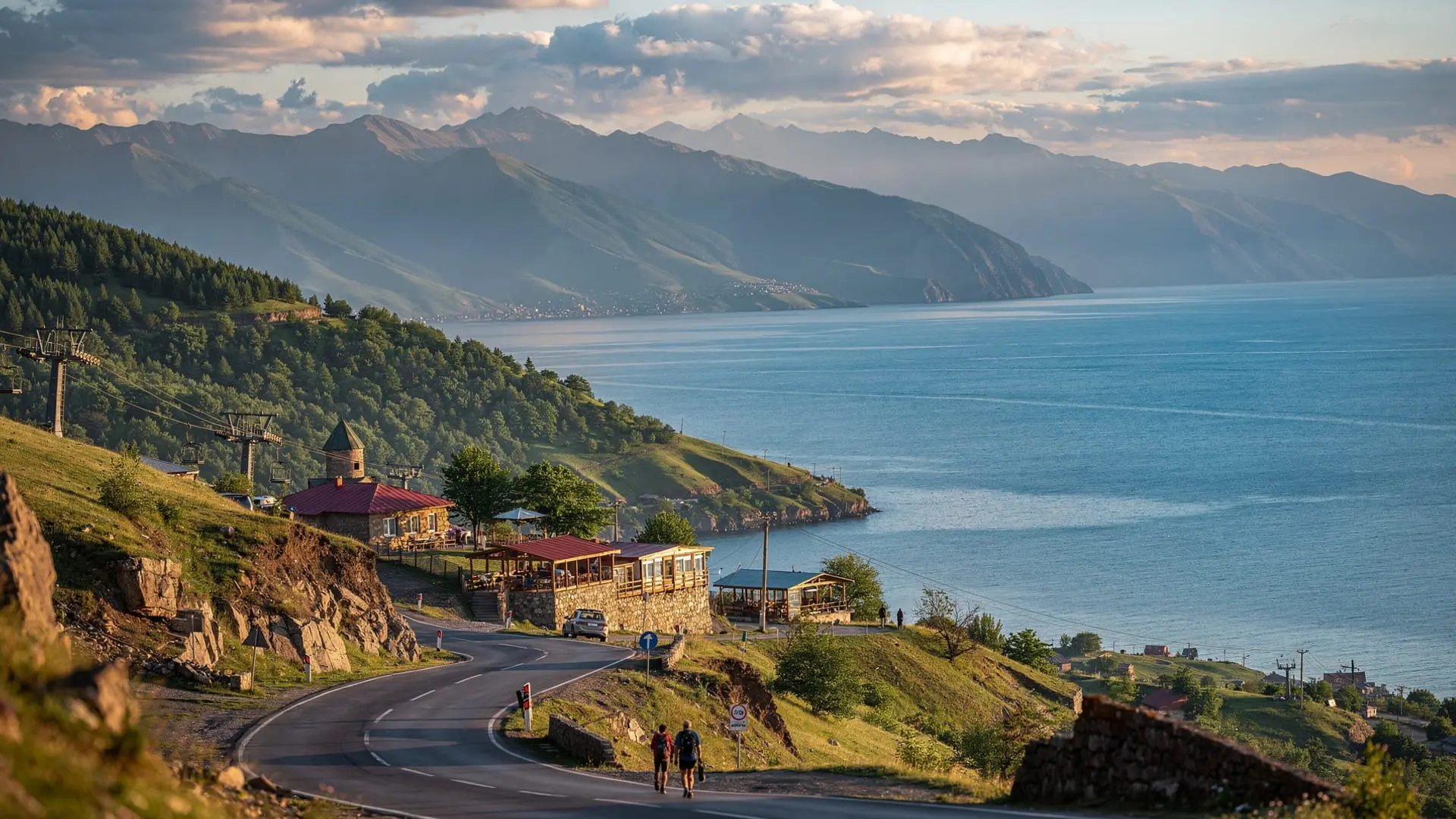
Two of Armenia’s most-visited destinations happen to sit along the same road heading north-east from Yerevan, separated by less than 40 minutes of driving. Tsaghkadzor — the country’s ski resort, summer mountain town, and ropeway destination — fills the morning slot perfectly. Lake Sevan — high-altitude, electric blue, ringed by a peninsula with a 9th-century monastery — takes the afternoon. Together they cover the full range of Armenian highland landscape: forest, ski runs, open mountain, and vast water.
This combo works in every season, which is part of its appeal. In winter (December–March) the pairing is ski + frozen lake. In summer it’s ropeway views + swimming at the beach. In autumn it’s golden forest + autumn light on the water. The logistics are simple enough that independent travel is easy, but guided tours also run this route daily.
| Where | Tsaghkadzor (Kotayk) then Lake Sevan (Gegharkunik), 55 km + 35 km from Yerevan |
| Cost | Ski pass + rental ~15,000–23,000 AMD; free at Sevan (donation at monastery) |
| Time needed | Full day, roughly 9am–5:30pm |
| Getting there | Rental car, organised tour, or marshrutka + taxi combination |
| Best time | Winter for skiing; September–October for the best light on both stops |
Tsaghkadzor: what to do here
Tsaghkadzor (meaning “valley of deer” in Armenian) sits at 1 800 metres in the Kotayk hills, 55 km from Yerevan. The drive takes about 1 hour on the M4 highway.
The resort covers a moderate ski area with three chairlifts and about 22 km of groomed pistes ranging from beginner to intermediate. It’s not the Alps — but it’s Armenia’s only real ski resort, well-run, and genuinely enjoyable for a day on the snow. Prices are very reasonable compared to European standards:
- Lift pass: approximately 10 000–15 000 AMD per day (adult)
- Equipment rental: 5 000–8 000 AMD per day (skis/board + boots + poles)
- Ski season: December through March, dependent on snow conditions
In non-ski seasons, the Tsaghkadzor ropeway operates from the base to an upper station at approximately 2 350 metres, giving panoramic views over the Kotayk hills and — on clear days — the Ararat plain. Ticket: approximately 2 500 AMD return.
Kecharis monastery (11th–13th century) sits adjacent to the resort base, making it a natural stop before or after the slopes. The complex of three churches in distinctive rose and grey tuff is well-preserved and rarely crowded. Entry is free.
Book a Tsaghkadzor & Lake Sevan guided tour from Yerevan
Lake Sevan: the afternoon stop
From Tsaghkadzor, Lake Sevan is 35–40 km east — about 45 minutes via a scenic mountain road that drops toward the lake basin, with the blue water coming into view as you descend from the hills.
Sevanavank monastery on its peninsula is the main stop: a pair of 9th-century churches atop a rocky headland, approached by 175 steps, with views that rank among the best in the country. Allow 45–60 minutes.
After the monastery: In summer, the beach south of the peninsula has swimming and boat trips. Year-round, the lakeside restaurants serve ishkhan trout (the lake’s endemic fish) — the best food experience of the day. Budget 3 000–6 000 AMD for lunch or a late afternoon meal.
In winter, the lake’s shoreline takes on a spare, dramatic character: grey water, snow-dusted hills, almost no other visitors. The monastery is no less beautiful cold.
Book a Tsaghkadzor and Sevan Lake day tour
Getting there: logistics
From Yerevan to Tsaghkadzor: 55 km, about 1 hour on the M4 highway. Tsaghkadzor to Lake Sevan (Sevanavank): approximately 35 km, 40–45 minutes. Lake Sevan to Yerevan: 65 km, 1 hour 15 minutes.
Transport options:
- Rental car: The most flexible option, especially for the winter ski day. Park at the Tsaghkadzor resort base, ski or take the ropeway, then drive to Sevan.
- Organised tour: Multiple operators run Tsaghkadzor + Sevan day trips, particularly popular in winter. Group tours: 10 000–18 000 AMD per person.
- GG Taxi: A full round trip via both sites with waiting costs approximately 30 000–45 000 AMD.
- Public transport: A marshrutka from Kilikia terminal serves Tsaghkadzor. From Tsaghkadzor to Sevan requires a local taxi. Workable but adds complexity.
Suggested itinerary: winter version
| Time | Activity |
|---|---|
| 8:30am | Depart Yerevan |
| 9:30am | Arrive Tsaghkadzor, rent equipment |
| 9:45am–12:30pm | Skiing / snowboarding |
| 12:30pm | Lunch at resort mountain restaurant |
| 1:30pm | Kecharis monastery (20 min, adjacent to base) |
| 2:00pm | Drive to Lake Sevan |
| 2:45pm | Sevanavank monastery |
| 3:30pm | Lake Sevan — lakeside walk, coffee |
| 4:15pm | Begin return to Yerevan |
| 5:30pm | Arrive Yerevan |
Suggested itinerary: summer/autumn version
| Time | Activity |
|---|---|
| 9:00am | Depart Yerevan |
| 10:00am | Arrive Tsaghkadzor |
| 10:00am–10:30am | Kecharis monastery |
| 10:30am–12:00pm | Ropeway to upper station, hike/walk |
| 12:00pm | Lunch in Tsaghkadzor town |
| 1:30pm | Drive to Lake Sevan |
| 2:15pm | Sevanavank monastery and peninsula walk |
| 3:30pm | Swim (June–August) or lakeside café |
| 4:30pm | Return to Yerevan |
| 5:45pm | Arrive Yerevan |
Adding Dilijan to the route
For a longer day, Dilijan is 30 km beyond Sevanavank via the Sevan–Dilijan tunnel. This triple-combo (Tsaghkadzor + Sevan + Dilijan) works well in summer but makes for a 10–11 hour day — best with a private car. See the Lake Sevan & Dilijan day trip guide for the Sevan–Dilijan leg.
Winter vs summer: which is better?
- Winter (Dec–Mar): Tsaghkadzor is at its best — ski runs in full operation, resort atmosphere, Kecharis in snow. Lake Sevan is austere and beautiful. Temperature in Yerevan –2 to +7°C; at Sevan –5 to 0°C; skiing temperatures perfect.
- Summer (Jun–Aug): Lake Sevan’s electric blue and beach swimming are the draw. Ropeway at Tsaghkadzor offers fine hiking base. Hotter in Yerevan (35°C) — the altitude of both sites is welcome relief.
- Autumn (Sep–Oct): Best overall — Tsaghkadzor forest turns gold and red, lake is still swimmable through September, light is magical. Many consider this the finest season in the Armenian highlands. See also the Armenia in autumn guide for the full season picture.
Kecharis monastery in depth
Most visitors treat Kecharis as a 20-minute stop on the way to the lifts or ropeway. That’s understandable — but the complex rewards a slightly closer look.
Church of St Grigor (1200 AD): The main church, dedicated to St Gregory the Illuminator. The exterior stonework includes a beautifully carved tympanum above the west entrance portal, with a deep-carved relief of the Deesis (Christ flanked by the Virgin and St John). The stone is a warm pink-grey tuff that photographs exceptionally well in morning light.
Gavit of Katoghike: The largest structure in the complex, built in 1214. The interior roof is supported by four massive pillars and decorated with interlaced arch patterns carved from stone.
Kathogike church ruins: The oldest part of the complex (11th century) — partially ruined but the standing arch fragment is elegant.
The complex is directly beside the Tsaghkadzor resort main base station — literally a 3-minute walk from the chairlift queue. There is no reason not to spend 25 minutes here before or after any ski or ropeway session.
What this day costs
| Item | Cost (AMD) | EUR approx. |
|---|---|---|
| Tsaghkadzor ski pass | 10 000–15 000 | ~24–37 |
| Equipment rental | 5 000–8 000 | ~12–20 |
| Ropeway (summer) | 2 500 return | ~6 |
| Kecharis monastery | Free | — |
| Sevanavank | Free | — |
| Group tour per person | 10 000–18 000 | ~24–44 |
| Ishkhan trout lunch at Sevan | 4 000–8 000 | ~10–20 |
Tsaghkadzor town beyond the ski resort
Most day-trip guides treat Tsaghkadzor purely as a ski resort and ropeway destination, which undersells the town itself. Tsaghkadzor is also a pleasant mountain resort with a Soviet-era resort culture still visible in its wide streets, sanatorium buildings, and walking culture.
Kecharis monastery (11th–13th century) — mentioned above — is the town’s main historical site and one of the most accessible examples of medieval Armenian church architecture. The complex includes three churches in different stages of preservation, a 12th-century gavit, and a famous 12th-century khachkar collection. The main church of Katoghike (1214) has fine stone carving on its facade.
The Soviet sanatoriums: Tsaghkadzor was designated as a health resort (zdravoye) during the Soviet period, and several large sanatorium buildings still operate as hotels or spas. The Tsaghkadzor ski prices and passes guide covers current lift ticket options in detail. The combination of pine forest air and mountain altitude made it a favoured destination for Soviet-era health tourism. Some of these buildings are architecturally interesting in a Socialist modernist way.
Walking the forest: The area around Tsaghkadzor has gentle walking trails through pine and deciduous forest. In summer, even a 30-minute walk from the resort base gives you complete solitude in dense mountain forest.
Winter ski practicalities
For those specifically planning a ski day at Tsaghkadzor, a few practical details beyond the basic numbers:
Snow conditions: Snow is generally reliable December through March. Snowmaking supplements natural coverage on lower runs. Conditions vary year to year — the 2024–2025 season was good; earlier seasons were thinner. Check Armenian ski forums or Tsaghkadzor’s social media for current reports.
Ski school: Tsaghkadzor has a ski school with instructors offering lessons in Russian and (with advance arrangement) English. Beginner packages (instruction + lift pass + rental) cost about 20 000–25 000 AMD per day — extremely affordable by European standards.
Après-ski: Non-existent in the European sense. The resort closes its lifts at 5pm and people return to hotels for dinner. The culture is family resort rather than party destination.
Getting skis and snowboards to the resort: Marshrutkas from Yerevan carry equipment (skis, boards) in the luggage area — ask the driver when boarding. Taxis also handle this without issue. Equipment rental at the resort base is cheap (5 000–8 000 AMD per day) and adequate quality.
Lake Sevan in winter
In winter, Lake Sevan takes on a character completely different from its summer self — and it is genuinely beautiful, if you are prepared for the cold.
Temperature: The lake surface does not freeze in normal winters (the high-altitude lake has thermal properties that prevent complete icing). The surrounding hills may be snow-dusted or covered. Air temperature at the lakeside in December–February: -5 to +3°C.
What’s open: Sevanavank monastery is open year-round. The summer beach restaurants mostly close in winter, but a few lakeside establishments remain open for those who come for the monastery and the winter landscape.
Tourism: Very few visitors in winter. The experience is intimate and quiet — the monastery, the frozen-looking grey water, the distant snow-capped mountains, and almost no one else.
Photography: Winter light on Lake Sevan (December–February) can be extraordinary — low sun, long shadows across the snowy hills, the dark water contrasting against white. If you’re visiting Armenia in winter, Sevan in the afternoon light is worth the extra hour of driving.
Families and the combo day
This combination works well for families with children of most ages, with a few adjustments worth planning around:
Winter with kids: Ski school (available in Russian and, with advance arrangement, English) makes the Tsaghkadzor morning manageable even for first-time skiers. Build in extra time — children take longer to gear up and tire faster than adults — and consider dropping the Sevan leg if the ski morning runs long, rather than rushing both.
Summer with kids: The ropeway ride is generally well-tolerated by children old enough to sit still for the 10–15 minute ascent. At Sevan, the beach below Sevanavank is the easiest spot for family swimming, with shallow entry and basic facilities.
Car sickness note: The descent from Tsaghkadzor toward Lake Sevan involves winding mountain road sections. If anyone in your group is prone to motion sickness, plan a short stop partway or have them sit in the front seat.
Toilets and rest stops: Both the Tsaghkadzor resort base and Sevanavank have basic public facilities, but the road between them has few reliable stops — plan bathroom breaks around the two main sites rather than counting on a roadside option in between.
Frequently asked questions about the Tsaghkadzor and Sevan day combo
How many ski runs are there at Tsaghkadzor?
Tsaghkadzor has 22 km of pistes served by three chairlifts and one drag lift. The runs cover beginner through intermediate levels. There is no truly difficult black run — it’s a family-friendly resort rather than a terrain park destination.
Is Tsaghkadzor good for beginners?
Yes — it’s often recommended as a starting resort precisely because the pistes are gentle, equipment rental is cheap, and ski schools offer instruction in English and Russian.
What is the best Sevan beach for swimming?
The beach below the Sevanavank peninsula (south shore) is the most accessible and has basic facilities. For cleaner and less crowded swimming, explore the small coves on the northern lake shore — accessible by car.
Can I do this trip by marshrutka?
You can get to Tsaghkadzor by marshrutka from Kilikia terminal in Yerevan (about 1 hour). For the Sevan connection, you’d need a local taxi from Tsaghkadzor. Doable but not as seamless as a car or tour.
Is Kecharis monastery worth visiting?
Absolutely — it is one of the most accessible and elegant examples of 12th-century Armenian architecture, and it’s directly beside the Tsaghkadzor resort base. It takes only 20–30 minutes and is free to enter.
Is this combo suitable if I only have a rental car for one day?
Yes — this is exactly the kind of route a single rental-car day is built for. The two sites sit along a natural east-west line from Yerevan, with no backtracking required, making it an efficient use of a limited driving window.
What if I only have time for one of the two sites?
If forced to choose, Lake Sevan and Sevanavank monastery generally deliver more for a first-time visitor regardless of season — the view from the peninsula is one of Armenia’s iconic sights. Choose Tsaghkadzor instead if skiing specifically is your priority, since Sevan has no comparable winter sport activity.