Eating Sevan trout (ishkhan): where & why it matters
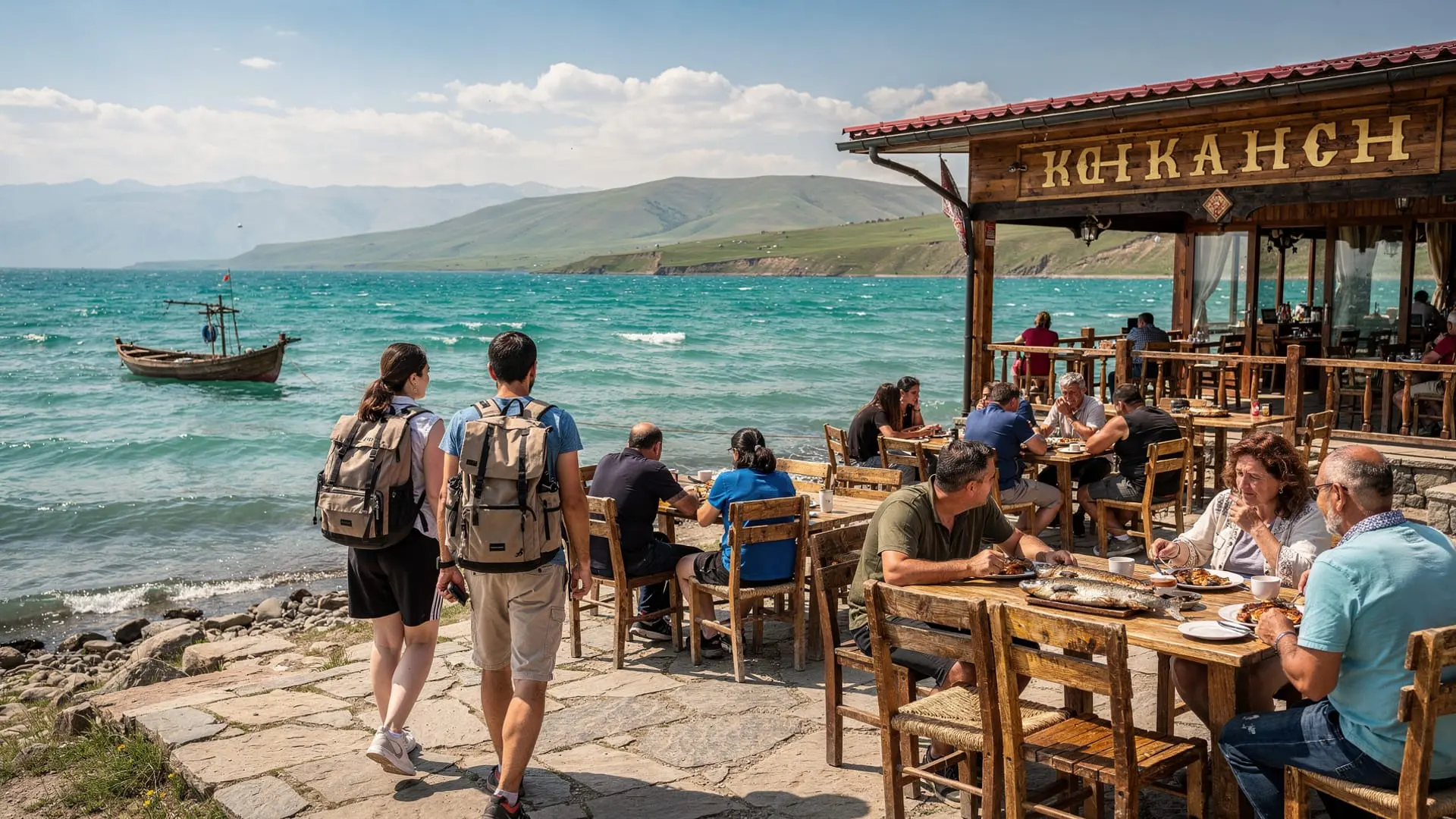
Ishkhan is the fish every visitor to Lake Sevan ends up ordering, usually without knowing the full story behind it. This dispatch is about what’s actually on the plate, why the species is endangered despite being on every menu, and how to eat it with your eyes open.
| Where | Sevan town promenade, and back-street family spots a block inland |
| Cost | Around 3,500–5,000 AMD/fish on the promenade; 2,500–3,500 AMD away from the main strip |
| Best time to eat it | Spring–early summer, when the fish is naturally fatter |
| Farmed vs wild | Ask directly — “fermer” on a menu signals farmed stock |
| Pairs with | Madzoon, fresh herbs, lavash, a chilled Voskehat white |
A note on visiting the lake in August
Lake Sevan in August is a specific experience: hot, busy, and slightly overwhelming in a way that feels Armenian in character — the volume turned all the way up. The road around the northern shore is clogged on weekends with Yerevan families in cars with their windows down. The beaches below Sevanavank and around the town of Sevan are full. The restaurant promenades are full. The boats doing tourist circuits of the peninsula are full.
This is not a complaint. The fullness of Lake Sevan in August is its own kind of spectacle: a whole city taking its summer collectively, the mountains visible above the water in every direction, the light on the lake having that peculiar quality of high-altitude water at altitude — deeper blue than you expect, almost luminescent. But it does mean that August is not the time to visit Sevan if you want quiet or a contemplative afternoon.
I went in August because August was when I was there. If you have the option, September — when the families have gone back to Yerevan and the light has shifted to something more golden and autumnal — is better for the food experience and for the lake visit generally. The restaurants are still open, the fish is still on the menu, and the crowds have thinned enough that you can actually have a conversation with the person who brings you your plate.
The fish on every menu
It’s August, and every restaurant along the lakeside promenade at Sevan has ishkhan on its menu. The chalkboards say it without apology: Ishkhan — 3,800 AMD. The waiters, when you order it, do not hesitate. The fish arrives on a plate twenty minutes later, grilled or fried, its flesh pale pink and delicate, smelling of nothing but fresh water and the grill.
This is the ishkhan, the Sevan trout, Armenia’s most celebrated freshwater fish and the unofficial symbol of the lake. It is also, technically, an endangered species whose commercial and recreational fishing has been officially banned or severely restricted for decades. That tension — the fish on every plate, the fish that is meant to be protected — is something any honest visitor to Sevan should understand before they order.
What the ishkhan is and why it matters
The ishkhan (Salmo ischchan) is a trout endemic to Lake Sevan. It evolved in isolation in a high-altitude, cold, oligotrophic lake at 1,900 metres, over millennia developing characteristics suited to its specific environment. There were originally four subspecies, each adapted to spawn at different times and in different tributaries or depths. Today, only one subspecies — the summer ishkhan (banak) — survives in significant numbers.
The collapse of the ishkhan population is directly linked to one of the more dramatic environmental interventions in Soviet history. Beginning in the 1930s, water was progressively diverted from Lake Sevan to irrigate the Ararat Valley and generate hydroelectric power. By the 1980s, the lake level had dropped by roughly 18 metres. The spawning streams that the other three ishkhan subspecies depended on were altered or destroyed. Simultaneously, rainbow trout and crayfish were introduced, competing with the native fish. The result was a population crash from which the endemic subspecies have not recovered.
Efforts to restore the lake level — begun in the 1960s and continuing today, partly through the Arpa-Sevan Tunnel completed in 1981 — have had some effect, and the banak subspecies has held on. But the commercial ishkhan fishery essentially collapsed in the late Soviet period, and official bans on fishing have been in place in various forms since the 1980s.
The reality at the restaurants
So why is it on every menu?
The short answer is that a small quota of licensed fishing is permitted, that farmed ishkhan from licensed aquaculture operations supplements this, and that the monitoring and enforcement of what exactly is on those plates is limited. When you order ishkhan at a lakeside restaurant, you are receiving a fish that may be from a licensed farm, from a licensed catch, or from neither. In practice, nobody will tell you which, and most restaurant staff genuinely may not know.
I spoke in August with a local guide who asked not to be named. She told me what most people in the region will confirm quietly: that poaching has never stopped, that the lake is large and the inspection resources are small, and that consumer demand from tourists and Yerevan day-trippers creates a market that licensed sources alone cannot supply. She was not condemning or celebrating this — it was a statement of conditions on the ground.
This does not mean you should definitely not eat ishkhan. It means you should eat it knowing what you’re eating into: a complex situation where a fish with genuine conservation concerns is also a central part of the culinary and cultural identity of the region, and where the regulatory line between legitimate and illegitimate supply is not reliably visible to diners.
Farmed alternatives worth knowing
Several aquaculture operations on and near Lake Sevan raise fish legally. The most visible of these supply restaurants with a combination of ishkhan and Sevan whitefish (sig, also called gegharkunik), which is a less celebrated but perfectly good eating fish that does not carry the same conservation baggage.
A few restaurants now make a point of advertising farmed ishkhan specifically — look for the word “fermer” (from Russian “fermerskiy”, meaning farm-produced) on menus, or ask directly. In my experience, asking is worthwhile both ethically and practically: farmed ishkhan from a proper operation is a known, consistent product, while wild-caught quality can vary with season and handling.
Rainbow trout (kale trout), introduced to the lake decades ago, is also available at many restaurants and is farmed extensively in the region. It lacks the cultural cachet of the native fish but is excellent eating and comes without the complications.
Sevan whitefish (sig, or gegharkunik) deserves more attention than it gets. It’s a milder, slightly less rich fish than ishkhan, usually cheaper, and entirely farmed, which removes the conservation question completely. Several restaurants serve it grilled alongside ishkhan on the same plate, letting you compare the two directly — worth doing once, since most visitors never try it and default to ishkhan out of name recognition alone.
Day trip to Lake Sevan with boat trip and lunchIs it actually legal to eat?
The honest answer is layered. Eating ishkhan is not illegal — restaurants are permitted to serve fish from licensed aquaculture and the small licensed catch quota. What’s murkier is the supply chain behind any individual plate, which no diner can verify from a menu. This isn’t unique to Sevan; it’s a familiar problem with wild-caught delicacies worldwide, from bluefin tuna to certain caviars, where legal and illegal supply intermingle and the end consumer has limited ability to distinguish them. Ordering ishkhan at Sevan means accepting that ambiguity rather than pretending it doesn’t exist. If that trade-off bothers you, ordering sig or rainbow trout instead sidesteps it entirely without sacrificing the meal.
Where I ate and what I found
I spent two days eating my way around the lake’s restaurants in August 2023, partly out of journalistic thoroughness and partly because I find the flavour of freshwater fish in alpine settings consistently excellent.
The best meal I had was at a family-run place in the village of Sevan town itself, not on the main tourist strip but a block back, with a hand-painted sign and plastic chairs under a grape arbour. The fish they served was identified as farmed banak, arrived deboned and simply grilled with salt, lemon, and a good deal of fresh tarragon. It was outstanding.
The lakeside promenade restaurants in high season are predictably busier and more expensive — 3,500 to 5,000 AMD per fish depending on size, with the tourist premium baked in. The fish I had at two of these was competent but unremarkable, and the whole fried presentation doesn’t show off the delicate flesh as well as the simple grill.
Sevanavank monastery, the extraordinary 9th-century complex on the peninsula above the town, has a handful of cafes in the courtyard area below the church. I wouldn’t recommend eating there for quality — the prices are high and the food ordinary — but if you’re visiting the monastery, the coffee is fine and the views from the terrace are among the better dining experiences in Armenia purely in scenic terms.
A practical guide to ordering
If you’re going to eat ishkhan at Sevan — and I think most visitors will, and I understand why — here is what I’d suggest.
Ask if it’s farmed. Most staff will answer honestly. If they don’t know, that’s a data point about the establishment’s supply chain awareness.
Prefer simple preparations: grilled or baked whole over deep-fried fillets. The fish has a delicate, clean flavour that heavy oil obscures. The best ishkhan I’ve had has been dressed with nothing more than salt, lemon, and fresh tarragon — the herbs are essential. Ask for them if they don’t come automatically.
The fish is best in spring and early summer when it’s naturally fatter, having fed through the cold season. In late August, after weeks of warm-water temperatures, the flesh can be slightly drier and less rich. The timing of my visit — peak summer — was not the ideal window for eating the fish, which is a truth worth acknowledging even as I was eating it.
Pair it with madzoon (Armenian yoghurt, thick and tangy), a plate of fresh herbs including coriander, basil, and dill, and a stack of lavash. This is how locals eat it and how it makes the most sense: the yoghurt cuts the richness of the fish, the herbs provide contrast, the lavash absorbs everything.
Portion sizes vary more than menus suggest — a “medium” ishkhan can mean anything from a modest fillet-sized fish to something closer to a full dinner plate, and pricing is usually per fish rather than per weight shown up front. If the size matters to your budget, ask before ordering; most places are happy to show you the fish itself, which is standard practice at Sevan and not considered an odd request.
For wine: a chilled Armenian white makes an excellent pairing. The Voskehat grape from Aragatsotn produces a clean, medium-bodied white that works well with freshwater fish. Several lakeside restaurants have begun stocking Armenian wines properly alongside the more predictable beer options.
What to see while you’re at the lake
If you’re at Sevan specifically for the food, the restaurant visit pairs naturally with a visit to Sevanavank monastery — the 9th-century complex on the peninsula above the town, forty-odd steps up a hillside that was formerly an island before the lake level dropped. The churches are small and exquisitely proportioned, and the views from the terrace above the lake are among the better panoramic experiences in central Armenia. From the peninsula, Lake Sevan’s sheer scale becomes apparent: 1,240 square kilometres of high-altitude water, deep blue-green in August, surrounded by mountains that in late summer still carry their summer colours.
The Noratus cemetery, on the western shore, is a remarkable khachkar (cross-stone) field with hundreds of medieval carved stones, some of them dating to the 9th century. If you have a car and are willing to spend a half-day exploring beyond the main town, Noratus combined with Sevanavank and a good fish lunch makes for one of the more satisfying single-day circuits in Armenia.
The environmental history in brief
The Lake Sevan situation is worth understanding even in outline, because it is a case study with international relevance and because the fish on your plate is part of a longer story.
The Soviet-era diversion of Lake Sevan’s water began in the 1930s and continued through the 1980s. The rationale was irrigation of the Ararat Valley (Armenia’s most agriculturally productive land) and hydroelectric power generation. At its lowest point, the lake had fallen approximately 18 metres from its natural level, losing roughly 40 percent of its surface area. The spawning streams that the different ishkhan subspecies had evolved to use over millennia were altered or destroyed.
Restoration efforts — including the Arpa-Sevan Tunnel completed in 1981, which diverts water from the Arpa River into the lake — have partially reversed the damage. The lake level has risen several metres since its lowest point. But the population of endemic species has not recovered proportionally, and the three disappearedsubspecies of ishkhan have not returned.
The surviving banak subspecies, and the aquaculture operations that produce farmed equivalents, represent what remains. When you order ishkhan at a Sevan restaurant, you’re eating into a complicated ecological inheritance. The fish is still delicious. The complexity doesn’t go away.
The complete Lake Sevan guide covers the restaurants more broadly and the best times to visit. The Gegharkunik province guide has the regional context, and the Sevanavank monastery guide covers the peninsula visit in detail. If you’re combining the lake with a wider trip, the Lake Sevan best beaches guide and the Tsaghkadzor and Sevan day combo both make the fish lunch part of a bigger day.