Sevanavank: the monastery on Lake Sevan
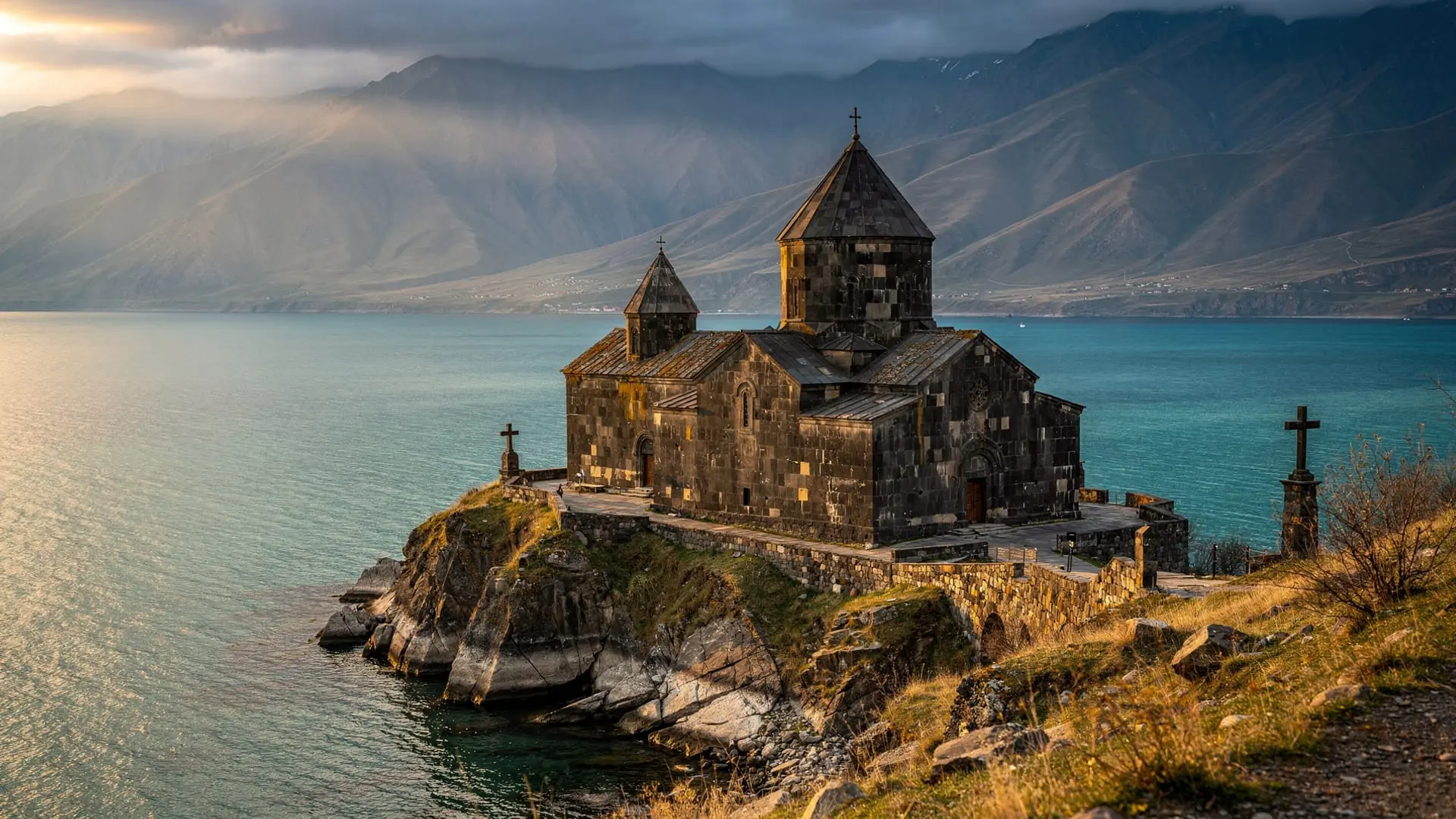
Two churches on a peninsula above the world’s largest alpine lake
Sevanavank occupies a spit of land that was once an island on Lake Sevan, at 1,900 metres altitude in the Gegharkunik province of central Armenia. The Soviet-era lowering of the lake by 20 metres for irrigation and hydropower — a policy widely considered an environmental catastrophe — turned the island into a peninsula by the 1930s. What was lost in symbolic isolation has been partly gained in access: a staircase now leads directly from the lakeside to the monastery terrace, 200 steps above the water.
The setting remains extraordinary. On a clear day, the lake stretches dark blue to every horizon, ringed by mountains on three sides. Sevanavank is 65 km from Yerevan (about 1h 15min by car) and one of the most visited sites in the country — primarily as a summer beach destination combined with the monastery stop.
| Where | Sevan peninsula, Gegharkunik, about 65km (1h15) north-east of Yerevan |
| Cost | Free entry (donation box); parking and beach facilities extra in summer |
| Time needed | 1.5–2 hours including the 200-step climb |
| Getting there | Self-drive, marshrutka to Sevan town + short walk/taxi, or an organised tour |
| Best time | Early morning (before 10am) or September–October to avoid summer crowds |
Why this monastery matters
Sevanavank was founded in 874 AD by Princess Mariam, daughter of the Bagratid king Ashot I. It was conceived as a monastic sanctuary on the then-island: the difficulty of access was the point, ensuring contemplative isolation. At its peak, the complex held multiple churches and a significant monastic community. The two surviving churches — Surb Arakelots (the Church of the Apostles) and Surb Astvatsatsin (the Church of the Mother of God) — date to the founding period, though the latter was partially rebuilt.
The monastery belongs to the Armenian Apostolic Church, an Oriental Orthodox denomination. The site is still active: a small community of monks resides here, and liturgies are held regularly. The view from the terrace — particularly at dawn when mist lies over the water — has made Sevanavank one of the most recognisable images in Armenian travel photography.
History
- 874 AD: Princess Mariam Bagratuni founds the monastery on the island, establishing a religious community with significant endowments.
- 855–886 AD: The Bagratid dynasty’s control of the region provides financial stability for the complex.
- 902 AD: King Smbat I, after a military victory, sends captive Arab soldiers to labour on the monastery as an act of devotion — an unusual episode recorded in Armenian chronicles.
- 10th–13th centuries: The island monastery grows but remains secondary to larger complexes on the mainland.
- 1930s–1960s: Soviet irrigation policy drains 18 metres from the lake level, transforming the island into a peninsula. The staircase is constructed.
- Late Soviet period: A writers’ union resort is established on the peninsula — the building still stands, now operating as a hotel.
- Post-independence: Restoration of active monastic life. The UNESCO process recognises Sevanavank as part of the broader Armenian cultural heritage.
What to see at the site
Surb Arakelots (Church of the Apostles, 874): The larger and more significant of the two churches. The main nave has been restored but retains its original proportions. The exterior is embellished with khachkars and decorative blind arcading typical of early Bagratid period. Inside, the altar area is usually partitioned from lay visitors when services are active; outside service times, the interior is open.
Surb Astvatsatsin (Church of the Mother of God): The smaller church, perched at the highest point of the peninsula. Its compact proportions and position against the lake sky make it the more photogenic of the two, particularly from below.
The terrace and panorama: The flat area between and around the two churches is the main viewing platform. In every direction, Lake Sevan dominates — in summer, an intense Prussian blue; in autumn, greyer and more turbulent. The outline of the Gegham and Vardenis mountain ranges closes the horizon.
The descent path: Walking around the back of the peninsula offers views of the lakeside beaches and the Soviet-era resort building — a reminder of the strange coexistence of monastery and beach culture that defines Sevan in summer.
How to get there
By car: From Yerevan, take the E117/H1 northeast toward Lake Sevan. The town of Sevan is on the west shore; Sevanavank is signposted 3 km north of the town. Total distance: 65 km, about 1h 15min.
By marshrutka: Marshrutkas run from Yerevan to Sevan town frequently (AMD 500, about 1h). From Sevan town, shared taxis or a 20-minute walk reach the Sevanavank parking area.
By tour: Sevanavank is included in virtually every Lake Sevan day-trip itinerary from Yerevan.
Lake Sevan and Sevanavank private tour Group tour: Lake Sevan, Sevanavank, and boat tripPhotography and best light
Sevanavank faces roughly west, receiving afternoon light on its main facade. The best light for the classic view — both churches framed against the lake — comes from the north side of the terrace at any time of day (the sky provides the backdrop, not the sun angle).
Early morning in all seasons is exceptional: mist rises from the lake, the water is flat and reflective, and the monastery is empty. Autumn (September–October) turns the surrounding mountains ochre and the lake a deeper, more saturated blue. Winter, when the lake occasionally partially freezes, offers surreal compositions of ice and stone.
Summer weekends bring heavy crowds to the beach below — the monastery itself is quieter but the parking area is chaotic from 11:00–16:00.
Combining with other sites
Sevanavank is rarely the only destination on a Lake Sevan trip:
- Noratus cemetery (30 km east of Sevanavank): the world’s largest collection of medieval khachkars in a single location — see the Noratus khachkar cemetery guide
- Hayravank monastery (50 km east): a small 9th-century monastery on the lake’s south shore, peaceful and uncrowded
- Dilijan (30 km north via the tunnel): for a Sevan-Dilijan combo day — see the Dilijan destination guide
- Tsaghkadzor (30 km west): ski resort with the Kecharis monastery — see the Tsaghkadzor destination guide
For itinerary planning: Lake Sevan and Dilijan: the lakes-and-forest day trip.
Practical visit info
Entry fee: Free. Donation box at the monastery gate.
The steps: 200 steps from the parking area to the terrace. Allow 10–15 minutes up, 8 minutes down. Not accessible for wheelchairs; manageable for most physically able visitors.
Opening hours: Dawn to dusk daily. The churches are open when monks are present; some days they are locked and only accessible from the exterior.
Dress code: Shoulders and knees covered; women must cover heads inside the churches.
Facilities: Small cafe and souvenir stalls at the parking area base. In summer, beach facilities below the peninsula. No ATM on site; bring cash.
Summer crowds: July and August see Sevan crowded with Armenian and Russian holidaymakers. The beach below the monastery is packed on summer weekends. The monastery itself is busiest midday — arrive before 10:00 or after 16:00 for a quieter experience.
Accommodation at Sevan: The Sevan Writers’ Resort (now a hotel) on the peninsula itself offers a unique stay — atmospheric Soviet-era building with lake views. Several mid-range hotels operate in Sevan town and along the western shore.
Lake Sevan and Armenian national identity
Lake Sevan — Sevan tzov in Armenian, the Sea of Sevan — occupies a place in Armenian national consciousness well beyond its status as the country’s largest body of water. It has been continuously inhabited since the Bronze Age; the lakeshore has Urartian-period fortresses, medieval monasteries, medieval khachkar cemeteries, Soviet-era resorts, and modern beach facilities. It is simultaneously an ancient sacred landscape and a recreational resource for a landlocked country.
The symbolism of the lake is complex. It is beautiful, undeniably — the altitude colour, the mountain ring, the quality of the light at dusk. But it has also been a site of environmental catastrophe and incomplete recovery, a reminder of the Soviet-era subordination of Armenian interests to Moscow’s water management priorities. The tension between the lake’s natural grandeur and its damaged ecology is part of its contemporary character.
Sevanavank, sitting above the water on its peninsula, embodies this duality. It is a place of genuine spiritual significance, founded in the 9th century when the lake was still pristine. It is also the most-photographed single image in Armenian travel, reproduced on postcards, guidebook covers, and tourism campaign advertisements. Managing your expectations of what it will feel like — as opposed to how it will look — is part of preparing for the visit.
The Armenian Apostolic Church and lake monasteries
Lake Sevan has several monasteries. Sevanavank is the most famous and most accessible. Hayravank monastery (on the south shore, accessible from the M4 highway, about 50 km east of Sevanavank) is quieter, less visited, and in some ways more atmospheric — a compact 9th-century complex on a small promontory with almost no tourist infrastructure. The contrast between the two is instructive: Sevanavank is the postcard; Hayravank is what most of the postcard monasteries actually felt like before tourism arrived.
Both belong to the Diocese of Gegharkunik of the Armenian Apostolic Church, the Oriental Orthodox denomination that has administered Armenian religious life since 301 AD. The diocese covers the entire Lake Sevan basin — a vast territory with scattered monastic communities maintaining centuries-old traditions.
The peninsula walk and the Soviet resort
The peninsula that Sevanavank occupies extends about 1.2 km into the lake. Beyond the monastery, a path continues to the tip of the peninsula, where the water is visible on three sides. This is a 20-minute walk from the monastery and worth making on a calm day — particularly in early morning when the lake is glassy and the surrounding mountains are reflected perfectly.
The Soviet-era writers’ resort building that occupies part of the peninsula is a characterful piece of modernist architecture — functional, utilitarian, and now operating as a hotel. Some rooms have direct lake views. If you want to stay overnight at Sevanavank itself, this is the option, though quality is inconsistent.
Gegharkunik province
Sevanavank and Lake Sevan sit in Gegharkunik province, the largest province in Armenia by area and one of the most sparsely populated. The lake covers roughly 5% of the province’s area. Beyond the western shore (the most developed and visited zone), the eastern and northern shores are markedly quieter and offer a very different experience: small fishing villages, medieval cemetery sites, and the dramatic backdrop of the Gegham and Vardenis mountain ranges.
The Noratus khachkar cemetery (about 35 km east of Sevanavank on the M10 road) is the most significant secondary site in the province — the largest collection of medieval khachkars in any single location in the world, stretching across a hillside above the village with approximately 900 cross-stones dating from the 9th to 17th centuries. It requires about 45 minutes to walk through properly and is completely free. The combination of Sevanavank and Noratus in a half-day is highly recommended.
Sevan town and practical logistics
Sevan town sits on the western shore, about 3 km south of the monastery peninsula. It is a workmanlike provincial town with no great architectural charm, but it has all the practical infrastructure visitors need: ATMs (Inecobank and Ameriabank branches), supermarkets, restaurants, and petrol stations.
The lakeside hotels along the western shore vary considerably in quality. The summer season (July–August) sees prices spike as Yerevan residents fill the resort hotels for beach holidays. In September–October, prices drop substantially and the lake is quieter. Spring (April–May) offers excellent lake views with almost no crowds but water temperatures too cold for swimming.
Eating near Sevanavank
The stretch of shore around Sevan town and the monastery access road has a dense concentration of lakeside restaurants specialising in Sevan trout (ishkhan) and crayfish, both regional specialities. Most operate open-air terraces overlooking the water in summer, with simple indoor dining in the off-season. Prices are noticeably higher than inland Armenia — reflect the tourist volume the lake attracts — but the freshness of the fish, when it is genuinely local rather than farmed elsewhere, is usually worth the premium. A grilled ishkhan with herbs, alongside fresh lavash and a simple salad, is the standard and reliable order at almost any of these restaurants.
For a quicker or cheaper stop, the small cafés near the monastery parking area serve coffee, pastries, and simple snacks, adequate for a short break before or after the climb but not a destination meal in themselves. Visitors planning a full day at the lake generally do better eating at one of the proper lakeside restaurants either before heading to the monastery or after descending the steps, when a cold drink and a plate of fish feel especially well earned.
Sevanavank at dawn: is it worth the early start?
For photographers or anyone chasing the calmest version of the site, arriving for sunrise is a genuinely different experience from a standard mid-morning visit. The lake is typically at its stillest in the hour after sunrise, before wind picks up across the open water, producing the mirror-like reflections that make the classic Sevanavank photographs possible. The site itself is essentially empty at this hour — no beach crowds, no tour buses, just the monks going about their morning routine and the occasional other early visitor. The trade-off is obvious: a 5–5:30am departure from Yerevan to catch the light, and cooler temperatures than the daytime warmth suggests, even in summer. For a first, casual visit this is not necessary. For anyone making a dedicated return trip to photograph the site properly, it is the single best use of the extra effort — and it pairs naturally with breakfast back in Sevan town once the light has softened and the day’s crowds begin to arrive.
The monastery and the lake: competing identities
Sevanavank in summer occupies a peculiar social position. The peninsula below the monastery is beach territory — deck chairs, sunbathers, families with paddling children, ice cream vendors, cafes with loud music. The monastery above is a place of prayer. These two realities coexist on the same 1.2-km spit of land, separated by 200 steps.
This coexistence is not unique to Sevanavank. At Khor Virap, souvenir sellers crowd the path to the monastery gate. At Tatev, a tourist café operates at the upper cable car station. Armenian sacred sites do not exist in hermetically sealed ritual space; they are embedded in the lived landscape, including its commercial and recreational dimensions.
What this means practically: on a summer Saturday afternoon, the Sevanavank terrace will have dozens of tourists taking selfies with the lake behind them, monks moving through the crowds on their way to the church, and children running between the buildings. This is not a degraded experience — it is Armenian religious life as it actually exists, where the sacred and the secular share territory without ceremony.
If you want the monastery in a more contemplative register, come in September, come on a weekday, or come at 08:00 before the beach crowd arrives.
Photography at Sevanavank: the complete toolkit
Sevanavank is one of the most photographed sites in Armenia and one of the most technically challenging to photograph well. The reason: the lake itself is the subject, but the lake fills the entire background in every direction, creating exposure problems and compositional constraints that test any photographer.
The classic shot: Both churches framed against the lake, from the north end of the terrace. Use a telephoto lens (85–200mm) to compress the lake and make the mountains on the far shore appear larger. Best light: golden hour (6:30–8:00 in summer, 7:30–9:00 in autumn).
The reflection shot: Early morning with a calm lake and mist. The peninsula tip is the best position. Wide angle (16–35mm). The mirror quality of early morning Lake Sevan is extraordinary when conditions allow — but the window is narrow (usually 07:00–09:00 before wind disturbs the surface).
The isolation shot: Come in November or March, when the beaches are empty and the lake is grey-green and textured. The monastery appears alone in a much more atmospheric landscape. This is the image that Armenian photographers prefer — the tourist brochure version sells optimism; the off-season version tells the truth about a lake that has been through a lot.
What not to shoot: The parking area. The Soviet resort building. The souvenir stalls. These are real parts of the site but not what you are here for, and including them degrades the composition without adding honesty.
Lake Sevan in Armenian culture and history
Lake Sevan has been continuously inhabited since at least the Bronze Age. The Hayasa-Azzi people, the Urartians, the Armenians under successive dynasties — all used the lake as a resource and oriented their settlements toward it. The Urartian fortress at Lchashen (on the western shore, now partially submerged due to the Soviet drawdown) was one of the most important sites in the pre-Christian Caucasus.
The lake also appears frequently in Armenian literature and poetry. The 20th-century poet Yeghishe Charents wrote memorably about Lake Sevan; the Soviet-era writer Paruyr Sevak — born near the lake — incorporated its imagery into some of the most significant Armenian poetry of the 20th century.
For diaspora Armenians, Lake Sevan is the landscape of the homeland that many encounter for the first time in person when visiting the Republic. Its blue, its altitude, its ring of mountains — these have been described in family conversations for generations before the actual visit. The first sight of the lake from the road is often genuinely affecting in a way that is difficult to explain to non-Armenians.
Sevanavank across the seasons
| Season | Crowds | What to expect |
|---|---|---|
| April–May | Low | Clear lake views, wildflowers, water too cold to swim |
| June | Building | Warmer weather, beaches starting to fill on weekends |
| July–August | High | Peak beach season; monastery terrace crowded 11am–4pm |
| September–October | Low–moderate | Best combination of mild weather and thinner crowds |
| November–March | Very low | Cold, sometimes icy steps; the lake occasionally partially freezes |
For visitors who can choose their timing, September stands out as the honest recommendation: swimmable water lingers into early September in a warm year, the worst of the tour-bus crowding has thinned, and the light on the surrounding mountains is at its sharpest.
Frequently asked questions about Sevanavank
Why is Lake Sevan so blue?
Lake Sevan sits at 1,900 metres altitude in an enclosed basin. Its intense blue colour results from the combination of altitude, cold water temperatures (the lake surface averages 14°C in summer), and very low turbidity — the water is exceptionally clear. It is the largest lake in the Caucasus region and one of the largest freshwater high-altitude lakes in the world.
What happened to the island that Sevanavank was built on?
Soviet-era engineers diverted inflows to the lake for irrigation and hydropower generation beginning in the 1930s. The lake level dropped by approximately 20 metres over three decades, and what had been an island became a peninsula connected to the shore. The lowering also damaged the lake ecosystem severely, reducing fish populations including the native ishkhan (Sevan trout). Since independence, Armenia has partially reversed this by reducing water extraction; the lake level has risen slightly but remains well below its historical norm.
Is Sevan trout (ishkhan) still available at lakeside restaurants?
Sevan trout (ishkhan) was devastated by the Soviet-era lake lowering but has recovered partially through aquaculture and reduced commercial fishing. It is available at restaurants around the lake but the price reflects scarcity — expect AMD 5,000–8,000 per portion (EUR 12–20). Quality is excellent when freshly grilled. Be aware that some restaurants serve farmed trout from other sources; ask whether it is genuine ishkhan from Lake Sevan. The Lake Sevan trout guide covers this in more detail.
How far is Sevanavank from Yerevan and is it worth a day trip?
Sevanavank alone is a half-day, not a full day. The drive from Yerevan is 1h 15min each way. Allow 2 hours at the site including the step climb. Pair it with Noratus cemetery or Dilijan to make a full day. The direct Sevan-Dilijan tunnel (opened 2005) cuts the drive between the two from 1h to 20 minutes. See the Lake Sevan complete guide for the full lake itinerary.
What is the Noratus cemetery and should I combine it with Sevanavank?
Noratus is the world’s largest khachkar cemetery — approximately 900 medieval cross-stones on a hillside 35 km east of Sevanavank. It is free, accessible by car in 40 minutes from Sevanavank, and requires about 45 minutes to walk through. The combination makes a strong half-day: the monastery for the lake views, Noratus for the depth of Armenian memorial tradition. See the Noratus khachkar cemetery guide.
Can I swim at Lake Sevan near the monastery?
There are no official beaches at the Sevanavank peninsula itself (it is a religious site). The nearest beaches are south of Sevan town — a 5-minute drive. The water temperature at Lake Sevan reaches approximately 18–20°C in August (warmest month) and is refreshing rather than warm. Swimming is not possible in late autumn or winter. For beach options: see the Lake Sevan best beaches guide.
Is the 200-step climb difficult?
For most visitors, no — the steps are broad, evenly spaced and not especially steep, and the climb takes 10–15 minutes at a relaxed pace with a couple of pauses to admire the view. It is a genuine climb rather than a stroll, though, so visitors with limited mobility, breathing conditions, or very young children in arms should plan for a slower ascent and take breaks. There is no alternative accessible route, and no accessibility accommodation exists at the site.
Can I combine Sevanavank with a boat trip on the lake?
Yes. Several operators run short boat trips on Lake Sevan from the area near the monastery peninsula, typically 30–45 minutes, giving a different perspective on the church silhouette from the water and a chance to feel the lake’s scale that is hard to grasp from the shore alone.
Lake Sevan boat trip combined with Dilijan day tour from Yerevan