Vendanges in Vayots Dzor: a wine harvest dispatch
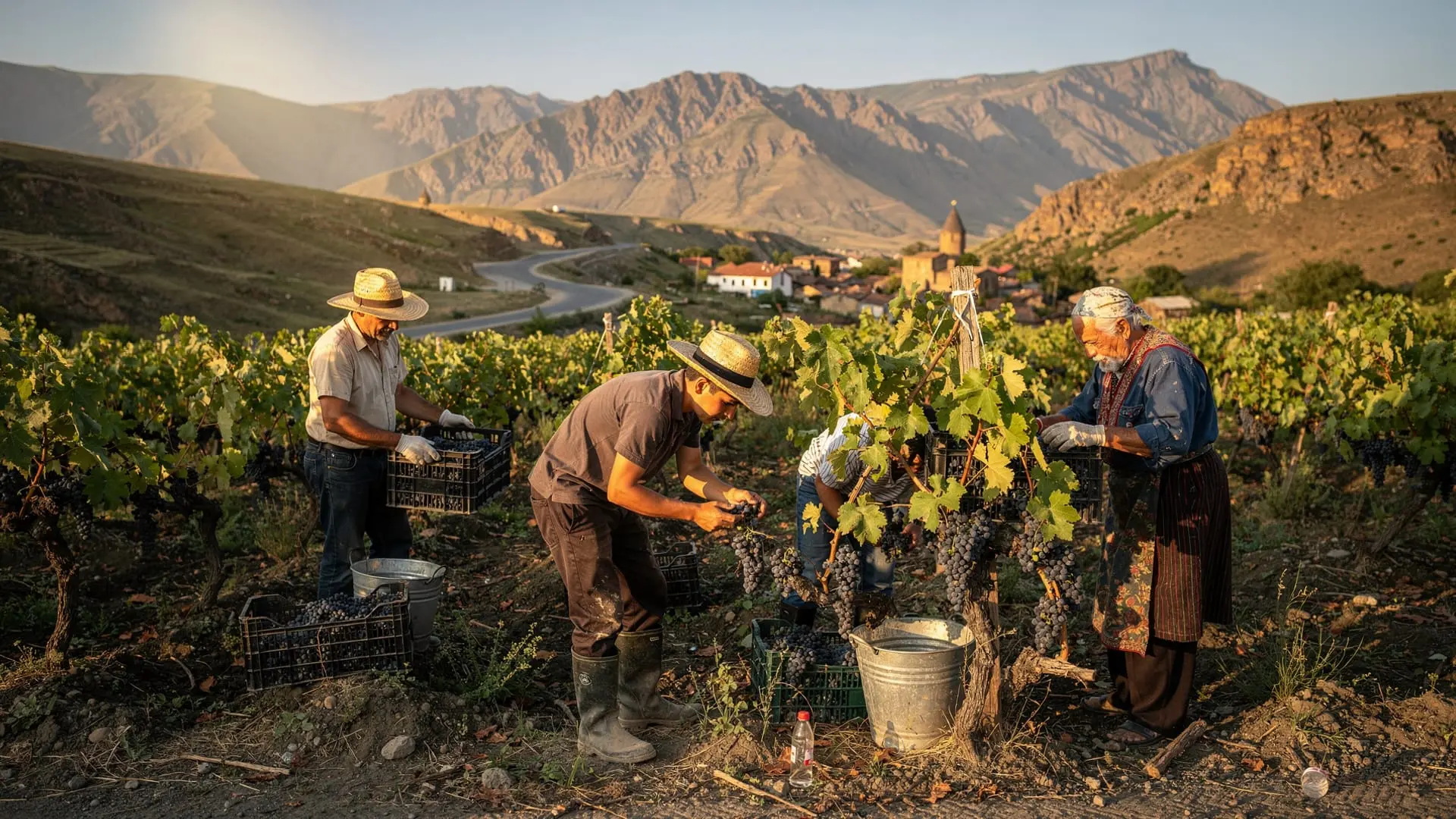
A late-September dispatch from the Areni harvest — Hin Areni winery, Trinity Canyon, grape stomping, and a long table under the vines with a family producer who doesn’t usually host visitors.
| Where | Areni village, Vayots Dzor, ~90 min south of Yerevan |
| Harvest window | Mid–late September, varies by a week or two yearly |
| Areni Wine Festival | First Saturday of October |
| Cave tour | Around 2,000 AMD/person, 30–40 minutes |
| Stay | Yeghegnadzor or Jermuk — book ahead near the festival |
The smell of the morning
It was the smell I hadn’t anticipated. You smell the fermentation from the road before you see the winery — a warm, yeasty sweetness carried in the September air, coming from the direction of the Areni valley where the presses had been running since early morning. I’ve been to a few harvests in my life, in France and in Georgia, and the smell is always the same: ancient, slightly alcoholic, and unmistakably linked to the transformation happening in those concrete vats.
We arrived at Hin Areni at 8:00 a.m. on the second Saturday of the harvest, which in 2024 fell around the 21st of September. The timing varies by a week or two depending on the year — you want to check with the wineries before booking a trip specifically for the harvest — but late September is consistently the window. The grapes had been picked over the previous week and some were still coming in from the furthest plots as we walked into the courtyard.
Hin Areni is one of the oldest licensed wineries in Armenia’s modern winemaking revival. The name means “old Areni” in Armenian, a reference to the ancient grape varieties the winery specialises in — principally Areni Noir, the indigenous red variety that also gave the nearby Areni-1 cave its name when archaeologists found evidence of 6,000-year-old winemaking inside. If you’ve read anything about Armenian wine, you’ve encountered both names.
The harvest at Hin Areni
The owner met us in the courtyard, walked us through the receiving area where the newly arrived Areni Noir clusters were being sorted on a long metal table — leaves removed, damaged fruit discarded — and then showed us the press room and the fermentation tanks. The explanation was in Armenian, translated by our guide, but the process needed minimal translation: you could see the purple-stained hands of the workers, the gentle pneumatic press, the young must flowing through clear plastic tubing into stainless steel tanks.
What I noticed was the gentleness of the pressing. Modern winemaking at this level uses low-intervention approaches: cold settling, minimal sulphur, temperature-controlled fermentation. The winery is working with a grape that has evolved over millennia in this specific climate and soil, and the approach is to support rather than correct.
After the tour, we sat in a small room off the cellar and tasted. Three vintages of the Areni Noir, plus a white made from Voskehat grapes, plus a late-harvest dessert wine that was viscous and extraordinary. The tasting notes I took were useless — I was too distracted by the conversation and the setting — but I remember the 2021 Areni Noir as having a quality of dried pomegranate and mountain herb that I hadn’t encountered in wine from anywhere else.
Trinity Canyon Vineyards
In the afternoon we drove the short distance to Trinity Canyon Vineyards, a newer operation set dramatically against the red cliffs of the Gnishik canyon. If Hin Areni feels rooted and ancient, Trinity Canyon feels designed: the tasting room is modern, the architecture intentional, the views of the canyon framed deliberately through large windows.
The wine at Trinity Canyon is also excellent — their Areni Noir-Syrah blend was a surprise, the Syrah adding body and pepper without overwhelming the native grape’s distinctive character. The winemaker, who spoke some English, explained that they were still experimenting with the proportion, and that the first two vintages had been quite different from each other as they calibrated the blend.
I bought two bottles to take back to Yerevan. The tasting room staff wrapped them in newspaper and sent me off with a small jar of grape molasses from the harvest.
| Hin Areni | Trinity Canyon | |
|---|---|---|
| Feel | Rooted, traditional | Designed, modern architecture |
| Signature wine | Areni Noir, late-harvest dessert wine | Areni Noir-Syrah blend |
| Setting | Village courtyard | Cliffside above Gnishik canyon |
| Best for | Understanding tradition and terroir | Photogenic tasting room, newer blends |
Both are worth a stop if you have the time; if you only have one, Hin Areni gives the deeper sense of continuity, Trinity Canyon the better view.
The Vayots Dzor wine route day tour — Areni wineries, caves, and vineyardsGrape stomping and the Areni Wine Festival
The Areni Wine Festival, which typically takes place on the first Saturday of October, is the visible celebration of what we were watching being prepared in September. Thousands of visitors descend on the village for traditional grape stomping, winery open days, music, food stalls, and the general festivity of harvest season.
I was there a week before the festival proper, but several of the wineries were already doing informal stomping events for groups who’d organised in advance. We joined one at a small family producer — not a winery in the formal sense, just a farmer with several hectares and a cellar under his house — where we removed our shoes, climbed into a large stone trough, and spent twenty minutes treading grapes while the family’s youngest daughter watched us with a mixture of amusement and mild disdain that was entirely justified.
The juice that runs from this process — the free-run must, pressed by foot rather than machine — produces a particularly soft, low-tannin wine, because the foot is much gentler than any press. The family was keeping this must separate, fermenting it in a clay kvevri buried in the cellar floor, to produce a small amount of natural wine that would never be sold and was mentioned only briefly, in a tone suggesting it was not particularly our business.
Lavash and the long table
The afternoon extended into the evening. The family whose vineyard we’d helped stomp produced a long table under the grape vines: lavash baked on a tonir while we watched, fresh from the earth-oven and draped over a cushion to cool; vegetable dishes; a bowl of tolma in their last week of the season; and a platter of churchkhela, the walnut-and-grape-juice confection strung like dark sausages.
The brandy appeared at some point after the lavash — homemade, brought out in an unmarked bottle, poured into small glasses without ceremony. It was sweet and rough and tasted of the grapes we’d been stomping three hours earlier. Nobody asked if we wanted more before pouring it.
This is the part of the harvest that you can’t book on a tour: the long table in the fading September light, the specific weight of hospitality that Armenian family producers extend to visitors who’ve worked alongside them, the sense that the wine and the food and the brandy are not separate things but expressions of the same relationship with this particular piece of land.
The Areni Noir story
The grape variety at the centre of the Vayots Dzor wine revival is Areni Noir, and its backstory is worth understanding because it makes tasting the wine a different kind of experience. The Areni-1 Cave, which sits 2 kilometres from the Areni village on the canyon wall, contained evidence of winemaking from approximately 4,100 BC when archaeologists excavated it in the late 2000s. The grape seeds found in the ancient presses were identified as ancestrally related to the Areni Noir variety grown in the same valley today.
This is not a marketing narrative. It is archaeology. The implication — that a wine tradition has persisted in this specific valley, with this specific grape, for more than six thousand years — is one of the more remarkable instances of agricultural and cultural continuity anywhere in the world. The vineyards I walked through with Hin Areni’s owner are not the same vineyards, obviously. But the terroir — the volcanic soil, the altitude, the particular combination of sun and mountain air — is the same. The grape’s genetic lineage is continuous.
When you taste an Areni Noir from this valley, you are tasting something that is genuinely connected to the oldest known winemaking site in the world. That is a legitimate reason for the wine to taste different to you.
Noravank and the wider wine route
No visit to Areni in harvest season is complete without a stop at Noravank Monastery, 9 kilometres up the Amaghu canyon from the village. The monastery, built in the 13th and 14th centuries on a narrow ledge above the canyon floor, is one of the most dramatically sited religious buildings in Armenia. The carved facades of the Surb Astvatsatsin church — a two-storey structure with an extraordinary stone staircase ascending to the upper entrance — are among the finest examples of medieval Armenian decorative carving anywhere.
In late September, the light on the red cliffs of the Amaghu canyon is particularly good: a warm, late-afternoon glow that makes the tuff walls incandescent and the monastery appear to float against them. I visited on the afternoon of our second day, after the grape stomping, and the combination of wine-damp hands and that particular light made the visit feel richly connected to the place rather than tourist-distant.
The 8-kilometre drive up the canyon from the Areni junction is winding and dramatic; take it slowly and pull over where the canyon walls are close, because the geology is interesting at eye level as well as from a distance.
The Areni-1 Cave
The Areni-1 Cave sits about two kilometres from the village, visible in the cliff above the road. It achieved international attention in 2010 when archaeologists working inside found evidence of winemaking dating to approximately 4,100 BC — grape seeds, a wine press, fermentation vats, and storage jars. At the time of the discovery it was the oldest known winery in the world.
The cave tour (around 2,000 AMD per person as of 2024) takes about 30-40 minutes and includes the main chamber where the winery was found, alongside artefacts from later periods of occupation. The guide explains the excavation findings and the significance of the Areni Noir connection — the same grape variety that evolved in this valley over millennia was found in those ancient pits. As origin stories go, it is compelling.
Practical notes for harvest tourism
The Areni destination page has the full winery list and contact information. For the Areni Wine Festival (typically the first Saturday of October), book accommodation in Yeghegnadzor or Jermuk well in advance — Areni village has very limited lodging and fills up completely in the days before the festival. Yeghegnadzor is 15 kilometres north and Jermuk is about 50 kilometres east; both are reasonable overnight bases with their own interest.
Hin Areni and Trinity Canyon both offer harvest visits with prior arrangement; email is the most reliable way to book. Several operators in Yerevan run structured wine route tours that include the Areni-1 Cave, Noravank monastery, and two or three wineries in a single day — a reasonable introduction to the area even if it can’t replicate the experience of a slow harvest day spent with one family.
The drive from Yerevan to Areni takes roughly 90 minutes on the M2 south through the Ararat Valley — a drive that passes Khor Virap with its view of Ararat and enters the increasingly spectacular canyon country of Vayots Dzor.
The Vayots Dzor province guide covers the full scope of what’s available: the wineries, the cave, Noravank, Jermuk’s thermal springs, and the high Selim caravanserai pass. The red cliffs of Noravank in late September harvest light are worth the drive independently of the wine, though the two things together are better than either alone. For a fuller list of producers along the valley, the Vayots Dzor wine route guide and the Areni Noir grape guide go deeper than a single harvest visit can.