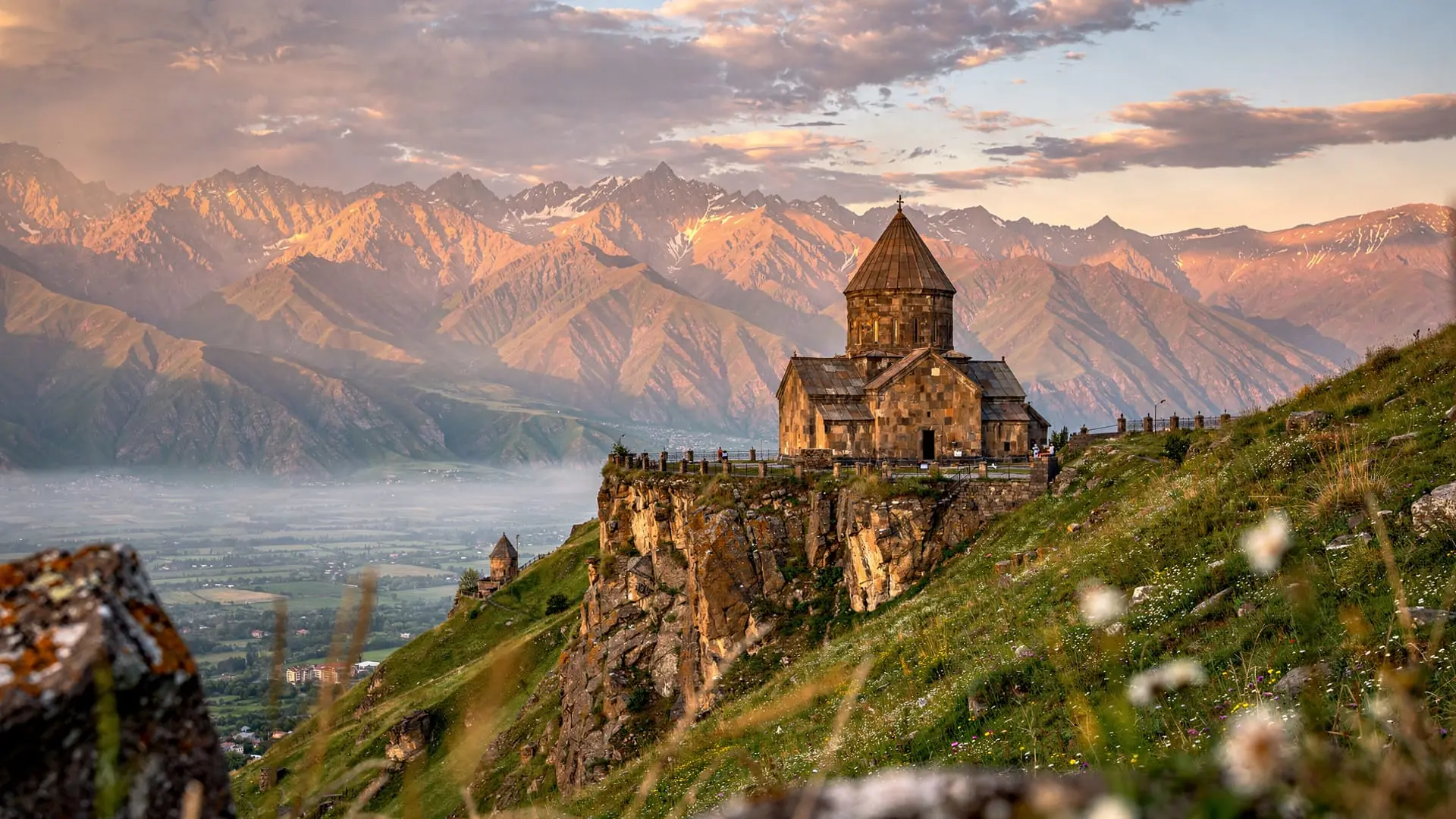
A medieval academy hidden in the Tavush forest
Goshavank sits quietly at the edge of the village of Gosh, 17 km northeast of Dilijan in the densely forested hills of Tavush province. To many visitors who come to northern Armenia for the UNESCO monasteries of Lori, Goshavank feels like a discovery — a less-visited site with genuine scholarly depth and one of the finest khachkars in the medieval world.
The complex was founded in 1188 by Mkhitar Gosh, a figure who deserves more recognition beyond Armenia’s borders. Gosh was not a typical medieval abbot. He was a jurist, a writer, and a fabulist — his collection of fables, written in the vernacular Armenian of his era, predates Aesop-influenced literary traditions in the Caucasus. More consequentially, he composed the Datastanagirk, a legal code that remained the basis of Armenian civil law for centuries. He chose this forested valley as the site for a monastery-academy: a place where monks would both pray and study.
The monastery is named Goshavank (meaning “Gosh’s monastery”) in his honour, though it was originally called Nor Getik (New Getik). Mkhitar Gosh is buried in a gavit (narthex) on the southern side of the complex — his tomb is marked by a carved stone effigy that visitors still come to see.
| Where | Gosh village, Tavush, 17 km northeast of Dilijan |
| Cost | Free entry (donations welcome) |
| Time needed | 30–45 min (up to 1h with the secondary chapels) |
| Getting there | Taxi from Dilijan (~3,000–5,000 AMD) or guided tour |
| Best time | May–Jun and Sep–Oct; roads can ice over Jan–Feb |
Getting there from Yerevan
The drive from Yerevan to Goshavank takes around 2 hours (about 105 km). The most common route goes via Lake Sevan and through the Dilijan tunnel, then north on the M6 highway toward Ijevan. The turnoff for Gosh village is signed from the main road; the monastery car park is just above the village.
No direct public transport links Yerevan to Gosh village. Your options are:
- Taxi or GG Taxi from Dilijan: Dilijan is the natural base. A taxi from Dilijan to Goshavank costs around 3,000–5,000 AMD one way. Many drivers will wait while you visit (30–45 minutes is enough for a standalone visit).
- Marshrutka to Dilijan, then taxi: Marshrutkas from Yerevan’s Kilikia bus terminal run to Dilijan regularly (around 700 AMD, 1h45). From Dilijan, arrange a taxi or rent a bicycle for the 17 km forest road — note that it is a hilly route.
- Guided tour from Yerevan: Several operators combine Goshavank with Haghartsin, Lake Parz, and Dilijan into a full northern Tavush day.
See tours combining Sevan, Dilijan, Haghartsin, Goshavank and Lake Parz on GetYourGuide
What to see at Goshavank
The main church (Surb Astvatsatsin)
The Cathedral of the Holy Mother of God, completed in 1197, is the largest structure in the complex. The carved portal is exceptional — stone lacework of interlocking crosses and pomegranate motifs above the entrance doorway. Inside, the lighting is dim and the atmosphere genuinely contemplative; the carved interior columns are noteworthy for the consistency of their decoration.
The church was heavily damaged in a 1213 earthquake and rebuilt, which is why the interior shows two distinct building phases if you look at the stonework carefully.
The khachkar of master Pavghos
This is the single object at Goshavank that art historians cite as one of the masterworks of Armenian stone carving. Located near the southern gavit, the khachkar carved by master craftsman Pavghos in the 13th century displays a complexity of interlaced geometric motifs that has no parallel in the country’s medieval output. The intricate lace-like patterns are carved in relief with extraordinary precision — the effect is more like metalwork than stonecutting.
If you have any interest in khachkars as an art form, this one is worth the trip alone. Stand close and let your eyes follow the interlocking star patterns radiating outward from the central cross.
The gavit (narthex) and Mkhitar Gosh’s tomb
The large narthex attached to the main church was built in 1197. It serves both as a vestibule and as a funerary chapel — Mkhitar Gosh rests here, as do other prominent abbots of the monastery. The ceiling of the gavit features a stalactite-like carved vault, a characteristic of Tavush monastic architecture that you will also see at Haghartsin.
The inscription above Gosh’s tomb is in classical Armenian (Grabar) and identifies him as “the great philosopher and jurist.”
The small chapel of Surb Grigor
A smaller chapel, dedicated to Saint Gregory the Illuminator, stands to the northeast of the main church. Built in 1237 by a local noble, it is the most ornate of the secondary structures — the tympanum above the door features a carved relief of Christ flanked by the Virgin and Saint Gregory that retains its original sculptural clarity, despite eight centuries of exposure to the Tavush winters.
The belfry and panoramic views
The free-standing belfry, added in the 13th century, provides the most photogenic exterior view of the complex. Standing above the forest canopy on a clear October afternoon, with autumn colour in the trees, it is one of the more beautiful compositions in northern Armenia.
Combining Goshavank with other sites
Haghartsin (12 km further northeast) is the natural pairing. Both monasteries are in the Tavush forest and both date from the 11th–13th centuries, but they have a different character — Goshavank is the more scholarly, Haghartsin the more atmospheric. Combine them on the same half-day visit if you have a car or have arranged a tour that covers both.
Dilijan is the obvious base and is worth an hour or two in its own right — the restored old town on Sharambeyan Street has craft studios, a good café (Café Jan) and the excellent Old Dilijan Complex guesthouse, if you’re overnighting.
Lake Parz (7 km from Dilijan) adds a pleasant forest walk to the circuit. You can combine Goshavank, Haghartsin, and Lake Parz in a full day trip from Yerevan.
For those travelling north on the way to Lori province — Haghpat, Sanahin, Akhtala — Goshavank fits naturally as a morning stop before continuing north. The drive from Gosh village to Haghpat takes about 1 hour 20 minutes via Ijevan.
Tours and tickets
There is no entrance fee for Goshavank itself — the site is managed by the Armenian Apostolic Church and is open to visitors during daylight hours. If you find the main church locked, a caretaker is usually present in the complex and will open it for you.
The most practical way to visit without a car is as part of a guided day tour from Yerevan.
Hiking in Dilijan National Park: from Lake Parz to Goshavank — full-day guided tour
Private tour: Lake Sevan, Dilijan, Goshavank and Haghartsin from Yerevan
Practical tips
Timing your visit: Arrive before 11:00 or after 14:00 on weekdays to avoid the group tours from Dilijan. Weekday mornings in May and June offer the quietest experience — you may have the complex entirely to yourself.
What to wear: The monastery is an active religious site. Shoulders and knees should be covered when entering the church. The grounds are at about 1,350 metres elevation — noticeably cooler than Yerevan, especially in the morning.
Photography: The interior of the main church allows photography without flash. The carved portal and the Pavghos khachkar are best photographed in soft afternoon light, when the sun is low enough to rake across the stone and emphasise the relief carving.
Nearby eating: There are no restaurants immediately at Goshavank. Pack a picnic from Dilijan (the bakeries on Sharambeyan Street are excellent) or plan to eat in Dilijan before or after your visit. A small shop in Gosh village sells snacks and water.
Altitude and weather: Even in summer, Tavush’s forested hills can see afternoon rain and mist. A light waterproof jacket is useful if you’re hiking between Goshavank and the surrounding trails.
Goshavank vs Haghartsin: which to prioritise
Both are 11th–13th-century monasteries in the same Tavush forest, both roughly equidistant from Dilijan, and both frequently paired on the same day trip — but they have distinct characters worth knowing before you go.
| Goshavank | Haghartsin | |
|---|---|---|
| Character | Scholarly, austere, the Pavghos khachkar | More atmospheric, deep forest clearing |
| Founded by | Mkhitar Gosh, 1188 | Earlier foundation, expanded 12th–13th c. |
| Distance from Dilijan | 17 km | 18 km |
| Best for | Khachkar art, medieval Armenian law history | Forest setting, autumn photography |
If forced to choose only one, Haghartsin’s setting tends to impress casual visitors more immediately, while Goshavank rewards those with a specific interest in Armenian intellectual history or khachkar carving. Most itineraries with a car do both in the same half-day, since the drive between them is short.
Why Mkhitar Gosh matters beyond Armenia
Gosh’s Datastanagirk deserves more context than a passing mention. Compiled in the late 12th century, it was one of the first comprehensive legal codes in the medieval Christian world to systematically address secular civil matters — property, inheritance, contracts — alongside canon law, rather than leaving such matters purely to custom or church authority. Copies of the code circulated among Armenian communities from Cilicia to the Crimea for centuries, giving Gosh’s work an influence that extended well beyond the Tavush forest where he wrote it. Standing at his tomb in the gavit, it’s worth remembering that the person buried there shaped Armenian civil law for longer than most European legal codes of the same era survived.
Frequently asked questions about Goshavank
Who was Mkhitar Gosh and why is he important?
Mkhitar Gosh (c. 1130–1213) was an Armenian monk, jurist, and writer who founded Goshavank monastery in 1188. He is best known for the Datastanagirk, a comprehensive legal code that governed Armenian civil society for several centuries. He also wrote a collection of fables — the first major fable collection in medieval Armenian literature — and is considered one of the most important intellectual figures of medieval Armenia.
Is Goshavank the same as Nor Getik?
Yes. The monastery was originally named Nor Getik (New Getik) because Mkhitar Gosh and his monks migrated here from an older monastery called Getik, which was destroyed by an earthquake. After Gosh’s death, the community renamed the monastery Goshavank in his honour. Both names refer to the same site.
How long does a visit to Goshavank take?
A focused visit takes 30–45 minutes. If you spend time studying the Pavghos khachkar closely and explore the secondary chapels, allow an hour. Most visitors combine Goshavank with Haghartsin (12 km away) and Lake Parz on the same day.
Can you visit Goshavank in winter?
Yes, though the road to Gosh village can be icy in January and February, and a 4WD vehicle is advisable after heavy snowfall. The monastery is more spectacular in snow, and the site is far less crowded in winter. The main church is usually open if the caretaker is present.
What is the significance of the Pavghos khachkar at Goshavank?
The khachkar carved by master Pavghos in the 13th century is considered one of the finest examples of Armenian stone carving. Its interlocking lacework of geometric motifs — carved with the precision of metalwork — is unmatched in complexity among medieval Armenian khachkars. Art historians point to it as evidence of a high-art tradition that developed in Tavush’s medieval monastery workshops.
Should I visit Goshavank or Haghartsin if I only have time for one?
Choose Haghartsin if a dramatic forest setting matters most — its clearing and architecture tend to impress first-time visitors more immediately. Choose Goshavank if you’re specifically interested in medieval Armenian law, khachkar carving, or want a quieter site with fewer visitors. With a car, both fit comfortably into the same half-day, since they’re only about 12 km apart.