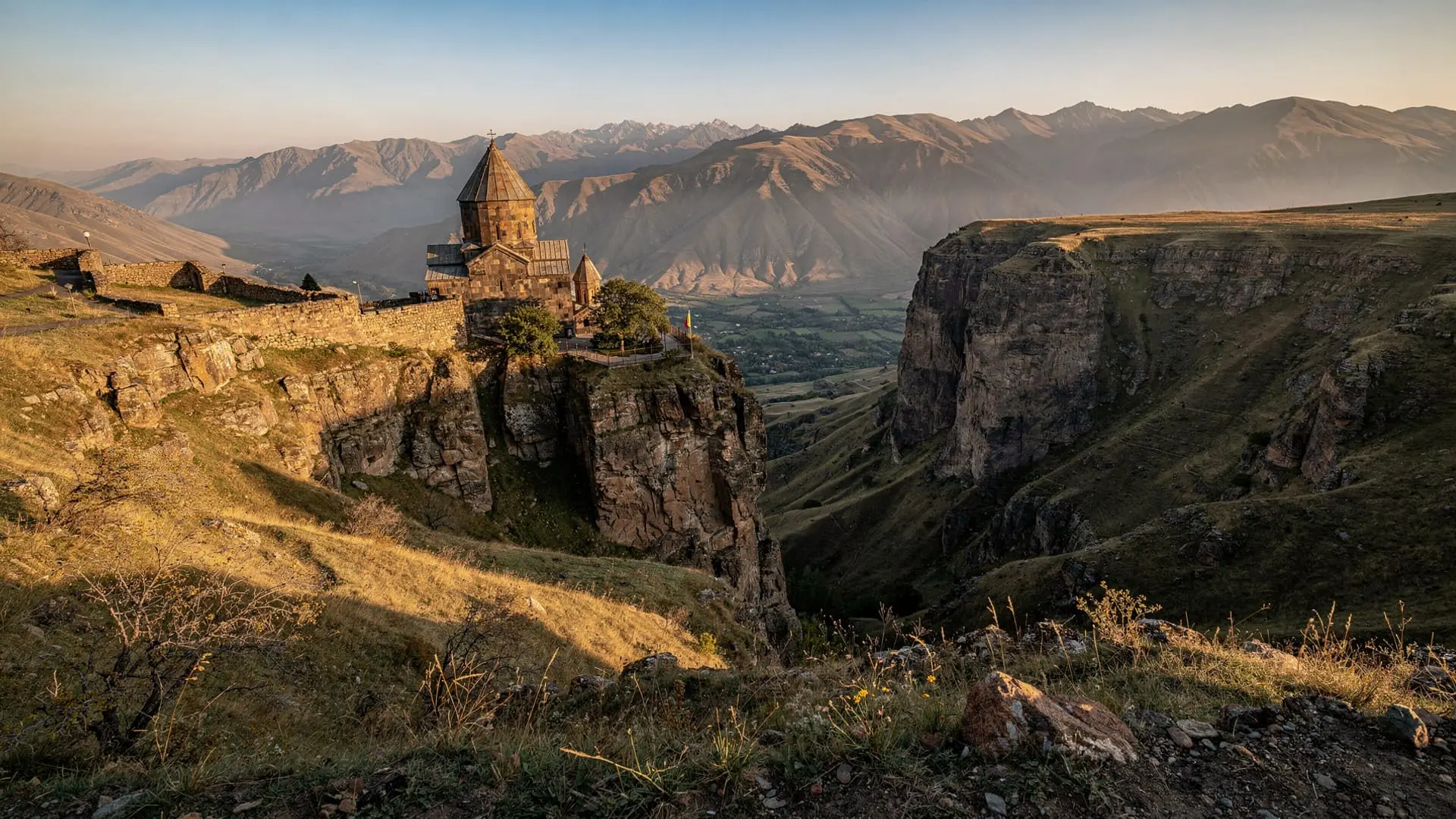
Armenia’s forest monastery — a thousand years in the trees
Nine kilometres northeast of Dilijan, where a dirt road climbs through dense mixed forest and the noise of the main highway completely disappears, Haghartsin monastery materialises from the trees like something from a medieval manuscript. The name means “the flight of the eagle” in Armenian — an apt description for a site perched among the beech and hornbeam forest of Tavush province at around 1,450 metres elevation.
The complex dates from the 10th to the 13th centuries, with the most significant structures built during the reign of the Kiurikian dynasty. It was never a large or politically powerful monastery — unlike Haghpat or Sanahin to the north, which were royal patronage projects. Haghartsin’s appeal is more intimate: a cluster of churches, a refectory, and a gavit tucked so deeply into the forest that the surrounding trees feel like part of the architecture.
The monastery suffered significant decay during the Soviet era. A remarkable restoration project, funded by the Emirate of Sharjah (UAE) and completed in 2012, stabilised and repaired the main structures. The project was controversial among some heritage specialists who felt the restoration went too far — some original medieval stonework was replaced with noticeably fresher-cut stone. The debate is worth knowing about before you visit, because it helps you read the layers of time in the complex.
| Where | Tavush province, 9 km from Dilijan, ~2h from Yerevan |
| Cost | Free admission |
| Time needed | Half a day, longer if paired with Goshavank |
| Getting there | Car/taxi from Dilijan, or a guided tour from Yerevan |
| Best time | Late September–October for foliage; May–June for green forest |
Getting to Haghartsin from Yerevan
By car or taxi from Yerevan: The drive takes approximately 2 hours (roughly 100 km via the Sevan–Dilijan tunnel). From Dilijan town centre, the monastery is 9 km on a forest road that is paved for most of its length. Road conditions can be poor in the final 2 km; a regular car is fine in dry seasons, but 4WD is preferable in winter.
By marshrutka and taxi: Take a marshrutka from Kilikia bus terminal in Yerevan to Dilijan (around 700 AMD, 1h45). From Dilijan, a taxi to Haghartsin costs 3,000–5,000 AMD. Agree a return price if you want the driver to wait.
On a guided tour: Most day tours from Yerevan that cover the Dilijan area include Haghartsin. It is frequently combined with Goshavank and Lake Parz.
From Yerevan: Haghartsin monastery and Yell Extreme Park private tour
What to see at Haghartsin
The church of Surb Astvatsatsin
The main Cathedral of the Holy Mother of God was built in the 13th century and is the largest structure in the complex. The exterior displays the characteristic Tavush style of decoration — carved stone frames around windows and portals, with subtle geometric patterns that are more restrained than the elaborate lacework at Goshavank.
The interior retains its original proportions and atmosphere. Light enters through narrow windows in shafts that cross the dark stone floor. There is no altar screen — the sanctuary is open, as is typical of early Armenian church design. The carved apse behind the altar is the architectural highlight.
The refectory
Haghartsin has one of the best-preserved medieval monastic refectories in Armenia. Built in the 13th century, it is a long vaulted hall supported by two slender columns. Monks ate here communally, and the hall was also used for the preparation of Eucharistic bread. The quality of the masonry — the precision of the pointed arches, the lightness of the vault — is noteworthy. The Sharjah restoration cleaned and repointed much of this space, and the result is perhaps the most controversial part of the project: the stonework looks almost new in places.
The gavit (narthex) of Surb Grigor
The narthex attached to the Church of Saint Gregory is the oldest structure at Haghartsin, dating from the 10th–11th centuries. The carved ceiling vault is a classic example of the interlocking stone bracket system unique to Armenian ecclesiastical architecture — the kind of construction that appears impossibly delicate for its age. Inside, several early khachkars are embedded in the walls.
The small church of Surb Astvatsatsin (eastern)
A smaller chapel to the east of the main complex is the most intimate space at Haghartsin. It can be entered from the courtyard and is usually unlocked. The relief carvings above the door include a small pomegranate motif — the Armenian symbol of prosperity and resurrection.
The forest setting
Even without the monastery, this forest would be worth visiting. The mixed deciduous-conifer woodland of Dilijan National Park is among the most ecologically rich in the South Caucasus. In September and October, the beech trees turn gold and copper, and the monastery buildings absorb those colours visually in ways that make Haghartsin one of the most photographed sites in northern Armenia.
Hiking to Haghartsin through the forest
Beyond the road, Dilijan National Park has a network of marked trails, and some of the more rewarding ones pass through forest close to the monastery rather than approaching it by tarmac. If you enjoy walking, ask at the park visitor centre in Dilijan about current trail conditions before setting out — routes can be affected by seasonal closures or maintenance. Our Dilijan National Park hiking guide covers the main trail options in more detail, and if you’re travelling with children, the Dilijan National Park families guide has gentler alternatives that still deliver forest scenery without a full day’s trek.
For a deeper dive into Haghartsin’s architecture and the restoration debate, our dedicated Haghartsin forest monastery guide covers the site in more detail than fits here, including a closer look at the carving styles across the three main structures.
Combining Haghartsin with other sites
Goshavank (12 km from Haghartsin via the forest road, or 30 minutes by car) is the essential companion visit. The two monasteries contrast nicely: Goshavank is the intellectual monastery, with its famous Pavghos khachkar and Mkhitar Gosh’s tomb; Haghartsin is the atmospheric monastery, defined by its forest setting and well-preserved refectory. Both can be covered in a comfortable half-day with a car.
Lake Parz (7 km southwest of Dilijan) adds an easy forest walk to the day — a pleasant 30-minute walk around the small lake in the national park, with a café at the entrance. Our Lake Parz getaway guide has more on making a half-day of it.
Dilijan town itself is worth 1–2 hours for its restored old town on Sharambeyan Street, with craft workshops, jewellers, and the excellent Hotel Old Dilijan Complex (a converted 19th-century merchant house, recommended by most independent travellers). If you’re staying over, our Dilijan wellness retreats guide rounds up spa and slow-travel options nearby, and this summer stroll piece captures the town’s evening pace well.
Yenokavan and Yell Extreme Park (40 minutes north of Dilijan) can be added for adventure travellers who want to combine cultural heritage with the zipline.
Sevan, Dilijan, Haghartsin, Goshavank and Lake Parz — full-day group tour from Yerevan
Seasonal visiting guide
| Season | Conditions | Notes |
|---|---|---|
| May–June | Deep green forest, mild temperatures | Fewer crowds than autumn; good hiking weather |
| July–August | Warm, forest shade helps | Group tours converge 11:00–14:00; visit early or late |
| September–October | Gold and copper foliage | Peak photography season, especially last two weeks of October |
| November–April | Cold, occasional snow, road can be icy | Atmospheric but check road conditions; fewer visitors |
Tours and tickets
Admission to Haghartsin is free. The site is managed by the Armenian Apostolic Church. The main church and refectory are typically open during daylight hours; if they are locked, the caretaker lives in a small house just inside the main gate.
Guided tours from Yerevan covering Haghartsin typically cost 30,000–50,000 AMD per person for a group tour or 60,000–90,000 AMD for a private tour.
Practical tips
Avoid midday in July–August: The forest provides shade, but group tours converge on Haghartsin between 11:00 and 14:00 in high season. An early morning or late afternoon visit is significantly more pleasant.
Combine with Goshavank: If you have a car, there is no reason to visit only one of these two Tavush forest monasteries. The road between them through the forest is beautiful and the total detour adds only 40 minutes to your day.
Dress appropriately: As an active church, shoulders and knees should be covered. The monastery shop near the entrance sometimes sells headscarves if needed.
Photographs: The refectory interior and the forest-framed exterior of the main church are the most rewarding subjects. The best exterior light on the main church is in the late afternoon (the church faces west).
Autumn colour: For photographers, the last two weeks of October are the peak period — the deciduous trees are at their most vivid, and Haghartsin photographs better in autumn colour than in full summer green.
Road note: The 9 km forest road from Dilijan is narrow with passing places. In wet conditions (October onward) it becomes slippery with fallen leaves, and in winter it can be icy. Drive slowly.
Frequently asked questions about Haghartsin
Was the Sharjah restoration of Haghartsin controversial?
Yes. The 2012 restoration, funded by His Highness Sheikh Sultan bin Muhammad Al-Qasimi of Sharjah, was the first major restoration project at the monastery since the Soviet era. While it stabilised structures that were at risk, some heritage specialists and local architects criticised the replacement of original medieval stonework with new-cut stone in certain sections, particularly in the refectory. The debate is ongoing in Armenian academic circles. The restoration undoubtedly made the site more accessible and safer to visit, but visitors who look closely will notice the contrast between old and restored stonework.
How does Haghartsin compare to Goshavank?
Both monasteries are in the Tavush forest, both date from the 11th–13th centuries, and both are within 12 km of each other. Haghartsin is larger, has a better-preserved refectory, and offers a more dramatic forest setting. Goshavank is smaller but has a higher density of exceptional carvings — particularly the Pavghos khachkar — and the scholarly association with Mkhitar Gosh gives it intellectual depth that Haghartsin lacks. Most visitors who have time should see both.
Can I walk from Dilijan to Haghartsin?
The 9 km road from Dilijan is not a pleasant walking route — it is a paved road with traffic and no pedestrian path. However, hiking trails in Dilijan National Park connect Dilijan to the monastery through the forest. Ask at the national park centre in Dilijan (on the main road entering town) about the current status of marked trails; the park trail network is well-maintained and some routes lead near the monastery.
Is Haghartsin worth visiting without a car?
Yes, but it requires planning. A taxi from Dilijan is the easiest solution (3,000–5,000 AMD). Alternatively, several guided tours from Yerevan include Haghartsin as a stop — this is the most cost-effective option if you are not renting a car.
What is the best time of year to visit?
September and October, when the deciduous trees turn gold and copper around the monastery, are the most visually spectacular months. May and June offer lush green forest. In winter, snow makes the site beautiful but the road can be challenging without 4WD.
Is Haghartsin suitable for a family day trip?
Yes, with some caveats. The forest road and short courtyard walks are manageable for children, and the setting itself — a monastery emerging from the woods — tends to hold kids’ attention better than a purely historical site would. There are no facilities at the monastery itself, so bring water and snacks. If you want a gentler pace that mixes heritage with easy nature time, see our Dilijan National Park families guide for a full day plan.