Armenia in spring (April–May): wildflowers and monasteries
Why spring is Armenia’s most photogenic season
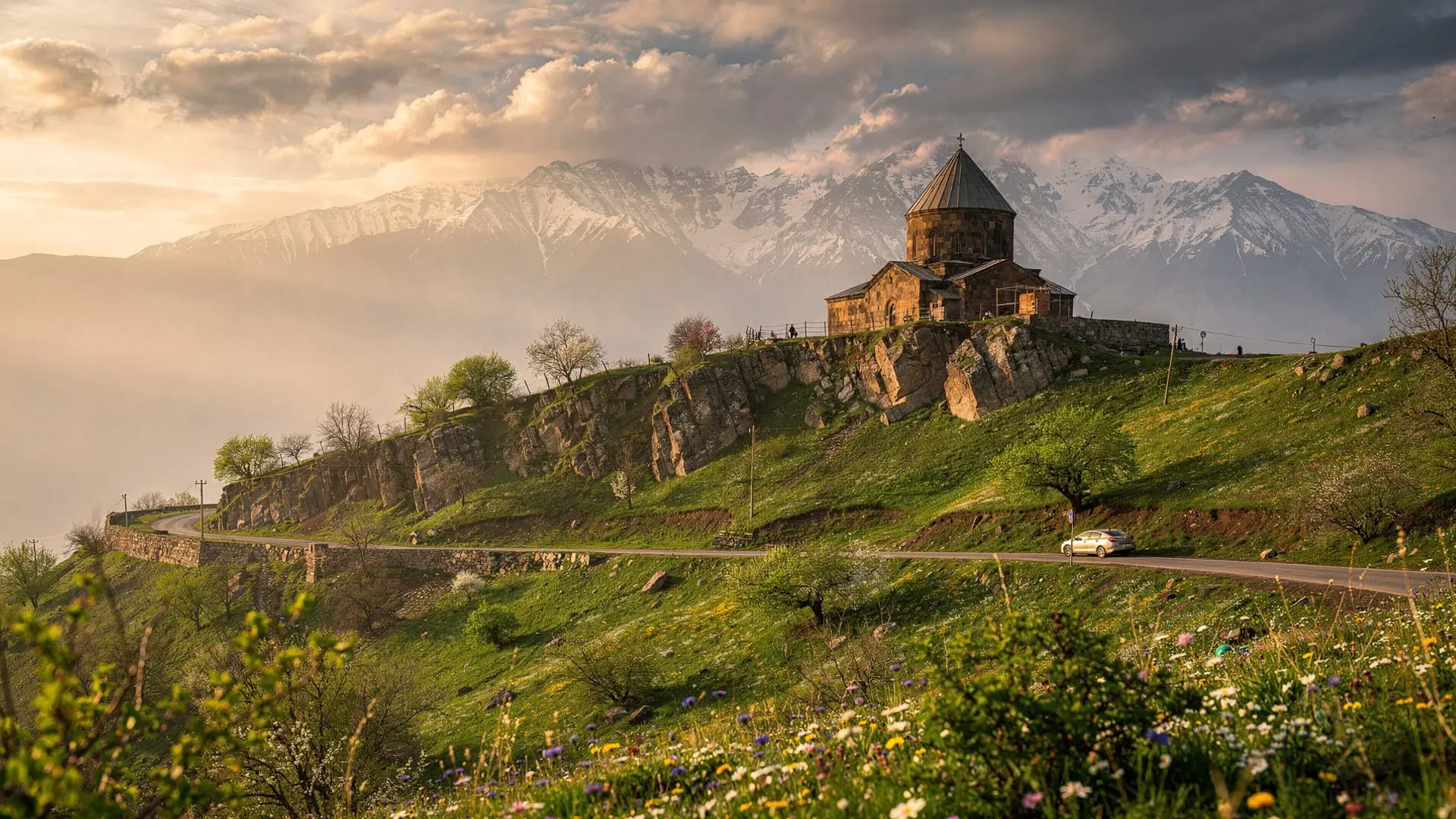
If there is one season that rewards travellers who did their homework, it is Armenian spring. The country transforms between March and June in ways that are genuinely spectacular: the grey plateau greens overnight, slopes that were bare and wind-scoured in February burst into wildflower coverage that defies the austere landscape around it, and the ancient monasteries — so powerful in winter’s severity — acquire a completely different light, gentle and golden, framed by blossoms.
Spring also coincides with manageable temperatures. The Yerevan heat that makes July and August uncomfortable has not yet arrived. Hiking is comfortable. The tourist infrastructure is not yet at peak capacity, meaning you can have Khor Virap’s forecourt largely to yourself on a Tuesday morning in May — something that is impossible in summer.
April and May together form the single best continuous window for first-time visitors and return visitors alike. May, in particular, is the month most consistently recommended by long-term Armenia travellers.
| Best for | Wildflowers, apricot blossom, mild hiking, quiet monasteries |
| Yerevan temperature | 8–23°C (April cooler, May warmer) |
| Prices vs summer | around 10–20% lower |
| Watch for | April 24 closures (Genocide Remembrance Day); April rain |
| Booking lead time | 2–4 weeks Yerevan; 4–6 weeks Dilijan |
April in Armenia
Weather in April
Yerevan: 8–18°C (daytime), 3–8°C (nights). April can feel fresh and cool, particularly in the first two weeks. Light jacket in the mornings and evenings; t-shirt weather by midday on good days.
Rain: April is the wettest month of the Armenian year, though rain tends to fall in short bursts rather than prolonged grey stretches. Pack a packable waterproof shell.
Ararat Valley: The Ararat Valley region around Khor Virap warms fastest. April mornings often bring the clearest views of Mount Ararat — the mountain is dusted with snow above 4,000 m and the lower slopes are green. The haze that obscures Ararat in summer has not yet arrived.
What’s in bloom in April
The apricot blossom is the symbol of April in Armenia. Apricot is deeply embedded in Armenian identity — the Latin name for apricot, Prunus armeniaca, literally means “Armenian plum”. The trees in the Ararat Valley (around Yeraskh, Artashat, and Vagharshapat) typically bloom in the first two weeks of April. The sight of snow-capped Ararat rising above fields of blossoming apricot trees is one of the most iconic images of Armenia.
Wildflowers follow the elevation — poppies and anemones appear in the lower valleys by mid-April; the higher slopes (Aragats, Geghama range) come into colour in May and June.
The April 24 consideration
April 24 is Armenian Genocide Remembrance Day — the most emotionally charged date on the Armenian calendar. If you are in Armenia on this date, you will experience the country in a profoundly different mode: a mass march to Tsitsernakaberd memorial, a city of quiet mourning, and a collective act of remembrance that connects Armenians worldwide to their history.
For travellers who want to understand Armenia deeply, being present on April 24 is powerful. For those who are unaware of its significance, arriving to find businesses closed and the atmosphere sombre can be disorienting. Plan accordingly. See our guide to visiting Tsitsernakaberd Genocide Memorial.
Best April itinerary
An April trip naturally groups around the two great early-spring experiences:
- Days 1–2: Yerevan — city exploration before the heat; Cascade, Matenadaran, Republic Square, Northern Avenue
- Day 3: Khor Virap — Mount Ararat visibility is at its best in April mornings. Drive or take a tour for sunrise. Then continue to Noravank (red cliffs starting to warm in April light)
- Day 4: Etchmiadzin and Zvartnots — UNESCO heritage sites in the Ararat Valley, surrounded by blossoming orchards
- Day 5: Garni and Geghard — the pagan temple and cave monastery are beautiful year-round but feel especially dramatic surrounded by fresh greenery in April
- Day 6–7: Dilijan — Tavush forest begins to green in April; walking through Dilijan’s old town and into the forested hills is excellent
May in Armenia
Weather in May
Yerevan: 12–23°C (daytime), 8–13°C (nights). May is widely considered the best single month for travel. Days are warm and bright, nights are comfortable, and the landscape is at full green before summer heat begins.
Mountains: May is when Aragats and the high alpine zones fully emerge from winter. The Aragats southern summit (3,879 m) becomes hikeable in late May or early June depending on snow conditions. Alpine wildflowers on Aragats include endemic species found nowhere else.
The wildflower peak
May on Mount Aragats and the Aragatsotn plateau produces carpets of poppies, forget-me-nots, wild irises, and other alpine wildflowers that photographers specifically travel for. The combination of vast volcanic landscapes and delicate spring flowers creates a visual contrast unique to Armenia.
The best spots for wildflowers:
- Aragats foothills (Aragatsotn): roadside slopes approaching the mountain from Aparan or Artashavan
- Geghama highlands: the high plateau between Yerevan and Lake Sevan
- Dilijan surroundings: forest-edge meadows in Tavush
- Vayots Dzor valley: the approach to Areni and Noravank in May has a particular lushness
Best May itinerary
May allows a more ambitious itinerary than April, with more consistent weather for mountain activities.
- Days 1–2: Yerevan — begin in the capital; Cascade, Republic Square, Vernissage (the open-air market is ideal on May weekends)
- Day 3: Garni, Geghard, Symphony of Stones — the triple classic in one day, entirely comfortable in May
- Day 4: Khor Virap and Noravank — clear skies most of May give good Ararat visibility
- Day 5: Aragats and Amberd — hike to the southern summit or explore Amberd fortress against the snow-spotted volcanic slopes
- Day 6: Lake Sevan and Sevanavank — the lake is still cool for swimming but spectacular under May skies
- Day 7: Dilijan — Haghartsin monastery in full forest greenery; Lake Parz for a walk
Spring-specific experiences
Lavash baking in spring
Spring is an excellent time to participate in traditional lavash flatbread baking. The cooler outdoor temperatures make stooping over the tonir (underground clay oven) more comfortable than in summer. Several day tours from Yerevan include a lavash-baking experience, typically at a village near Garni. See our lavash baking experience guide.
Easter in Armenia
Armenian Easter (Zatik) falls in spring, though the exact date varies by year, calculated on the Armenian Apostolic calendar and typically landing 1–5 weeks after Western Easter. Church services at Etchmiadzin and churches across Armenia are especially beautiful in spring light. Red-dyed eggs are the traditional symbol, echoing the story of Mary Magdalene presenting an egg to the Roman emperor. If you happen to be in Armenia around Easter, the Etchmiadzin Cathedral celebration is worth attending — arrive early, as the courtyard fills well before the service starts. For the wider festival calendar, see the Armenian public holidays and festivals guide.
Spring hiking
May is the best month for hiking in Armenia outside of the high alpine zones. The trails are dry enough to be comfortable but the heat has not yet arrived. The Kasakh gorge near Hovhannavank, the trails around Dilijan, and the Garni-Geghard valley are all excellent in May.
For comprehensive trail information, see our Transcaucasian Trail Armenia guide.
Practical spring travel tips
Clothing: Layer for spring. Mornings at high-altitude sites like Aragats or Sevanavank can be 5–8°C even in May. A mid-layer fleece and a packable rain jacket are essential. Monastery visits require covered shoulders and knees year-round.
Roads: Most roads are fully accessible by April. The Geghard road and main highway to Tatev are generally fine. The high Aragats plateau road (to Lake Kari) may have residual snow in early May — check locally before driving.
Accommodation: April and May are shoulder season, meaning prices are 10–20% lower than summer peak. Book Yerevan accommodation 2–4 weeks ahead; this is usually sufficient. For popular guesthouses in Dilijan, 4–6 weeks is safer.
Photography tip: The low-angle spring light (golden hour lasts longer than in summer) makes April–May the best period for monastery exterior photography. At Khor Virap, arriving at sunrise (around 06:30 in April) gives you Ararat in orange light with virtually no crowds.
April vs May: which is better?
| Factor | April | May |
|---|---|---|
| Weather stability | Variable, some rain | More reliable, warmer |
| Apricot blossom | Peak (first two weeks) | Finished |
| Alpine wildflowers | Lower elevations only | All elevations in bloom |
| Aragats hiking | Difficult (snow) | Possible from late May |
| Tourist crowds | Low | Low to moderate |
| Prices | Lower | Slightly higher |
| April 24 consideration | Significant (day of mourning) | No impact |
For most first-time visitors, May edges ahead: better hiking, more reliable weather, and no scheduling conflicts. For those specifically drawn to the apricot blossom and the emotional resonance of April 24, April has its own powerful appeal.
Yerevan in spring: city highlights
Spring is when Yerevan is at its most pleasurable for a city break. The contrast with summer is marked:
Northern Avenue and Abovyan Street: The city’s main pedestrian zone transitions to outdoor café culture in April. On weekend afternoons, the street fills with locals — families with children, young couples, elderly Yerevanites enjoying the sun. This is a deeply local experience, not a tourist performance.
Republic Square fountains: The musical fountain show at Republic Square begins in spring (typically April). Evening shows run Tuesday through Sunday, drawing crowds that watch from café terraces.
Cascade Complex: The outdoor stairway connecting Tamanyan Street to the Monument neighbourhood is spectacular in spring as flowering trees along its edges come into bloom. The indoor Cafesjian Museum galleries are worth visiting any time, but the outdoor terraces particularly shine in May.
Matenadaran in spring light: The great manuscript museum at the top of Mashtots Avenue has an impressive exterior best photographed in the warm spring morning light. The permanent collection of illuminated manuscripts is unmissable regardless of season.
Vernissage market: Open on Fridays, Saturdays, and Sundays. The spring market awakens from its winter quiet with increased vendors and more craftspeople present. Khachkars, carpets, Armenian ceramics, and Soviet-era memorabilia fill a market that is genuinely browsable rather than tourist-targeted.
Spring transport tips
Marshrutkas in spring: All routes fully operational. The Kilikia station schedule from Yerevan to regional destinations runs normally from April onwards. Some remote seasonal services (e.g., to high-altitude summer pastures) begin in May.
Road conditions: By April, all main roads are clear and in their best condition before summer heat stresses the tarmac. Rural monastery approach roads (Haghpat, Tatev, Noravank) are fully accessible. The high Aragats plateau road to Lake Kari opens when snowmelt allows — typically late April at lower elevation stages, late May at the full Lake Kari car park elevation.
Hiring a car in spring: Spring is ideal for self-drive exploration. Roads are clear, conditions are mild, and you have maximum flexibility. See our car rental in Armenia guide.
Regional spring highlights beyond Yerevan
Lake Sevan: Post-winter clarity makes May the best month to see the lake’s water at its most vivid blue, even though it is still too cold for swimming. Sevanavank monastery on its peninsula gets a fraction of its summer visitor numbers. See the Lake Sevan complete guide for planning.
Tatev and the south: Syunik province in April and May is quieter than the Yerevan day-trip circuit but no less impressive — the Wings of Tatev cable car runs without the summer queues, and the Vorotan gorge below is at its greenest. See the Tatev complete guide.
Gyumri: Armenia’s second city has its own spring character, with 19th-century architecture set against blooming courtyards. The train from Yerevan makes a comfortable half-day trip in mild spring weather — see the Gyumri day trip by train guide.
Garni, Geghard and Lake Sevan day tour from YerevanFrequently asked questions about spring in Armenia
Can I see Mount Ararat clearly in spring?
Yes — April and early May offer the clearest Ararat views of the year. The summer haze that obscures the mountain from Khor Virap by late morning has not yet developed. Arrive at Khor Virap early (before 09:00) for the best visibility. Cloudy days can still obscure the view, but clear spring mornings are reliably magnificent.
Is the weather too cold for Armenian spring travel?
Armenia in spring is comfortably mild, not cold. Yerevan daytime temperatures in April hit 18°C; in May, 23°C. The nights are fresh (8–12°C) but not uncomfortable if you pack a layer. It is nothing like the cold of a Northern European spring.
Are all monasteries and sites open in spring?
Yes. All major sites — Garni, Geghard, Khor Virap, Tatev, Haghpat, Sanahin, Etchmiadzin, Sevanavank — are fully accessible in April and May. This is unlike winter, when some routes can be affected by snow.
Is spring the cheapest season in Armenia?
Not the cheapest — that is autumn (November–March, excluding the holiday season). Spring is shoulder season with prices 10–20% below summer peaks. You get excellent conditions at reasonable prices — the best value-to-experience ratio.
How does spring compare to Armenia’s other shoulder season, October?
Both are excellent, but for different reasons: spring gives wildflowers and apricot blossom, October gives wine harvest and autumn foliage. Weather-wise they are similar in temperature range, though spring carries more rain risk in April. For a full side-by-side, see the shoulder season guide to May and October.
How should I dress for monastery visits in spring?
Bring a lightweight scarf or long-sleeved layer for monastery visits. Covered shoulders and knees are required in Armenian Apostolic churches. In spring, a pashmina or cotton scarf serves double duty: monastery modesty cover and warmth against the cool morning air at altitude.
Is spring a good time to combine Armenia with Georgia?
Yes. Both countries share a similar spring pattern — mild temperatures, wildflowers, and roads clear of winter snow by April. The overland route between the two is straightforward in spring; see the Armenia–Georgia combined trip guide for routing and border logistics.
Can I hike Mount Aragats in April?
Generally no, not the summit. Snow typically persists on Aragats’s upper slopes into May, and the road to Lake Kari (the trailhead) often only clears in late April or May depending on the year. April is better spent on lower-elevation trails around Dilijan or the Kasakh gorge; save Aragats for a late-May or June visit.