Best time to visit Armenia: month-by-month
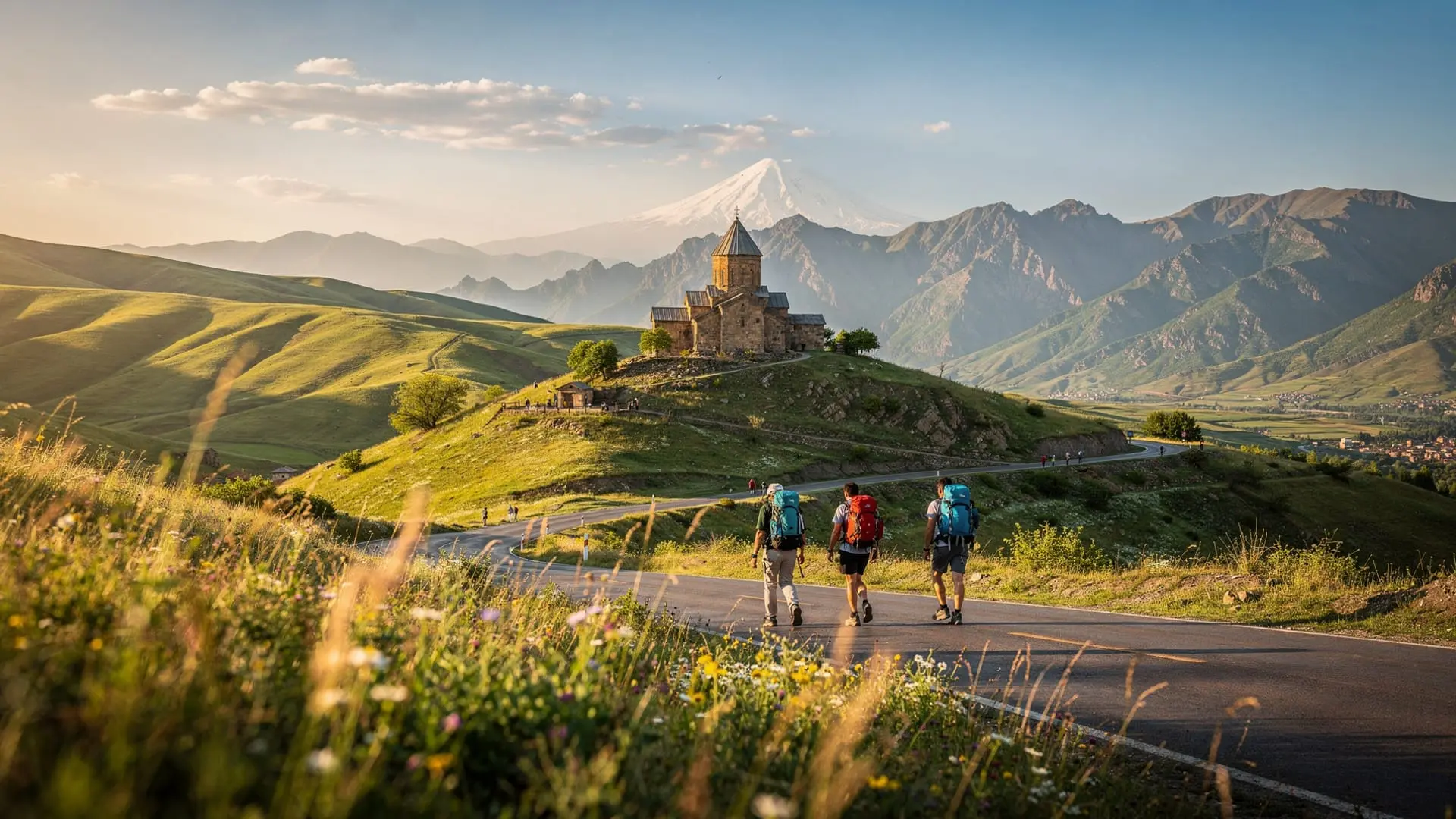
| Best overall | Late April–mid June, or late September–mid October |
| Avoid | Yerevan in July–August (up to 35°C) |
| Cheapest | November, February, March (off-season) |
| Skiing | December–March, Tsaghkadzor |
| Wine harvest | Late September–October, Areni |
The short answer: two golden windows
Armenia’s geography creates sharp contrasts: the high plateau sits at 800–1,400 metres, while the Ararat Valley drops below 900 metres and bakes in summer. This means the ideal time to visit depends partly on what you want to do.
Window 1 — Late April to mid-June: The country is at its most beautiful. Wildflowers blanket the slopes of Mount Aragats, apricot trees bloom in the Ararat Valley, and temperatures across the country stay in the 15–25°C range. This is when you can hike, visit all monasteries without weather complications, and see Khor Virap’s famous view of Mount Ararat relatively free of haze.
Window 2 — Late September to mid-October: The wine harvest in Areni and Vayots Dzor, golden foliage in Tavush and Dilijan, and temperatures that have dropped from the summer peak to a comfortable 20–25°C. The Areni Wine Festival typically takes place on the first weekend of October. Booking gets tight at this time.
Month-by-month breakdown
January — cold, quiet, ski season peak
Yerevan temperatures: -2°C to 5°C
Snow is possible in the capital but not guaranteed. Tsaghkadzor ski resort is at its busiest (December through March). Geghard monastery’s access road can be treacherous and occasionally closed after heavy snowfall. Wings of Tatev cable car may be under maintenance — check in advance. Most museums and churches are open. New Year holidays (January 1–2) and Armenian Christmas (January 6) create a festive atmosphere in Yerevan but mean many shops close.
Best for: Ski enthusiasts, those wanting Yerevan without crowds, Armenian Christmas experience.
Avoid if: You want to hike or explore the south and east.
February — coldest month, ski still good
Yerevan temperatures: -1°C to 7°C
February is statistically the coldest month in Yerevan, though rarely extreme. Tsaghkadzor still good for skiing. The countryside is quiet and monasteries like Haghpat and Sanahin in Lori are often blanketed in snow — dramatic for photography if you have a car and winter tyres.
Best for: Winter photography, skiing, off-peak budget travel.
March — transition month, unpredictable
Yerevan temperatures: 3°C to 12°C
Snow begins melting in the lower elevations. Aragats remains inaccessible for hiking. Road conditions in Syunik (Tatev, Goris) can be difficult early in the month. By late March, Yerevan’s parks begin to show early spring colour.
Best for: Budget travelers comfortable with variable conditions.
April — spring begins, a strong choice
Yerevan temperatures: 8°C to 18°C
April marks the start of the first golden window. Apricot trees blossom in early April in the Ararat Valley, creating some of the most photographed landscapes in Armenia. Wildflowers appear at lower elevations. April 24 is Armenian Genocide Remembrance Day — a deeply significant national date; Yerevan is sombre and many businesses close. If you are visiting specifically for this occasion, the Tsitsernakaberd memorial draws hundreds of thousands of Armenians and diaspora visitors.
Best for: Spring flowers, photography, culturally significant travel. Moderate crowds.
For a deeper dive, see our guide to Armenia in spring (April–May).
May — the best single month
Yerevan temperatures: 12°C to 23°C
May is consistently rated the single best month for general travel to Armenia. Days are warm but not hot, the landscape is at peak green, and hiking conditions are excellent from Aragats to Dilijan. Tourist infrastructure is not yet stretched to peak season limits, so prices remain reasonable and popular sites are accessible without long waits. The Wings of Tatev cable car runs normally. Lake Sevan, though still cold for swimming, looks spectacular.
Best for: Everything — hiking, monasteries, wine country, city exploration. Highly recommended.
June — early summer, still excellent
Yerevan temperatures: 16°C to 29°C
June begins warm and ends hot. The first two weeks feel like an extension of May — still excellent for all travel. By late June, Yerevan daytime temperatures approach 30°C and the city starts to feel summer-heavy. The high-altitude sites (Aragats, Dilijan, Sevan) remain comfortable all month.
Best for: Early June is near-perfect. Late June works well if you spend time in the mountains or at Lake Sevan.
July — peak season, Yerevan heat
Yerevan temperatures: 20°C to 35°C
July is peak season in terms of visitor numbers, but the Yerevan heat (regularly hitting 35°C by early afternoon) makes the capital uncomfortable for extended sightseeing. Smart July visitors use Yerevan as a base for early-morning excursions and escape to the mountains or Lake Sevan for the hottest part of the day. Dilijan stays pleasantly cool. The Wings of Tatev sees maximum queues — arrive early or book a tour that includes priority boarding.
Lake Sevan’s water temperature reaches a swimmable 20–22°C in July — this is the prime beach month. See our Lake Sevan guide for the best swimming spots.
Best for: Lake Sevan, Dilijan, mountain hiking, nightlife in Yerevan. Avoid if you dislike heat.
August — very hot Yerevan, high crowds
Yerevan temperatures: 19°C to 35°C
Much like July. The city is at maximum tourist density and maximum heat. International flights from Europe are most frequent and most expensive. Budget accommodation is stretched. The countryside and mountains remain the better choice. Aragats in August is accessible on most days and offers a cool escape at altitude.
Best for: Lake Sevan, mountain escapes, those who have no choice of month.
Avoid if: City-focused, dislike crowds, or are on a tight budget.
September — the second golden window opens
Yerevan temperatures: 14°C to 30°C
Early September still carries summer’s warmth but gradually softens. By mid-September the light changes, evenings cool down, and the Ararat Valley vineyards begin to colour. The wine harvest in Areni and Vayots Dzor gets underway in late September. This is one of the most atmospheric times to visit Noravank, with the red cliffs lit by a lower sun.
Best for: Wine country, Noravank, photography, comfortable city exploration. Excellent overall.
October — the best autumn month
Yerevan temperatures: 8°C to 22°C
October is exceptional. Tavush and Dilijan go golden, the Areni Wine Festival takes place on the first weekend of the month, and the number of visitors drops sharply after peak season. Prices fall. Monasteries are quiet. The light in the Ararat Valley on a clear October morning — with Mount Ararat fully visible against a deep blue sky — is hard to beat.
Best for: Wine harvest, autumn foliage, photography, budget travel. Highly recommended.
For the full autumn guide, see Armenia in autumn: vendanges and golden Tavush. And for a deeper look at why May and October stand out, read Why May and October are Armenia’s secret seasons.
November — off-season begins
Yerevan temperatures: 2°C to 13°C
November is off-season. Prices drop significantly, monasteries are empty, and the countryside has a melancholy quality that some travellers love. The risks: some mountain roads become difficult, Jermuk’s season winds down, and the Wings of Tatev can operate reduced hours. Weather is genuinely unpredictable.
Best for: Budget travel, solitude, atmospheric winter photography.
December — heading toward winter
Yerevan temperatures: -1°C to 7°C
Early December is quiet and cold. The Western Christmas on December 25 is not a major celebration in Armenia — the Armenian Apostolic Church marks Christmas on January 6. Late December sees Yerevan decorated for New Year (January 1 is a major Armenian holiday). Tsaghkadzor ski season typically begins by mid-December.
Best for: New Year atmosphere in Yerevan, ski preparation.
Planning by activity
| Activity | Best months |
|---|---|
| Hiking and trekking | May, June, September, early October |
| Wine harvest and tastings | Late September, October |
| Skiing (Tsaghkadzor) | December through March |
| Monastery visits | April through June, September through October |
| Lake Sevan swimming | July, August |
| Photography (flowers) | April, May |
| Photography (autumn colour) | October |
| Budget travel | November, February, March |
| Armenian Christmas | January 6 |
How weather affects specific destinations
Khor Virap and Mount Ararat visibility: Mount Ararat is clearest in spring (April–May) and autumn (October–November). Summer haze often obscures the summit by mid-morning. The iconic postcard view — monastery in the foreground, snow-capped Ararat behind — is most reliably captured in early morning in April or October.
Geghard monastery: The road from Garni to Geghard (9 km) is usually fine year-round. After heavy winter snowfall it can ice over, but it rarely closes completely. January–February warrant caution if you are driving yourself.
Wings of Tatev: The cable car typically undergoes brief maintenance closures in late October or early November. Check the official schedule before planning a winter trip to Tatev. In summer (July–August), queues at the lower station can be long — arrive before 10:00 or book a guided tour with reserved boarding.
Mount Aragats hiking: The highest summit (4,090 m) is only accessible July through September. The southern summit (3,879 m), the most popular, opens from June when snow melts. April and May offer spectacular views but you may encounter snow on the path.
Dilijan National Park: Year-round, but best for hiking from May to October. The forest is at its most spectacular in October for autumn colour.
Frequently asked questions about the best time to visit Armenia
Is Armenia good in winter?
Armenia in winter offers a specific experience: Tsaghkadzor skiing (December–March), snow-draped monasteries, and a very local atmosphere in Yerevan. It is not the ideal time for first-time visitors wanting to cover ground, but it suits those specifically interested in ski holidays or the January 6 Armenian Christmas. See our guide Armenia in winter: snowy monasteries and Tsaghkadzor.
When should I avoid visiting Armenia?
July and August are the months most commonly cited by travellers as disappointing — not because the country is bad, but because Yerevan heat and crowded sites do not match expectations. If you can only travel in summer, lean heavily on Lake Sevan, Dilijan, and Aragats.
How far ahead should I book in peak season?
For late April through early June and for the first two weeks of October, book accommodation in Yerevan 4–6 weeks ahead. Popular hotels in Dilijan and guesthouses near Areni fill up fast during the wine festival weekend. Off-season (November–March, excluding New Year) requires almost no advance booking.
Does rain affect travel in Armenia?
Spring (April–May) brings the most rainfall, but it is typically short-lived and the landscape benefits dramatically. Summer is very dry, especially July–August. Autumn is drier than spring with occasional showers. Winter snow is common above 1,000 m.
How does the timing compare if I want to combine Armenia with a Georgia trip?
If your itinerary spans both countries, May and late September–October remain the strongest windows for the combined trip, since both hold true for Georgia’s Kakheti wine region and Tbilisi as well. The Yerevan-Tbilisi overland guide and the Armenia-Georgia combined trip guide both build on this seasonal logic when sequencing a multi-country itinerary, and are worth reading before fixing your dates if Georgia is part of the plan, since a border crossing adds its own seasonal wrinkle — peak summer weekends bring the longest queues at Bagratashen, another reason May and October travel more smoothly end to end.
Can I see both wildflowers and the wine harvest in a single trip?
No — the two windows are about five months apart. Some travellers resolve this by returning twice: a spring trip in May and an autumn trip in October. For a single visit, choose based on your priorities: spring for landscapes and hiking; autumn for wine and culture.
Is Armenia colder or warmer than neighbouring Georgia at the same time of year?
Broadly similar, but Armenia’s higher average elevation (much of the country sits above 1,000m, versus Georgia’s lower western regions near the Black Sea) means Armenian winters can feel colder and drier, while Armenian summers in the Ararat valley can run hotter than coastal Georgian areas. If you’re combining both countries in one trip, expect Tbilisi and western Georgia to be milder and more humid than Yerevan and the Armenian highlands at the same time of year — useful to know when packing for a combined itinerary.
What’s the single biggest weather mistake first-time visitors make?
Underestimating how much altitude changes the experience within the same day. A traveller who leaves Yerevan in a T-shirt at 25°C can find themselves shivering at Lake Kari on Aragats an hour later, or caught in an afternoon mountain thunderstorm that never touched the capital. Packing layers regardless of the Yerevan forecast, and checking mountain-specific conditions before day trips to Aragats, Sevan, or Tatev, avoids the single most common weather-related disappointment reported by visitors.
Temperature and precipitation by region
Armenia’s elevation changes dramatically over short distances, which means weather varies more by altitude than by latitude. Here is a region-by-region snapshot for the key months:
| Region / Site | May avg. | July avg. | October avg. | Notes |
|---|---|---|---|---|
| Yerevan (900–1,000 m) | 12–23°C | 20–35°C | 8–22°C | Most rain in April–May |
| Lake Sevan (1,900 m) | 6–18°C | 14–26°C | 4–16°C | Cooler; summer thunderstorms common |
| Dilijan / Tavush (1,200–1,500 m) | 10–21°C | 17–29°C | 6–18°C | Most forested region; rainfall year-round |
| Aragats south summit (3,879 m) | Snow | 6–14°C | -2–8°C | Accessible Jul–Sep only |
| Tatev / Syunik (1,200–1,500 m) | 10–21°C | 17–30°C | 5–18°C | Warm summers, cold winters |
| Jermuk (2,070 m) | 4–15°C | 13–23°C | 0–12°C | Cool refuge in summer; limited Nov–Mar |
| Khor Virap / Ararat plain (850 m) | 14–25°C | 22–38°C | 9–24°C | Hottest and driest; summer haze |
The practical takeaway: if you visit in July or August and stay in Yerevan all day, you will be uncomfortable. Shift your sightseeing to early morning (before 10:00) and afternoon/evening, and use the hottest midday hours for Lake Sevan, Dilijan, or a long lunch.
Festivals and annual events calendar
Armenia’s festival calendar rewards travellers who plan around it. The major annual events:
January 6 — Armenian Christmas (Surb Dzrnund). The Armenian Apostolic Church follows the Julian calendar for Christmas; January 6 is the traditional date. Churches across the country hold candlelit services from midnight on January 5-6. Yerevan is festive (New Year was January 1; Christmas continues the atmosphere). Fewer tourists, excellent atmosphere.
March 8 — International Women’s Day. A major unofficial holiday in Armenia. Yerevan fills with flowers (literally — the flower markets around Republic Square are spectacular). Not a tourist event, but worth knowing if you are visiting in early March.
April 24 — Genocide Remembrance Day (Medz Yeghern). The most significant date in the modern Armenian calendar. Hundreds of thousands of Armenians — including large diaspora delegations — gather at the Tsitsernakaberd memorial. Businesses close. The atmosphere is solemn and deeply moving. For diaspora visitors, this is often the primary motivation for their trip to Armenia. See our Tsitsernakaberd guide.
Late September–early October — Areni Wine Festival. Takes place on the first weekend of October in the village of Areni, Vayots Dzor, at the base of Noravank canyon. Local wineries (Areni, Hin Areni, Trinity Canyon Vineyards, and others) set up stalls; folk music, dancing, and wine pour from early morning. Book accommodation in the region 4–6 weeks ahead — everything nearby fills up. The 2026 edition is expected on October 3–4.
Late October — Vernissage market peak. The outdoor market near Republic Square, open most days but at its fullest on weekends, peaks in October as tourist numbers drop and local craftspeople fill the stalls with pre-winter stock. Best selection, negotiable prices.
Early December — Yerevan Art Week / gallery openings. The Cascade Complex and galleries on Abovyan Street run autumn exhibitions that often culminate in December openings. Not a major tourist event, but worthwhile for art-focused visitors.
December 31 — New Year’s Eve. Armenia’s biggest secular holiday. Republic Square has a public celebration; restaurants and bars are full. If visiting around this date, book accommodation weeks ahead and expect a festive atmosphere that rivals any European New Year.
Peak, shoulder, and off-season pricing
Budget matters when choosing when to go. Here is a realistic view of how prices shift across the year:
| Period | Accommodation premium | Flight premium | Booking lead time |
|---|---|---|---|
| Peak (Jul–Aug) | +30–50% vs average | +25–40% | 6–10 weeks ahead |
| Second peak (late Apr–May, early Oct) | +15–25% | +10–20% | 4–6 weeks ahead |
| Shoulder (Jun, Sep) | Market rate | +0–10% | 2–3 weeks |
| Off-season (Nov–Mar, excl. New Year) | -25–40% | -10–20% | Few days to 1 week |
The clearest savings are in November and February. A 3-star hotel in Yerevan that costs 80 EUR per night in July often drops to 50–55 EUR in November. The trade-off is cold, some closed rural cafes, and the Wings of Tatev potentially on reduced schedule.
What NOT to visit in each season
This section is more useful than “best time” lists — knowing what to avoid saves frustration:
Winter (Dec–Feb): The Wings of Tatev cable car may be on maintenance schedule in November or early winter — check the official website before planning. Geghard’s access road (9 km from Garni) can ice over after heavy snowfall; accessible but drive carefully. Jermuk town is quieter; some guesthouse-restaurants close. Mount Aragats hiking is impossible above 2,000 m. Khor Virap is fine (and often spectacular in snow), as is Haghpat and Sanahin.
Summer (Jun–Aug): Mount Ararat views from Khor Virap are frequently obscured by summer haze — the famous postcard shot requires an early morning start and even then is not guaranteed. The Wings of Tatev queue in July–August can mean 45–90 minutes waiting at the lower station on weekends; either book a guided tour with priority boarding or arrive before 9:30 am.
Early spring (Mar–Apr): Aragats is completely inaccessible. The road to Noravank from Areni (11 km) may have potholes from winter frost damage that are not yet repaired. Jermuk road from Yeghegnadzor can be tricky in early March. Wine country (Areni area) looks bare in March — the vineyards are dormant.
Late autumn (Nov): Dilijan National Park hiking trails get muddy and some become slippery after leaf-fall; manageable with proper footwear but not the idyllic experience of October.
Matching your trip length to the calendar
The right season also depends on how many days you have. A short weekend trip (3–4 days) benefits most from the reliability of May or early October, when weather risk is lowest and you can’t afford a washed-out day. A longer 7–10 day trip has more room to absorb a poor-weather day or two, which opens up June, early September, or even a well-planned winter trip built around Tsaghkadzor and Yerevan’s indoor museums. If your dates are fixed rather than flexible — a family holiday period, a specific festival, a work trip extended into leisure time — the Armenia travel guide complete has broader itinerary planning that adapts to whatever window you’re given rather than assuming you can choose the ideal month.
Regional timing differences worth knowing
Armenia’s small size hides real regional timing differences. The south (Syunik, Tatev, Goris) tends to hold summer warmth slightly longer into autumn than the north, making late October a reasonable window for Tatev even after Dilijan’s forest has gone bare. The north (Lori, Tavush, Dilijan) gets more rainfall year-round and greens up earlier in spring than the arid Ararat valley. Lake Sevan’s own microclimate means it can be notably cooler and windier than Yerevan on the same day, which matters if you’re deciding what to pack for a day trip versus a multi-day stay. Planning a route that moves from north to south, or vice versa, across a two-week trip means you’ll experience several distinct microclimates rather than one uniform “Armenia weather.”
Garni Temple, Geghard Monastery & Symphony of Stones