Geghard cave monastery: complete visitor guide
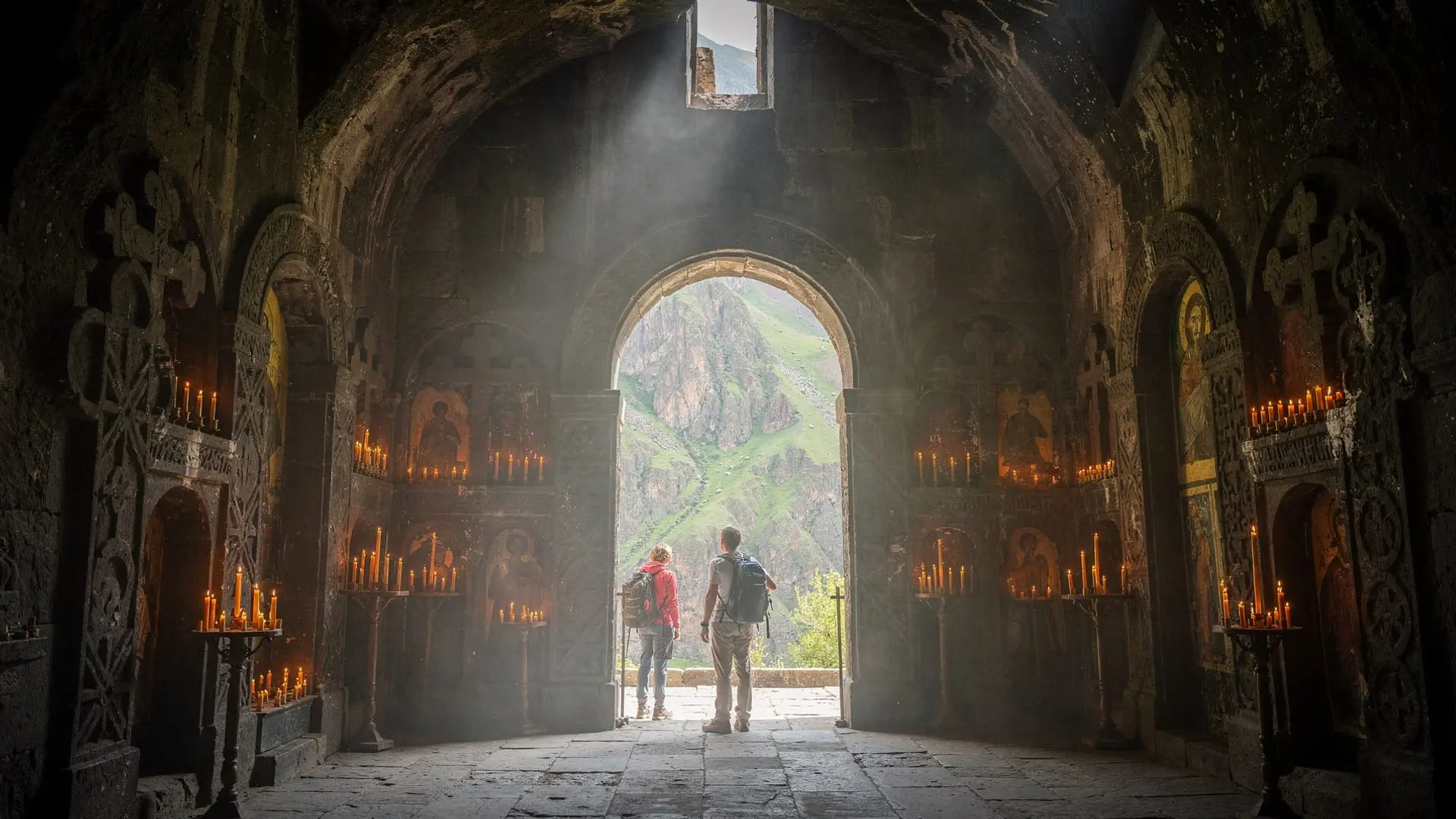
Armenia’s most extraordinary cave complex
Geghard monastery sits at the head of the Azat river gorge, 40 km east of Yerevan, where the valley narrows to a slot of sheer volcanic basalt and the air smells permanently of water and stone. It is the most visited monastery in Armenia for a reason: unlike almost every other site in the country, a significant portion of Geghard is carved directly into the cliff face. Three of its four main churches exist entirely underground, cut from living rock by medieval masons in the 12th and 13th centuries. The effect is unlike anything else in the Caucasus — cavernous, acoustically rich, and faintly surreal.
| Where | Azat gorge, 40 km east of Yerevan, 9 km past Garni |
| Cost | Free entry (donations welcome); candles around 100–300 AMD |
| Time needed | 45–90 minutes at the site |
| Getting there | Tour, private car (~55 min from Yerevan), or marshrutka to Garni + shared taxi |
| Best time | Weekday mornings before 09:30, or October–November / March–April |
Geghard was inscribed on the UNESCO World Heritage List in 2000, jointly with the nearby Garni temple, under the collective title “Cathedral of Zvartnots and the Ensembles of Geghard Monastery and Azat River Valley.”
Why this monastery matters
The site was occupied as a place of worship well before Christianity. A natural spring in the main rock-cut chamber points to a pre-Christian cult of sacred water — early Armenians venerated springs as sites of divine presence. When Gregory the Illuminator converted King Tiridates III in 301 AD and Armenia became the first officially Christian nation, existing sacred sites were often reappropriated. Geghard was first known as Ayrivank — Monastery of the Cave — precisely because of this spring.
The monastery that exists today was built primarily under the Zakarian dynasty of princes (Armenians serving the Georgian crown) in the 12th and 13th centuries. The Zakarids and their vassals, the Proshian family, funded the rock-cut halls that make Geghard visually unique. The monastery belongs to the Armenian Apostolic Church, an Oriental Orthodox body with its own theological tradition that separated from both Rome and Constantinople at the Council of Chalcedon in 451 AD.
Today Geghard is an active religious site and a pilgrimage destination. On feast days — particularly Vardavar (in July) and Easter — thousands of Armenians pack the gorge. Lambs are sometimes blessed in the courtyard in a tradition older than the current church buildings.
History
- Before 301 AD: The cave spring is venerated as sacred. Pre-Christian rituals are held in the gorge.
- 4th century: Following Armenia’s Christianisation, a church is built at the cave mouth. The site acquires the Holy Lance relic according to tradition.
- 923 AD: Arab raids destroy the early monastery; the site is abandoned briefly.
- 12th–13th centuries: The Zakarian princes rebuild and massively expand the complex. Rock-cut chambers are excavated under the patronage of the Proshian noble family.
- 1215: The Cathedral of the Mother of God (the main freestanding church) is completed.
- 1240s: The first rock-cut gavit is carved by order of the Zakarian princes.
- 1283: The deepest and finest rock-cut chamber, the Proshian family tomb, is completed.
- 1441: The Holy Lance is transferred permanently to Etchmiadzin.
- 2000: UNESCO World Heritage inscription.
What to see at the site
Cathedral of the Mother of God (Surb Astvatsatsin): The main freestanding church (1215), built from pale grey basalt. Its exterior khachkars are 13th-century originals. The interior holds a carved altar screen and two small apses. Acoustics are excellent — if a choir or group of monks is singing, stop and listen.
First gavit (Zhamatun): The large covered vestibule attached to the cathedral’s west facade, also freestanding, 1225. Its supporting columns and vaulted ceiling serve as an antechamber and burial space for Armenian nobles. Stone carved portraits of the Zakarian princes are above the entrance.
First rock-cut church (Avazan): Step through a low doorway into the cliff and you enter a completely different register. This cave church, cut in the 1240s, has a natural spring in the floor — the Ayrivank spring that gave the monastery its original name. The walls show carved rosettes and geometric tracery of extraordinary precision. The water still flows; locals fill bottles from it.
Second rock-cut church (Proshian Jamatun, or Gavit of Papak and Ruzukan): The masterpiece of the complex, carved in 1283 for the Proshian noble family. The ceiling is an interlocked star pattern cut directly from rock — arguably the most refined piece of medieval carving in all of Armenia. The north wall bears a large relief of the Proshian coat of arms: an eagle holding a chained ox and lion. Four arcosolium niches serve as family tombs.
Third rock-cut chamber: Behind the Proshian gavit, a narrow doorway leads to a small, dimly lit chapel with a carved column and an arched altar niche. This is the most atmospheric space — bring a torch or use your phone light.
Open-air khachkar wall: The southern cliff face outside the main complex has dozens of khachkars (ornamental cross-stones) cut directly into the rock. Some date to the 9th century; others were added as recently as the 19th. Standing back and looking at the gorge wall studded with these carved crosses gives the clearest sense of how continuously sacred this site has been.
How to get there
By tour from Yerevan: Geghard is almost always combined with Garni temple and the Symphony of Stones — a half-day or full-day excursion that is one of Armenia’s most popular day trips.
Garni Temple, Geghard Monastery and Symphony of Stones from Yerevan From Yerevan: Garni and Geghard with Lavash Baking experienceBy car: From Yerevan, take the road east toward Garni (28 km, 40 min). Continue 9 km east on the H3 through the Azat gorge to the monastery parking area. The gorge road is narrow and scenic. Parking costs AMD 300–500 (informal attendants). Total driving time from Yerevan: about 55 minutes.
By marshrutka: A marshrutka runs from Yerevan’s Gai bus station to Garni (AMD 300, around 40 min). From Garni village, shared taxis charge about AMD 2,000 per person for the 9 km to Geghard (or AMD 8,000–10,000 for the whole car). Arrange a return pickup. No direct marshrutka serves the monastery.
Important note on winter access: The gorge road to Geghard can be icy and treacherous in January–February. Check conditions before driving in winter; some organised tours cancel during this period.
Photography and best light
Geghard faces west, so afternoon light — from about 14:00 to sunset — catches the cathedral facade most directly. The gorge itself is in shadow for most of the morning, giving a moody quality well-suited to documentary photography of the exterior khachkars.
Inside the rock-cut chambers, you are shooting by available light (candles + thin natural light from windows). Bring a fast lens (f/1.8 or faster) or a small LED panel. Flash is technically permitted but disturbing to other visitors and to any services in progress. The star-pattern ceiling of the Proshian gavit requires a wide-angle lens and a steady hand in low light.
The gorge approach, particularly in autumn (October), shows golden poplars flanking the river — a classic composition with the monastery walls above.
Combining with other sites
Geghard fits naturally into the Kotayk day-trip circuit:
- Garni temple (9 km west): the only Hellenistic-era pagan temple in Armenia, best visited before Geghard. See the Garni destination guide.
- Symphony of Stones: the remarkable basalt column formation in the Azat gorge, 3 km below Garni. See the Symphony of Stones guide.
- Tsaghkadzor (30 km north): ski resort and Kecharis monastery, workable as a half-day extension if you have a car.
- Full-day Kotayk circuit itinerary: Garni and Geghard day trip from Yerevan
For a broader loop including Khor Virap and the south: Armenia classic 5-day itinerary.
Practical visit info
Entry fee: Free. There are donation boxes at the entrance to each church. Candles (for light and devotion) are sold at a small stall by the main gate, AMD 100–300 each.
Opening hours: Daily, sunrise to sunset. No fixed hours — the monastery grounds are accessible throughout daylight. Services are held on Sundays (approximately 10:00–12:00) and on major feast days; expect large crowds and limited movement through the rock-cut chambers at these times.
Dress code: Mandatory. Shoulders and knees covered for both sexes. Women must cover their heads inside the churches; headscarves available at the entrance. The rock-cut interiors are cool year-round (around 10°C) — bring a layer regardless of outside temperature.
Facilities: Several souvenir and food stalls operate in the parking area. Grilled trout (khorovats style) is sold from roadside stalls along the Azat gorge — genuinely good. A basic WC is near the parking area. No ATM; bring cash.
Crowds and timing: Geghard is extremely popular on weekends and public holidays. Arrive before 09:30 or after 15:00 for a quieter experience. On Vardavar (the water festival, around July 14) and Easter Sunday, the site is packed from dawn — remarkable to witness but challenging for photography.
Accessibility: The main cathedral and first gavit have low thresholds but are manageable for most visitors. The rock-cut chambers have very low doorways (you must crouch) and uneven floors — not suitable for wheelchairs or those with limited mobility.
The Azat gorge approach
The 9-km road from Garni temple to Geghard through the Azat gorge is part of the experience, not merely transport. The gorge is narrow — in places the volcanic walls close to within 50 metres — and the road runs beside the Azat river through a landscape of dark basalt, poplars, and small orchards. In October the poplars turn gold; in spring the orchard trees bloom against the dark rock; in summer the river is reduced to a thin thread and the gorge is dry and atmospheric.
The approach prepares you for Geghard before you arrive. By the time the monastery walls appear ahead, partially built into the cliff and partially projecting from it, you have already absorbed the logic of the place: a deep valley, sheer stone walls, the sense of enclosure and protection that made this a sacred site long before the first church was built.
Geghard’s place in the day-trip ecosystem
The Garni-Geghard combination is Armenia’s most popular day trip by a significant margin. Almost every visitor to Yerevan does it; every tour operator offers it. The question worth asking is: does this popularity damage the experience?
The honest answer is: somewhat, in peak season. On summer Saturdays (July–August), the parking area at Geghard holds hundreds of tour buses and private vehicles from 10:00 to 14:00. The rock-cut chambers are entered in queues. The atmosphere of contemplative isolation that the monastery was designed to produce is temporarily obliterated.
But this is seasonal and time-dependent. Visit on a Tuesday morning in May, or in October at any time, and Geghard is quiet enough to feel genuinely remote. The crowds are real; so is the monastery’s capacity to absorb them outside the worst windows.
Tactical advice:
- Arrive before 09:30 (get there before the first tour buses)
- OR arrive after 15:30 (when afternoon tours have departed)
- Weekdays are significantly quieter than weekends
- October–November and March–April offer good weather with half the summer crowds
The Azat gorge khachkars outside the monastery
The section of the gorge below the monastery parking area holds several medieval khachkars carved directly into the cliff face. These are separate from the monastery complex proper and are often missed by visitors who head straight to the main gate. Walk 200 metres back down the road from the parking area and look at the cliff walls on the right (the Geghard side of the gorge): you will see several large khachkars cut into the basalt at eye level, some with accompanying inscriptions. These represent the extended sacred landscape of the gorge — the monastery complex reaches further than its walls.
Budget and pricing for Garni-Geghard
Organised tour from Yerevan: AMD 10,000–25,000 per person depending on group size, vehicle type, and whether lunch is included. Private tours (car + guide) cost AMD 40,000–60,000 for 1–4 people.
Independent by car: Petrol cost (Yerevan-Garni-Geghard-Yerevan): approximately AMD 1,500–2,000. Parking: AMD 300–500 at Geghard. Total vehicle costs: AMD 2,000–2,500. No entry fee at either site.
Independent by marshrutka + taxi: Marshrutka Yerevan–Garni: AMD 300. Shared taxi Garni–Geghard: AMD 2,000 per person one way (AMD 8,000–10,000 for the whole car). Return taxi to Garni: same. Total without car: AMD 5,000–10,000 per person.
The independent option is genuinely feasible for budget travellers but requires flexibility about timing. Shared taxis are not on a schedule; you wait until a car fills with people going the same way.
Armenian stone carving: understanding what you see
Geghard is the finest site in Armenia for understanding the tradition of Armenian decorative stone carving — a tradition that spans fourteen centuries and represents one of the most distinctive artistic contributions of any medieval culture.
The key elements to recognise:
Khachkars (cross-stones): Ornamental stone slabs carved with a central cross surrounded by interlace patterns, rosettes, and geometric ornament. No two khachkars are identical; the best examples approach the complexity of lace. Geghard has dozens — on the exterior cliff face, embedded in the church walls, and in the courtyard. The finest date from the 12th–14th centuries.
Interlace (hatching): The most characteristic Armenian decorative motif — a continuous line weaving over and under itself to create a knotwork pattern. At Geghard, this reaches extraordinary density in the Proshian gavit ceiling. Armenian scholars sometimes compare this tradition to Celtic knotwork; the parallel is real but independent — similar problems (how to fill a surface with controlled complexity) produce similar solutions.
Rosettes: Carved circular flower patterns, usually in high relief, that appear on drum windows, portal frames, and column capitals. They derive from pre-Christian Armenian and Parthian decorative traditions.
Stalactite corbelling (muqarnas): This device — rows of small carved projections stepping inward to create a decorative corbelled surface — appears in Armenian medieval architecture as early as the 11th century. It is also common in Islamic architecture of the same period; whether Armenian or Islamic sources are primary is debated. At Geghard, the main church apse corbelling shows this technique at a high level.
The Holy Lance relic and relic culture in Armenia
The Holy Lance of Longinus — the spearhead said to have pierced Christ at the Crucifixion — is one of several major Christian relics held in Armenia. The Armenian tradition holds that the apostle Thaddaeus brought the lance to Armenia in the 1st century; it was kept at Geghard for centuries, giving the monastery its name. In 1441, when the Catholicosate returned from Sis (Cilicia) to Etchmiadzin, the Holy Lance was transferred to the mother cathedral.
The Treasury Museum at Etchmiadzin also holds what is claimed to be a fragment of Noah’s Ark, preserved in a silver reliquary. This relic reflects the Armenian theological tradition’s deep engagement with the ark narrative — Mount Ararat (visible from Khor Virap, 80 km west of Geghard) is traditionally identified with the landing site of Noah’s ark, and the Armenian church has venerated this connection since early Christianity.
Relic culture in the Armenian Apostolic tradition is less prominent than in Roman Catholicism but more present than in most Protestant denominations. Visiting pilgrims seek proximity to relics for intercessory prayer; the physical object is understood to be infused with sanctifying power through its contact with a holy person or event.
The Azat gorge wildlife and ecology
The gorge below Geghard supports an interesting ecology that most visitors miss entirely. The steep basalt walls and the permanent water source of the Azat river create a microclimate notably cooler and more humid than the surrounding plateau. The cliff vegetation includes several endemic fern species and specialised plants that grow only in rock crevices.
The gorge is good for birdwatching: chukar partridge (heard constantly in the rocky slopes), various raptors including the short-toed eagle, and in winter, Wallcreeper — a remarkable bird that moves spiderlike across vertical cliff faces. The trout of the Azat river are smaller than the famous Sevan ishkhan but still fished by locals.
In spring (April–May), the poplar trees along the gorge floor produce an extraordinary show of catkins and new leaf. In autumn, the poplars turn bright gold against the black basalt — one of the characteristic colour combinations of Armenian autumn. The road through the gorge is genuinely worth treating as a destination in itself, not just a route to the monastery.
Geghard compared to Armenia’s other great monasteries
Armenia has no shortage of remarkable monastic sites, and it helps to know how Geghard fits among them before deciding how much of the country to see. Haghpat and Sanahin, the other UNESCO-listed monastery pair, sit far to the north in Lori province and are freestanding rather than rock-cut — their appeal is more about the dramatic hilltop and valley setting than carved interiors. Goshavank and Haghartsin, both in forested Tavush near Dilijan, are freestanding medieval complexes surrounded by woodland rather than basalt cliffs — a gentler, greener counterpoint to Geghard’s stark gorge setting. Further south, Khor Virap trades architectural complexity for the single best view of Mount Ararat in the country and its own underground pit associated with Gregory the Illuminator’s imprisonment.
If you only have time for one monastery in Armenia, Geghard’s rock-cut architecture makes the strongest case — nothing else in the country matches the Proshian gavit’s carved ceiling. If you have several days, pairing Geghard with one northern site (Haghpat-Sanahin or the Tavush monasteries) and Khor Virap in the south gives a genuinely representative picture of Armenian monastic architecture across three very different landscapes.
Where to stay for a Geghard visit
Almost everyone visits Geghard as a day trip from Yerevan rather than staying nearby — there is no real hotel infrastructure in Garni village or at the monastery itself, just the roadside food stalls. Basing yourself in Yerevan keeps your options open: you can combine Geghard with Garni and the Symphony of Stones in a single morning, and still have the afternoon free for the city. If you are building a longer Kotayk-focused itinerary, Tsaghkadzor (30 km north of Geghard) has more developed accommodation and works as an alternative overnight base with its own monastery, Kecharis, and easy access back down to Garni and Geghard the next morning.
Visiting respectfully as a non-Armenian or non-Christian traveller
Geghard is an active place of worship, not a museum, and this shapes how you should behave even as a secular visitor. Keep voices low inside the rock-cut chambers, especially if a service or a small prayer group is present — the acoustics carry sound much further than you would expect. Photography is generally tolerated outside of active services but always lower your camera if a priest or worshipper gestures for quiet. Lighting a candle at the entrance stall is open to visitors of any faith or none, and donation boxes fund the upkeep of the site — a small contribution is appreciated even if you do not light a candle. The dress code (shoulders and knees covered, head covering for women) is enforced consistently and headscarves are provided free at the entrance if you arrive unprepared.
None of this requires being Christian or religious yourself — Armenian churches are generally welcoming to respectful visitors of any background, and monks and priests will not single out non-Armenian or non-Christian visitors as long as basic etiquette is observed. If a service is underway when you arrive, it is entirely acceptable to wait quietly at the back or return to that chamber later rather than walking through mid-service.
Frequently asked questions about Geghard
Is the Holy Lance still at Geghard?
No. The Holy Lance relic was kept at Geghard for several centuries but transferred to the main Catholicosate at Etchmiadzin in 1441, where it remains in the Treasury Museum. Etchmiadzin also holds other relics including a fragment of Noah’s Ark. See the Etchmiadzin: the mother cathedral of Armenia guide.
How do the rock-cut churches compare to other cave monasteries in the region?
Geghard is the most refined example of rock-cut ecclesiastical architecture in the South Caucasus. Georgian cave monasteries like Vardzia are larger and more dramatic as cave complexes, but Geghard’s carved decoration — particularly the star-pattern ceiling of the Proshian gavit — surpasses anything in Georgia for sheer sculptural precision. The Armenian tradition of interlacing geometric carving had no equal in medieval Europe.
Can I combine Geghard and Tatev in one day?
Only with a car and a very early start, and even then the day would be rushed. Tatev is 250 km from Yerevan; Geghard is 40 km. A Geghard-only morning and a Tatev-only day are both rewarding; squeezing both into the same itinerary is not advisable. See Tatev monastery: complete guide for logistics.
Is there a spring inside Geghard?
Yes — the Avazan (first rock-cut church) contains the natural spring that gave the monastery its original name, Ayrivank. The water still flows along a small channel in the floor. It is considered holy water; locals and pilgrims fill bottles and flasks from it. Drinking it is a long-standing tradition, though official guidance on water quality is not posted.
What is the best time to visit Geghard to avoid crowds?
May and September offer the best balance of good weather, manageable crowds, and attractive light. Weekday mornings (Tuesday–Thursday before 10:00) are consistently quieter than weekends. July and August bring the largest tour groups, with parking areas overflowing by mid-morning on weekends.
Are there guides available on-site?
No official guide service operates from the monastery itself. Monks and priests are present but do not offer tours. Visiting with a private guide hired in Yerevan is the best option if you want detailed historical commentary. Several English-speaking guides are available through tour agencies in Yerevan; quality varies — read reviews carefully.
Is Geghard worth visiting if I’ve already seen other Armenian monasteries?
Yes, on the strength of the rock-cut architecture alone. Freestanding monasteries like Haghpat and Sanahin or Goshavank are beautiful but architecturally conventional by comparison; Geghard’s carved-from-rock chambers, particularly the Proshian gavit ceiling, are unmatched anywhere else in the country and worth the trip even on a short Armenia itinerary.
Can I visit Geghard without joining a tour group?
Yes — independent visits by private car or the marshrutka-plus-taxi route described above are straightforward, and the site has no timed-entry restrictions. The main advantage of a tour is transport logistics and commentary, not access; independent travellers see exactly the same chambers on the same terms as tour groups.