Matenadaran: visiting Armenia's manuscript treasure
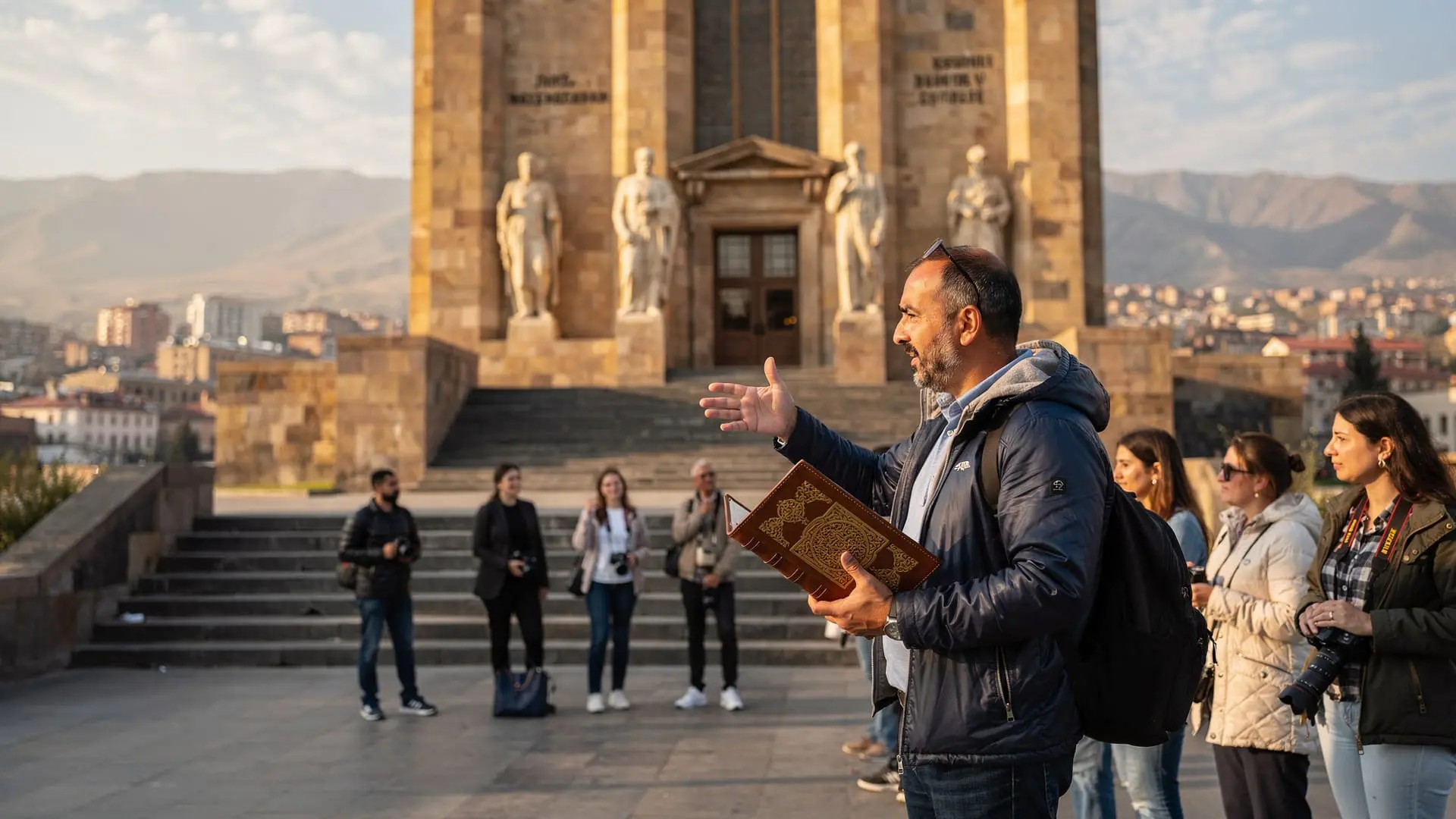
The building on the hill that holds Armenia’s memory
From Republic Square you can see it: a solid, temple-like building on a raised terrace to the northwest, with a bronze statue of a seated figure on its steps. That figure is Mesrop Mashtots, the 5th-century monk who invented the Armenian alphabet in 405 AD. The building behind him is the Matenadaran — the Mesrop Mashtots Institute of Ancient Manuscripts — and inside it are more than 23,000 manuscripts that represent the most complete surviving record of Armenian intellectual and spiritual life across fifteen centuries.
Few museums anywhere in the world carry this weight. The Matenadaran is not simply a repository of old documents. It is the reason the Armenian language survived the medieval conquests, the Ottoman centuries, and the Soviet era. When Armenians say that the alphabet and the manuscripts saved the nation, this is the institution that made that possible.
At a glance
| Where | 53 Mashtots Avenue, Yerevan |
| Cost | ~1,500 AMD admission; ~1,000 AMD extra for the English audio guide |
| Time needed | 90 min for a solid visit; 2.5–3 hrs if reading closely |
| Getting there | 20-min walk from Republic Square, or ~5 min by GG Taxi |
| Best time | Tuesday–Saturday mornings, before tour groups arrive |
What the word “Matenadaran” means
The name comes from the classical Armenian words “matenadaran” — manuscript repository or book depository. Medieval Armenian monasteries kept their own matenadars to preserve the gospels, theological texts, scientific treatises, and chronicles they produced and copied. The most significant monastic libraries were at Tatev, Haghpat, Sanahin, and Gladzor.
After the Armenian Genocide of 1915, vast numbers of manuscripts that had survived in western Armenian monasteries were lost. The institution in Yerevan was formally established in 1959 to centralise and protect what remained. Today its collection includes:
- 17,000 complete manuscripts and 6,000+ fragments
- Texts in Armenian, Arabic, Persian, Greek, Hebrew, Syriac, and Latin
- The world’s largest collection of medieval Armenian manuscripts by far
- Documents on history, theology, philosophy, astronomy, medicine, mathematics, and literature
Many of the most important items in the collection date from the 9th to 17th centuries. The oldest complete manuscript in the collection is a gospel from 887 AD. Some fragments are older.
The Armenian alphabet and why it matters
Any visit to the Matenadaran is, at its core, a visit to the story of the Armenian alphabet. Understanding it makes everything else make sense.
Mesrop Mashtots created the 36-character (later 38) Armenian script in 405 AD, working with the Catholicos Sahak I and supported by the Armenian king Vramshapuh. The motivation was partly religious (translating the Bible from Greek and Syriac into Armenian) and partly cultural-political: having its own alphabet was, in the ancient world, a crucial marker of national identity. Without it, the Armenian church would have been absorbed into either Byzantine or Persian ecclesiastical structures.
The first text translated into the new script was the Book of Proverbs. Within a generation, Armenian scholars had translated the entire Bible, major theological works, and significant Greek philosophical texts. Some of these translations — including works by Philo of Alexandria — survive only in Armenian; the Greek originals were lost. Armenian manuscripts became, in certain cases, the world’s last copy of texts otherwise destroyed.
This is why the Matenadaran matters beyond Armenia. It is part of the record of human knowledge.
What you see in the permanent galleries
The permanent exhibition is organised across two main floors, accessible from the entrance hall where Mashtots’ statue gazes down.
Ground floor — the alphabet and early manuscripts: The exhibition opens with the creation of the Armenian script, showing facsimiles of the earliest inscriptions and explaining the process of manuscript production: the preparation of vellum from goatskin, the mixing of pigments, the scribal traditions of Armenian monasteries. Several early illuminated gospels are displayed in secure cases. The colours in the oldest surviving illuminations — deep lapis lazuli, gold leaf, verdigris green — are extraordinary given their age.
Upper floors — the great collections: Moving higher, the exhibition presents thematic sections: medieval science (Armenian astronomical and medical texts were highly sophisticated), historiography (a tradition of chronicle writing stretching from the 5th century onward), and theology. Key items displayed include:
- The Gospel of Queen Mlke (862 AD), one of the oldest and finest illuminated manuscripts in the world
- The Gospels of Gladzor (early 14th century), with miniature paintings of breathtaking quality
- Manuscripts annotated with marginal notes that give historians direct insight into medieval Armenian daily life
- A collection of medieval Armenian maps and geographical manuscripts
The exhibition hall also shows documentation of manuscript preservation techniques — UV-light examination, humidity-controlled storage, and the ongoing digitisation project that is making the collection available online.
The exhibition of stolen and repatriated manuscripts: A notable section documents the history of manuscript theft and the efforts to recover dispersed items. Some manuscripts from the Matenadaran collection, taken during the Soviet period or earlier conflicts, have been repatriated from collections in Istanbul, Venice (the Mekhitarist library on San Lazzaro island holds a parallel Armenian collection), and the United States.
Visiting logistics
Address: 53 Mashtots Avenue, Yerevan. A 20-minute walk from Republic Square along Mashtots Avenue, uphill; the building is visible from the street. GG Taxi from central Yerevan takes about 5 minutes.
Opening hours: Tuesday–Saturday, 10 am to 5 pm (last entry 4:30 pm). Closed Sunday, Monday, and public holidays. Hours can shift around Armenian holidays (Armenian Christmas falls on 6 January; Easter varies). Confirm times if visiting near a holiday.
Admission: Approximately 1,500 AMD for adults (around 3.65 EUR at April 2026 rates). Student and group rates available. An audio guide in English is available for an additional fee and is strongly recommended — the context it provides makes the manuscripts far more legible.
Dress code: The Matenadaran is a cultural institution, not a church, but dress modestly as a mark of respect. No specific dress requirements are enforced, but shorts and sleeveless tops feel out of place.
Photography: Photography without flash is generally permitted in the public galleries. Cases containing original manuscripts may have no-photography restrictions; follow the signage.
Language: Exhibit labels are in Armenian and English. The audio guide covers the main items. Several staff members speak English and can answer basic questions.
Time needed: Ninety minutes to two hours for a thorough visit with the audio guide. If you are a researcher or particularly interested in medieval illuminated manuscripts, half a day is not excessive.
Yerevan City Tour: Discover an Old and New YerevanThe Matenadaran’s role during the Soviet period
The decision to build the current Matenadaran building (opened 1959, designed by architect Mark Grigoryan) was itself a cultural and political statement. The Soviet Armenian government, which had suppressed much of Armenian religious and cultural life, nonetheless invested significantly in the manuscript repository. Preserving the manuscripts served Soviet purposes — demonstrating Armenian cultural depth within the USSR’s nationality framework — but it also genuinely protected irreplaceable material.
During the Soviet period, the Matenadaran was one of the few places in Armenia where aspects of Armenian identity (language, medieval scholarship, pre-Christian heritage) could be studied and celebrated, albeit within ideological constraints. Scholars working here maintained scholarly traditions that survived into the post-Soviet period.
Since independence in 1991, the Matenadaran has expanded its digitisation programme and research activities. Its scholarly journal and publications are now part of the international medieval studies conversation.
How the Matenadaran connects to wider Armenian cultural heritage
The Matenadaran does not exist in isolation. The manuscripts it preserves were produced in monasteries that you can still visit — places like Haghpat and Sanahin, the great UNESCO-listed monastery complexes in Lori province where significant scriptoria were active in the 12th–14th centuries. Understanding what those monasteries actually produced — the manuscripts, the translations, the original scholarship — makes the buildings themselves more meaningful.
Similarly, the Erebuni museum connects to a much older cultural tradition: the Urartu kingdom whose citadel gave Yerevan its name. Armenian cultural identity runs from Erebuni (782 BCE) through Mesrop Mashtots (405 AD) through the manuscript tradition to today — and the Matenadaran is where the middle part of that story lives.
For a broader context of Yerevan’s cultural institutions, see our ranked museum guide.
Private tour: Walking observing city tour in YerevanTimeline: from Mashtots to the modern collection
Understanding the Matenadaran’s collection requires knowing when things happened. Here is the key chronology:
405 AD: Mesrop Mashtots creates the Armenian alphabet. The purpose is Bible translation; the lasting effect is that Armenian intellectual life develops independently of Greek and Persian frameworks. Within a generation, scholars have translated the full Bible and major patristic texts. Some translations — including works of Philo of Alexandria — survive only in Armenian, the Greek originals lost.
5th–8th centuries: The earliest manuscript production period. Most of these manuscripts were destroyed in subsequent invasions. The oldest complete manuscript currently in the Matenadaran dates from 887 AD (a gospel produced at the monastery of Noravank Amaghu). Some fragments are older.
9th–11th centuries: The great monastic scriptoria of Haghpat, Sanahin, and Tatev develop into major centres of manuscript production. These monasteries you can visit today were, in their prime, functioning universities — producing not just gospel books but scientific treatises, medical texts, astronomical tables, and chronicles.
12th–14th centuries: The golden age of Armenian manuscript illumination. The Gospels of Gladzor (early 14th century) and related manuscripts from the Gladzor university in Vayots Dzor represent the peak of the tradition — miniature paintings of such quality that they rank among the finest illuminated manuscripts produced anywhere in the medieval world. Also in this period: the Gospel of Queen Mlke (862 AD, in the Matenadaran), one of the oldest dated Armenian illuminated manuscripts.
15th–17th centuries: Production continues despite repeated invasions. The printing press arrives: the first Armenian book was printed in Venice in 1512, beginning the gradual transition from manuscript to print. Manuscript production does not cease — it continues in parallel for devotional and luxury uses until the 19th century.
1915: The Armenian Genocide destroys the manuscript-holding monasteries of western Armenia. Vast numbers of manuscripts held at Van, Kars, Mush, and other centres are lost. Some were saved by being buried, hidden, or carried in the flight of survivors — a small number of these have since been recovered and returned.
1959: The current Matenadaran building opens, designed by architect Mark Grigoryan in the style of Armenian Stalinist classicism — solid, temple-like, faced with pink tufa stone. Mashtots’ statue is placed on the steps. The collection is centralised here from previously distributed locations across Soviet Armenia.
1991–2026: Post-Soviet expansion of digitisation, research, and international cooperation. The collection has grown through repatriations and donations from the Armenian diaspora.
Five must-see manuscripts
The Matenadaran is too large to see comprehensively in one visit. These five items justify the trip alone:
1. The Gospel of Queen Mlke (862 AD): Among the oldest dated illuminated Armenian manuscripts in existence. Queen Mlke of Vaspurakan commissioned this gospel; it survived via a route through Cilician Armenia and eventually the Mekhitarist library before reaching Yerevan. The gilded full-page miniatures use lapis lazuli blue and gold leaf in a style that predates the fully developed Armenian illumination tradition but already shows its distinctive features.
2. The Mugni Gospels (1060 AD): Named for the monastery of Mugni (near Etchmiadzin). A large-format ceremonial gospel produced at a time when Armenian illumination was maturing into its characteristic style. Significant for showing the transition from early Byzantine-influenced work to the distinctively Armenian visual language of the high medieval period.
3. The Gospels of Gladzor (early 14th century): The acknowledged masterpiece of the collection, produced at the university-monastery of Gladzor in Vayots Dzor under the painter Toros Roslin’s stylistic influence. The full-page miniatures include figures of the four evangelists in a style of unusual psychological intensity. The borders of the canon tables are decorated with birds, animals, and interlaced knotwork that approaches the quality of the finest contemporary European manuscript production.
4. The Etchmiadzin Gospel (989 AD): Produced at Etchmiadzin with covers added later (the ivory covers, now displayed separately, are among the finest surviving examples of Early Christian ivory carving). The text represents an important version of the Armenian gospel tradition and the covers demonstrate the international connections of the Armenian church in the medieval period.
5. The Vehapar Gospel: Associated with the Catholicos and used in major ceremonial contexts. More significant historically than visually — it represents the documentary chain from Mashtots’ original translation project through the unbroken manuscript tradition to the present day.
Practical visit details
Ticket prices: Admission is approximately 1,500 AMD for adults (around 3.65 EUR). Reduced rates for students with ID and for senior visitors. Children under 12 are typically free. Group rates available on advance booking.
Audio guide: An audio guide in English is available at the ticket desk — approximately 1,000 AMD additional (about 2.44 EUR). Guides are also available in French, German, Russian, and Armenian. The English audio guide covers the twenty most significant items and takes approximately 75 minutes to complete. It is strongly recommended for first-time visitors — without it, the display cases can feel like a collection of old books rather than the extraordinary human document they are.
Guided tours vs. self-guided: The audio guide is adequate for most visitors. A live-guided tour (available on advance booking, approximately 8,000–12,000 AMD for a private group) provides more interaction and can be adapted to your specific interests — medieval science, the illumination tradition, the Genocide documentation section. If you are travelling with children, a live guide can adjust the pace and focus.
Photography rules: Photography without flash is permitted throughout the public galleries. Individual cases may have no-photography symbols — clearly posted and respectfully enforced. The gift shop sells high-quality printed reproductions of key manuscripts.
Time required: 90 minutes with the audio guide for a solid overview. Allow 2.5–3 hours if you want to read the display texts carefully and spend time with the illuminated manuscript cases. Researchers and specialists can spend half a day.
Child-friendliness: Not purpose-built for children, but the illuminated manuscripts — vivid colours, intricate miniature figures — appeal visually in a way text-heavy exhibits often do not. Children under 10 may lose interest after 45–60 minutes; the terrace and Mashtots statue outside provide a change of scene.
Café and gift shop: No café inside the Matenadaran. The small gift shop sells scholarly books on Armenian manuscript tradition, attractive printed facsimiles of famous pages, Armenian calligraphy sets, and small decorative items. The nearest good coffee options are on Mashtots Avenue, three to four minutes’ walk south. Several cafés cluster around the Opera House plaza, a ten-minute walk.
The terrace and approach: The terrace in front of the Matenadaran, with Mashtots’ statue and the view down Mashtots Avenue toward Republic Square, is architecturally significant. The building echoes the portal structures of Armenian medieval monasteries — the same broad, solid, stone-faced form — and the connection to the monasteries where these manuscripts were produced is intentional and worth a moment before you go inside.
Best of Yerevan: A Private Cultural Walking TourIs the Matenadaran worth it if you’re short on time in Yerevan?
If you only have one full day in Yerevan and are weighing the Matenadaran against Republic Square, the Cascade Complex, and other headline sights, the honest answer depends on your interests. The Matenadaran rewards visitors with any curiosity about history, calligraphy, or how a small nation preserved its identity through centuries of upheaval — even 45 minutes with the audio guide covering the five must-see manuscripts above is worthwhile. Visitors purely after photogenic city views or architecture may get more from an afternoon at the Cascade instead.
Frequently asked questions about the Matenadaran
How many manuscripts does the Matenadaran have?
Over 23,000 manuscripts, plus approximately 100,000 archival documents. The manuscript collection includes items in Armenian, Arabic, Persian, Greek, Hebrew, Syriac, and Latin, spanning from the 5th to the 19th century.
Can I see the original manuscripts?
Yes. The permanent exhibition displays original manuscripts in secure, climate-controlled cases. You will see illuminated gospels, scientific texts, and chronicles with original medieval pigments and calligraphy. Not all 23,000 items are on display simultaneously — the exhibition rotates and focuses on key items.
Is the Matenadaran worth visiting if I am not interested in religion or manuscripts?
Yes, for two reasons. First, the illuminated manuscripts are works of visual art of the highest order — the miniature paintings in the Gladzor Gospels are aesthetically stunning regardless of their subject matter. Second, the story of how a people preserved its identity through writing is a compelling human narrative that extends beyond religious context.
Who was Mesrop Mashtots?
Mesrop Mashtots (c. 360–440 AD) was an Armenian monk, theologian, and linguist who created the Armenian alphabet in 405 AD. Working with Catholicos Sahak I and with royal patronage, he developed the 36-character script specifically to translate the Bible into Armenian and to give the Armenian people a written language independent of Greek and Persian. He is venerated as a saint in the Armenian Apostolic Church. His statue stands at the Matenadaran entrance.
What is the connection between the Matenadaran and Venetian Armenians?
The Mekhitarist congregation, Armenian Catholic monks based on the island of San Lazzaro in Venice since 1717, maintained a parallel library of Armenian manuscripts and ran a printing press that published Armenian-language books for centuries. The two collections — Venice and Yerevan — complement each other and scholars travel between them. Venice also holds manuscripts that the Matenadaran does not have, and vice versa.
Can I access the Matenadaran’s digital collection?
Yes, in part. The Matenadaran has an ongoing digitisation project and many manuscripts are accessible through the institution’s digital portal. Full digital access to the complete collection is not yet publicly available, but the most significant items have been scanned in high resolution.
Is there a shop or cafe at the Matenadaran?
There is a small gift shop selling books, reproductions, and Armenian cultural items. No cafe inside the building; the nearest good options are on Mashtots Avenue a few minutes’ walk south.