Khorovats: the art of Armenian barbecue
Armenia’s most sacred outdoor ritual
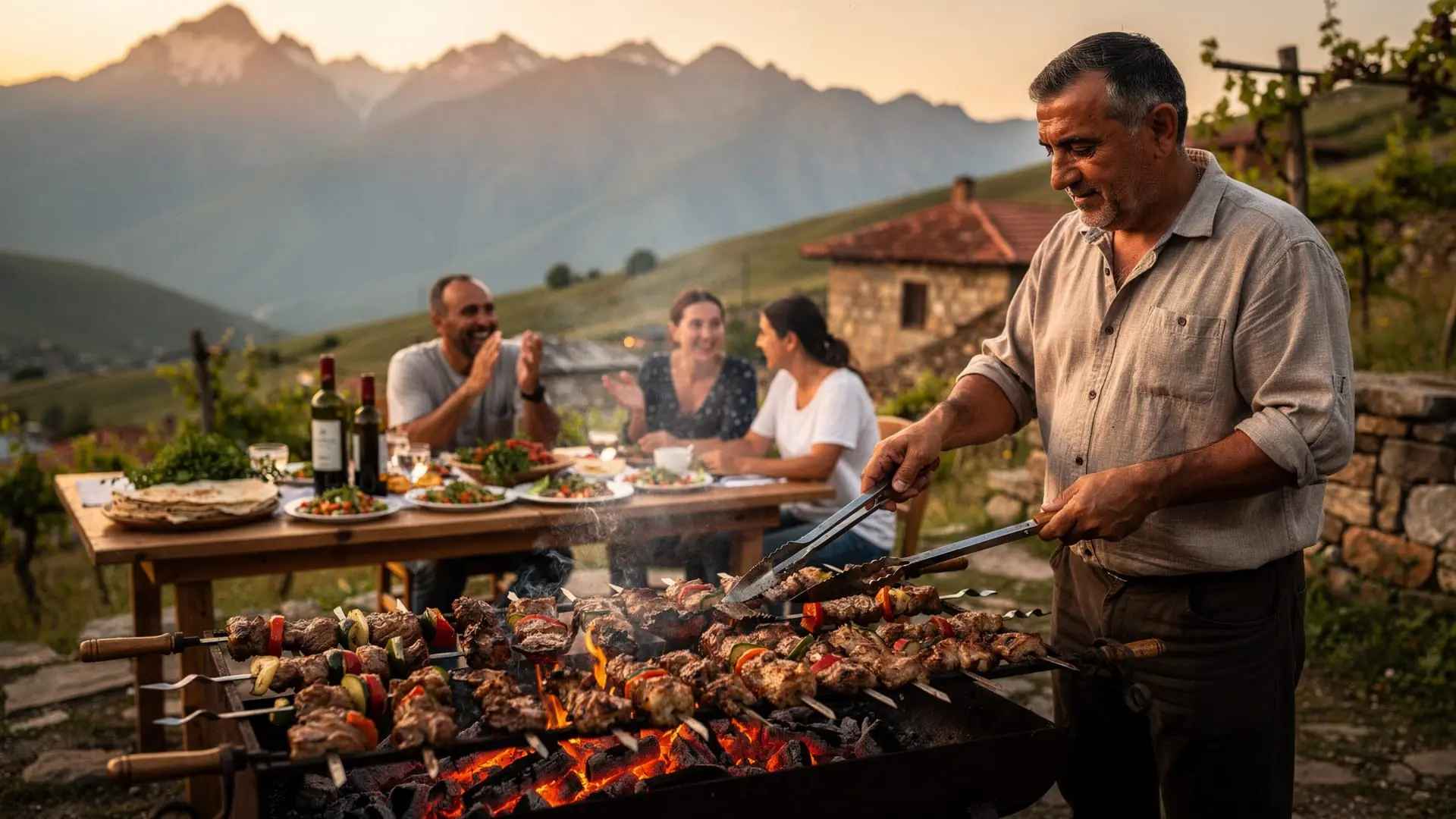
Ask an Armenian what they love most about their food culture and the answer is almost always khorovats. Not because it is the most complex dish — it is technically simple — but because of what it represents. Khorovats is an event. It requires space, time, charcoal or wood, extended family, and the particular male competitiveness that surrounds who manages the fire. Women typically handle the preparations; the grill is, by stubborn tradition, male territory.
Understanding khorovats means understanding something important about Armenian social life: the slow build, the hospitality, the insistence on quality ingredients, and the pleasure taken in feeding others well. The meat is the centrepiece but the structure around it — the herb platter, the cold matsun, the lavash torn by hand, the shots of mulberry oghi — is what makes khorovats Armenian rather than merely grilled meat.
| Where | Restaurants across Yerevan; best outside the city near vineyards |
| Cost | Around 10,000–18,000 AMD for two at a tavern, with drinks |
| Time needed | 2–4 hours for a proper gathering |
| Getting there | Walkable in central Yerevan; taxi for out-of-town spots |
| Best time | April–October outdoors; year-round indoors at dedicated taverns |
The fire and the fuel
The fuel is part of the flavour. Traditional khorovats uses dried grape vine cuttings — the thick woody stems left after the autumn pruning of Armenia’s vineyards. These burn hot and long, produce minimal flame and maximum coal, and impart a faint sweetness and resinousness to the meat that distinguishes khorovats from ordinary charcoal grilling.
In cities where vine wood is not practical, hardwood charcoal is used. The result is still excellent, but specialists insist the vine smoke is irreplaceable. When you eat khorovats at a restaurant in Yerevan’s centre, you are almost certainly getting charcoal; for genuine vine-wood khorovats, you need to be invited to a home in the countryside or find a restaurant that sources the fuel specifically.
The grill itself (also called a mangal) is a long rectangular iron trough, elevated on legs. Skewers (shampurs) span its width; a skilled griller rotates them continuously and works the coals with a flat fan to control temperature. The process is meditative and the griller rarely leaves the fire.
The cuts: what goes on the skewers
A full khorovats spread typically involves three animals:
Pork is the most popular cut and the one most associated with the dish. The preferred choice is pork neck (vrat) — well-marbled, forgiving, and flavourful. Pork shoulder works well for larger gatherings. Despite Armenia being a majority Christian country (Apostolic Church), pork utterly dominates Armenian barbecue in a way that surprises visitors expecting the Muslim-influenced avoidance of neighbouring countries. Armenian Christianity has no dietary restrictions on pork. For context on the church’s traditions, see the Armenian Apostolic Church overview in the Etchmiadzin guide.
Lamb — either leg or ribs — is the older and more traditional choice. Older cookbooks describe khorovats exclusively with lamb; pork’s dominance is a 20th-century shift. Lamb khorovats has a deeper, more complex flavour and benefits from longer marination.
Chicken — usually thighs rather than breast, often marinated longer than the red meats. Chicken khorovats is the most approachable for first-timers and the one that works best as a wrap in lavash.
Lule khorovats — a different skewer: minced lamb (sometimes beef) mixed with finely grated onion, red pepper paste, and parsley, pressed onto flat wide skewers and grilled until slightly charred at the edges. The fat renders into the coal, producing dramatic flame-ups that the griller plays against. Lule is fattier and richer than the chunk cuts and is served alongside rather than instead of them.
The marinade
Armenian khorovats marinade is debated with the seriousness of constitutional law. Some families use only salt, black pepper, and grated onion. Others add pomegranate juice for acidity, a little dry wine, dried herbs, or even sparkling mineral water to tenderise. Yoghurt-based marinades appear in some regions.
What everyone agrees on: the meat must marinate for a minimum of 4 hours; overnight is better. And the marinade should not overpower the meat. The point is enhancement, not masking.
The accompaniments
Khorovats without its accompaniments is meat without context. The table should include:
Lavash — torn by hand, used to wrap meat with herbs and onion, or eaten on the side. See our lavash baking guide for the full story. Fresh tonir lavash is ideal; restaurant lavash is still essential.
Fresh herbs — a large bunch of tarragon (tarkhun) is the defining Armenian khorovats herb. No other herb carries the same weight in this context. Alongside it: basil, coriander, flat-leaf parsley, and spring onion. The herb plate is refreshed throughout the meal.
Raw vegetables — sliced tomatoes and raw onion rings are non-negotiable. The acidity and crunch of raw tomato against charred pork is one of Armenian food’s great contrasts. Armenian summer tomatoes (July–September) are excellent; the winter versions are much inferior — plan accordingly.
Matsun — a bowl of Armenian strained yoghurt as a cooling dip and sauce. Also eaten between bites to refresh the palate.
Bread — both lavash and sometimes matnakash (the thicker oval loaf) for the table.
Drinks — cold beer (Kilikia lager is the local favourite), oghi (mulberry vodka, served in small glasses throughout), and sometimes Armenian wine. Khorovats is not a wine-pairing exercise; the cold beer is the practical choice.
The ritual: khorovats as an event
Khorovats is rarely a quick meal. The social structure of a khorovats gathering follows a loose but real protocol:
- Guests arrive; cold snacks, cheese, and herbs appear while the fire is built
- The fire is lit and burns down to coals — this takes 30–45 minutes and is the social aperitif period
- First skewers go on; bread and cold salads appear at the table
- Rounds of toasting begin (tamada, or toast-master, leads)
- Meat arrives in rounds rather than all at once — the griller controls the timing
- The meal extends for 2–4 hours depending on the gathering
- Fruit and coffee close the meal; nobody leaves immediately after eating
This structure is not ceremonial in a formal sense — it is simply the rhythm that the format requires. And within it, a great deal of Armenian family and social life unfolds.
Where to eat khorovats in Yerevan
Finding excellent khorovats in Yerevan is not hard. Finding truly authentic vine-wood khorovats requires a little effort.
Tavern Yerevan (Mashtots Avenue) — the city’s best-known khorovats tavern, popular with locals and tourists alike. Consistent quality, good lule khorovats, cold Kilikia beer. Mid-range: expect 10,000–18,000 AMD (25–44 €) for two with drinks. Busy on weekends; arrive by 7 pm or book.
Sayat-Nova (Sayat-Nova Avenue near Opera) — an older institution with live folk music on weekends. The khorovats is excellent and the meze starters are among the city’s best. Traditional atmosphere, slightly slower service.
Achajour (Pushkin Street) — known primarily for breakfast and brunch but serves khorovats at lunch and dinner. The quality of meat sourcing is noticeably higher than average.
Lavash Restaurant (Tumanyan Street) — upscale take on traditional Armenian food; the khorovats is precisely executed and the herb selection is excellent. Pricier than Tavern Yerevan but worth it for a special evening.
Sherep (Abovyan Street area) — modern Armenian fine dining. The khorovats here is a refined interpretation rather than a traditional serving; smaller portions, more careful accompaniments. For the definitive Yerevan restaurant experience rather than the most authentic khorovats.
Outside Yerevan — the best khorovats you will eat in Armenia is almost certainly at a private home or a village restaurant in Vayots Dzor, Lori, or near a vineyard region where vine wood is freely available. If you are travelling to Areni or Noravank for wine tasting, ask your guesthouse whether they do khorovats evenings; many do.
Budget tip: In summer, the parks north of the Cascade Complex and along the Hrazdan gorge fill with families doing khorovats on portable mangals. You cannot join uninvited, but the sight and smell are unavoidable — and locals who catch you watching often offer a plate.
Khorovats beyond the city: where to eat it well on a day trip
If you are doing the Garni and Geghard day trip, several restaurants along the road between Garni village and Geghard serve khorovats grilled on-site. Look for smoke visible from the road — it is a reliable indicator of activity. The Garni gastro-cultural tour includes a khorovats lunch as part of its format.
Near Lake Sevan, the road along the southern shore is lined with restaurants cooking over open fires. Sevan trout (ishkhan) and khorovats are the twin attractions; the combination of lake views, cold white wine, and charcoal smoke in late September is one of Armenia’s best eating experiences. See the Lake Sevan food guide for specifics.
Khorovats and Armenian family culture
No account of khorovats is complete without noting that the dish functions as a social anchor rather than merely a food. The verb “to do khorovats” (khorovats anem) in Armenian describes an event involving people, outdoor space, time, and the entire performance of hospitality — not merely the act of grilling meat.
The setup of a khorovats gathering has a quasi-ritual structure. The host who brings the mangal, who sources the meat, who lights the fire, and who manages the grill holds a particular status. In Armenian family culture, this is often the father or a male elder, and the performance of the role is public and evaluated. A fire that does not come together properly is a social embarrassment. Meat that arrives at the table dry or under-seasoned reflects on the griller. The pressure is informal but real.
The guest’s role is equally defined: arrive on time, bring something (cold drinks, herbs, a bottle of oghi), eat what is offered, accept second servings, and do not rush away. Khorovats gatherings that end in under two hours are considered rushed; three to four hours is the expected duration. This social contract is why khorovats is not weeknight food — it requires the expansiveness that only weekends and holidays provide.
Khorovats vocabulary for the table
A few Armenian words that will mark you as a respectful guest at a khorovats table:
- Khorovats (Խորոված) — the dish itself
- Mangal (Մանգալ) — the grill/brazier
- Shampur (Շամփուր) — the metal skewer
- Lule (Լուլե) — the minced meat skewer version
- Tarkhun (Թարխուն) — tarragon, the defining herb of the spread
- Oghi (Օղի) — mulberry vodka, the traditional spirit alongside
- Akhchelik (Ախչելիք) — the appetiser/starter course that precedes the main grilling
- Tamada (Թամադա) — the toast-master at a formal gathering
Knowing these words will not make you a local, but using them will prompt genuine appreciation from your hosts — and possibly a more generous helping.
Khorovats in Armenian literature and film
The image of khorovats recurs throughout modern Armenian literature and cinema as a shorthand for peace, abundance, and the particular happiness of a good summer day. Parajanov’s films do not feature khorovats directly, but the documentary imagery of post-Soviet Armenian life in short films and photography is saturated with it: smoke rising from a hillside, a group of men gathered around a fire, children chasing each other around the edges of an outdoor table.
For diaspora Armenians — in France, the United States, Russia, Lebanon — khorovats is one of the most powerful connective foods. The smell of meat and vine smoke at a diaspora gathering evokes the homeland in a way that wine or dolma, however delicious, does not quite match. It requires outdoor space and fire; it is irreducibly physical and communal; it cannot be replicated in a restaurant.
Frequently asked questions about khorovats
What does khorovats mean?
The word comes from the Armenian root khorov, meaning “to roast” or “to grill.” It refers specifically to skewer-grilled meat; the mangal (grill) and shampur (skewer) are also used as descriptors in conversation.
Is khorovats always pork?
No, though pork is now the most common choice. Traditionally lamb was the primary meat. Modern khorovats gatherings typically offer pork, lamb, and chicken simultaneously. In Muslim-adjacent communities in the Yezidi villages of Aragatsotn, pork is absent and lamb dominates.
How do I eat khorovats correctly?
There is no wrong method. The most common approach: place a piece of meat in a torn sheet of lavash, add onion and tarragon, fold loosely, eat. Between bites, eat raw tomato. Drink beer or oghi. Repeat. The matsun goes on as a dip for bread or is eaten in spoonfuls as a palate cleanser.
Can vegetarians eat at a khorovats restaurant?
Most khorovats-focused restaurants in Yerevan serve a meze spread of vegetable dishes, cheese, herbs, lavash, and salads that constitutes a solid vegetarian meal. The khorovats itself is obviously meat, but no Armenian host will let a vegetarian guest go unfed.
Is khorovats safe to eat medium-rare?
Lamb and chicken khorovats is always cooked through. Pork neck — because of its fat content — retains some pink at the centre even when fully cooked. The fat is the point; do not ask for well-done pork neck or you will get a dry skewer that the griller will feel personally hurt about.
When is khorovats season?
Technically year-round, but the ritual is strongest April through October when outdoor eating is practical. Summer weekends see the most activity. In winter, khorovats moves indoors to dedicated taverns with indoor grills.
Can I request vine-wood khorovats specifically at a Yerevan restaurant?
Some restaurants will do so on request or as a specialty offering, but most central Yerevan taverns use charcoal by default for consistency and cost. If genuine vine-wood khorovats matters to you, ask directly when booking, or plan a stop in a wine region like Areni or Vayots Dzor, where vine cuttings are abundant and restaurants often use them as a matter of course rather than a special request.
Is it rude to decline khorovats if I’m a guest at someone’s home?
Declining outright would be unusual and could read as a social misstep, but hosts are generally accommodating of dietary restrictions if you explain them clearly and early — ideally before the fire is lit, since the meat selection often happens in advance. Vegetarian and other guests are still expected to sit through the full gathering; the meal is as much about company and hospitality as it is about the meat itself.