Khor Virap monastery: views of Mount Ararat
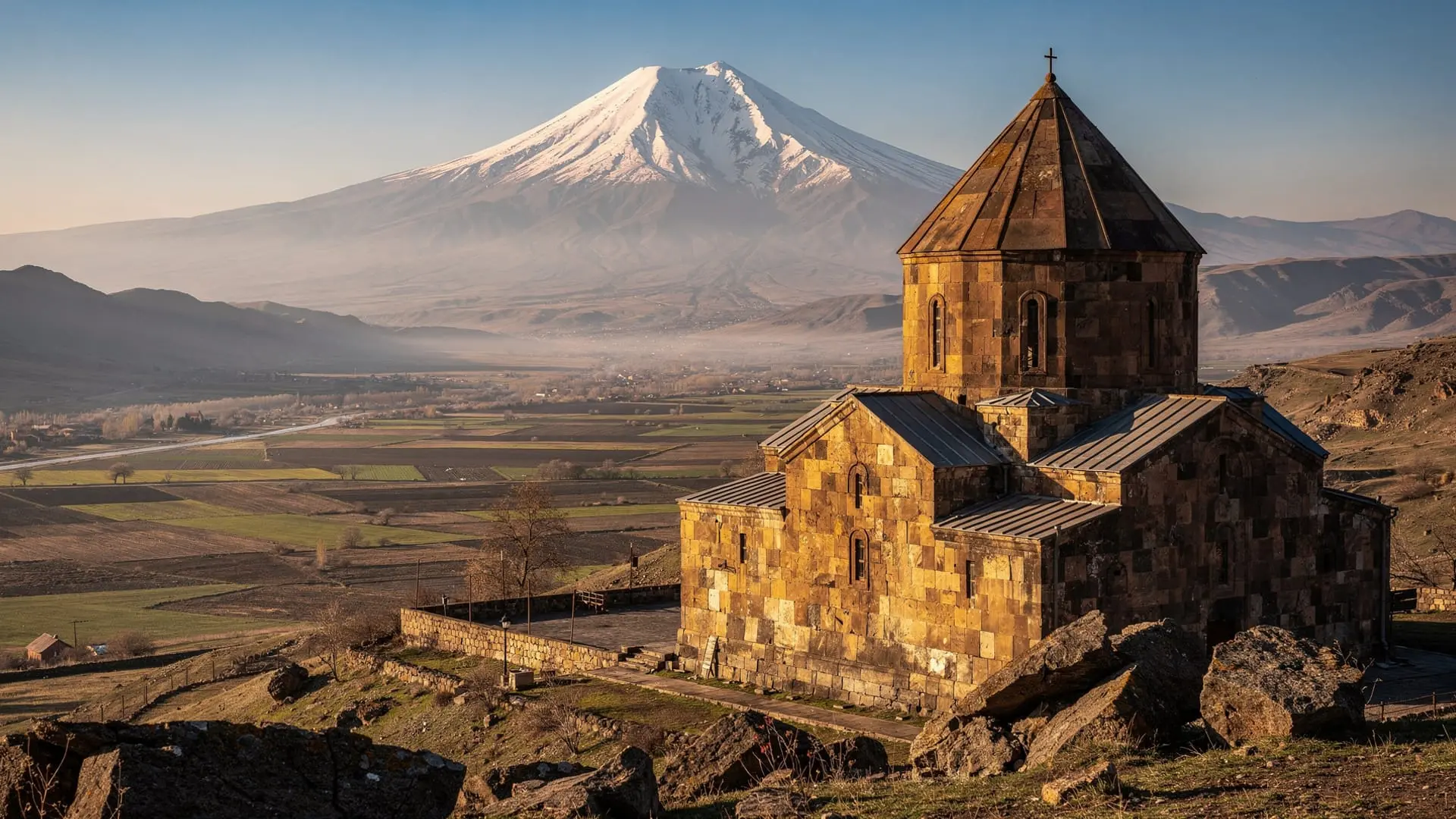
Armenia’s most photographed viewpoint
No image defines Armenia internationally more than the one taken from Khor Virap’s walls: a medieval monastery in the foreground, an unbroken plain, and the vast white summit of Mount Ararat rising to 5,137 metres on the Turkish side of the border, less than 20 km away as the crow flies. The sight is genuinely arresting the first time you see it — or when you see it at all. Mount Ararat is not always visible. It disappears into haze, cloud, or smog for days at a time, and this uncertainty is both the monastery’s frustration and its dramatic tension.
Khor Virap is 35 km south of Yerevan, a 50-minute drive. It is the most accessible major monastery in Armenia and often the first site visitors see on arriving. That accessibility is also its limitation: on summer weekends the parking area overflows, souvenir sellers crowd the path, and the panoramic platform feels like an open-air photo studio.
| Where | Ararat marz, 35 km south of Yerevan |
| Cost | Free entry, donation box at the chapel |
| Time needed | 45–90 minutes |
| Getting there | Car/taxi (~50 min); no direct marshrutka to the gate |
| Best time | Before 09:00, October–February for Ararat visibility |
Why this monastery matters
Khor Virap’s fame rests on a single historical event, not its architecture. In 287 AD, the future Gregory the Illuminator was thrown into a deep pit (khor virap means “deep dungeon” in Armenian) by King Tiridates III, accused of being a Christian. Gregory survived 13 years of imprisonment in the pit. When Tiridates fell ill, Gregory was released to cure him; the king converted to Christianity, and in 301 AD, Armenia became the first country in the world to adopt Christianity as its state religion.
The site is therefore not merely a monastery — it is the origin point of Armenian Christian identity. A chapel was built over the dungeon pit in the 4th century. The current monastery complex dates primarily to the 17th century, with significant restorations in the 19th and 20th centuries. It belongs to the Armenian Apostolic Church, an Oriental Orthodox denomination, not affiliated with Rome or Constantinople.
The monastery also sits at the edge of the Ararat plain, the most fertile and historically contested land in Armenian geography. The border with Turkey runs just a few kilometres west; Mount Ararat — the national symbol of Armenia, depicted on the state coat of arms — stands in territory that has been part of Turkey since the 1921 Treaty of Kars. This proximity, and the political impossibility of crossing to reach it, makes Khor Virap emotionally charged for Armenians in a way that purely religious sites rarely are.
History
- 287–301 AD: Gregory the Illuminator imprisoned in the dungeon at the site of the future monastery. Released, converts King Tiridates III; Armenia adopts Christianity in 301 AD.
- 4th century: A small chapel is built over the pit. The site becomes a place of pilgrimage.
- 7th century: Expansion under Catholicos Nerses III.
- 1662: Major reconstruction under Catholicos Hakob IV Jughaetsi. Most of the current structures date from this period.
- 17th–19th centuries: Several restoration phases. The defensive walls reflect the site’s strategic position on the Persian-Ottoman frontier.
- 1989: The pit is formally opened to visitors for descent.
What to see at the site
Church of the Blessed Virgin (Surb Astvatsatsin): The main church, built in 1662. Relatively modest in scale but gracefully proportioned. The interior holds wooden carved furnishings and a small altar screen. Services are held here on Sundays and feast days.
Church of Saint Gregory the Illuminator: A smaller chapel attached to the south side of the complex, built over the original dungeon site. This is the spiritual heart of the monastery — the place where Gregory was imprisoned.
The dungeon pit: A hole in the floor of St Gregory’s chapel leads to an iron ladder descending about 6 metres into the actual pit where Gregory was confined. The space is roughly 4 metres wide and 4 metres tall — genuinely dark and claustrophobic. Visitors with anxiety around confined spaces should note this before committing to the descent. Bring a small flashlight; the lighting inside is minimal. The descent is free and informal — no ticket required.
Panoramic terrace and walls: Walk the exterior walls for the full Ararat panorama. The best angle for photography is from the northwest corner of the walls, facing southeast toward both summits. The smaller peak (Little Ararat, 3,896 m) is almost as photogenic as the main summit.
Souvenir market: The path from the parking area to the monastery gate is lined with stalls selling dried fruits, herbs, pomegranate juice, and souvenirs. Quality is variable. The pomegranate juice is usually freshly pressed and excellent; the “cognac” bottles labelled Ararat are sometimes counterfeits — buy Armenian brandy from a reputable shop in Yerevan rather than roadside stalls here.
How to get there
By tour: Khor Virap is included in dozens of day-tour itineraries from Yerevan, usually combined with Noravank, Areni winery, or Garni and Geghard.
Private tour to Khor Virap with Mount Ararat view From Yerevan: Khor Virap and NoravankBy car: From Yerevan, take the A1 motorway south (direction Ararat/Artashat), exit at Lusarat, and follow signs to Khor Virap (35 km total, 50 minutes). Parking at the site costs AMD 300–500 (informal attendants).
By marshrutka: Marshrutkas from Yerevan to Artashat (AMD 250–300) stop at Lusarat crossroads, about 4 km from Khor Virap. From the crossroads, shared taxis or walking (40 min on a flat road) reach the monastery. There is no direct public transport to the monastery gate itself. A GG Taxi from Yerevan costs approximately AMD 3,500–5,000 one way.
Honest note on Ararat visibility: Any tour operator selling a “Khor Virap with Mount Ararat view” tour should be taken with appropriate scepticism. The mountain is not guaranteed to be visible. Between June and September, summer haze makes a clear view unlikely by mid-morning. November through February offers the highest probability of clear skies, but mornings remain the best window. If your heart is set on the postcard image, book a November–February morning departure and have a backup plan.
Photography and best light
The monastery faces west-southwest, which means it is lit from the front in the afternoon and backlit in the morning. For classic sunrise photography with Ararat behind the monastery, use a telephoto lens (200mm+) from a position east of the monastery walls — the summit appears enormous relative to the church when compressed.
Golden hour in autumn (October–November) turns the monastery walls orange and the mountain snow pink. Blue-hour shots (just after sunset) with a long exposure can be spectacular if Ararat catches lingering alpenglow.
In February–March, snow can dust the plains around Khor Virap, echoing the snow on Ararat’s summit — a particularly striking composition.
Combining with other sites
Khor Virap is almost always combined with at least one other stop due to its proximity to Yerevan:
- Noravank canyon (1h 20min south): spectacular red-cliff monastery — see Noravank monastery: the red-cliff jewel
- Areni winery and Areni-1 cave (1h 40min south): wine tasting and the world’s oldest winery site — see the Areni destination guide
- Garni and Geghard (45 min east): classic Kotayk monasteries pairable with a Khor Virap sunrise stop — see Geghard cave monastery: complete visitor guide
- Etchmiadzin (25 min north): if returning via the mother cathedral — see Etchmiadzin: the mother cathedral of Armenia
For day-trip planning: Khor Virap and Noravank: the southern monasteries day.
Practical visit info
Entry fee: Free. Donation box at the chapel entrance.
Opening hours: Daily from early morning to dusk. No official closing time. The pit descent is available during daylight hours.
Dress code: Mandatory — shoulders and knees covered. Women must cover their heads; scarves are available at the gate.
Facilities: Toilets (AMD 100) near the parking area. Several cafes and stalls in the parking area. No ATM on site — bring cash.
Parking: Paid informal parking at the site; AMD 300–500 per car.
Best season: Year-round accessible. For Ararat views: October–February (cold, clear mornings). For pleasant weather: April–May and September–October. Summer (July–August) is hot, hazy, and crowded.
Accessibility: The path from the parking area to the monastery gate is flat and paved. Inside the compound, surfaces are uneven. The dungeon pit descent requires a vertical iron ladder — not accessible for those with limited mobility.
Photography note: No restrictions on photography in the grounds or from the walls. Inside the churches, photography is generally permitted but flash is not appropriate during services.
The Armenian Apostolic Church and the Gregory story
The story of Gregory the Illuminator is the founding narrative of Armenian Christianity, and Khor Virap is its physical location. Understanding the full story enriches the visit considerably.
Gregory (Grigor Lusavorich) was an Armenian nobleman of Parthian descent, raised as a Christian in Cappadocia. When he returned to Armenia, he refused to renounce his faith before King Tiridates III, who had him thrown into the dungeon at Artashat — the pit that would become Khor Virap. Gregory survived 13 years in the pit, sustained according to tradition by a Christian widow who secretly brought him bread.
In 287 AD (some sources say 301 AD), Tiridates experienced a severe illness. Gregory was released to heal him; the king converted to Christianity. The precise date of Armenia’s official adoption of Christianity as the state religion is given as 301 AD — making it the first country in the world to do so, predating the Roman Empire’s conversion by more than a decade.
Gregory went on to be consecrated bishop in Caesarea (Cappadocia) and became the first Catholicos of Armenia — the head of the Armenian church. He is venerated as both a saint and the founder of the Armenian Apostolic Church, which bears his name in its official title: the Armenian Apostolic Church (also called the Armenian Gregorian Church).
The Armenian Apostolic Church is an Oriental Orthodox denomination — not Roman Catholic, not Greek or Russian Orthodox. It separated from mainstream Chalcedonian Christianity in 451 AD and has maintained its own theological tradition, liturgical language (Classical Armenian/Grabar), and ecclesiastical hierarchy since that date.
The Ararat plain: contested landscape
Khor Virap sits in the most politically charged landscape in Armenia. Mount Ararat — 5,137 metres, the highest peak visible from Yerevan — is the national symbol of Armenia, depicted on the state coat of arms. It stands in Turkey, on territory that belonged to Russian Armenia until the 1921 Treaty of Kars.
The plain stretching between Khor Virap and the mountain was historically known as the Ararat plain — the breadbasket of ancient Armenia, the heartland of the Artaxiad and Arsacid kingdoms, the location of multiple ancient capitals including Artashat. Today it is divided by the closed Armenian-Turkish border (shut since 1993), visible from the monastery walls as a strip of fencing and a military zone.
For Armenian visitors, particularly those of diaspora background, this view carries a weight that no photograph entirely captures. The mountain is physically close — clear on certain mornings it seems you could walk to it in an hour — and yet entirely inaccessible. The border cannot be crossed. Ararat can only be climbed from Turkey. The distance is geographical; the distance is political; the distance is historical.
For international visitors, this context makes Khor Virap more than a monastery with a nice view. It is a site where landscape, history, theology, and geopolitics converge.
Ararat visibility: a realistic guide
The Ararat view is the primary draw of Khor Virap for most visitors, and it is important to set expectations honestly.
Best conditions: November through February, on clear days, early morning (before 09:00). Winter atmospheric conditions are stable and dry; the mountain is fully snow-capped and typically visible on about 60–70% of clear-weather days.
Worst conditions: June through August. Summer haze and particulate pollution from Yerevan and the Ararat plain frequently obscure the mountain by mid-morning. On a hot July day, Ararat may be invisible by 10:00 even if it was clear at dawn.
Spring: April and May offer moderate visibility — better than summer but less reliable than winter. The wildflowers on the plain in April and May make a Khor Virap visit beautiful regardless of Ararat.
Autumn: September–October is excellent — clear air, warm light, and the mountain visible on most mornings.
Practical tip: Check the Yerevan weather app the morning before your visit. If visibility in Yerevan itself is good (you can see the eastern mountains from the city), Ararat will likely be visible from Khor Virap. If Yerevan is hazy, the Ararat plain will be worse.
Gregory the Illuminator and the founding of Armenian Christianity
The story that makes Khor Virap significant deserves more than a paragraph summary — it is genuinely extraordinary in its structure, and understanding it changes how the dungeon feels when you descend into it.
Gregory (Grigor in Armenian) was born around 257 AD into a Parthian noble family, the Suren-Pahlavids. His father assassinated the Armenian king Chosroes I; Gregory was taken to Cappadocia as an infant and raised as a Christian there. As a young man, he returned to Armenia and entered the service of King Tiridates III — without disclosing his Christian faith or his family’s role in the previous king’s death.
When Tiridates discovered both facts, his response was severe: Gregory was thrown into the dungeon at Artashat — the pit that would become Khor Virap. This was not a quick execution; it was intended as a slow death in a waterless pit. Gregory survived there for thirteen years. The means of his survival — according to tradition, a Christian widow secretly brought him bread — is the domestic detail that makes the story human.
The conversion narrative that follows is theatrically structured: Tiridates falls into a severe mental illness; his sister, Khosrovitukht, has a vision that only Gregory can heal the king; Gregory is released, cures Tiridates, and in 301 AD the king converts to Christianity. Gregory travels to Caesarea (Cappadocia) to be consecrated bishop, returns to Armenia as the first Catholicos, and oversees the building of the first churches including the cathedral at Etchmiadzin.
The story is part miracle narrative, part psychological drama about the relationship between political power and religious conviction. Standing in the pit — dark, low-ceilinged, smelling of stone and moisture — it is possible to imagine thirteen years there with unexpected vividness.
The Artashat connection
The pit at Khor Virap was part of the ancient Armenian royal capital of Artashat, founded by King Artashes I in 188 BC on Roman advice (according to Plutarch, who wrote that Hannibal suggested the site). Artashat was the main Artaxiad and Arsacid royal capital for several centuries — a city that Roman sources described as wealthy and well-fortified. Its location at the confluence of the Araxes and Metsamor rivers, with a direct view of Mount Ararat, made it both strategically and symbolically important.
The city was destroyed by the Roman general Gnaeus Domitius Corbulo in 58 AD as part of the Roman-Parthian wars over Armenia. It was rebuilt and remained significant until the 5th century. Almost nothing of ancient Artashat survives above ground; the site has been only partially excavated. The monastery at Khor Virap was built on the ruins of this ancient city, and the dungeon pit may be a remnant of the royal citadel.
Budget visitors and the south of Armenia
Khor Virap is one of the easiest and cheapest sites in Armenia to visit independently. The road from Yerevan is well-maintained; a GG Taxi from central Yerevan to the monastery costs AMD 3,500–5,000 one way. The site itself has no entry fee. Combine with Noravank (80 km further south) for a cost-effective southern day trip:
Budget southern day trip from Yerevan (2026 prices):
- GG Taxi Yerevan–Khor Virap–Noravank–Areni–Yerevan: AMD 15,000–20,000 for the car
- Marshrutka Yerevan–Yeraskh junction + shared taxi to Khor Virap + return: AMD 2,000–3,000 per person
- Wine tasting at Areni: AMD 2,000–4,000 per person
- Lunch (Armenian khorovats, salads) at a roadside restaurant: AMD 3,000–5,000 per person
Total per person for the full southern day: AMD 7,000–12,000 (EUR 17–29) depending on transport choices.
Frequently asked questions about Khor Virap
Can I cross from Khor Virap into Turkey to see Ararat?
No. The border between Armenia and Turkey has been closed since 1993. There is no crossing at or near Khor Virap. Mount Ararat can only be climbed from the Turkish side, specifically from the town of Dogubayazit. Armenian citizens, in particular, face significant logistical and political barriers. Do not attempt to approach the border fence.
How visible is Mount Ararat on average?
Visibility varies enormously. In winter (November–February), clear days with full Ararat visibility occur perhaps 60–70% of the time on clear mornings. In summer, haze and smog from Yerevan and the Ararat plain reduce visibility significantly — perhaps 30–40% of summer mornings offer a clear view. Checking a weather and visibility forecast for Yerevan the morning before visiting gives a reasonable indication.
Is Khor Virap worth visiting if Ararat is not visible?
Yes, though fewer visitors would agree in the moment. The dungeon pit, the history of Gregory the Illuminator, and the monastery architecture are genuinely interesting independent of the mountain. The site also functions as an active pilgrimage destination, and the combination of the plain, the fortress-monastery silhouette, and the knowledge of what lies hidden in the clouds gives even a foggy day a certain atmosphere.
Is Khor Virap a good day trip for families?
Yes. The site is easy to access, flat, and takes about 1.5–2 hours. The dungeon descent is a popular novelty for older children and teenagers, though it may frighten younger children. The road from Yerevan is in good condition.
What religious services are held at Khor Virap?
The Armenian Apostolic Church holds liturgies at the main church on Sundays (approximately 10:00–12:00) and on feast days, particularly around Tiridates and Gregory’s story on 30 September. On these occasions, the monastery receives large numbers of pilgrims and the site becomes crowded.
Khor Virap as a pilgrimage site for diaspora Armenians
For diaspora Armenians, Khor Virap carries a weight that goes beyond its architecture or even its Ararat view. As the physical location where Christianity became the state religion of Armenia — the first nation to do so — the site functions as something closer to a national foundation stone than a conventional tourist attraction. Many diaspora visitors describe an unexpectedly emotional reaction on first seeing the monastery against the mountain, a combination of religious, historical, and personal significance that is hard to anticipate from photographs alone.
This is worth knowing before you visit: Khor Virap is not merely photogenic, and treating it purely as a photo stop undersells what the site means to many of the Armenians you will share it with, particularly on Sundays and around the 30 September feast day connected to Gregory and Tiridates. A few minutes spent reading the Gregory the Illuminator story properly, or descending into the pit itself, changes the visit considerably compared to a five-minute drive-by.
Wildlife and landscape of the Ararat plain
The Ararat plain around Khor Virap is one of Armenia’s most intensively farmed regions — the fertile volcanic soil and reliable irrigation from the Araxes river system support extensive orchards (apricot in particular, a fruit closely associated with Armenia internationally) and vineyards. Driving to Khor Virap in late spring, the plain is a patchwork of blossoming orchards with the monastery and the mountain as a backdrop.
The plain also supports a distinctive bird population, including several raptor species that use the thermals rising off the exposed flatland, and migratory birds that pass through the Araxes valley corridor. Birdwatchers visiting Khor Virap for the Ararat view sometimes find the plain itself, rather than the monastery, the more rewarding half of the visit — particularly in spring and autumn migration windows.
Should I book a tour or drive myself for the best Ararat photo?
Drive or taxi yourself if the Ararat view is your priority. Most group tours depart Yerevan at 8–9am, arriving at Khor Virap well after the best morning light and visibility window has often already started fading, particularly in warmer months. A private car, taxi, or rental gives you control over a 5:30–6:00am departure, which is the single biggest factor in seeing a clear mountain. See the Khor Virap and Noravank day trip guide for a full dawn-departure itinerary that extends the day south.
Is Khor Virap the same experience every time, or does it change with the seasons?
It changes considerably. Summer brings crowds, haze, and heat with a real chance of Ararat staying hidden past sunrise. Winter brings cold, quiet, and the best odds of a clear, snow-capped summit, sometimes with snow dusting the plain itself for a striking symmetry between foreground and mountain. Spring adds wildflowers on the plain; autumn adds golden light on the monastery walls. Repeat visitors often say each season feels like a different site.