The art collection inside Yerevan's Cascade
A world-class collection in an unlikely setting
When Gerard Cafesjian began placing art inside the unfinished concrete shell of the Cascade in the late 1990s, the building was still a half-built ruin — a 30-year-old Soviet construction project that had never been completed. The choice to fill it with a serious contemporary art collection rather than a shopping mall or office complex was, by any measure, improbable.
The result is now one of the most distinctive museum experiences in the South Caucasus. The Cafesjian Center for the Arts, occupying the interior of the Cascade Complex, houses a collection that ranges from studio glass of international museum quality to major outdoor bronze sculptures, from Armenian diaspora art to works by artists like Fernando Botero and Lynn Chadwick. Getting the most from it requires some orientation, which is what this guide provides.
| Where | Cascade Complex, central Yerevan, on Tamanyan Street |
| Cost | Free outdoor sculpture garden; around 1,500–2,500 AMD for indoor galleries |
| Time needed | 45 minutes outdoors only; 1.5–2 hours with the indoor galleries |
| Getting there | 10–12 minutes on foot from Republic Square |
| Best time | Morning for the glass galleries (natural sidelight); golden hour or after dark for the outdoor sculpture |
Who was Gerard Cafesjian?
Gerard Cafesjian was born in 1925 in Troy, New York, to Armenian immigrant parents. He built his fortune in the printing industry — he was a principal at West Publishing, a major legal publishing company — and later became one of the most significant individual philanthropists in Armenia following independence in 1991.
Cafesjian’s relationship with Armenia was complex but committed. He funded not only the Cascade but also significant contributions to the preservation of historic buildings in Yerevan, cultural programmes, and political advocacy. He was a controversial figure: some in Armenia’s cultural world appreciated his ambition and resources; others felt the terms of his philanthropic engagement with Armenian institutions were overly controlling. The legal disputes that arose after his death in 2013 over the ownership and management of the Cascade collection reflected these tensions.
What is not in dispute is the quality and significance of what he assembled. The collection he funded is genuinely world-class in its glass section, and the decision to make much of it publicly accessible in a free outdoor context (the sculpture garden) or at modest admission charges has made it more democratically available than many comparable collections.
The studio glass collection
The heart of the Cafesjian collection — and the element that most distinguishes it internationally — is the studio glass. American studio glass emerged as a serious art movement in the 1960s when artists began treating blown and cast glass as a sculptural medium rather than a craft product. The movement produced artists of significant ambition, and Cafesjian, who had been collecting glass for decades before the Cascade project began, assembled one of the finest private collections in the world.
What you see in the gallery is a compressed history of the art glass movement: early works showing the transition from craft to art, mature pieces where artists pushed glass into genuinely sculptural territory, and monumental installations that exploit glass’s properties of transparency, reflection, and internal light in ways that no other medium can replicate.
The names represented include figures whose work commands significant prices in the international market. Without pointing to specific works that may have rotated out of the permanent display, the general quality level is consistently high — this is not a provincial collection made impressive only by its unlikely location. It would hold its own in a dedicated glass museum in Seattle, Venice, or Prague.
The lighting in the glass galleries is particularly well considered: natural and artificial light combine to activate the internal qualities of each piece, and the placement of works against windows or in dark-walled alcoves is deliberate. Spend time with the glass. It rewards close attention.
The outdoor sculpture program
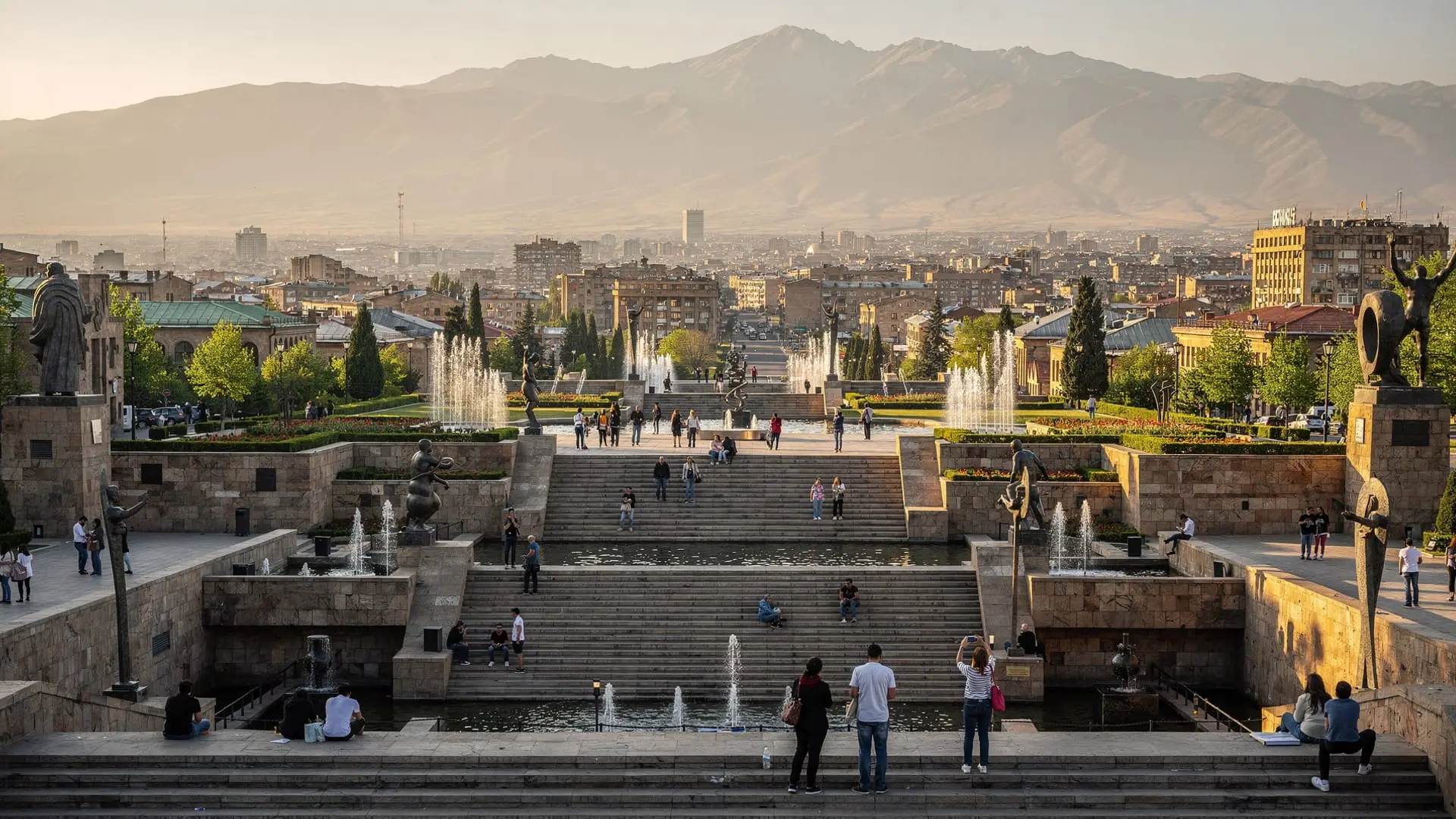
The outdoor component of the Cafesjian collection is where most visitors first engage with it, because the main staircase of the Cascade is lined with sculpture at every level, free and accessible at all hours.
Fernando Botero is the best-known name. The Colombian artist, famous for his “inflated” figurative style — all subjects appear rounded, enlarged, almost cartoonishly volumetric — donated several works to the Cascade. The massive bronze “Cat” at the base of the staircase weighs approximately two tonnes and is the most photographed artwork in Yerevan. Other Botero works appear at different terrace levels. The artist’s relationship with Cafesjian was personal: Botero visited Yerevan and expressed genuine enthusiasm for the Cascade project.
Lynn Chadwick (1914–2003), the British sculptor known for angular, armature-like iron figures, is represented by several pieces on the upper terraces. Chadwick’s work is in the collections of major museums worldwide; seeing it in the Yerevan context — against the backdrop of Armenian mountains — gives it a different resonance than it has in a white-cube London gallery.
Other outdoor works include pieces by Colombian sculptors (Cafesjian had longstanding connections to the Colombian art world, Botero being the most prominent) and by contemporary Armenian artists represented through the Center’s programming.
The outdoor collection changes periodically as the Center acquires new works or rotates pieces for conservation. What you see will depend on when you visit, but the overall quality and the integration of sculpture with the architectural terraces has been consistent.
Contemporary Armenian art programming
Beyond the permanent collection, the Cafesjian Center runs a temporary exhibitions programme that has become one of the most important venues in Yerevan for contemporary Armenian art. Since opening in 2009, the Center has hosted major exhibitions of work by Armenian-American and diaspora artists, retrospectives of significant Armenian painters and sculptors, and thematic shows that engage with Armenian history and contemporary identity.
The programming under the Soviet period suppressed much Armenian artistic experimentation; the independence era produced a generation of artists working through both the legacy of that suppression and the very rapid transformation of Armenian society since 1991. The Cafesjian Center has been one of the institutional spaces where that conversation happens publicly.
If you are visiting at a time when a major temporary exhibition is on, it is worth checking what is showing before you go — the quality and relevance vary, but the Centre’s stronger exhibitions have been genuinely significant events in the Armenian contemporary art world.
The Cafesjian Center in depth: free vs paid, rooftop, and hidden galleries
The Cascade is layered — literally and institutionally — in ways that first-time visitors do not immediately understand. Knowing what is free and what costs admission, and what exists at each level, transforms the visit.
The outdoor sculpture garden (free, always open)
The staircase levels of the Cascade are public space, accessible without admission at any hour. The major sculptures — Botero’s “Cat” at the base, several Botero figures on the second and third terraces, Lynn Chadwick’s angular iron figures on the upper terraces — can be experienced completely for free. The staircase itself rises 572 steps (though the indoor escalators cover this if you have gallery admission), and each terrace offers a progressively widening view of Yerevan, with the Ararat plain and the peak visible on clear days.
Evening walk: The Cascade at dusk, when the staircase lights come on and Yerevan spreads below, is one of the great urban walking experiences in the South Caucasus. No admission. No closing time. The outdoor sculpture takes on different dimensions in artificial light — the Botero “Cat” glows bronze under warm spotlights.
Dress code: None for the outdoor areas. For the indoor galleries, standard museum clothing applies. The Cafesjian Center does not have a formal dress code stricter than “no swimwear.”
Indoor galleries: what you pay for
Gallery admission (~1,500–2,500 AMD) covers access to the interior escalators and the glass galleries distributed across five levels. The escalators alone justify the ticket for anyone who wants to ascend the Cascade without climbing 572 steps. The gallery spaces are integrated into the escalator route — you see the collection progressively as you rise.
The glass collection galleries occupy levels 2–4. These are climate-controlled, well-lit spaces with individual works on plinths and in cases. The curation is deliberately sparse — individual works have space to breathe. The combination of natural light from the staircase windows and focused artificial lighting on each piece is the best glass lighting environment outside a dedicated glass museum.
The temporary exhibition galleries are at the lower and upper levels. These spaces have hosted solo shows by Armenian painters and international artists. The quality is variable but the exhibition design consistently benefits from the building’s generous ceiling heights and natural light.
Level 5 — rooftop terrace access: The indoor escalator sequence terminates at a covered upper gallery level. From here, stairs access the open roof of the Cascade structure — the highest publicly accessible terrace, with 360-degree views including Mount Aragats to the north and the Ararat plain to the south. This is the view that the Cascade’s Soviet builders envisioned; even unfinished, the view justifies the ascent. Rooftop access is included with gallery admission and available during museum hours.
Key artworks: a closer look
Botero’s “Cat” (2002): Fernando Botero’s signature monumental bronze sits at the base of the staircase and is the single most photographed object in Yerevan. The Colombian artist’s characteristic “inflated” aesthetic — all subjects rounded beyond naturalism — is fully evident. The Cat weighs approximately two tonnes and stands 3.5 metres. Botero’s relationship with Armenia extended to a personal visit to Yerevan; his enthusiasm for the Cascade project was genuine. Three additional Botero bronzes appear at upper terrace levels.
Jaume Plensa: The Spanish sculptor is represented by a piece typical of his text-and-light installations. Plensa’s work frequently involves human figures constructed from interlocking letters or symbols — the surface is language, the form is human. The Cascade piece is best seen in dimming natural light.
Roy Lichtenstein prints: The American Pop Art figure is represented in the collection through his characteristic dot-pattern prints. Lichtenstein at the Cascade is a useful marker of Cafesjian’s collecting range — American art from glass through Pop to contemporary sculpture.
Martiros Saryan connection: The collection includes work related to Saryan (the most important 20th-century Armenian painter, also central to the National Gallery’s permanent collection). Cafesjian had particular interest in cementing Saryan’s place in both Armenian and international art-historical consciousness; the Center has hosted major Saryan-adjacent programming.
Lynn Chadwick (1914–2003): The British abstract sculptor’s angular, almost mechanistic human and bird figures appear on the upper outdoor terraces. Chadwick is in the Tate Modern and the Museum of Modern Art in New York; his presence in Yerevan reflects the genuinely international ambition of the Cafesjian acquisition programme.
The Zangak bookshop: a destination in itself
At the base of the Cascade, on the lower terrace level, the Zangak bookshop is separately operated from the Cafesjian Center but shares the site. It holds the most comprehensive English-language selection on Armenia available anywhere in the country: history, travel, art, archaeology, diaspora literature, and translations of Armenian poetry. If you read only one book on Armenia, it should be from Zangak. The staff have consistently good recommendations. The shop also sells Armenian music, maps, and a curated selection of design objects.
Zangak’s hours generally align with the Cascade opening hours (Tuesday–Sunday). It is worth a dedicated visit even if you do not pay for gallery admission.
The Sergei Parajanov dimension
The Cafesjian Center has maintained a specific curatorial interest in Sergei Parajanov — the visionary Armenian-Soviet filmmaker whose work is the subject of the Parajanov Museum nearby. Several Parajanov-themed exhibitions have been hosted here, and the Center’s collection includes works directly related to the filmmaker’s visual world.
This makes a combined visit to the Cafesjian Center and the Parajanov Museum one of the most coherent cultural sequences in Yerevan: both institutions are concerned with the question of Armenian visual identity under Soviet conditions, and both answer it through radically personal, highly decorative, often surrealist or collage-based approaches.
Yerevan City Tour: Discover an Old and New YerevanPractical information for the collection
Admission: Gallery admission is approximately 1,500–2,500 AMD (3.65–6 EUR at April 2026 rates), depending on which galleries and temporary exhibitions are open. The outdoor sculpture garden is always free.
Opening hours: Tuesday–Sunday, approximately 11 am–7 pm. Closed Mondays. Check current hours before visiting, as the Center occasionally closes for installation of new exhibitions.
Escalators: The interior escalators are included with gallery admission. They cover the full height of the Cascade in approximately five minutes, with gallery access at each level.
Audio guide: An audio guide in English is available and recommended for the glass collection — it provides the art-historical context that distinguishes individual pieces. The outdoor sculpture is more self-explanatory.
Photography: Permitted without flash in the permanent galleries. Temporary exhibitions may have restrictions; follow posted signs.
Shop and bookshop: The Cafesjian Center has a shop selling books, prints, and Armenian design items. The Zangak bookshop on the lower terrace is separately operated but has one of the best selections of English-language books on Armenia in the city — highly recommended.
Yerevan: Walking Tour with a Local GuideHow the collection fits into Yerevan’s museum landscape
Among Yerevan’s major cultural institutions, the Cafesjian Center occupies a distinctive niche. The Matenadaran is the deepest expression of historic Armenian civilisation; the History Museum covers archaeological and political history; the Parajanov Museum is a single-artist shrine of intense personal vision. The Cafesjian Center is the most internationally connected and the most contemporary — it speaks to a world beyond Armenia while remaining grounded in Armenian cultural priorities.
For a full picture of how the collection compares to other Yerevan museums, see our ranked guide to Yerevan’s best museums.
Combining the Cascade with the rest of central Yerevan
The Cascade sits at the northern end of Yerevan’s main cultural spine, which makes it easy to fold into a half-day or full-day walking circuit rather than treating it as an isolated stop.
Southbound toward Republic Square: From the base of the staircase, it is a 10–12 minute walk down Tamanyan Street to Republic Square, Yerevan’s pink-tuff civic heart and the site of the evening dancing fountains. Combining the two — Cascade in the morning, Republic Square at dusk — makes a natural bookend to a day.
Charles Aznavour Square: A short detour east from Abovyan Street brings you to Charles Aznavour Square, where a bronze statue of the French-Armenian singer stands in front of the Soviet-era Cinema Moskva — a useful contrast to the Cafesjian collection’s international contemporary art.
The Opera House: Roughly 12 minutes on foot, the Yerevan Opera and Ballet Theatre makes a good early-evening stop if you time the Cascade visit for the afternoon and want a performance afterwards.
Vernissage flea market: Open Saturday and Sunday, the Vernissage market near Republic Square pairs well with a Cascade morning if your visit falls on a weekend — Soviet ephemera and handmade crafts as a counterpoint to the museum-grade art inside the Cafesjian Center.
If you are staying near Yerevan’s centre, all of these sit within a comfortable 20-minute walking radius of the Cascade, so a single pair of good shoes covers the whole circuit.
Accessibility and getting around the site
The Cascade’s outdoor staircase is, by design, not step-free — 572 steps rise across seven terrace levels, and there is no exterior ramp. The interior escalators, included with gallery admission, are the practical route up the building for anyone who cannot or does not want to climb the exterior stairs, and they stop at each gallery level rather than running straight to the top. Strollers and wheelchairs can use the escalator route with assistance from staff at busy times; contact the Center ahead of a visit if you need step-free access confirmed for a specific day, since escalator maintenance occasionally takes sections briefly out of service.
For visitors arriving directly from Republic Square without a car, the walk up Tamanyan Street toward the Cascade has a gentle but sustained incline; taxis and GG Taxi rides are inexpensive and a reasonable alternative in summer heat or for anyone who would rather save their energy for the galleries themselves.
Frequently asked questions about the Cascade art collection
What is the most valuable work in the Cafesjian collection?
The studio glass collection is generally considered the most valuable in financial terms — individual works by top-tier American glass artists command significant prices at auction. In terms of art-historical significance, the Botero bronzes are internationally recognised names. Cafesjian never released a full valuation of the collection, and post-death legal disputes created further opacity around ownership and insurance.
Can children visit the Cafesjian Center?
Yes. The outdoor sculpture garden is particularly engaging for children — the scale of the Botero works and the variety of forms are visually accessible regardless of art-historical context. The indoor glass galleries require more care due to the fragility and value of exhibits; supervising young children in close proximity to display cases is advisable.
Is the Cascade art collection related to the Parajanov Museum?
They are independent institutions but share thematic territory and have a history of collaboration. Both are concerned with Armenian visual culture and both represent serious investment in cultural infrastructure in post-Soviet Yerevan. A combined visit in one day is strongly recommended; allow half a day for the Cascade and two hours for the Parajanov Museum.
Has the Cafesjian Center changed since Cafesjian’s death in 2013?
Yes, though the core collection remains. Legal disputes between the Cafesjian Foundation and the Armenian state over property and management created a period of instability. As of 2026, the Center is operational and the collection accessible, but institutional development has been slower than in the earlier years of Cafesjian’s personal involvement.
Are there any works by Armenian artists in the collection?
Yes, both in the permanent collection and through the temporary exhibitions programme. The Center has specifically prioritised contemporary Armenian and diaspora artists in its programming, and some works have been acquired for the permanent collection as a result of successful exhibitions. Armenian artists in the collection tend toward the contemporary and international-facing end of the spectrum.
Is the rooftop of the Cascade accessible to visitors?
Yes. The indoor escalator sequence terminates at a covered upper gallery level, from which stairs lead to the open roof terrace — the highest publicly accessible viewing point on the Cascade. Access is included with gallery admission and is available during normal museum hours. The views of Yerevan, Mount Aragats, and on clear days the Ararat plain are among the best in the city.
What is the best time of day to visit the Cascade?
For the outdoor sculpture garden: late afternoon (16:00–18:00) when the light on the staircase is warmest and the view of Ararat is clearest. For the indoor galleries: morning (11:00–13:00) when the glass galleries benefit from natural sidelight. For the evening walk without admission: any time after 19:00 when the staircase is lit and Yerevan spreads below in the dark.
What is in the Zangak bookshop at the Cascade?
Zangak is the best English-language bookshop in Armenia — stocking history, travel, art, archaeology, diaspora literature, and translations of Armenian poetry. It is separately managed from the Cafesjian Center but occupies the lower terrace level. Open roughly Tuesday–Sunday. Even if you skip the paid galleries, Zangak is worth a visit.
How much time should I budget if I’m combining the Cascade with Republic Square?
Allow at least half a day for both. A relaxed Cascade visit (outdoor sculpture plus indoor galleries) takes 1.5–2 hours; the walk down to Republic Square is 10–12 minutes, and the square itself deserves at least 30 minutes, more if you visit the History Museum. Starting at the Cascade in the morning and finishing at Republic Square for the evening fountain show (summer only) makes an efficient and satisfying day.