The Parajanov Museum: a Yerevan must-visit
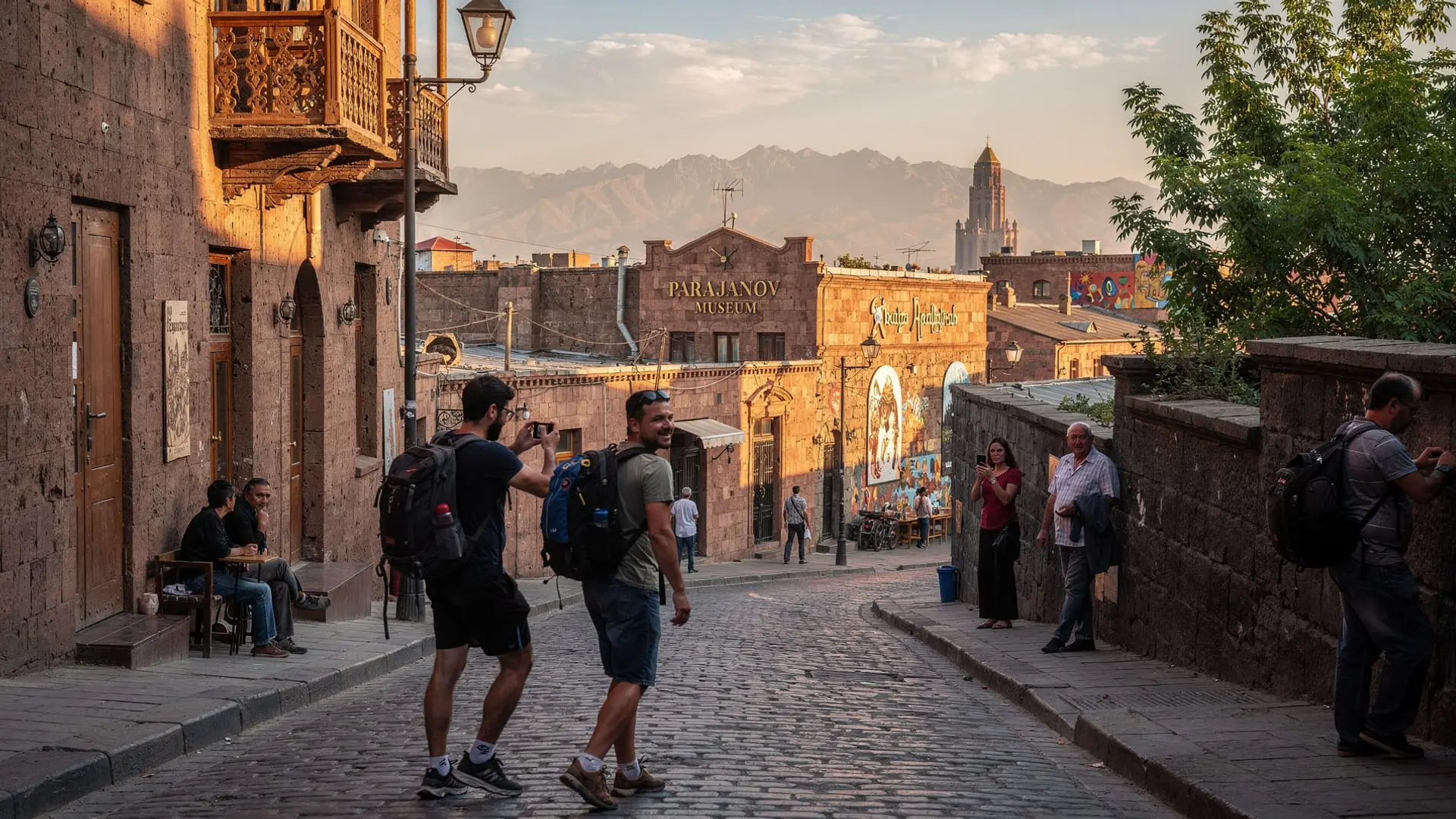
The filmmaker who turned repression into art
Some museums house collections. The Parajanov Museum in Yerevan houses a mind. Or rather, it houses the physical evidence of a mind — hundreds of collages, assemblages, costume designs, drawings, and found-object constructions made by Sergei Parajanov, a filmmaker whose films the Soviet authorities found so threatening that they imprisoned him rather than allow him to continue making them.
The museum opened in 1991, a year after Parajanov’s death, in a renovated traditional Armenian courtyard building in the Kond district of Yerevan. Walking into it feels like stepping into the interior of an imagination that was simultaneously Byzantine, surrealist, Armenian, and entirely personal. There is nothing else like it in Yerevan, and arguably nothing quite like it anywhere.
| Where | 15 Dzoragyugh Street, Kond district, central Yerevan |
| Cost | Around 1,500 AMD (roughly $4) entry; small extra fee for an English guided tour |
| Time needed | 1.5–2 hours for a thorough visit |
| Getting there | Walkable from Republic Square (10min) or Parajanov metro station (10min) |
| Best time | Tuesday–Sunday, 10:30am–5:30pm; closed Mondays |
Who was Sergei Parajanov?
Sergei Parajanov was born in Tbilisi in 1924 to an Armenian family. He studied at the All-Union State Institute of Cinematography (VGIK) in Moscow and worked in Kyiv before making the film that changed his life and his relationship with Soviet power.
The Color of Pomegranates (Sayat Nova, 1969) is the film that establishes Parajanov’s place in cinema history. Shot in Armenia with Armenian actors and designed around the life of the 18th-century Armenian troubadour Sayat Nova, it is unlike any film made before or since. There is almost no conventional narrative: instead, a sequence of static or minimally moving tableaux, each arranged like a painting or a medieval illumination, in which symbolic objects, costumes, and bodies combine to create meaning through visual association rather than story. The film was suppressed by Soviet authorities on its completion and never received wide distribution in the USSR.
Parajanov was arrested for the first time in 1974 on charges of homosexuality (illegal under Soviet law), later expanded to include accusations of bribery, incitement to suicide, and dealing in artworks — charges that his defenders, then and now, view as entirely fabricated political persecution. He served four years in a labour camp. He was arrested again briefly in 1982.
During his imprisonments and periods of enforced non-filmmaking, Parajanov created art from whatever materials he had access to: matchboxes, buttons, wire, fabric, thread, old photographs, labels, glass, and scraps. The resulting works are not sketches or doodles but fully realised visual statements — dense, layered, sometimes disturbing, always inventive. The museum holds the largest collection of these objects.
Parajanov died in Yerevan in 1990, shortly after completing his last film, “Confession,” which remained unfinished. He was 66.
What you see in the museum
The museum occupies a restored traditional Armenian house with a central courtyard — the dokharan type, with carved stone details and a wooden gallery on the upper level. The courtyard itself is used for exhibitions in good weather; the interior rooms display the collection in a sequence that moves from biographical context through to the art.
The collages: The core of the collection. Parajanov’s collages range from small works (postcard size) to large panels. He worked by cutting, layering, gluing, and sometimes painting over found images — magazine photographs, old postcards, theatrical programmes, architectural photographs — to create new images that are simultaneously referential and invented. A recurring collage shows a woman’s face assembled from fragments of other images; another compresses an entire architectural interior into a rectangular composition that looks simultaneously medieval and contemporary.
The technique owes something to 20th-century European collage (Dada, Surrealism) but is more clearly related to medieval Armenian manuscript illumination — the same practice of dense visual assembly, the same comfort with symbolic rather than realistic space. Looking at Parajanov’s collages, you understand what “The Color of Pomegranates” was doing: the film is collage in motion.
The assemblages and sculptural objects: Three-dimensional constructions using wire, dolls, glass, fabric, and found objects. Several are mounted in shadow boxes; others stand freestanding. The most disturbing and powerful are the works made during or referencing his imprisonment — objects whose materials clearly limited, whose scale is constrained, whose beauty is an act of defiance.
Costume and theatrical designs: Parajanov’s aesthetic vision extended to costume and set design; the museum holds designs for films and theatrical productions, including sketches for “The Color of Pomegranates” and his later Georgian films. These give visitors a window into how the visual world of his films was conceived.
Personal objects and photographs: The museum contextualises the art with biographical material: photographs of Parajanov (often in flamboyant self-presentation — he had a theatrical public persona), letters, documents from his trials, and objects from his personal life. Several photographs show him in his Tbilisi apartment, surrounded by the same kind of dense visual accumulation that characterises his collages.
Film screening area: The museum typically has a space where a film — “The Color of Pomegranates” or a documentary about Parajanov — is screening or can be screened on request. If you have not seen “The Color of Pomegranates” before visiting, watching even 20 minutes of it in the museum context transforms the art objects from interesting curiosities into necessary expressions of a specific vision.
Before you visit: watch the film
The single most effective preparation for the Parajanov Museum is to watch “The Color of Pomegranates” (also titled “Sayat Nova” in some distributions). It is available on various streaming platforms and is approximately 73 minutes long. You do not need to understand it — the film resists conventional understanding by design — but seeing it before visiting the museum creates a direct connection between the visual language of the art and the visual language of the cinema.
Parajanov himself said that the film was not about Sayat Nova but was structured like a poem — meaning that sequential meaning (narrative, cause and effect) was not the point. Each image is complete in itself; the images relate to each other by association, resonance, and contrast rather than by story. The same is true of the collages. Coming to the museum with that framework makes the experience much richer.
Visiting the museum
Location: 15 Dzoragyugh Street, Yerevan, in the Kond district. About 10 minutes’ walk east of Republic Square and 10 minutes west of the Parajanov metro station. The area around the museum — the Kond quarter, one of the few remaining pre-Soviet neighbourhoods in Yerevan — is itself worth exploring.
Opening hours: Tuesday–Sunday, 10:30 am–5:30 pm. Closed Mondays and some public holidays.
Admission: Approximately 1,500 AMD (around 3.65 EUR at April 2026 rates). Guided tour in English available for an additional fee; strongly recommended for those without prior knowledge of Parajanov’s life and work.
Time needed: 1.5–2 hours for a thorough visit. Shorter visits miss the cumulative effect of the collection.
Photography: Permitted without flash in the main galleries.
Yerevan City Tour: Discover an Old and New YerevanThe Parajanov Museum and Yerevan’s cultural landscape
The Parajanov Museum sits at an interesting intersection in Yerevan’s cultural geography. It is near the Cascade Complex and Cafesjian Center, which together represent the international contemporary art world’s engagement with Armenia. It is near the Matenadaran, which represents the deepest historical layers of Armenian cultural identity. And it is in the Kond district, one of the oldest surviving neighbourhoods in Yerevan — a place of narrow streets, courtyard houses, and a pre-Soviet urban texture that is disappearing elsewhere in the city.
Together, these institutions form an argument about Armenian cultural identity: what it inherits, what it makes under pressure, and what it gives to the world. Parajanov’s position in that argument is among the most interesting — a Georgian-born Armenian whose most celebrated work was made in Ukraine, who was persecuted by the Soviet state and became a symbol of Armenian cultural defiance, and whose art draws on Armenian medieval visual tradition while being entirely modern and personal.
Suggested combination days:
- Parajanov + Cascade: Morning at the Parajanov Museum, walk up to the Cascade for the outdoor sculpture and gallery in the afternoon. Both institutions deal in visual imagination, and the contrast between Parajanov’s intimate, personal work and the Cascade’s international scale is illuminating.
- Parajanov + Vernissage: If visiting on a Saturday or Sunday, the Vernissage market is 10 minutes west of the museum. The combination of Parajanov’s found-object art and the market’s own accumulation of objects has an unplanned thematic coherence.
Parajanov’s films: a brief guide
If the museum sends you to Parajanov’s cinema (which it should), here is where to start:
“The Color of Pomegranates” / “Sayat Nova” (1969): The essential film. See above. Available on most streaming platforms.
“Shadows of Forgotten Ancestors” (1965): Parajanov’s earlier film, made in Ukraine, is more conventionally narrative but still visually extraordinary — a folk tragedy shot with spectacular camera movement and colour. This was his international breakthrough before “Pomegranates.”
“The Legend of Suram Fortress” (1985): Made in Georgia after his rehabilitations, this film returns to the static-tableau style but in a Georgian mythological context. Powerful and strange.
“Ashik Kerib” (1988): His last completed film, based on a Lermontov story set in the Caucasus. Joyful and flamboyant compared to the earlier work.
The Kond district: walking beyond the museum
The Parajanov Museum sits on the edge of Kond, one of the last surviving pre-Soviet neighbourhoods in central Yerevan — a hillside tangle of narrow lanes, courtyard houses, and 19th-century domestic architecture that escaped the wholesale Soviet-era demolition and rebuilding that transformed most of the rest of the city into wide boulevards and neoclassical apartment blocks. Spending 30–45 minutes wandering Kond’s streets before or after the museum gives useful context for the dokharan courtyard-house building type the museum itself occupies, and for the kind of pre-Soviet urban texture that shaped Parajanov’s Armenian visual imagination even though he grew up in Tbilisi.
Kond is a genuine residential neighbourhood, not a restored tourist quarter — some buildings are beautifully kept, others visibly crumbling, and redevelopment pressure is a live local issue. Visitors should walk respectfully, as it is home to real families rather than a museum-piece district. The contrast between Kond’s fragile, human-scale streets and the Soviet monumentalism of the Cascade Complex a short walk away is itself a useful lesson in Yerevan’s layered architectural history.
Should you hire a guide?
The museum can be visited independently — labels are in Armenian and English, and the biographical framing in the early rooms gives enough context to follow the collection. That said, a guide adds real value here specifically because Parajanov’s work rewards interpretation: the visual language of his collages draws on medieval Armenian manuscript illumination, Georgian and Persian miniature painting, and his own turbulent biography in ways that are not always obvious from labels alone. Visitors with only a passing knowledge of Soviet-era Armenian and Georgian cultural history will get considerably more out of a guided visit or a private walking tour that includes the museum as one stop.
Yerevan walking tour with local guide, including the Kond quarter and Parajanov Museum areaFrequently asked questions about the Parajanov Museum
Is the Parajanov Museum worth visiting if I have not seen his films?
Yes, though you will get more from it with some prior knowledge. The museum contextualises the art objects with biographical material that makes Parajanov’s life comprehensible without prior film knowledge. The collages and assemblages are compelling as visual objects regardless of the film context. Watching 20 minutes of “The Color of Pomegranates” on your phone before entering the museum is a worthwhile investment.
How does the Parajanov Museum rank among Yerevan’s museums?
In our Yerevan museum ranking, the Parajanov Museum is ranked fifth overall but first for uniqueness — there is nothing quite like it elsewhere. For visitors with specific interest in 20th-century art, Soviet cultural history, or cinema, it would rank higher.
Was Parajanov Armenian or Georgian?
Parajanov was ethnically Armenian, born in Tbilisi (then part of the Russian Empire, now Georgia) to an Armenian family. He lived and worked in multiple Soviet cities — Moscow, Kyiv, Tbilisi, Yerevan — and made films in Armenian, Georgian, and Ukrainian cultural contexts. He is claimed as a cultural figure by Armenia, Georgia, and Ukraine, with some justification in each case. His museum is in Yerevan, which he regarded as his homeland city despite being born in Tbilisi.
What does the museum building look like?
The museum occupies a restored dokharan — a traditional Armenian courtyard house type with carved stone facades, a wooden gallery running around the courtyard at upper-floor level, and rooms opening off the courtyard. This building type was common in pre-Soviet Yerevan and is now rare; the Kond district around the museum has several others in varying states of preservation. The building is as historically significant as its contents.
Are there events or screenings at the Parajanov Museum?
The museum occasionally hosts film screenings, lectures, and cultural events, particularly around the anniversary of Parajanov’s death (20 July) and Armenian cultural holidays. Check the museum’s website or ask at the entrance for current programming. The Cascade Complex has also hosted Parajanov-themed exhibitions with which the museum has collaborated.
Is the museum suitable for children?
Older children and teenagers with an interest in art or filmmaking can find the museum fascinating, but the dense, symbolic collages and the biographical material about imprisonment are more likely to resonate with adults and older students than with young children. It is a small museum, so a visit is short enough (1–1.5 hours) not to overtax a patient child even if the content goes over their heads.
How does the Parajanov Museum compare to the Matenadaran?
They are complementary rather than comparable. The Matenadaran holds Armenia’s medieval manuscript heritage — centuries of illuminated books and religious texts. The Parajanov Museum holds one 20th-century artist’s deeply personal response to Soviet repression, executed with materials that manuscript illumination would never have used. Visiting both on the same day, in either order, gives a genuinely wide arc of Armenian visual culture across a thousand years.