Yerevan's Soviet modernism: an architecture walking tour
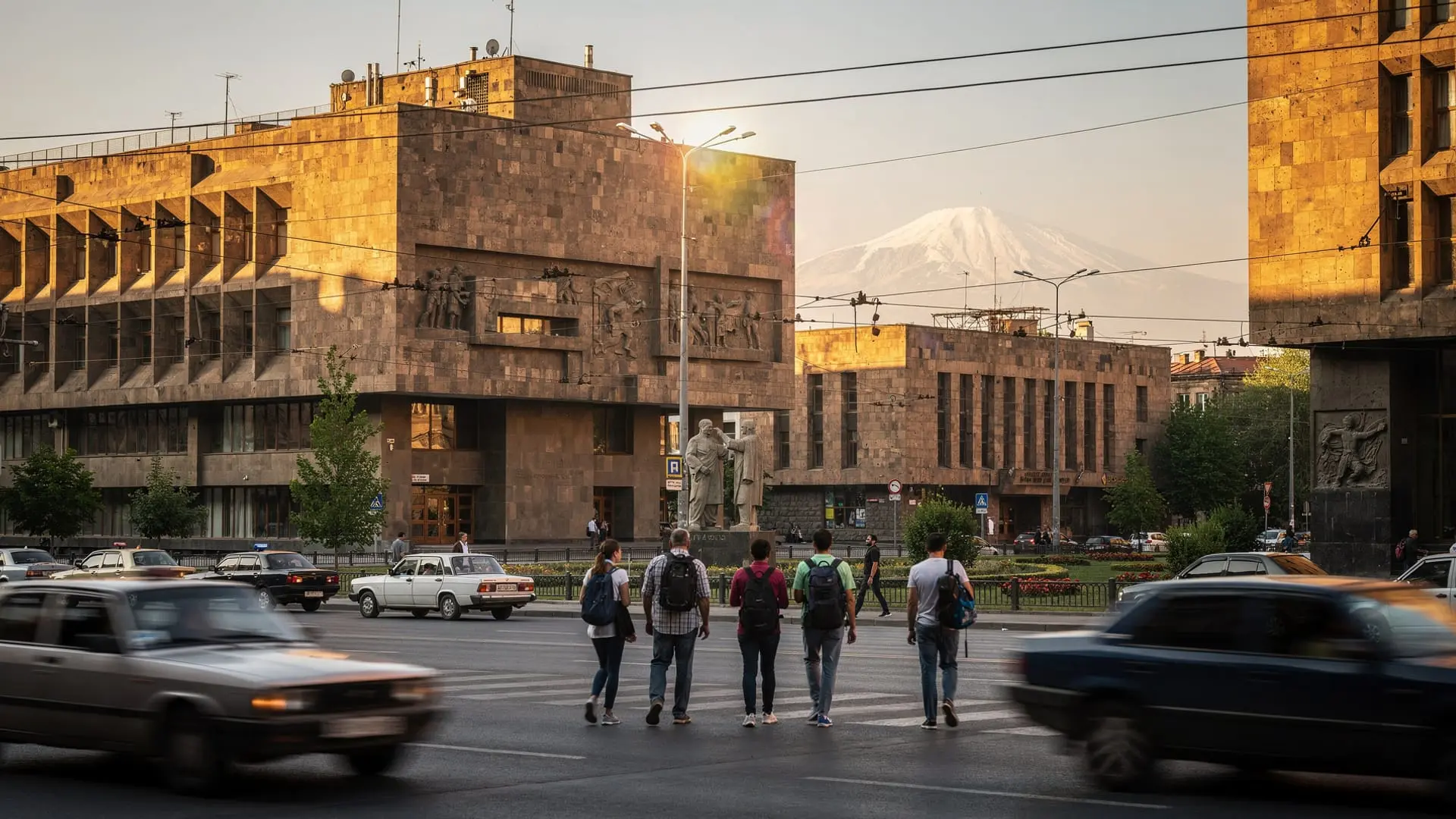
Pink tuff and raw concrete: two Yerevan in one city
Most visitors come to Yerevan for the pink tuff stone — the warm, apricot-coloured volcanic rock that gives Alexander Tamanyan’s Republic Square and the surrounding neoclassical buildings their distinctive glow. But step off the main tourist circuit and a second architectural city reveals itself: the Soviet modernism of the 1960s, 1970s, and 1980s, built in raw concrete, dark basalt, and industrial glass.
These buildings divide opinion in Yerevan as they do everywhere they were built. Some are being demolished; others are listed for protection; many are quietly decaying. But for architecture enthusiasts, urban historians, and anyone interested in the Soviet experiment as expressed through building, Yerevan is exceptional. The modernist intervention here was large-scale, confident, and — at its best — genuinely inventive.
This guide is a self-guided walking tour of the most significant Soviet modernist buildings in the city, with notes on their history, their current state, and the preservation debates surrounding them.
| Where | Loop starting/ending at Republic Square, central Yerevan |
| Cost | Free (exteriors only); Metro fare ~100 AMD per journey |
| Distance/time | ~5–6 km, 2.5–3 hours at a comfortable pace |
| Getting there | Hanrapetakan Hraparak metro station |
| Best time | Overcast days for concrete texture; golden hour for the basalt Sports Complex |
Context: why Soviet modernism in Yerevan is different
Soviet modernism — broadly the architectural movement from the Khrushchev Thaw (late 1950s) through the Brezhnev era (to 1982) — was a pan-Soviet phenomenon. Standard apartment blocks (Khrushchyovki), industrial civic buildings, and monumental cultural structures appeared from Tallinn to Tashkent. But in Yerevan, the movement took a distinctive Armenian turn.
Armenian architects working in the Soviet system were often better educated and more internationally connected than their counterparts elsewhere in the USSR, thanks to Yerevan’s strong architecture schools and the diaspora connections that allowed some exposure to Western modernism. The result is a set of buildings that quote Le Corbusier, Breuer, and Kahn but express them through Armenian stone and form. The Sports and Concert Complex, for instance, is a brutalist structure that would not be out of place in a European capital of the same era — but it is built in volcanic basalt and sited against the backdrop of Mount Ararat.
The walking route
The tour begins at Republic Square and moves through central and northern Yerevan in a loop of roughly 5–6 km. Allow 2.5–3 hours at a comfortable walking pace, with stops.
Stop 1: The Metro stations (starting point: Hanrapetakan Hraparak)
Yerevan’s Metro opened in 1981 and was a showcase of late Soviet monumental design. Unlike the Moscow Metro’s decorative excess, the Yerevan Metro stations tend toward a cleaner, more geometric modernism — but several have significant decorative programmes worth seeing.
Hanrapetakan Hraparak station (Republic Square station, red line) is the most accessible starting point. The platform level features bas-relief panels depicting Armenian history, and the vaulted tunnel design uses the characteristic combination of grey concrete and decorative stone facing that marks Yerevan’s Metro aesthetic.
Zoravar Andranik station (two stops north on the red line) has the most striking interior: large-scale mosaic panels depicting historical battle scenes, executed in a bold, Soviet heroic register. The mosaics are in good condition and represent some of the most ambitious public art in the Metro system.
Barekamutyun station (further north, on the same line) has circular platform architecture with a large central dome — an unusual spatial experience for an underground station.
Stop 2: Cinema Moskva and Charles Aznavour Square
Emerging from the Metro onto Abovyan Street, you reach what is now called Charles Aznavour Square — a small plaza in front of the former Cinema Moskva (also known as Cinema Rossiya). The cinema building, a 1970s modernist structure in concrete and glass, has been variously renovated, repurposed, and debated since Armenian independence. The statue of Charles Aznavour installed in 2014 now anchors the square’s identity more firmly than the cinema.
The building itself is worth examining: the horizontal banding of the facade, the canopy over the main entrance, and the integration with the surrounding streetscape are characteristic of late-Soviet civic modernism at its most functional. Whether it qualifies as architecture worth preserving is actively debated in Yerevan.
Stop 3: Ararat Cinema
A short walk south on Abovyan Street leads to Ararat Cinema, another Soviet-era film venue with a more flamboyant modernist approach — cantilever canopies, angled glass, and a facade that attempts something more expressive than the utilitarian standard of the period. Ararat Cinema has been largely non-operational for years; its future is uncertain. The exterior, however, is a good example of the aspirational quality that some Soviet architects brought to public entertainment buildings.
Stop 4: Sports and Concert Complex
The Sports and Concert Complex (Spordayin Ev Konsertayin Kompleks) on Tigranyan Street, about 1.5 km west of Republic Square, is the most significant Soviet modernist building in Yerevan and arguably the most architecturally distinguished. Built in 1983 to a design by Arthur Tarkhanyan and Spartak Khachikyan, it is a massive domed structure in dark basalt — 6,000-seat arena capacity — that achieves a monumental scale without resort to the pomposity typical of late Soviet civic architecture.
The dome is the key move: a genuine structural achievement that rises above the flat roof of the surrounding concourse, creating a silhouette that reads against the Yerevan skyline from a considerable distance. The basalt cladding gives the building a colour that is almost black in overcast light, dramatically different from the pink tuff of central Yerevan, and the effect against snow in winter is striking.
The complex is still operational, hosting concerts (including major Armenian and international artists), sports events, and political gatherings. There is no formal interior access for tourists, but the exterior and immediate surrounds are public space.
Stop 5: Government buildings and Ministry of Defence
The Ministry of Defence building and surrounding government complex near Baghramyan Avenue represent a different strain of Soviet modernism — the administrative register, characterised by grid facades, uniform window spacing, and an architecture of bureaucratic authority. These buildings are less celebrated than the Sports Complex but are important for completing the picture of how Soviet Yerevan was built.
The Constitutional Court building on Baghramyan Avenue (completed in the early Soviet period but modified later) and the adjacent administrative structures form an ensemble that rewards close reading.
Stop 6: Soviet apartment blocks — the Khrushchyovki districts
Walking north from Baghramyan towards the Cascade, you pass through areas of Soviet-era residential architecture — the Khrushchyovki (named for Nikita Khrushchev, under whose government the standardised apartment block programme was launched). These five-storey prefabricated concrete buildings, designed to provide rapid mass housing in the 1950s–70s, are now frequently in poor repair.
In the context of Yerevan, they are made more interesting by the way Armenian builders and residents have modified them — enclosing balconies, adding stone facing, planting elaborate rooftop gardens. The personalisation of the standardised Soviet block is a minor Armenian art form.
Soviet Yerevan in Motion: Streets, Metro & Local LifeFrom Tamanyan’s neoclassicism to Soviet modernism: the full arc
To understand what Soviet modernism meant in Yerevan, you need to start with Alexander Tamanyan. The Russian-Armenian architect who designed Republic Square and the surrounding city plan in the 1920s conceived Yerevan as a neoclassical capital in pink tuff — a city that would express Armenian civilisation through the grandeur of European city planning applied to native materials. His Republic Square, completed in stages through the 1930s and 1950s, is a masterwork of the form: the curved ensemble of ministries, the History Museum, and the government building around a central plaza that functions as a coherent urban room.
Tamanyan’s plan dominated Yerevan’s identity for three decades. But Soviet architecture did not remain neoclassical. The Khrushchev Thaw of the late 1950s explicitly repudiated Stalinist decorative excess — Khrushchev’s 1955 speech denouncing architectural “formalism” and demanding functional, economical building marked the beginning of the modernist shift across the entire Soviet Union. In Yerevan, this transition happened quickly.
The generation of Armenian architects who came to prominence in the 1960s and 1970s were educated partly in the Soviet academy and partly through exposure to Western modernism via diaspora contacts and international publications. This gave them a more cosmopolitan frame of reference than their counterparts in many other Soviet cities. They had seen (or read about) Le Corbusier, Louis Kahn, Marcel Breuer, and Eero Saarinen. They were interested in expressing Armenian identity through modernist form rather than through historical pastiche.
The result was a specific Armenian strain of Soviet modernism — buildings that quote international sources but transform them through local materials, local scale, and a specifically Caucasian sense of monumental landscape. The Sports and Concert Complex, for instance, recalls the work of Paul Rudolph and Kenzo Tange but is built in black basalt against the backdrop of Mount Ararat. The Metro stations have the spatial confidence of the Moscow Metro but with a geometric restraint and decorative programme rooted in Armenian visual culture.
Key buildings beyond the walking route
The buildings described in the walking route above are the most accessible. Several additional structures merit attention for visitors with specific architectural interest:
The Sundukyan Theatre (on Isahakyan Street, near the Opera House) is a mid-century modernist intervention into the classical boulevard streetscape — its angular canopy and glass facade read as a deliberate counterpoint to the surrounding neoclassical buildings. The theatre remains operational and hosts performances by the national drama company.
Hrazdan Stadium was built in 1935 but significantly expanded and modified in the Soviet modernist period — the late-Soviet concrete additions to the original structure are visible on the north and east stands. Situated above the Hrazdan gorge on the western edge of the city, it occupies one of the more dramatic natural settings of any stadium in the former Soviet Union. The gorge below, largely inaccessible to tourists, is a remarkable piece of unmanaged urban nature.
The House of Chess (Dom Shakhmatt), near Kentron district, is a small but extraordinary building designed specifically for Armenia’s serious chess culture. Chess has been central to Armenian intellectual life for generations — Armenia has produced multiple World Chess Champions, including Tigran Petrosian (World Champion 1963–1969) and, more recently, the Aronian generation. The House of Chess, a small Soviet modernist pavilion, reflects this cultural priority in architectural form.
Rossia Cinema (now partly repurposed) on Mashtots Avenue is another Soviet-era film venue with a more conventionally modernist facade than Cinema Moskva — taller, more assertive, with a vertical emphasis unusual in the horizontal register of Soviet civic architecture. It has been partially converted to commercial use but the facade remains.
The Ministry of Defence complex on Baghramyan Avenue represents the administrative register of Soviet modernism — grid facades, uniform window patterns, the architecture of bureaucratic authority. Less celebrated than the civic buildings, but important for understanding how Soviet Yerevan was built as a system of institutional spaces.
Suggested 3-hour walking route
The following route covers the most significant buildings in a logical sequence, minimising backtracking:
Start: Hanrapetakan Hraparak Metro station (Republic Square) — 10 minutes underground examining the platform mosaics and spatial design.
Walk north on Abovyan Street to Charles Aznavour Square and Cinema Moskva — 15 minutes including exterior examination.
Continue north on Abovyan to Isahakyan Street — detour east to Sundukyan Theatre facade — 10 minutes.
Walk west on Northern Avenue (the post-independence pedestrian boulevard, which itself replaced Soviet-era housing in a contested urban renewal project) to Mashtots Avenue — 15 minutes, noting the contrast between the post-Soviet commercial architecture and the surviving Soviet buildings on side streets.
Take Mashtots south to Yerevan Opera House (Soviet-era interior modifications to the 1930s exterior) — 10 minutes.
Walk west on Sayat-Nova Avenue toward Tigranyan Street, passing through the neighbourhood of Soviet apartment blocks (Khrushchyovki) — 15 minutes.
Arrive at the Sports and Concert Complex on Tigranyan Street — 20 minutes of exterior examination, circumnavigation of the building, photography of the dome from different angles.
Return east on Tigranyan and north on Baghramyan to the Constitutional Court and government complex — 20 minutes.
End: Zoravar Andranik Metro station (the most ornate station in the system, with the battle mosaics) — take the Metro one stop back to Republic Square, or continue walking north to the Cascade Complex.
Total walking: approximately 5–6 km. Time: 2.5–3 hours without extended stops, 3–4 hours with photography.
Photography ethics and practical notes
Most Soviet-era buildings in Yerevan can be photographed freely from public space. However, several practical notes:
Government and military buildings: The Ministry of Defence complex and Constitutional Court buildings are on Baghramyan Avenue. Photography from the public pavement is generally fine; do not enter grounds or photograph security personnel or installations. In 2026, there are no reported incidents of tourists being stopped for photographing the exteriors, but use common sense.
Metro stations: Strictly speaking, photography in the Yerevan Metro requires a permit from the operating authority. In practice, tourists photograph freely with phones and small cameras without incident. Large tripod setups or professional equipment may attract attention. The most valuable mosaics — at Zoravar Andranik — are worth photographing despite the dim light; a modern smartphone with a night mode handles the conditions adequately.
Private buildings: Some Soviet-era buildings that appear public are privately owned following post-Soviet privatisation. The Ararat Cinema exterior is on a public street; the interior (closed or limited) is private.
Yerevan vs Tbilisi: comparing Soviet modernism across the Caucasus
Tbilisi and Yerevan are the two capitals of the South Caucasus with significant Soviet modernist heritage, and comparing them is instructive.
Tbilisi’s most celebrated Soviet-era building is the former Bank of Georgia headquarters — now repurposed as a hotel — designed by the Georgian architect Giorgi Chakhava in the 1970s. It is a spectacular piece of Brutalism, modular and assertive, drawing on Western Brutalist references (Paul Rudolph, Le Corbusier’s Chandigarh work) more directly than most Yerevan buildings. Tbilisi also has the former Inturist Hotel (now Biltmore) and several Khrushchev-era residential areas in Saburtalo that compare directly with Yerevan’s.
What Yerevan has that Tbilisi lacks is a coherent modernist ensemble at civic scale — the Sports Complex, the Metro stations, the government quarter — all within walking distance and all expressing a consistent vision of Soviet Armenian modernity. Tbilisi’s Soviet architecture is more scattered and its preservation debate more advanced (the Bank of Georgia building was explicitly saved and repurposed). Yerevan’s debate is less resolved, which makes the buildings simultaneously more at risk and more available to visit in their original context.
For the traveller combining Armenia and Georgia — a natural pairing, see the Yerevan to Tbilisi overland guide — the architectural contrast between the two cities is one of the more interesting cross-border cultural observations available.
Yerevan’s Soviet modernist buildings are at the centre of a live preservation debate. The Armenian government and Yerevan municipality have, since the early 2000s, approved the demolition of several significant Soviet-era structures in favour of new commercial development. In some cases — the demolition of the Hotel Ani in 2020 — the decisions generated significant protest from architecture professionals and civil society.
On the other side, many Yerevanites associate the Soviet period with economic hardship, political repression, and aesthetic bleakness, and feel no obligation to preserve its architectural legacy. The Khrushchyovki in particular are seen as slum housing — cramped, poorly insulated, past their design life.
The international architecture community, including DOCOMOMO (Documentation and Conservation of the Modern Movement) and local Armenian heritage organisations, has increasingly made the case for the most significant buildings — the Sports Complex, selected Metro stations, the Ararat Cinema — as architecturally irreplaceable. Whether the political will exists to act on that case is, as of 2026, unclear.
Unveiling the Iron Curtain: Tour in a Soviet convertiblePhotography notes
Soviet modernist buildings photograph very differently depending on light conditions:
- Overcast grey days suit brutalist concrete best — the flat light emphasises form and surface texture without the distraction of sharp shadows.
- Golden hour (early morning or late afternoon) transforms the basalt of the Sports Complex from dark grey to warm brown, and makes the Khrushchyovki look almost Mediterranean.
- Snow creates the most dramatic effect on all the concrete buildings — the contrast between white ground and dark grey facades approaches Constructivist graphic design.
- Metro stations require a long-exposure capability or a phone camera with a good low-light mode. The mosaics at Zoravar Andranik are particularly rewarding.
Key buildings compared: status and what to prioritise
| Building | Condition (2026) | Access | Priority |
|---|---|---|---|
| Sports and Concert Complex | Operational, secure | Exterior only | Highest — the tour’s centrepiece |
| Zoravar Andranik metro station | Excellent, mosaics intact | Public with Metro fare | High — best decorative programme |
| Cinema Moskva / Ararat Cinema | Partially operational/closed | Exterior; interior limited | Medium — preservation status uncertain |
| Ministry of Defence complex | Operational, administrative use | Exterior from public pavement only | Lower — for completists |
| Khrushchyovki residential blocks | Variable, often poor repair | Public streets | Optional — context rather than destination |
If time is short, the Sports and Concert Complex and the Zoravar Andranik Metro station are the two stops to prioritise; both are secure, accessible, and represent the strongest examples of Yerevan’s specifically Armenian take on Soviet modernism.
Combining the tour with Yerevan’s other architecture
Soviet modernism reads best in contrast with what came before it. Starting or ending the walk at Republic Square puts Tamanyan’s pink-tuff neoclassicism directly alongside the concrete and basalt of the later period — the tension between the two is one of the most interesting visual arguments in the city. Charles Aznavour Square, with its bronze statue set against the former Cinema Moskva, is a compact example of that same tension in miniature and sits directly on the walking route. For a rest stop with a different register of 20th-century Armenian culture, the Cascade Complex and its Cafesjian art collection is a 10–15 minute detour from the northern end of the loop.
Frequently asked questions about Soviet modernism in Yerevan
Is the walking tour described here suitable for self-guided visits?
Yes. All buildings described are publicly visible; none require paid entry for exterior viewing. The Metro stations require a Metro fare (around 100 AMD per journey). The route can be abbreviated if you are short on time — the Sports Complex and Metro stations are the most important stops.
What is the best guided tour for Soviet architecture in Yerevan?
Two dedicated tours cover the subject well. The “Soviet Yerevan in Motion” tour (key: yerevan-soviet-city-tour) focuses on the Soviet daily-life experience alongside the architecture. The “Armenian Modernism” specialist tour (key: yerevan-soviet-modernism) is more architecture-focused and recommended for those with specific interest in the buildings.
Are any Soviet-era murals or mosaics still visible in Yerevan?
Yes. The Metro mosaics are the most accessible. Several Soviet-era apartment buildings and public institutions retain exterior mosaics or bas-relief panels, though many have been painted over or damaged. A knowledgeable local guide will know additional locations. The Cascade Complex also houses some Soviet-period decorative art in its lower sections.
How does Yerevan’s Soviet modernism compare to Tbilisi’s?
Both cities have significant Soviet-era architectural heritage, and the debate over preservation is active in both. Tbilisi’s most celebrated Soviet-era building is the Bank of Georgia headquarters (now repurposed), a very different typology from Yerevan’s civic buildings. Yerevan’s Sports Complex is considered superior architecturally to most of Tbilisi’s modernist civic stock. See the Armenia-Georgia overland guide for cross-border travel context.
Which Soviet buildings in Yerevan are at greatest risk of demolition?
As of 2026, the Cinema Moskva/Ararat Cinema complex and several Soviet apartment districts are under development pressure. The Sports and Concert Complex is considered more secure due to its size and continued operational use. Specific buildings in the government quarter are also at risk as ministerial functions are relocated or consolidated.
Is there a map of Soviet modernist buildings in Yerevan?
There is no single comprehensive published map, but the guided tours (yerevan-soviet-modernism, yerevan-soviet-city-tour) include route information. Several architecture and urban heritage blogs have published custom maps; searching for “Soviet architecture Yerevan map” will find current resources.
Can I combine this walk with other Yerevan sightseeing in one day?
Yes. The route naturally starts or ends at Republic Square, and the northern end of the loop is a short detour from the Cascade Complex. A full day combining the Soviet modernism walk in the morning with the Cascade and Republic Square’s evening fountain show in the afternoon and evening is a realistic and rewarding itinerary.