Charles Aznavour Square: a Yerevan landmark
A small square with an outsized story
In a city of monuments and memorials, Charles Aznavour Square is one of the more intimate. It is a small pedestrian plaza on Abovyan Street, in front of the Soviet-era Cinema Moskva building, just north of Republic Square. The square itself is unremarkable in dimension — a few hundred square metres of paving, some benches, the cinema’s Soviet-modernist facade as backdrop. But the bronze statue at its centre, unveiled in 2014, marks the presence of the most internationally famous Armenian who ever lived.
Charles Aznavour — born Shahnour Vaghinag Aznavourian in Paris in 1924 to Armenian immigrant parents, died in Alphen-sur-Rhône in 2018 at the age of 94 — was a singer, songwriter, actor, and humanitarian whose career spanned seven decades and who recorded over 1,300 songs in eight languages. He sold more than 100 million records. He was voted “Entertainer of the century” in a 1998 online poll. And for Armenians everywhere, he was something more than an entertainer: he was the face of Armenian identity in the French-speaking world, and the person who, in Armenia’s darkest hour, showed up.
| Where | Abovyan Street, ~200 m north of Republic Square |
| Cost | Free, always accessible |
| Time needed | 10–15 minutes for the statue and square; longer with the walking radius below |
| Getting there | 5-minute walk from Republic Square or the Hanrapetakan Hraparak metro station |
| Best time | Golden hour (18:00–19:30 in summer) or after dark for the lit statue |
Aznavour’s Armenian roots
The Aznavourian family was from the Armenian community of Akhaltsikhe, Georgia — one of the significant Armenian diaspora communities outside historic Armenia. His father, Misha Aznavourian, was a singer; his mother, Knar Baghdassarian, was an actress. They emigrated to Paris in the 1920s, part of the large wave of Armenian refugees displaced by the Genocide of 1915 and its aftermath.
Aznavour grew up in the Armenian quarter of Paris — the community that had rebuilt itself in France after the Genocide, keeping its language, its church, and its cultural identity. He was raised bilingual in Armenian and French, and the Armenian consciousness he absorbed in that community never left him.
His professional name, Aznavour, was suggested by Édith Piaf (under whose management he worked early in his career) as a simplification of Aznavourian. The French-ness of the name did not obscure the Armenian-ness of the identity: Aznavour consistently and publicly identified as Armenian, spoke Armenian, and engaged with Armenian political and cultural causes throughout his life.
The 1988 earthquake and Aznavour’s response
On 7 December 1988, a 6.8-magnitude earthquake struck Soviet Armenia, killing over 25,000 people and devastating the cities of Gyumri (then Leninakan) and Spitak. It was one of the deadliest earthquakes of the 20th century, and it struck a Soviet republic whose resources for disaster response were wholly inadequate.
Aznavour’s response was immediate and personal. Within days of the earthquake, he was organising relief concerts and fundraising in France. He established the organisation Aznavour pour l’Arménie (Aznavour for Armenia) and raised tens of millions of francs for earthquake relief and reconstruction. He made multiple visits to the disaster zone, refusing to treat his involvement as symbolic — he supervised aid distribution, engaged with reconstruction plans, and continued to advocate for Armenia’s recovery for years after international media attention had moved on.
The organisation he founded became a permanent institution, continuing to support Armenian causes — earthquake reconstruction, social welfare programmes, educational initiatives — well beyond the immediate crisis. Estimates of the total funds raised through his efforts range from 30 to 50 million US dollars.
The gratitude this generated in Armenia is not hyperbolic. In a country that, in 1988, was still part of a collapsing Soviet system with no international aid mechanisms, Aznavour’s rapid and generous personal commitment was a lifeline. The square and statue are expressions of a debt that Armenians genuinely feel.
Aznavour as an advocate for Genocide recognition
Beyond earthquake relief, Aznavour was one of the most prominent international advocates for official recognition of the Armenian Genocide of 1915. He campaigned publicly for French recognition (achieved in 2001), testified before international bodies, and used his celebrity status to raise awareness of the Genocide in countries where it was little known.
France’s recognition of the Armenian Genocide in 2001 was a landmark moment; Aznavour’s decades of advocacy were a significant factor in that political outcome. He was appointed Honorary Ambassador of Armenia to Switzerland in 1995, one of several formal acknowledgements of his service to Armenia from the Armenian government.
His song “Ils sont tombés” (“They have fallen”), written as a response to the Genocide, is one of the most powerful artistic responses to the event and remains a central reference point in Armenian cultural memory.
The statue and the square
The bronze statue of Aznavour in the square was sculpted by Armenian sculptor David Yerevanian and unveiled on 24 May 2014 — a date chosen for cultural significance (24 April is Armenian Genocide Remembrance Day; May commemorations follow). The statue depicts Aznavour as a young man, in his performing posture — head slightly back, arms slightly open, the characteristic stance of a chansonnier in full voice.
The choice of location — in front of Cinema Moskva, one of the Soviet-era modernist buildings that characterise this part of Yerevan — was deliberate. The cinema building, now sometimes called Cinema Moskva and sometimes by other names following various ownership changes, is a 1970s concrete-and-glass structure; the juxtaposition of a French-Armenian crooner’s statue against this Soviet backdrop is typically Yerevan — the collision of different eras and cultural registers that the city habitually produces.
The square itself was named after Aznavour in 2001, before the statue was erected. Since the statue’s installation it has become a standard landmark on Yerevan city walks and a gathering point for tourists photographing the statue against the cinema facade.
Aznavour’s relationship with Yerevan
Aznavour visited Armenia multiple times during his lifetime. His first visit, in 1962, was to Soviet Armenia — a rare cultural contact between the diaspora and the Soviet republic during the Cold War. Subsequent visits were more frequent after independence in 1991, and the earthquake relief work in 1988–1990 brought him to Yerevan and Gyumri repeatedly.
He described his relationship to Armenia in interviews as one of emotional identification — he did not grow up there, had not lived there, but felt it as a homeland in the way that diaspora Armenians typically do: through language, through the stories of grandparents, through the church, through the consciousness of loss. “Every Armenian carries two homelands,” he said in one well-known interview: “the country where they live and Armenia.”
Aznavour’s last visit to Yerevan was in 2018, a few months before his death in October of that year. He performed a final concert, was received by Armenia’s president, and visited the Genocide Memorial at Tsitsernakaberd. He died at 94, having received state funeral honours from both France and Armenia.
What to do near the square
The square is on Abovyan Street, one of Yerevan’s main cultural and commercial streets. Within a 10-minute walk:
- Republic Square and History Museum: 5 minutes south
- Vernissage flea market: 5 minutes south (weekends only) — see the Vernissage guide
- Parajanov Museum: 10 minutes east — see the Parajanov Museum guide
- Opera House: 8 minutes north on Mashtots Avenue — see the opera and ballet guide
- Cascade Complex: 12 minutes north — see the Cascade guide
The Armenian Apostolic church of Katoghike (one of the oldest churches in Yerevan, partly 13th-century) is a 5-minute walk east on Abovyan — a remarkable survival in the Soviet-rebuilt city, worth a brief stop.
The Magic and Secrets of Yerevan Walking TourThe diaspora tradition Aznavour represents
Aznavour Square is, in a broader sense, a monument to the Armenian diaspora — the 5–8 million Armenians living outside Armenia, predominantly in France, the United States, Lebanon, Russia, and Argentina. The diaspora’s connection to Armenia has been culturally central since 1915: it preserved the language, the church, the political advocacy, and the cultural life that might otherwise have been extinguished.
Aznavour is the most famous individual expression of what the diaspora produced: a specifically Armenian sensibility expressed through a European artistic form (the chanson), in a language (French) that is not Armenian, reaching an audience that is not primarily Armenian, while maintaining an unbroken identification with the homeland. That synthesis — French by language and career, Armenian by identity and commitment — is one of the most interesting and specifically modern things about him.
For visitors to the Matenadaran, or to the Genocide Memorial, or to any of the other institutions in Yerevan that represent the depth and continuity of Armenian civilisation, Charles Aznavour Square is the contemporary chapter — the evidence that the tradition continued into the 20th century, through the diaspora, through suffering and success, and produced something recognisable as specifically Armenian.
Yerevan: Highlights and Culture Walking Tour with TastingsThe renaming of the square: 2001 and the political context
The square at the base of Abovyan Street had no particular name before 2001. The decision to rename it after Aznavour was taken by the Yerevan municipality under Mayor Robert Nazaryan, following sustained public and diaspora advocacy. The renaming coincided with France’s formal recognition of the Armenian Genocide in January 2001 — an event in which Aznavour’s decades of lobbying had been a contributing factor. The timing was deliberate: Yerevan chose to honour its most famous diaspora son at the exact moment his greatest political campaign reached its conclusion.
The 2001 naming predated the statue by thirteen years. For over a decade, Charles Aznavour Square was a name without a monument — a plaza that bore a great name but lacked a visual focal point. That changed on 24 May 2014, when the bronze statue by David Yerevanian was unveiled in a ceremony attended by Aznavour himself, then aged 90. The choice of date — 24 May rather than 24 April, which is Armenian Genocide Remembrance Day — was a deliberate slight softening: a day of celebration rather than mourning, fitting for a man whose life was an argument against the extinction of Armenian culture.
Cinema Moskva: the square’s architectural backdrop
The building behind the statue is a significant piece of Yerevan’s Soviet modernist heritage. Cinema Moskva — variously renamed after independence as Cinema Nairi, Cinema Rossiya, and by other names depending on the ownership period — was built in the early 1970s as one of Yerevan’s premier film venues. At its peak it could seat more than 800 people and screened both Soviet productions and, occasionally, foreign films approved by the censors.
The architecture is characteristic of late Soviet civic modernism: horizontal banding on the facade, a canopy over the entrance suggesting movement and welcome, and an integration with the street that reflects the Soviet urban design philosophy of the period. The building is not grand, but it is competent — an honest expression of the optimism that Soviet architects brought to public entertainment venues before the Brezhnev era’s conservatism fully set in.
After independence, the cinema went through multiple phases of partial closure, renovation, and repurposing. As of 2026 it functions in a reduced capacity, hosting some film screenings and cultural events. Its future is uncertain in the way that many Soviet-era buildings in Yerevan are uncertain — neither listed for protection nor scheduled for demolition, suspended in the ambiguity of post-Soviet urban management.
The juxtaposition — Aznavour’s statue in front of a faded Soviet cinema — is one of the more telling images Yerevan offers: the diaspora that kept Armenian culture alive, memorialised against the backdrop of the state that tried to contain it.
The surrounding eateries and Abovyan Street
Abovyan Street, which runs from Republic Square northward past the square toward the Cascade, is one of the more pleasant streets for an evening walk in Yerevan. The stretch immediately around Aznavour Square has several dining options worth knowing:
Tavern Yerevan (on nearby Pushkin Street, 5 minutes’ walk) is one of the city’s most consistent restaurants for traditional Armenian food — dolma, khorovats (barbecue), tolma, and the dense lamb stews that are the backbone of Armenian home cooking. The setting is old-Yerevan in a theatrical way that manages not to feel false, and the quality has been reliably high for years. Reservations recommended on weekends.
Sayat-Nova restaurant (on Sayat-Nova Avenue, 8 minutes’ walk southwest) is named after the great 18th-century Armenian poet and musician. The menu covers traditional Armenian dishes and some Georgian-inflected preparations, reflecting the Caucasian cultural overlap. Prices are moderate; the atmosphere is quieter and less tourist-targeted than the Republic Square restaurants.
Along Abovyan Street itself, several cafes and small restaurants have opened in the past decade, reflecting the neighbourhood’s gradual gentrification. For coffee before visiting the square, the cluster of independent cafes between Abovyan and Tumanyan streets offers better options than the Republic Square tourist belt.
Evening fountain shows and the light at night
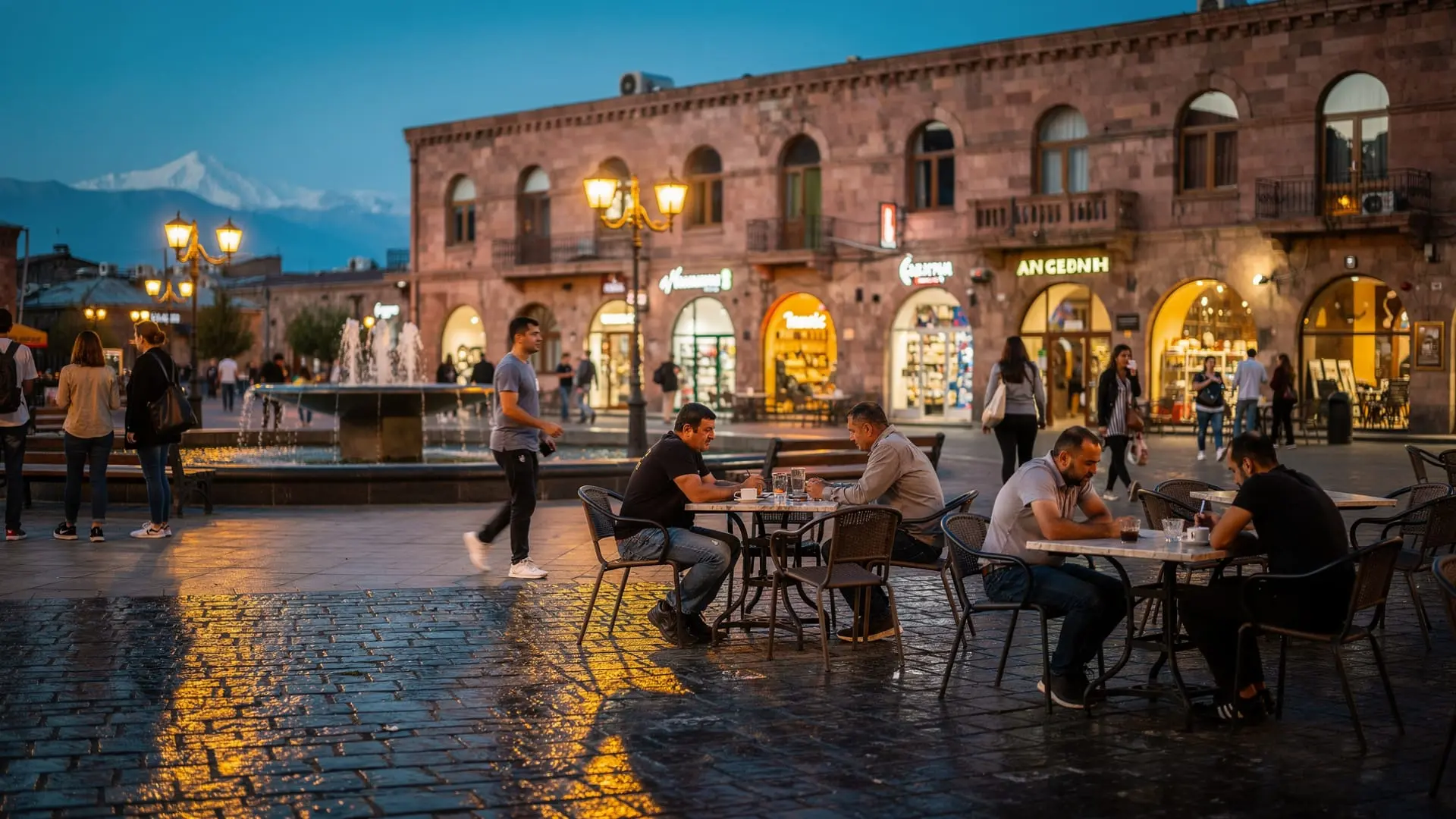
Charles Aznavour Square comes into its own in the evening. The monument is lit at night with warm directional lighting that gives the bronze statue a presence it lacks in flat afternoon light. On summer evenings, the small plaza fills with Yerevan residents — families, couples, tourists — and the street surrounding it sees steady foot traffic until late.
Republic Square, five minutes’ walk south, has its musical fountain shows in summer months (typically May through September, evenings from around 21:00). The fountains are synchronised to music — a mix of Armenian classical, international standards, and, occasionally, Aznavour himself. Combining an evening walk from Aznavour Square to Republic Square for the fountain show is one of the simplest and most satisfying Yerevan evenings available, and it costs nothing.
The best light for photographing the Aznavour statue is the golden hour before sunset (around 18:00–19:30 in summer), when warm light catches the bronze and the cinema facade behind it. The statue faces roughly east, so afternoon light from the west catches it from the side. At dusk, the artificial lighting takes over; the effect is different but equally photogenic.
Photography and walking radius
For photography, the Aznavour Square area offers several angles. The most photographed shot is the statue from the south, with the Cinema Moskva facade behind it. A wider shot from across Abovyan Street captures the statue in urban context. For architectural interest, standing at the corner of Abovyan and Tumanyan and looking north frames the Soviet modernist streetscape with the statue as a midground anchor.
The walking radius from the square is exceptional. Within 12 minutes on foot, you can reach: Republic Square (5 min south), the Vernissage market (weekends, 5 min south-east), the Parajanov Museum (10 min east), the Opera House (8 min north on Mashtots Avenue), the Cascade Complex (12 min north-west), and the Katoghike church (5 min east on Abovyan). This makes the square an ideal anchor point for a half-day walking circuit of central Yerevan.
Photoshoot on Iconic Streets of YerevanAznavour’s impact on diaspora awareness internationally
What distinguished Aznavour from other Armenian diaspora figures of the 20th century was not merely the scale of his fame but the way he used it. He was not primarily a political figure — his public identity was as an entertainer — and this gave him access to audiences and heads of state that explicitly political advocates could not reach.
When he testified before the French Senate on Genocide recognition, he was received not as a lobbyist but as a national treasure making a personal request. When he performed benefit concerts for earthquake victims, the funds raised reflected the affection of audiences who might have been indifferent to an abstract humanitarian appeal. He turned personal fame into political currency with a consistency that no Armenian diaspora figure has matched before or since.
His legacy is visible in Yerevan not only in the square and statue but in the broader cultural confidence of the city. The Armenia that Aznavour helped reconstruct after 1988, and that he continuously represented to the outside world, is the Armenia that tourists now visit. The square is a monument to the diaspora’s material and symbolic contribution to that reconstruction.
Yerevan Unveiled: A Journey in Armenia's Vibrant CapitalBuilding a half-day walk around the square
Charles Aznavour Square works best not as a standalone stop but as an anchor point for a longer central Yerevan walk, since it sits within easy reach of the city’s other major landmarks.
Start at the square itself for photographs in the morning light, when the plaza is quiet. Walk 5 minutes south to Republic Square for the pink-tuff architecture and, if it is a weekend, the Vernissage flea market just beside it. From there, head north again past the square toward the Yerevan Opera and Ballet Theatre on Mashtots Avenue, about 8 minutes on foot, and continue to the Cascade Complex for the afternoon.
This loop — Aznavour Square, Republic Square, the Opera House, the Cascade — covers roughly 2 km and 90 minutes of walking without stops, making it realistic to complete as a single half-day circuit even with time built in at each location. If your evening includes the Republic Square fountain show (summer only, from around 9 pm), finishing the loop back at Republic Square ties the day together.
For visitors more interested in nightlife than daytime sightseeing, the same anchor point works in reverse: start the evening near Aznavour Square with dinner on Abovyan Street, walk to Republic Square for the fountains, and finish with a drink or live jazz — see the Yerevan nightlife guide for the full rundown of bars, wine spots, and Malkhas Jazz Club, all within the same compact central-Yerevan radius.
Frequently asked questions about Charles Aznavour Square
Where exactly is Charles Aznavour Square?
On Abovyan Street, approximately 200 metres north of Republic Square, in front of the Cinema Moskva building. The bronze statue is visible from the street.
When was the statue unveiled?
The statue was unveiled on 24 May 2014. The square itself was named after Aznavour in 2001.
Did Aznavour visit the square in person?
Yes. Aznavour attended the statue unveiling ceremony in 2014 and visited the square on subsequent trips to Yerevan.
Is there a connection between Aznavour and the Genocide Memorial?
Yes, a deep one. Aznavour was one of the most prominent international advocates for recognition of the Armenian Genocide. He visited the Genocide Memorial at Tsitsernakaberd multiple times, and his song “Ils sont tombés” is among the most significant artistic responses to the event. The memorial and the square represent complementary aspects of Armenian historical memory.
Are there other streets or sites in Yerevan named after diaspora Armenians?
Yes. Several streets and institutions in Yerevan honour diaspora Armenians who contributed significantly to the country — Kirk Kerkorian (businessman and philanthropist, funded major infrastructure), Alex Manoogian (industrialist, funded cultural institutions), and others. The tradition of naming sites after diaspora donors and advocates reflects the specific relationship between the Armenian state and its diaspora.
Was Aznavour the only Armenian singer of international fame?
He was the most internationally famous, but not the only one. The Armenian musical diaspora has produced significant figures in multiple genres: Komitas Vardapet (early 20th century, classical music and folk preservation), Alan Hovhaness (composer), System of a Down (rock band, four members of Armenian descent), and several French-Armenian singers in the chanson tradition who followed Aznavour’s path.
How long should I spend at Charles Aznavour Square?
Ten to fifteen minutes covers the statue, the Cinema Moskva backdrop, and a slow lap of the plaza. Most visitors fold it into a longer walk between Republic Square and the Cascade Complex rather than making it a dedicated outing, since all three sit within about 15 minutes of each other on foot.