April 24, 2026: Genocide Remembrance Day in Yerevan
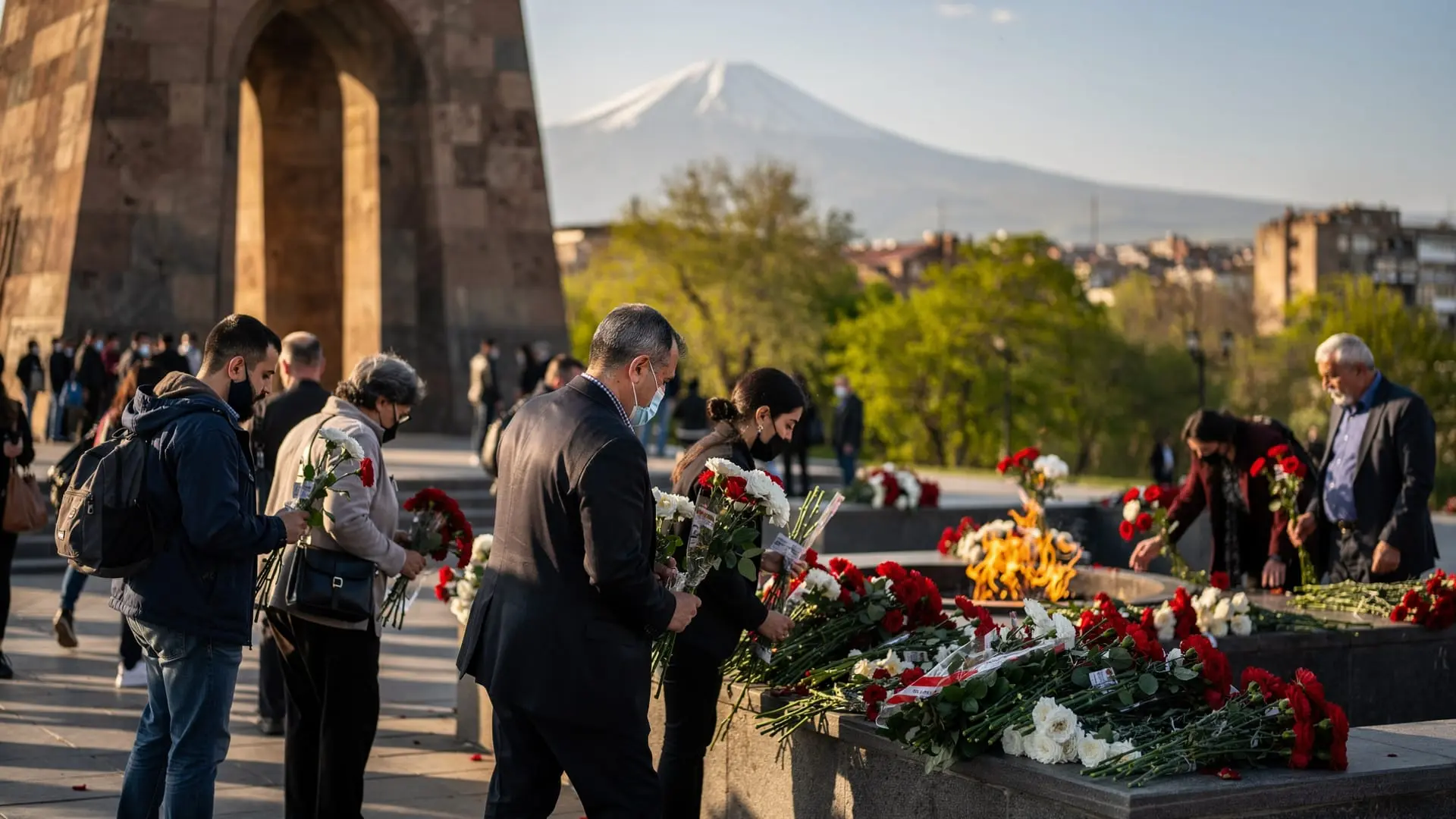
Writing this on April 22
Two days from now — on April 24, 2026 — hundreds of thousands of people will walk to Tsitsernakaberd, the Armenian Genocide Memorial on the hill above Yerevan, to lay flowers at the eternal flame and commemorate the 1.5 million Armenians who were killed in 1915. It will be one of the largest annual gatherings in the South Caucasus. For the Armenian diaspora who travel specifically for this day, and for visitors who happen to be in Yerevan on April 24, it is an experience unlike anything else in the Armenian calendar.
This is a practical and respectful preview of what to expect, when and how to attend, and what April 24 means in the life of the city.
| Where | Tsitsernakaberd hill, above Yerevan |
| Official ceremony | Starts around 11:00 a.m. |
| Peak crowds | Noon–3:00 p.m., 200,000–300,000+ people over the day |
| Getting there | Walk from the Cascade (~30-40 min) or bus; roads often closed to cars |
| Quieter alternative | Visit April 23 or April 25 instead |
What the day looks like
April 24 is a national public holiday in Armenia. The city quiets in the morning. Schools and most businesses are closed. The streets around Tsitsernakaberd fill from mid-morning onward as families, groups, and individuals make their way to the memorial complex on foot or by car.
The official ceremony begins at the memorial in the morning, typically around 11:00 a.m. It includes a wreath-laying by the President of the Republic, the Prime Minister, and representatives of foreign governments and embassies. The Catholicos — the head of the Armenian Apostolic Church — gives a homily. The ceremony is solemn and televised nationally.
What follows for the rest of the day is less formal: a continuous procession of ordinary people walking to the eternal flame, placing flowers — carnations are traditional — and standing in silence or prayer for however long they choose. The procession reaches its peak in the early afternoon and continues until evening.
Estimates for total attendance on April 24 typically range from 200,000 to 300,000 people over the course of the day. In 2024, official figures were over 250,000. The numbers include Yerevan residents, people who travel from other Armenian provinces, and diaspora Armenians who plan their visit specifically around this date. The mood is one of collective grief and collective affirmation — not political demonstration, not nationalist performance, but something more fundamental: a community’s insistence on acknowledging what happened to it.
The memorial complex
Tsitsernakaberd — the name means “swallow’s fortress” in Armenian, referring to a medieval structure that once stood on the hill — is a complex designed by architects Jim Torosyan and Sashur Kalashyan and opened in 1967. It consists of two main elements: the eternal flame in a sunken circular space, surrounded by twelve tall basalt slabs representing the twelve lost provinces of Armenian civilization; and a 44-metre needle-like stele that is visible from much of Yerevan, split vertically as if to represent a divided nation.
The adjacent Genocide Museum (Հայոց Ցեղասպանության Թանգարան-Ինստիտուտ) documents the deportations and killings through photographs, testimonies, and archival records. It is one of the most serious and carefully presented commemorative museums in the world. Visit it on April 23 or April 25 if you want to engage with it properly — on April 24 the focus is on the outdoor ceremony.
The Catholicos’s homily and the official ceremony
The homily delivered by the Catholicos — the supreme head of the Armenian Apostolic Church — at the official memorial ceremony is the central spoken element of the April 24 observance. It is delivered in Armenian (Grabar or Eastern Armenian depending on the year) and is simultaneously translated in the broadcast. The text usually combines theological reflection on the concepts of remembrance, justice, and hope with specific references to the events of 1915 and the current situation of the Armenian people.
The Catholicos’s role at the memorial is not purely ceremonial. The Armenian Apostolic Church was not merely a religious institution that survived the genocide; it was a primary target of the deportations, with many clergy among those killed and with churches, monasteries, and religious libraries destroyed across Anatolia. The Church’s survival — partly through the Catholicate of Sis relocating to Antelias in Lebanon, partly through Etchmiadzin maintaining its role as the mother see — is itself part of the resilience story that April 24 commemorates.
For a visitor attending the ceremony: the homily is the moment when the crowd is quietest and most concentrated. Even without understanding the language, the liturgical gravity of the moment is perceptible. People who have been talking or shifting stand still. The silence in the crowd during the homily, from hundreds of thousands of people, is one of the more striking collective experiences I’ve encountered anywhere.
For visitors: how to attend respectfully
If you are in Yerevan on April 24 and want to attend, you are welcome. Visiting Tsitsernakaberd on April 24 is not forbidden to foreign visitors — on the contrary, many international figures attend and the presence of non-Armenians who come to pay their respects is understood as meaningful by Armenians.
What is expected of you is what is expected at any commemorative event: appropriate dress (nothing loud or casual), silence or quiet behaviour at the eternal flame, and sensitivity to the emotional weight of what the people around you are experiencing. Many of them have family stories connected to 1915. Some are descendants of survivors who carried those stories across generations. You are a guest in that space.
Bring flowers if you wish — carnations are traditional and widely sold by vendors near the memorial entrance on April 24 at around 500-1,000 AMD per bunch. Place them at the eternal flame or on the path approaching it. If you photograph, do so without putting cameras in front of faces and without behaviour that suggests the event is a spectacle.
Practical notes: crowds and timing
The procession to Tsitsernakaberd builds from around 10:00 a.m. and reaches peak density between noon and 3:00 p.m. Walking there from central Yerevan takes approximately 30-40 minutes from the Cascade. The approach roads are often closed to vehicles; public buses run to nearby stops and taxis drop off at designated points on the edge of the closed zone.
Water, appropriate footwear, and patience with the crowds are practical requirements. The queue to reach the eternal flame can be an hour or more at peak times; some people wait in the line as part of the observance rather than trying to rush it.
If you are not specifically attending for the ceremony and want to see the memorial without the April 24 crowd, April 23 (the day before) and April 25 (the day after) offer a quieter visit. The museum is open on both days. The eternal flame burns year-round. The basalt monoliths and the views of Yerevan from the hill are accessible every day.
Yerevan city tour with a local guide — understand the memorial’s place in the cityThe evening vigils
In recent years, April 24 in Yerevan has extended into the evening with candlelight vigils in various public spaces — particularly around the Cascade and in parks around central Yerevan. These are informal gatherings, not official events, that continue the mood of the day in a more ambient form. If you’re in the city on the evening of April 24, you may encounter groups standing quietly with candles in public spaces. This is not alarming; it is part of how the city marks the day.
The international dimension
The Armenian Genocide is recognised by 34 countries as of 2026, with recent additions including several that had long deferred recognition for diplomatic reasons. For visitors coming from countries whose governments have not formally recognised it, this context is worth understanding before you arrive at Tsitsernakaberd — not because you need to hold a political position, but because the people around you on April 24 are living with a particular relationship to that question.
The recognition issue is not merely political theatre. For Armenian families whose ancestors survived the genocide and who have been making the case for international acknowledgment across four or five generations, the state of the recognition map is a live and personal matter. Diaspora Armenians who travel from France, the US, Lebanon, or Argentina specifically for April 24 are often carrying family stories directly connected to the events of 1915. The granddaughter of a survivor who walked from Anatolia to Syria in 1915 and whose family eventually reached Beirut has a different relationship to this date than a tourist who learned about it from a travel article.
None of this should be paralysing. It should simply inform the quality of attention you bring to the day.
The Matenadaran connection
The Matenadaran — the institute on Mashtots Avenue holding Armenia’s collection of ancient manuscripts — has a particular relevance to April 24 that is not always obvious to visitors. Among the manuscripts preserved there are records of Armenian intellectual and ecclesiastical life from the 4th century onward: liturgical texts, historical chronicles, scientific treatises, illuminated gospels. The deportations of 1915 targeted exactly the educated and clerical classes who were the custodians of this tradition. The preservation of the manuscripts — many of which were hidden, carried out on donkeys, buried in monasteries, and smuggled across borders during and after 1915 — is itself part of the story of cultural survival.
Visiting the Matenadaran in the days around April 24, or the Erebuni Museum (which tells the 2,800-year story of the city that became Yerevan), gives April 24 a longer context: the remembrance is not only about what was destroyed but about what persisted.
The 24th in context
April 24 is the date on which the Ottoman government, in 1915, began the systematic arrest and deportation of Armenian intellectuals and community leaders in Constantinople — the event widely taken as the beginning of the organised genocidal campaign. The following months saw mass deportations on death marches through the Syrian desert, mass executions, and the destruction of Armenian communities across Anatolia that had existed for centuries. Estimates of those killed range from 600,000 to 1.5 million; the figure of 1.5 million is used in the official Armenian commemorations.
The historical record, documented through Ottoman archives, survivor testimonies, foreign diplomatic dispatches, and missionary accounts, is extensive. The scale of what happened is not disputed in any serious historical scholarship; the specific terminology and the legal categorisation continue to be contested for reasons that are primarily political rather than evidentiary.
For visitors from outside Armenia: you do not need to arrive at Tsitsernakaberd with a position on international law. You need to arrive with attentiveness to the fact that you are sharing space with a community for which this is not historical abstraction but lived inheritance.
The Tsitsernakaberd visiting guide and the diaspora pilgrimage planner cover the memorial and its context in depth. For those who want to understand the history before visiting, the museum’s own digital archive is accessible online in advance of your trip.
If you’re staying elsewhere in Armenia that week
Diaspora travellers often build April 24 into a longer trip rather than a single-city visit. It is common to arrive a few days early, attend the ceremony, and then head south to Khor Virap with its view of Mount Ararat — the mountain that looms over the genocide narrative both literally and symbolically, since it sits just across the closed Turkish border. Others extend north to Gyumri, Armenia’s second city, which suffered its own catastrophic losses in the 1988 earthquake and carries a distinct, quieter memorial culture worth comparing to Yerevan’s. Neither detour needs to happen on April 24 itself — both work better in the calmer days around it.
Transport and accommodation logistics that week
Hotel availability in Yerevan tightens noticeably in the days around April 24, particularly for diaspora family reunions, and it is worth booking accommodation several weeks ahead rather than assuming April is a quiet shoulder month. Flights into Zvartnots Airport also see a bump from diaspora communities in France, the US, Russia, and Lebanon flying in specifically for the date. If you’re arriving independently, budget extra time for the airport-to-city transfer on April 23-24, since taxi demand rises alongside everything else. A private transfer booked in advance removes one variable from an already logistically dense few days.
Private round-trip airport transfer in YerevanFAQ
Is it appropriate for a non-Armenian tourist to attend the April 24 ceremony? Yes. Foreign visitors, including tourists with no personal connection to the events of 1915, are welcome at Tsitsernakaberd on April 24. What matters is behaving as a respectful guest — appropriate dress, quiet conduct near the eternal flame, and restraint with photography — rather than staying away out of a sense that the day belongs only to Armenians.
Do I need to buy flowers before I arrive, or can I get them there? You don’t need to bring flowers from elsewhere. Vendors sell carnations, the traditional flower for the day, right near the memorial entrance, typically for around 500-1,000 AMD per bunch. Buying on site is normal practice and supports local sellers who set up specifically for the occasion.
Is the Genocide Museum open on April 24 itself? It’s technically open, but April 24 is not the day to visit the museum properly — the focus that day is the outdoor ceremony and procession, and the crowds make an unhurried museum visit difficult. Come back on April 23 or April 25, when the museum can be visited at a normal pace and the memorial grounds are far quieter.