Noravank in autumn: the red cliffs at their best
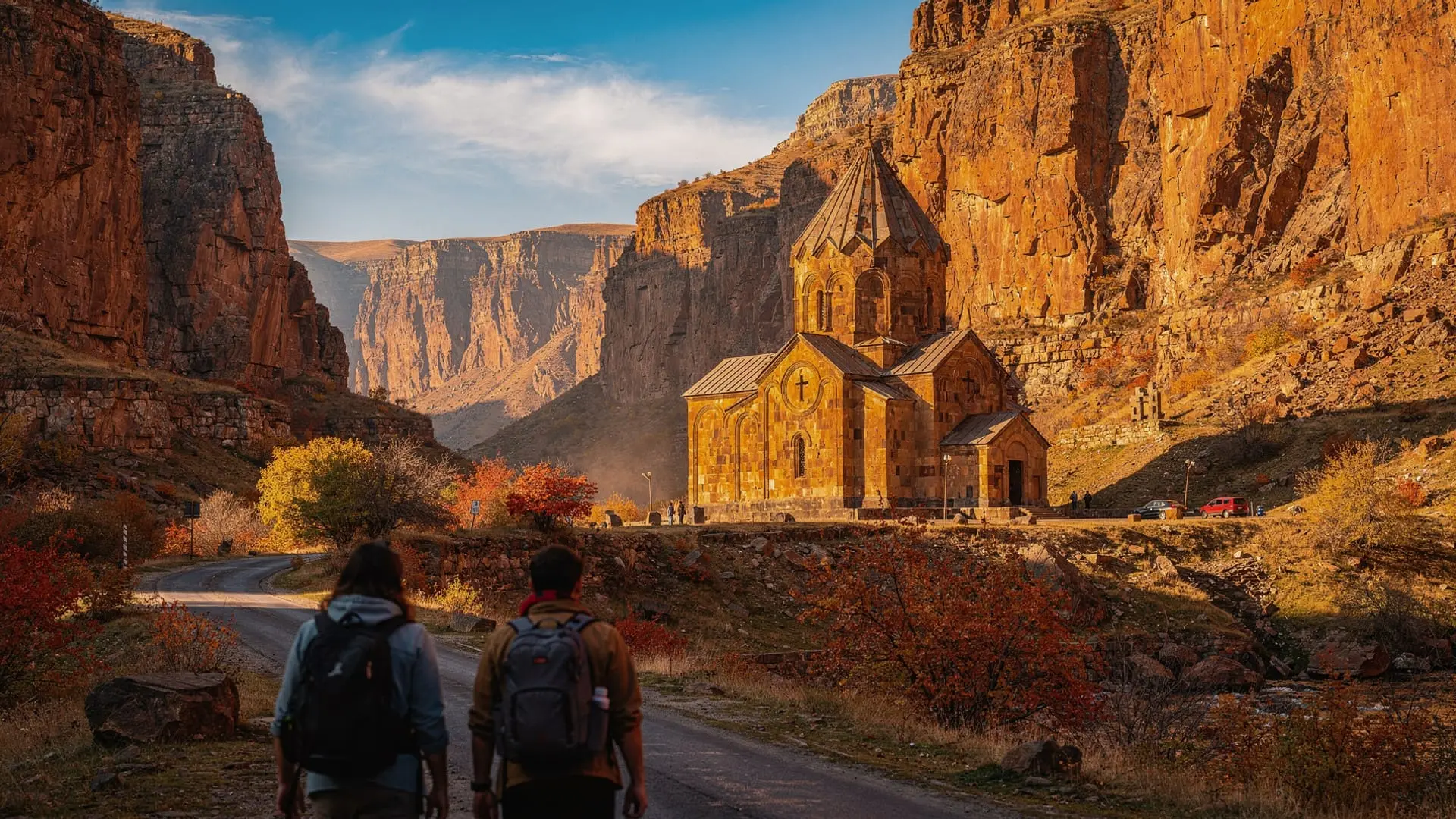
A November dispatch from the Amaghu gorge, where the red tuff cliffs, the double-stairway church, and the Vayots Dzor wine harvest all come together once the summer coach tours have gone.
| Where | Amaghu gorge, Vayots Dzor, ~120km / 2hrs south of Yerevan |
| Best light | Early morning, low autumn sun on the cliffs from the east |
| Cost | Small entrance fee in summer; often none collected in autumn/winter |
| Combine with | Khor Virap (morning), Areni wine tasting (afternoon) |
| Stay | Overnight in Yeghegnadzor for an 8am arrival before any tour buses |
The gorge in November
The road from the main highway into the Amaghu gorge is about 9 kilometres of narrowing canyon, and the transformation it makes on the traveller is gradual and then sudden. At the highway junction near Areni village, you’re in the gentle vineyard country of the lower Ararat valley — tame, agricultural, the kind of landscape that doesn’t demand your attention. Then you turn into the gorge and the cliffs close in.
The rock in the Amaghu gorge is tuff — the same volcanic material that Yerevan is built from — but here in its natural, uncut form: deep red, layered, twisted in places by geological pressure, with the river running at the base and the walls rising 200 metres above it. In summer, the red is vivid against the blue sky. In November, the light is lower and more angled, the sky overcast or very pale blue, and the tuff takes on a richer, darker quality — more terracotta than orange, shading to near-purple in the shadowed sections of cliff.
I had been here in June and in August. November was different enough to feel like a different place.
The road ends at a small car park outside Noravank Monastery. In November, the car park holds perhaps four or five vehicles on a weekday — the vans and coaches of the summer tours are gone. There’s a small café-restaurant that was open but serving only a reduced menu: soup, bread, coffee. The proprietor, a middle-aged man in a heavy jacket, waved me toward a table by the window with the gorge visible through the glass.
I had soup (Armenian vegetable soup with herbs and a small piece of lamb) and coffee before going to the monastery. This was the correct approach.
The architecture of the two churches
Noravank is primarily two churches built into the cliff face in the 13th and 14th centuries, and the architectural centrepiece is Surb Astvatsatsin — the Church of the Holy Mother of God — built between 1339 and 1352 by the master architect Momik, whose signature is visible in the quality of the stone carving.
What makes Surb Astvatsatsin unusual is its structure: a two-storey church with an external double stairway. The narrow staircases rise along the front facade to reach the upper level, which contains a gavit (narthex) with a khachkar of exceptional quality set above the doorway. The stairs are steep and there is no handrail; they have been climbed for seven centuries without one, and the stone is polished smooth at the edges. In November, with no one else there, I took my time on them.
The upper doorway is the reason photographers come to Noravank. Momik’s relief carving here is some of the finest medieval stonework in Armenia: the tympanum above the door contains a composition of God the Father with outstretched arms (an unusual representation for the period, more Western than typical Armenian iconography) and the stone below it bears an intricate interlace of vine motifs and human figures. The surface is pink tuff, the details crisp despite seven centuries of weather.
The lower church — Surb Karapet, the Church of St. John the Baptist, built in 1216 — is older and more austere. Its interior has been partly excavated to reveal the burial sites of the Orbelian princes who funded the monastery. The floor stones are large and flat and bear inscriptions in Armenian that I could not read but stood over for some time.
The colour calibration question
I want to say something honest about the photographs. Noravank is one of the most photographed sites in Armenia, and the photographs are, almost universally, colour-saturated beyond what the eye typically sees. The tuff cliffs in the images circulating on Instagram are often cranked to a deep orange-red that bears a relationship to the real colour but amplifies it significantly.
In November at 2 p.m. under an overcast sky, the real colour of the cliffs is subtler than any iPhone-processed image — more muted, more layered, more complicated. The warm tone is present but it’s competing with the grey of the sky, the blue-grey of the shadows, the ochre of the dry grass on the cliff ledges. It’s more beautiful, I think, than the saturated version, because it has more information in it. But it photographs less dramatically.
I say this because the contrast between expectation and arrival can be disorienting at Noravank, and it’s worth calibrating. The site is extraordinary. It’s just extraordinary in a different key in November than in July.
When the cliffs look their best
| Season | Cliff colour | Crowds | Notes |
|---|---|---|---|
| Spring (Apr–May) | Bright red-orange, green gorge floor | Moderate | Wildflowers in the valley, occasional rain |
| Summer (Jun–Aug) | Vivid, most saturated | Heaviest — coach tours | Hottest hiking conditions in the gorge |
| Autumn (Oct–Nov) | Muted terracotta, near-purple in shadow | Light, especially by mid-Nov | Harvest energy at nearby Areni wineries |
| Winter (Dec–Feb) | Darker, sometimes dusted with snow | Quietest | Café may have limited hours; check ahead |
There’s no wrong season to see Noravank, but if solitude and the gorge’s subtler colours matter more to you than the postcard-orange version, aim for late October through November.
The wine country context
Noravank sits in the heart of the Vayots Dzor wine region. The Amaghu gorge empties into the main valley just below Areni village, where the Areni-1 cave — site of the world’s oldest known winery, discovered in 2007 and dated to around 6,100 years ago — sits in the hillside a few minutes from the road.
In November, the vendange is over. The vineyards above the valley are stripped bare, the leaves gone, the pruning teams moving through the rows. The wine cellars at the local producers are busy with the new vintage, which is why this is one of the better months to visit if you’re interested in wine: the producers have time to talk, the harvest energy is present, and a tasting room visit feels like participation rather than tourism.
I stopped at a small producer near Areni village whose sign I had passed before without stopping. The woman who came to the door — Lilit, mid-forties, who had studied viticulture in France in the late 1990s — showed me the new Areni Noir fermenting in open-top tanks and gave me a glass of the previous year’s wine from a barrel she was monitoring. The wine was dark, slightly tannic, with the specific dried-cherry character that Areni Noir develops in the high-altitude volcanic soils. I bought two bottles for about 6,000 AMD each and drank one that evening in Yeghegnadzor.
For the full story of the wine region, the Vayots Dzor wine route guide covers every producer worth visiting.
What the Orbelian connection means
The princes who built Noravank were the Orbelians — one of the major noble dynasties of medieval Armenia, with power centred in Syunik and Vayots Dzor. Surb Astvatsatsin was their family mausoleum as much as a church: the underground gavit at the base of the two-storey church contains the tombs of Orbelian princes, and the stonework itself was commissioned partly as a statement of dynastic status.
The great khachkar above the entrance door bears an inscription dedicating the church; the complexity of the stonework is partly artistic and partly a deliberate signal of wealth and cultural sophistication. Momik, the architect, was one of the most accomplished craftsmen of his period — his work appears at several other sites in Vayots Dzor and Syunik — and the Orbelians’ patronage of him was itself a form of prestige.
Understanding this context doesn’t change what you see, but it deepens it. The monastery is not simply a religious building; it is a political statement made in stone by a dynasty that wanted to be remembered in a specific way. Seven centuries later, the statement holds.
The Orbelian dynasty also built the caravanserai at Selim — the 14th-century Silk Road waystation on the mountain road above Yeghegnadzor — which means that a visit to the province can be organised around their legacy: Noravank in the gorge, the Selim Caravanserai on the plateau above, and the wine that still grows from the soil they once controlled.
Staying overnight in Yeghegnadzor
Most visitors to Noravank treat it as a day trip from Yerevan and drive back the same evening. This is understandable and also slightly wasteful. The capital of Vayots Dzor province is Yeghegnadzor, about 20 kilometres east of the gorge junction, and spending a night there changes the rhythm of the whole visit.
Yeghegnadzor is a small, quiet provincial town that doesn’t particularly cater to tourists, which is why it’s pleasant to be in. The main street has a few decent restaurants, a market with good local cheese and dried apricots, and guesthouses at very reasonable prices. The Selim Caravanserai — a 14th-century Silk Road waystation in remarkably good condition — is 20 kilometres up the mountain road from town, accessible in good weather on a drive that rewards the effort.
Arriving the night before your Noravank visit means you can be at the monastery at 8 a.m., in the gorge before any tour group from Yerevan could possibly have arrived. In November, even the 10 a.m. crowd barely exists. But the dawn light in the Amaghu gorge, low and warm, hitting the red cliffs from the east — that’s worth the overnight stop.
The practicalities
Noravank is about 120 kilometres from Yerevan — roughly 2 hours by car, taking the M2 highway south and then turning east at the Areni junction. The road into the gorge is paved but narrow; meeting another vehicle in the canyon means someone reverses. In November this is not a problem.
The site is open year-round. In winter and autumn, there is sometimes no entrance fee collected (in summer, a small fee applies). The café outside the monastery was open on my November visit but may not be in all conditions; take water and something to eat if you’re doing a long day.
Combine with Khor Virap for an efficient southern loop — Khor Virap in the morning for the Ararat view, then east to Noravank for the afternoon cliffs. Both sites are at their least crowded in November, and the drive between them passes through the Ararat valley at its most peaceful autumn. The Noravank monastery guide covers all the access logistics and what to expect in each season.
This is among my favourite single-day routes in Armenia. The cliffs are at their best in November. The tourist infrastructure is mostly asleep. And the wine country just outside the gorge entrance, in the weeks immediately after harvest, has a specific energy that rewards showing up without a plan.
If you’re deciding between the two great southern monasteries, the Tatev vs Noravank comparison guide lays out the trade-offs — Tatev has the cable car and the bigger canyon, Noravank has the finer architecture and, in autumn, near-total quiet.