ArmAs & Karas: large-scale Armenian wineries
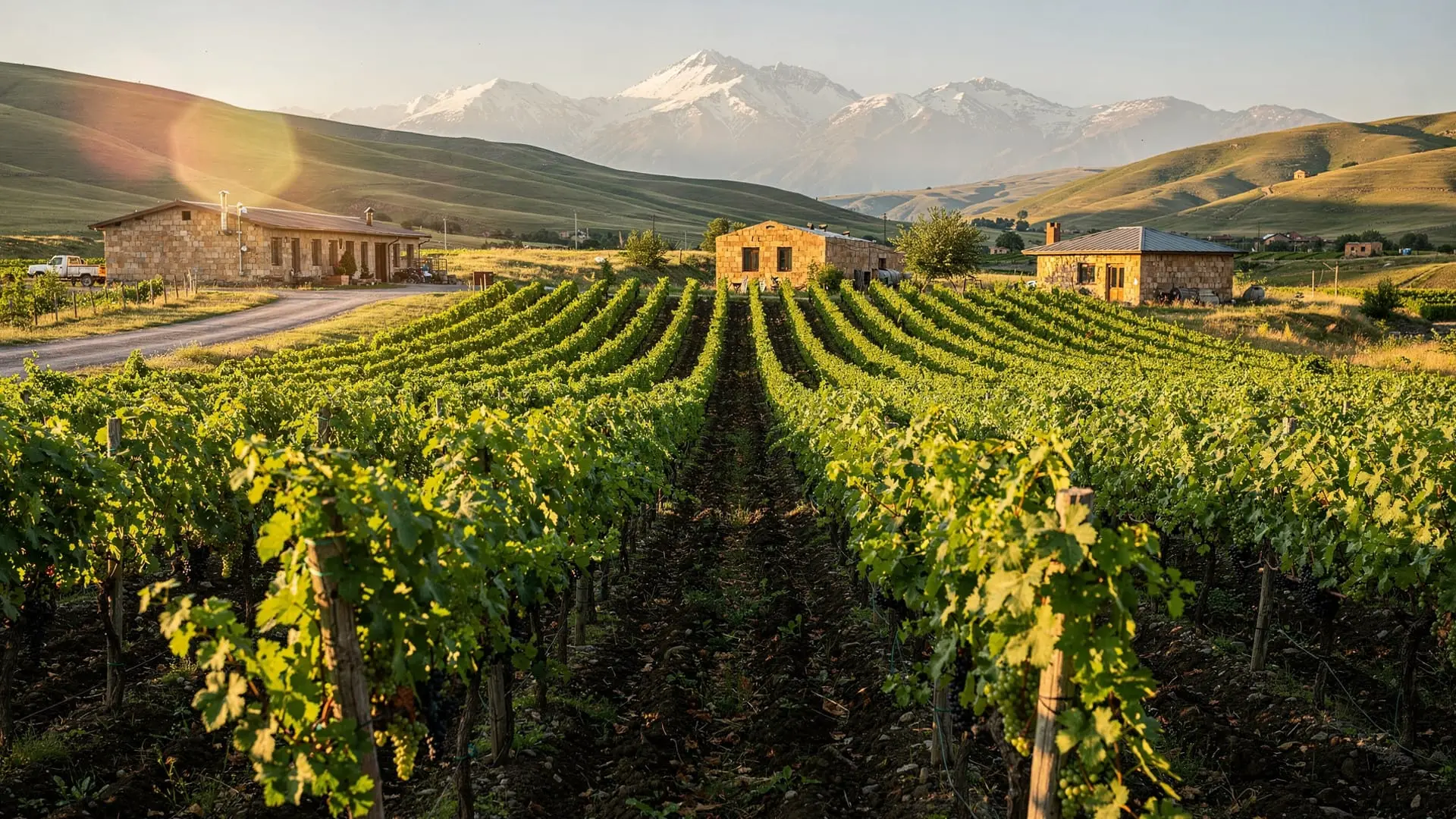
Armenia’s two faces of commercial wine
Armenian wine comes in two broad modes: the artisan boutique estates of Vayots Dzor (Zorah, Trinity Canyon, Hin Areni) and the larger commercial producers who supply the domestic market and pursue international export. ArmAs and Karas represent this second mode — not industrial giants by global standards, but wineries producing in the tens of thousands to hundreds of thousands of bottles per year, with serious facilities, professional marketing, and broad distribution.
Understanding the difference between them helps map the full spectrum of Armenian wine as a category. The boutique estates make the wines that attract critical attention and educate international palates; the commercial producers make the wines that fill restaurant lists, supermarket shelves, and hotel dining rooms across Armenia and the diaspora. Both have their place.
| Where | ArmAs: Oshakan, Aragatsotn; Karas: Ararat Valley |
| Cost | Tastings around 4,000–12,000 AMD depending on programme |
| Time needed | 30–45 minutes per tasting; a full day to visit both |
| Getting there | Self-drive, taxi, or organised wine tour from Yerevan |
| Best time | Year-round; harvest season (September–October) adds atmosphere |
ArmAs winery
Location and background
ArmAs sits near the village of Oshakan in Aragatsotn province, approximately 30 km northwest of Yerevan — close to Voskevaz and well within reach of a day trip from the capital. The winery was founded in the late 1990s by Armenian investors seeking to build a commercially viable wine operation that could serve both the domestic market and nearby export markets (Russia, the CIS countries, and increasingly the United States).
The name ArmAs is a contraction of “Armenia” and a reference to the winemaking tradition the founders wanted to revive. The estate farms vineyards across Aragatsotn and also sources from contracted growers in Vayots Dzor.
The wines
ArmAs produces a wide range across multiple tier levels. The indigenous varieties — Areni Noir, Voskeat, Karmrahyut, and Kakhet — anchor the most interesting tier of the portfolio. A line of international varieties (Cabernet Sauvignon, Chardonnay, Merlot) is produced primarily for export markets and Yerevan hotel restaurants where international grape names remain important for less adventurous buyers.
ArmAs Areni Noir (entry-level): clean, well-made, immediately approachable. Red cherry and pomegranate, medium body, soft tannins. One of the best-value Areni Noirs available in Armenian supermarkets, typically priced at 2,500 to 3,500 AMD (6 to 8.50 EUR) retail.
ArmAs Areni Noir reserve: more structured, with 12 months in French oak. Darker fruit, better integration, longer finish. Approximately 5,000 to 7,000 AMD (12 to 17 EUR).
ArmAs Voskeat: the white highlight of the range. Clean, with good quince and dried apricot character. Not as textural as Voskevaz’s benchmark version, but consistent and food-friendly. Around 4,000 AMD (10 EUR).
ArmAs Karmrahyut: produced as a varietal wine in some vintages — dense, darkly coloured, good for ageing. Worth trying alongside other expressions of the variety.
ArmAs Kakhet: a Kakhet-based white, sometimes made with skin contact in limited quantities. One of the more interesting experimental releases in the range.
Visiting ArmAs
The ArmAs winery operates a tasting room at the Oshakan production facility. Visits are available by appointment and on a walk-in basis during business hours (generally 10:00 to 17:00 Monday to Friday; limited weekend hours). The tasting room is functional rather than elaborate — this is primarily a production facility, not a hospitality destination. Standard tasting of five wines: approximately 4,000 AMD (10 EUR).
The facility is easy to combine with a visit to Hovhannavank or Saghmosavank monastery (both within 15 km) or with Voskevaz winery to compare two Aragatsotn producers back to back. See the Voskevaz guide for the more hospitality-focused Aragatsotn alternative.
Karas winery
Location and background
Karas operates primarily from the Ararat Valley, closer to Yerevan and benefiting from the warmer, lower-elevation terroir of the valley floor. The winery has a more dramatic backstory than most Armenian producers: it was founded with Italian investment — the Rallo family, known for their Donnafugata estate in Sicily, are among the principal owners — and designed from the outset as an export-oriented operation aimed at the international fine wine market.
The flagship estate vineyards sit at approximately 900 to 1,100 metres in the Aragatsotn foothills, but the main processing and ageing facility is in the Ararat Valley. The brand name “Karas” is the Armenian word for “clay vessel” — the same root as Zorah’s “Karasi” — a nod to the ancient winemaking tradition stretching back to the Areni-1 cave.
The wines
Karas produces at multiple levels. The Reserve wines, made from indigenous varieties, are the most interesting.
Karas Reserve Areni Noir: the flagship, aged in French barrique. Full-bodied by Areni Noir standards, with dark cherry, dried rose, and a structured, tannic finish. This is a more international style than the Vayots Dzor boutique producers — more extraction, more oak influence — but the quality is consistent and the wine represents good value at its price point (approximately 8,000 to 11,000 AMD / 20 to 27 EUR).
Karas Reserve White (Voskeat + blends): reliably made, with the characteristic quince and almond notes of the variety. Approximately 6,000 to 8,000 AMD (15 to 20 EUR).
Karas Classic range: a set of blended wines using both indigenous and international varieties. These are widely available across Armenia (restaurants, supermarkets, hotel bars) and represent the accessible entry point to the brand. Priced from 3,000 AMD (7 EUR) upward.
Karas Karmrahyut: appears as a varietal wine in some vintages, offering the dense, structured character of this indigenous variety in a more internationally approachable format.
The international variety wines (Cabernet Sauvignon, Syrah, Chardonnay, and blends) are technically well-made but not the reason to seek out Karas specifically — you can drink those everywhere. The indigenous variety reserves are the point.
Visiting Karas
The Karas production facility in the Ararat Valley is open to visitors by prior arrangement. The winery has a more formal event facility than most Armenian producers — it was designed with international wine trade visitors in mind — and offers structured tasting programmes with multilingual staff.
Standard tasting: five wines, approximately 5,000 AMD (12 EUR). Reserve and prestige tasting: seven wines, approximately 10,000 AMD (24 EUR). Cellar tour + tasting: approximately 12,000 AMD (29 EUR).
The location near the Ararat Valley also makes Karas a natural addition to a southern loop itinerary that includes Khor Virap monastery — one of Armenia’s most visited sites, famous for its views of Mount Ararat. See /destinations/khor-virap/ for details.
Comparing ArmAs and Karas side by side
| ArmAs | Karas | |
|---|---|---|
| Location | Aragatsotn (Oshakan) | Ararat Valley + Aragatsotn |
| Ownership | Armenian investors | Armenian + Italian (Rallo family) |
| Primary focus | Indigenous varieties, domestic market | Indigenous + international, export |
| Style | Traditional, somewhat rustic | More international, polished |
| Tasting experience | Functional, appointment advised | Formal, multilingual |
| Distance from Yerevan | 30 km (Oshakan) | 40–50 km (main facility) |
Neither winery should be dismissed by visitors who have tasted Zorah Karasi and find everything else underwhelming by comparison. The commercial producers serve a different purpose — they are the backbone of Armenian wine culture, producing wines that reach tables that boutique estates cannot supply — and tasting broadly across the spectrum, from Maran’s rustic informality to Karas’s polished reserves, is the way to understand Armenian wine as a whole.
Where to taste both in Yerevan
If a trip out to the wineries is not possible, both ArmAs and Karas are well represented in Yerevan wine bars and shops. The Armenian wine tasting at In Vino covers both producers alongside boutique estates. The Armenia Wine Talks tasting event also typically includes commercial producers for comparison.
Supermarkets (SAS, Yerevan City) stock both ranges at their full depth — a practical way to browse and compare before deciding which bottles to take home.
The wider Aragatsotn wine picture
ArmAs and Voskevaz together with several smaller producers (including Voskeni, which operates vineyard lunch experiences) form a coherent Aragatsotn wine cluster that merits a dedicated day trip from Yerevan. A logical itinerary:
- Morning: ArmAs tasting (30 to 45 minutes) + Oshakan village (Armenian Alphabet Monument at nearby Artashavan is 10 minutes away)
- Midday: Voskevaz winery tasting and restaurant lunch
- Afternoon: Hovhannavank or Saghmosavank monastery (beautiful 10th to 13th-century complexes on the edge of the Kasakh gorge)
For full Aragatsotn destination information, see /destinations/aragatsotn/. For the Voskevaz winery in detail, see the Voskevaz guide. For the boutique Vayots Dzor comparison, the Vayots Dzor wine route guide covers all the major estates.
Frequently asked questions about ArmAs and Karas
Are ArmAs and Karas wines available outside Armenia?
Karas exports to Russia, the CIS, the United States, and several EU countries. Distribution varies by country; check your local specialist retailer or wine importer. ArmAs exports more modestly, primarily to Russia and a few diaspora markets. In major cities with significant Armenian diaspora populations (Los Angeles, Paris, Moscow, Beirut), both may be found in Armenian-focused grocery stores.
Which producer makes the best Areni Noir for the money?
For everyday drinking, ArmAs entry-level Areni Noir represents exceptional value. For a wine to serve at a dinner party, Karas Reserve is the better choice. For something memorable, Trinity Canyon or Hin Areni reserve outperform both in character and complexity, at a modest price premium.
Is the Italian influence at Karas noticeable in the wines?
Subtly, yes. The winemaking philosophy at Karas shows Italian influences in the use of barrique ageing, in the attention to extraction and structure, and in the presentation of the wines. The house style is more international and accessible than the more austere, mineral-driven Armenian boutique style. Whether this is a positive or a negative depends on your palate.
Can both wineries be visited in a single day?
ArmAs (Oshakan) and Karas (Ararat Valley) are roughly 60 km apart. A full day combining both, with travel from and back to Yerevan, is feasible but tiring. A more relaxed approach would combine ArmAs with Voskevaz on one day (both Aragatsotn) and Karas with Khor Virap on another.
Do either of these wineries produce natural or biodynamic wine?
Neither ArmAs nor Karas operates biodynamically. Both use conventional viticulture with professional pest management. If natural or biodynamic production is important to you, focus your visits on Zorah (fully biodynamic in practice, if not certified) or the smaller Van Ardi estate in Vayots Dzor.
Should I book ahead, or can I just show up?
ArmAs generally accepts walk-ins during business hours, though an appointment is advised for groups or if you want a guided tasting rather than a self-directed one. Karas, with its more formal event facility, is better booked ahead, particularly for the reserve or cellar-tour programmes, since staff need notice to prepare the multilingual tasting.
Are ArmAs and Karas suitable for a first-time visitor to Armenian wine, or should I start with the boutique estates?
They’re actually a sensible starting point precisely because they are less intense than the high-altitude boutique wines. ArmAs’s entry-level Areni Noir and Karas’s Classic range are approachable, food-friendly introductions to indigenous Armenian grapes before you move on to the more mineral-driven, structured expressions from Vayots Dzor’s smaller producers.
Armenian wine on the world stage: the role of commercial producers
It would be easy to dismiss ArmAs and Karas by comparison with the more celebrated boutique estates. But that dismissal would misunderstand how wine culture develops in an emerging market.
When Armenia’s wine industry was rebuilding after independence in 1991, there was no guaranteed market for premium boutique wine — domestic consumers were predominantly wine drinkers who had grown up with cheap Soviet table wine or brandy; international buyers were unfamiliar with Armenian varieties; restaurants needed reliable supply at accessible price points. ArmAs and Karas filled that gap. By producing consistent, competently made wine at scale, they created the retail and restaurant infrastructure on which the boutique producers now also depend.
The supermarket shelves of SAS and Yerevan City stocked with ArmAs Areni Noir have introduced hundreds of thousands of Armenians and visitors to the idea that Armenia makes serious domestic wine. The restaurant wine lists of Yerevan’s mid-range restaurants, loaded with Karas Classic, have normalised indigenous Armenian varieties for diners who might otherwise default to imported Georgian or European wines. This normalisation is not glamorous, but it is the foundation on which Zorah’s international prestige rests.
Scale, export, and the future of Armenian wine
Karas’s Italian investment and export ambitions represent one possible future for Armenian wine: an internationally integrated industry competing in a crowded global market on the basis of terroir and indigenous variety differentiation. The precedents are encouraging — Georgian wine made exactly this transition over the 2010s, with Rkatsiteli and Saperavi going from regional unknowns to darlings of the natural-wine circuit.
For Armenia, Areni Noir is the equivalent transformative variety — high enough quality at its peak, distinctive enough in character, and old enough in heritage to tell a compelling story. The commercial producers are the volume backbone of that story; the boutique producers are its prestige apex.
The most interesting development to watch over the coming years is whether producers like ArmAs and Karas will invest more heavily in the premium end of the indigenous variety range — particularly in high-altitude parcels that could produce wines closer to Zorah’s quality level — or whether they will continue to focus on the volume mid-market. The infrastructure investments both companies have made suggest ambition. The wines themselves, at their best, suggest the raw material is there.
Finding Armenian wine beyond Armenia
If you want to continue drinking Armenian wine after returning home, the following notes are useful.
Karas is the most internationally distributed Armenian wine brand. In the United States, it is available through several importers in California, New York, and the Pacific Northwest. In France and Germany, a small number of specialist natural-wine retailers stock it. In the United Kingdom, Armenian Wine Society (a specialist online retailer) and Hedonism in London stock multiple Armenian labels.
ArmAs has a smaller international footprint, with the bulk of its exports going to Russia and nearby CIS countries. However, Armenian diaspora communities in Los Angeles, Paris, and Beirut can often find ArmAs through Armenian grocery stores and specialist importers.
For current stockist information, the best approach is to email the wineries directly (both maintain websites) and ask for their distributor list in your country.
The Armenian wine tour that covers it all
For visitors who want to understand Armenian wine in all its range — from the boutique high-altitude expressions of Vayots Dzor to the commercial breadth of Aragatsotn — the wine tour visiting four wine factories and wineries in one day offers a comprehensive single-day introduction. The 5-day Armenia tour with wine and brandy tasting extends the immersion across the full week, combining the major wine regions with the Yerevan Brandy Company and the country’s broader attractions.
For the complete context on what you are tasting, the Armenian wine grapes guide covers all the indigenous varieties in depth, and the Armenia wine country overview places everything in the six-thousand-year story that begins at Areni-1 cave.
What to eat alongside the tastings
Neither winery operates as a full restaurant destination in the way that some Vayots Dzor estates do, so plan food separately. ArmAs is close enough to Oshakan and Voskevaz that pairing the tasting with lunch at Voskevaz’s on-site restaurant makes for a natural sequence — see the Voskevaz winery guide for details. Near Karas, the Ararat Valley has a scattering of roadside cafes serving grilled meats and lavash, and a stop at Khor Virap’s small vendor stalls covers basic needs if you are combining the winery with the monastery. Neither location is a food destination in itself, so travellers doing a full wine-and-food day usually build the meal around Yerevan or Voskevaz rather than around ArmAs or Karas directly.
Getting there without a car
Neither ArmAs nor Karas is on a direct marshrutka route, which is one of the main reasons most visitors reach them by taxi, private driver, or organised tour rather than public transport. A one-way taxi to ArmAs (Oshakan) from central Yerevan typically runs a modest fare given the 30 km distance; Karas, in the Ararat Valley, is a longer and correspondingly pricier ride. For a day that includes both wineries plus a monastery stop, a private driver hired for the full day or a structured wine tour is usually more cost-effective than stacking multiple one-way taxis. See the private tour vs marshrutka comparison for how the maths generally works out on multi-stop wine days.