Armenian wine grapes explained: Areni Noir, Voskeat & more
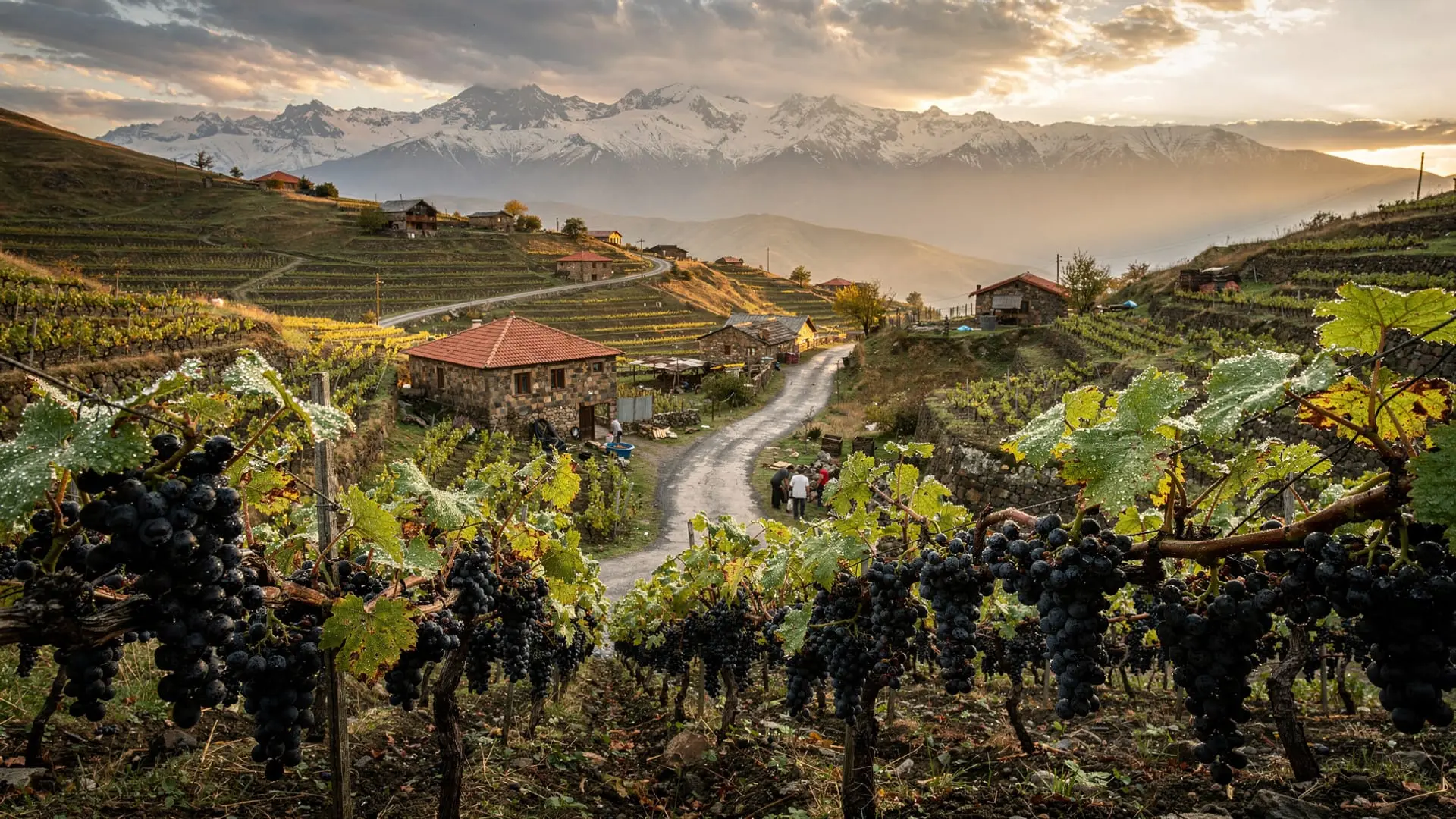
| Signature red | Areni Noir — pomegranate, dried cherry, high acid |
| Signature white | Voskeat — quince, beeswax, bitter-almond finish |
| Where grown | Mostly Vayots Dzor, elevations 900–1,800m+ |
| Where to taste | In Vino or Areni-village wineries |
| Entry-level price | From around 2,500 AMD (6 EUR) a bottle |
Why indigenous Armenian varieties matter
When archaeologists excavated the Areni-1 cave in Vayots Dzor and dated its winery installation to approximately 4100 BCE — making Armenia home to the oldest known winemaking site in the world — they also found seeds of Vitis vinifera, the wine grape species. Those vines were not imported from somewhere else. They were cultivated locally, from a genetic pool that had been developing in the South Caucasus for millennia.
Modern DNA analysis confirms that the South Caucasus, encompassing Armenia, Georgia, and Azerbaijan, is one of the primary centres of Vitis vinifera domestication. Armenia’s indigenous varieties — Areni Noir, Voskeat, Karmrahyut, Khndoghni (Sireni), Kakhet, and dozens of others — are not simply local curiosities. They represent a direct genetic link to the earliest cultivated vines on earth, preserved in place by geography, climate, and centuries of careful farming.
Understanding these varieties is not just an exercise in wine education. It is a way of reading Armenia’s landscape, history, and the ambitions of the new generation of winemakers who are bringing them back to international attention.
Areni Noir: the signature red
History and distribution
Areni Noir (also written Areni or Areni noir) takes its name from the village of Areni in Vayots Dzor province, the epicentre of Armenian wine culture. It is the most widely planted indigenous red variety in Armenia and the one that has attracted the most international attention, largely due to the critical success of wines produced by Zorah and Yacoubian-Hobbs.
The variety is cultivated primarily in Vayots Dzor (the heartland), with smaller plantings in the Ararat Valley and Aragatsotn. It thrives at elevations between 900 and 1,800 metres above sea level, where cool nights preserve acidity and delay full ripeness.
Flavour profile
Areni Noir produces wines that are, by global red wine standards, relatively light in body and high in acidity. Colour is a translucent ruby rather than dense purple. The nose typically shows:
- Pomegranate — the fruit most frequently cited by Armenian winemakers and tasters; vivid, tart, and distinctive
- Dried cranberry and dried cherry — concentrated red fruit with a dehydrated quality at lower yields
- Dried rose and dried violet — floral notes that become more pronounced at high altitude
- Volcanic mineral — a chalky or stone-fruit-skin quality that varies with soil type
- Black tea and dried herbs — in more structured, longer-aged examples
On the palate, the wine is fresh and energetic, with moderate tannins (in many cases quite silky), a long acid finish, and a characteristic slight bitterness that integrates with age. The best examples (notably Zorah Karasi and Yacoubian-Hobbs Faraway) have demonstrated ageing potential of ten years or more. Day-to-day commercial versions are best drunk young, within three to five years of vintage.
Why the Pinot Noir comparison is useful but imprecise
Areni Noir is often compared to Pinot Noir because both are delicate, high-acid, pale-coloured reds that struggle in excessive heat and shine in cool climates. The comparison is a useful entry point for wine drinkers unfamiliar with Armenian varieties. But Areni Noir has its own character: the pomegranate note is specific to it and absent from Pinot Noir; the volcanic mineral quality reflects Armenian terroir rather than Burgundy; and the structural quality — particularly the fine tannin and the bitter finish — has its own Armenian signature.
Recommended producers
Zorah Wines (Karasi label): the flagship. Grown at 1,700+ metres, aged in clay amphorae, biodynamic approach. Available internationally.
Yacoubian-Hobbs (Faraway label): California winemaker Paul Hobbs in partnership with Alex Yacoubian. High altitude, very small production. Sought after by collectors.
Trinity Canyon Vineyards: reliable, well-crafted, accessible. Both standard and reserve levels available. Visit information here.
Hin Areni: the most approachable and widely available. Reserve Areni Noir is consistent and good value. Visit information here.
Van Ardi, Maran, Tariri: all producing quality examples at different price points. Worth exploring on the Vayots Dzor wine route.
Voskeat: the golden white
History and distribution
The name Voskeat means “golden grape” in Armenian — a reference to the colour of fully ripe clusters hanging heavy in the late-summer sun. It is Armenia’s most prestigious indigenous white variety, grown primarily in Vayots Dzor and Aragatsotn, with the best results at elevations above 1,000 metres.
Voskeat was nearly lost during the Soviet period, when the focus on bulk production favoured high-yielding international varieties. Its revival over the past twenty years — driven by Hin Areni, Voskevaz, and a handful of committed producers — is one of the success stories of post-independence Armenian winemaking.
Flavour profile
Voskeat produces full-bodied, textural white wines with:
- Quince and baked pear — the dominant fruit notes, rich and stone-inflected
- Beeswax and lanolin — a waxy, almost glycerol quality on the palate
- Dried apricot — characteristic Armenian fruit note, brighter in younger wines
- Bitter almond — a distinctive and persistent finish that sets Voskeat apart from most other white varieties
- White stone mineral — increasingly present at higher elevations and in lower-yield vintages
The wine is medium to full in body, with relatively low acid compared to Areni Noir. This gives it a round, almost caressing texture that holds up beautifully against the fatty, herb-rich dishes of Armenian cooking. It can age well — four to eight years for the better examples — but is also pleasurable young.
Recommended producers
Voskevaz (Aragatsotn): the benchmark for Voskeat in northern Armenia. Available at the winery and in Yerevan shops. Details at the Voskevaz guide.
Hin Areni: reliable varietal Voskeat, widely available.
ArmAs: produces a clean, well-made commercial Voskeat available across Armenia. Context at the ArmAs and Karas guide.
Karmrahyut: the deep red
Karmrahyut means “red fruit” in Armenian, though the variety produces wines of a deep, almost inky colour — more reflecting a misunderstanding of the name over centuries than a literal translation issue. The grape is high in anthocyanins (colour pigments) and tannins, producing concentrated, structured wines with:
- Blackberry and black plum — the dominant fruit signature
- Dried herbs and leather — secondary notes in aged examples
- Dark chocolate and graphite — present in low-yield, high-altitude plantings
Karmrahyut is rarely bottled as a single variety by smaller producers — its firm tannins and dense colour make it more tractable as a blending component. It adds structure and colour to Areni Noir blends, which can otherwise be quite pale. ArmAs and Karas both use it in blended reds.
A few experimental producers in Vayots Dzor have bottled it as a standalone wine, and the results are impressive: full-bodied, age-worthy, and quite unlike any mainstream variety.
Khndoghni (Sireni): the aromatic lighter red
Khndoghni, also known as Sireni in some growing areas, is a medium-bodied red with a distinctly aromatic profile. It is less widely planted than Areni Noir and Karmrahyut but valued for its:
- Fresh cherry and raspberry — bright, light fruit
- Rose petals and dried violet — delicate floral notes more pronounced than in Areni Noir
- Light spice — clove and cinnamon in oak-aged examples
The variety produces wines that are genuinely light in colour and body — sometimes surprisingly pale in the glass. In Vayots Dzor’s higher-altitude plots, these characteristics intensify. Several of the newer natural-wine producers have embraced Khndoghni for its expressiveness and low alcohol (typically 11.5 to 13%).
Kakhet: the amber ancestral white
Kakhet is perhaps the most ancient of Armenia’s cultivated varieties still in commercial production. A white grape (the name is unrelated to the Georgian wine region Kakheti), it produces wines of extraordinary character when vinified with extended skin contact — the technique that creates “orange wine” or amber wine.
In traditional practice, Kakhet was fermented and stored in large clay vessels (similar to Georgian qvevri), with extended maceration producing wines that are tannic for a white, deeply coloured (golden to amber), and rich with:
- Dried apricot and orange peel — oxidative, textural fruit
- Walnuts and almonds — nutty, phenolic notes from the skin contact
- Beeswax and dried flowers — aromatic complexity
- Savoury umami — in extended-maceration, qvevri-aged examples
Armenian winemakers have begun exploring Kakhet for natural-wine and orange-wine markets, with promising results. Tushpa, Van Ardi, and a small number of craft producers in Vayots Dzor are the names to look for.
Other indigenous varieties worth knowing
Armenia’s genetic diversity in wine grapes extends well beyond these five. The following varieties are less commonly encountered by visitors but appear on menus at specialist wine bars in Yerevan and are bottled by experimental producers:
Sireni (distinct from Khndoghni/Sireni — naming conventions overlap here): a white variety producing light, refreshing wines.
Garandmak: a robust red with good acid and tannin, grown in Ararat Valley.
Haghtanak: (“victory” in Armenian) a red variety with dense colour and herbal notes.
Tozot: rare, found only in isolated plots in Vayots Dzor; produces wines of considerable age potential.
The Yerevan State Agrarian University maintains a research collection of over 200 Armenian grape varieties, many of which have never been commercially bottled. This genetic library is considered one of the world’s significant viticultural resources.
Where to taste indigenous Armenian varieties in Yerevan
You do not need to travel to Vayots Dzor to encounter these varieties — Yerevan has an excellent wine bar scene built around indigenous Armenian wine. The Armenian wine tasting at In Vino is widely regarded as the best structured introduction to the country’s indigenous varieties, with knowledgeable staff and a comprehensive cellar. The Armenia Wine Talks event is another structured tasting experience available in the capital.
For a field trip to the source, the Vayots Dzor wine route guide covers everything from winery bookings to transport from Yerevan. The Armenia wine country overview situates these varieties in the broader story of 6,100 years of winemaking. And for a comprehensive account of the most important individual estates, see the guides to Hin Areni, Trinity Canyon Vineyards, and Zorah and Yacoubian-Hobbs.
Frequently asked questions about Armenian wine grapes
Are Armenian grape varieties related to Georgian varieties?
Both countries share the South Caucasus as a primary centre of Vitis vinifera domestication, so there is a shared genetic heritage. However, Armenian and Georgian varieties diverged thousands of years ago and are genetically distinct. Areni Noir and Rkatsiteli (Georgia’s benchmark white) are unrelated; Saperavi (Georgia’s signature red) and Karmrahyut share some distant genetic overlap but are commercially treated as distinct varieties.
Can I find Armenian wine outside Armenia?
Yes, though availability is limited. Zorah Karasi Areni Noir is the most distributed Armenian wine internationally and can be found in specialist retailers in the United States, France, Germany, and the United Kingdom. Yacoubian-Hobbs is available in the US market. Karas exports to multiple countries. Most smaller producers distribute primarily within Armenia itself.
What food pairs best with Areni Noir?
The high acidity of Areni Noir makes it a versatile food wine. It excels with khorovats (Armenian barbecue, particularly lamb), river trout, rich bean stews, and aged cheeses. Its pomegranate and dried-cherry notes also complement dishes with pomegranate molasses in the sauce — a common element in Armenian cooking.
What is the price range for Armenian wine in shops?
In Yerevan’s supermarkets (SAS, Yerevan City) and wine shops, entry-level indigenous varieties start at around 2,500 AMD (6 EUR). Mid-range wines from established producers like Hin Areni and Trinity Canyon cost 5,000 to 10,000 AMD (12 to 25 EUR). Reserve wines and prestigious labels like Zorah Karasi range from 12,000 to 25,000 AMD (30 to 60 EUR) in local shops.
Is there an “orange wine” tradition in Armenia?
Skin-contact or amber wine has ancient roots in Armenia — the Areni-1 cave likely produced wines by maceration simply because that was the default technology. However, modern Armenian orange wine is largely a contemporary phenomenon inspired by natural-wine trends rather than a maintained tradition. A handful of producers in Vayots Dzor (Tushpa, Van Ardi) are producing genuinely interesting examples. Armenia’s orange wine tradition is less institutionalised than Georgia’s qvevri amber wine culture.
Which grape should I try first if I only taste one?
Areni Noir, without much debate — it is the variety most Armenian producers put their best work into, the one with the deepest international reputation, and the one most widely available at every price point from supermarket shelf to prestige bottle. Starting elsewhere risks missing the reference point that makes the rest of Armenia’s indigenous varieties make sense by comparison.
Do Armenian wineries offer tastings without an appointment?
Larger, visitor-oriented estates like Hin Areni and Trinity Canyon generally accommodate walk-ins during opening hours, though calling ahead is still wise in peak season. Smaller and appointment-only producers such as Zorah and Yacoubian-Hobbs require advance contact, sometimes weeks ahead for groups. If your schedule is tight, book through a structured Vayots Dzor wine route tour rather than risk a closed door at a boutique estate. A guided route also solves the practical problem of tasting at several wineries in one day without needing a designated driver.
Buying Armenian wine in Yerevan: a practical guide
For visitors who want to take Armenian wine home, Yerevan offers several reliable options.
Fine Wine Bar (Abovyan Street): the most comprehensive wine shop in Yerevan, stocking virtually every commercially available Armenian label including limited-release and reserve editions. Staff are knowledgeable and English-speaking. Prices are fair and consistent.
SAS supermarkets: the national supermarket chain carries a good selection of mid-range Armenian wines across the country. The wine section is well-organised by variety and producer. Best for everyday bottles and for comparing commercial labels side by side.
GUM market: the covered market near Republic Square has several wine and spirits vendors selling Armenian wine alongside local preserved foods. Prices are competitive; authenticity is generally good (unlike the Vernissage flea market for spirits — see the Armenian brandy guide for the counterfeit warning).
Winery shops: the best prices for specific producers are at the winery itself. If you are visiting Vayots Dzor, buying directly at Hin Areni or Trinity Canyon is both cheaper and more meaningful than buying the same bottle in Yerevan.
Price guide for Yerevan wine shops:
- Entry-level Areni Noir (ArmAs, Hin Areni standard): 2,500 to 4,000 AMD (6 to 10 EUR)
- Mid-range Areni Noir or Voskeat: 5,000 to 9,000 AMD (12 to 22 EUR)
- Reserve wines (Hin Areni, Trinity Canyon, Karas): 8,000 to 14,000 AMD (20 to 34 EUR)
- Prestige wines (Zorah Karasi, Yacoubian-Hobbs): 18,000 to 28,000 AMD (44 to 68 EUR)
Armenian wine and food: the fundamental pairings
The indigenous grape varieties of Armenia were selected over centuries in a specific culinary context. Understanding the food traditions that shaped them illuminates why the wines taste as they do and what to drink alongside what.
Areni Noir and khorovats: the classic pairing. Armenian barbecue — lamb, pork, and chicken cooked over charcoal — produces rich, smoky flavours that require a wine with enough acid to cut through the fat and enough body to hold its own against the char. Areni Noir’s high acidity, moderate tannin, and fresh pomegranate fruit are ideal companions. Entry-level Areni Noir is the everyday choice; the reserve for a more ceremonial occasion.
Voskeat and fresh herbs and cheese: Armenian cuisine makes heavy use of fresh herbs (tarragon, cilantro, purple basil) and soft white cheeses (like Armenian mozzarella, served with lavash). Voskeat’s textural weight and apricot fruit complement both; the wine’s bitter almond finish echoes the slight bitterness of tarragon.
Karmrahyut and slow-cooked lamb: the dark, tannic character of Karmrahyut is calibrated for the richest Armenian dishes — slow-braised lamb shoulder with dried fruits and aromatic spices, or spas (a yogurt and grain soup with a lamb broth base). The tannin structure cuts through the fat; the dark fruit echoes the dried plum and apricot often used in the sauce.
Khndoghni (Sireni) and river trout: the delicate, floral character of Khndoghni is best matched with similarly delicate food. Areni’s river trout — caught from the Arpa River within sight of the vineyards — is the natural partner. Served with fresh dill, lemon, and crushed walnuts, it is a combination that speaks directly to the landscape.
Kakhet skin-contact with aged cheese and walnuts: the oxidative, nutty qualities of long-macerated Kakhet pair beautifully with the complex, savoury flavours of aged Armenian cow’s or sheep’s milk cheese, particularly when served with walnuts and a drizzle of mountain honey.
These pairings are not abstract exercises — they are the actual combinations that have evolved in Armenian kitchen culture over generations. At restaurants in Areni village, in the winery restaurants of Vayots Dzor, and at the festival food stalls in October, the instinct to reach for the right wine alongside the right dish is automatic. Visitors who follow the local cue rather than overthinking the pairing will eat and drink well.
A simple tasting sequence for beginners
If you are new to Armenian indigenous varieties and want a structured way to taste through them — whether at In Vino or a winery visit — a logical progression runs from lightest to fullest: start with Khndoghni for its delicate red-fruit profile, move to Areni Noir to establish the country’s benchmark red, then Karmrahyut to see how much darker and more structured an Armenian red can become. On the white side, begin with a young Voskeat before trying a skin-contact Kakhet, since the oxidative, tannic character of the latter is easier to appreciate once you have a reference point for a “normal” Armenian white. Tasting in this order, rather than randomly, makes the differences between varieties much clearer, particularly for visitors whose prior wine experience is limited to more familiar European grapes.
Altitude and vintage variation
Because so much of Armenia’s viticulture happens above 1,000 metres, vintage variation is more pronounced than in warmer, lower-altitude wine regions. A cool, late-ripening year at high-altitude Vayots Dzor sites can push harvest into late October and produce wines of exceptional acidity and aromatic lift; a hot, early year can bring riper, darker fruit with lower acid. Serious Areni Noir producers like Zorah and Yacoubian-Hobbs treat vintage variation as part of the wine’s character rather than something to correct in the cellar, which is one reason their wines are compared to Burgundy in international coverage — a comparison about vintage sensitivity as much as about the pomegranate-versus-cherry flavour profile. For visitors buying wine to age, asking the producer directly about a given vintage’s growing season (a wet spring, a dry August, an early or late harvest) gives a much better sense of what to expect in the bottle than the vintage year alone.