Voskevaz winery: visit, dining & cellar
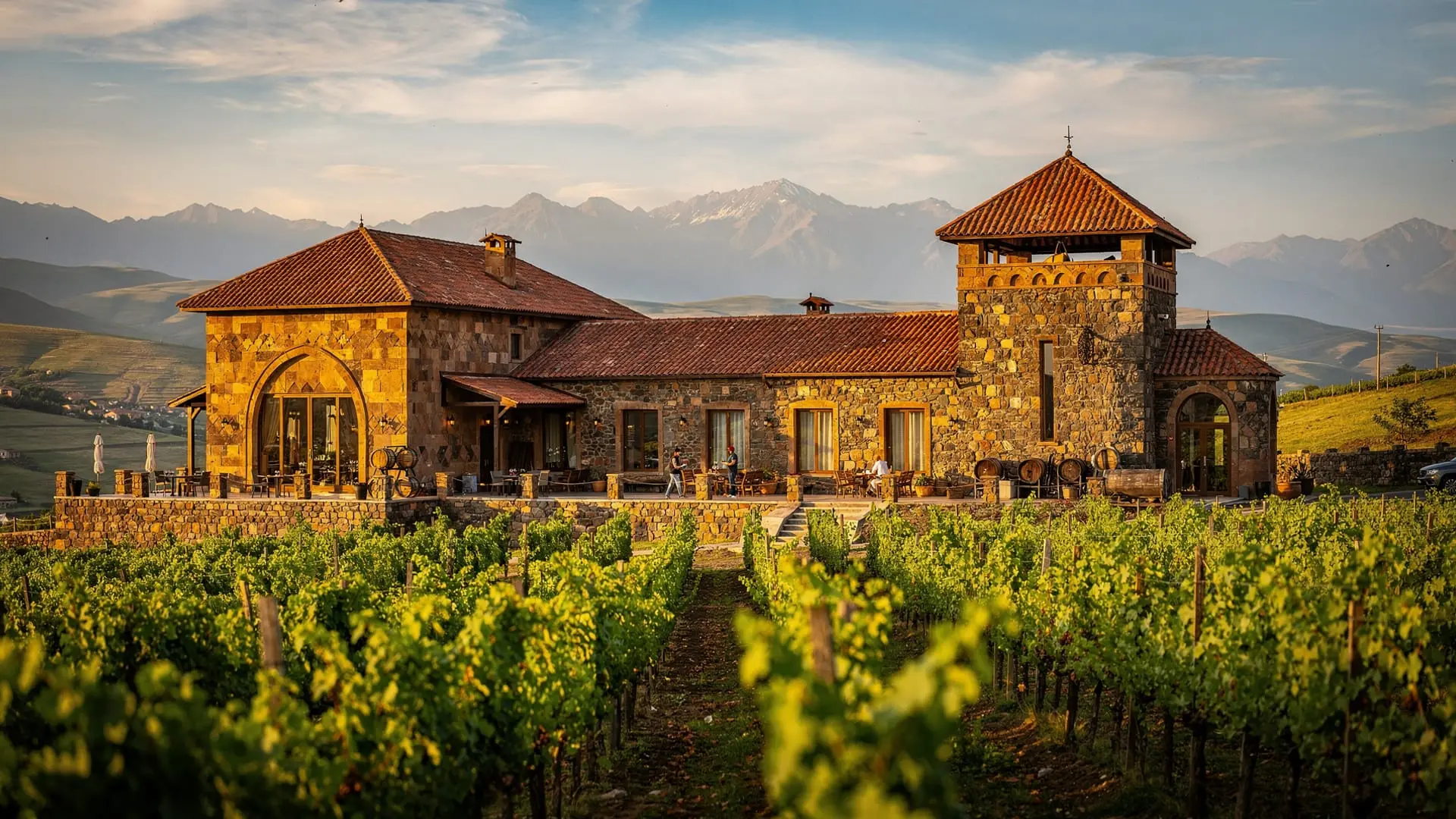
Armenia’s most accessible serious winery
Most of Armenia’s best wineries require a full day from Yerevan — the drive to Vayots Dzor alone is two hours each way. Voskevaz is the exception. Sitting roughly 35 km northwest of the capital in the Aragatsotn province, at the foot of Mount Aragats, it offers a genuinely serious tasting experience within easy striking distance of the city. An afternoon at Voskevaz, combining a cellar tour with a restaurant lunch and a comprehensive tasting, is one of the most satisfying wine experiences in Armenia for visitors with limited time or without a car.
| Where | Voskevaz village, Aragatsotn (35 km / 40–50 min from Yerevan) |
| Cost | Tastings around 5,000–10,000 AMD (12–24 EUR); lunch 8,000–15,000 AMD |
| Time needed | Half-day (3–4 hours including lunch) |
| Getting there | Rental car, GG Taxi (~4,000–5,000 AMD), or a guided day tour |
| Best time | Open year-round; September–October for harvest, April–May for spring light |
The winery is located near the village of the same name — Voskevaz — which sits on the slopes below Aragats at an elevation of around 1,400 metres. This elevation is significant: the volcanic soils and diurnal temperature swings of Aragatsotn produce wines with a different character from Vayots Dzor, generally showing a more pronounced mineral structure and slightly different fruit profile. Voskeat, the indigenous white variety that the winery has done more than any other producer to revive and publicise, grows particularly well here.
History and philosophy
Voskevaz was established in 2008 as one of the early post-independence boutique wineries in Armenia. The founders were committed from the outset to indigenous Armenian varieties, and the estate has been instrumental in the commercial revival of Voskeat — a white grape that was nearly lost during the Soviet period when industrial production favoured international varieties and bulk output.
Today Voskevaz farms approximately 25 hectares across Aragatsotn, with additional sourcing from trusted growers in Vayots Dzor for Areni Noir and other varieties. The winery has invested significantly in its production facility over the past decade: modern temperature-controlled fermentation tanks, a range of ageing vessels from French oak to clay, and a state-of-the-art bottling line.
The approach blends technical precision with a genuine commitment to Armenian genetic heritage. This combination — reproducible consistency plus indigenous identity — makes Voskevaz one of the most export-friendly wineries in the country.
The wines
Voskeat (white)
This is Voskevaz’s definitive wine and the reason to seek out the estate specifically. The Aragatsotn Voskeat shows the variety’s characteristic quince, beeswax, and dried apricot notes, with a mineral quality that is slightly different from Vayots Dzor examples — more chalky, less volcanic. The bitter almond finish is clean and persistent. The wine is produced in a standard version (approximately 5,500 AMD / 13 EUR at the winery) and a reserve expression (approximately 9,000 AMD / 22 EUR) aged for longer in large-format oak.
Areni Noir
Voskevaz sources Areni Noir from Vayots Dzor to complement its Aragatsotn-grown varieties. The wine is reliably made and approachable, if slightly less site-specific than the versions produced by estates farming their own Vayots Dzor vineyards. Pomegranate and dried cherry dominate; the palate is mid-weight with good acidity. Approximately 5,000 AMD (12 EUR) at the winery.
Karmrahyut and Kakhet
Both varieties appear in the Voskevaz range. The Karmrahyut is typically blended with Areni Noir to produce a structured, darkly coloured red blend. The Kakhet is increasingly offered as a skin-contact white with oxidative notes and walnut-and-dried-fruit complexity — a nod to the traditional Armenian practice of extended skin maceration.
Khndoghni (Sireni)
A lighter-bodied red with delicate cherry and rose notes, the Khndoghni is a good companion for the winery’s restaurant food, particularly dishes that would overwhelm a heavier wine.
International varieties
Voskevaz also produces small quantities of Chardonnay and Syrah for the domestic market, particularly for Yerevan restaurant menus where international varieties remain important for less adventurous diners. These are competently made but not the reason to visit.
The tasting experience
The Voskevaz tasting room occupies a well-designed space within the main winery building. Large windows look out toward the vineyard and the slopes of Aragats beyond; the room is calm and comfortable.
Standard tasting (five wines): approximately 5,000 AMD (12 EUR).
Extended tasting (seven to eight wines including reserves): approximately 8,500 AMD (21 EUR).
Cellar tour + tasting: a guided walk through the production facility followed by a five-wine tasting. Approximately 10,000 AMD (24 EUR). Available by advance booking.
Staff are English-speaking and knowledgeable. Tastings can be conducted in Armenian, English, Russian, or French depending on guide availability. The presentation emphasises the indigenous varieties and their historical background — the Areni-1 cave, the significance of 6,100 years of continuous Armenian winemaking — which provides useful context for visitors encountering these grapes for the first time.
The restaurant
Voskevaz’s restaurant is one of its strongest assets. The kitchen focuses on traditional Armenian dishes prepared with local seasonal produce:
- Aragats trout (sourced from mountain streams above Voskevaz; 5,500 to 7,000 AMD / 13 to 17 EUR)
- Lamb shoulder slow-roasted with herbs and pomegranate molasses (8,000 to 10,000 AMD / 20 to 24 EUR)
- Tolma (stuffed vine leaves and vegetables; 3,500 AMD / 8.50 EUR per portion)
- Cheese board with local cheeses, honey, dried apricots, and walnuts (4,500 AMD / 11 EUR)
- Lavash bread baked on-site in a traditional tonir oven
The wine list covers the full Voskevaz range plus a small selection from other Armenian producers. Corkage of an external bottle is generally not permitted; the winery-by-the-glass list is comprehensive enough to substitute.
Reservations for the restaurant are strongly recommended at weekends and essential during September and October. Weekday lunch without a booking is generally possible.
Vineyard lunch experiences
For larger groups or special occasions, Voskevaz offers a vineyard lunch format: a set meal served among the vines, with wine pairings across multiple courses. This experience requires advance booking (minimum four to six people) and costs approximately 18,000 to 25,000 AMD (44 to 61 EUR) per person including wine. The Wine tasting and vineyard lunch at Voskeni Winery on GetYourGuide offers a comparable format at another Aragatsotn estate — worth comparing the two when planning.
Getting to Voskevaz
By car from Yerevan: take the road northwest toward Aparan, then turn toward Voskevaz village via the Aragatsotn provincial road. The drive is approximately 35 km and takes 40 to 50 minutes from central Yerevan.
By taxi: a GG Taxi from central Yerevan costs approximately 4,000 to 5,000 AMD (10 to 12 EUR) each way. Arrange for the driver to wait if you do not want to call for a return taxi after your visit.
By organised tour: several tours from Yerevan include Voskevaz as a wine stop alongside Mount Aragats or Amberd fortress. The Amberd fortress and wine tasting day tour combines the fortress visit with a winery experience in the same Aragatsotn region.
Voskevaz is an excellent pairing with the monasteries of northern Aragatsotn — Hovhannavank, Saghmosavank, and the Armenian Alphabet Monument are all within 30 km. See the Aragatsotn destination page for a full itinerary combining wine and religious heritage in the province.
When to visit
Voskevaz is open year-round, making it more reliably accessible than the Vayots Dzor estates that close or reduce operations in winter. The best times are:
September and October: harvest energy, fresh-pressed juice sometimes available, and the grape-to-glass process visible in the winery.
April and May: spring light on the vineyards, Aragats occasionally snow-capped in the background, comfortable temperatures.
June through August: the vineyard is in full green growth. Summer weekends in particular bring crowds from Yerevan; book ahead.
Comparing Aragatsotn and Vayots Dzor wine styles
Visitors who have the time to taste at both Voskevaz and the Vayots Dzor producers will notice genuine stylistic differences rooted in terroir.
Aragatsotn wines (Voskevaz, Voskeni, ArmAs) tend toward a more mineral, somewhat leaner style. The volcanic soils here are less varied than Vayots Dzor’s complex mix of basalt, limestone, and alluvial deposits; the resulting wines have a cleaner, more defined mineral quality. White wines in particular (especially Voskeat) show well in this region.
Vayots Dzor wines generally show more aromatic generosity and slightly richer fruit — the warmer south-facing aspects and greater soil variety producing wines that are often more immediately expressive. The comparison enriches the experience of both.
For context on the Vayots Dzor side, see the Vayots Dzor wine route guide. For the comparison between Armenia’s two largest commercial producers (both with Aragatsotn connections), see the ArmAs and Karas guide.
Frequently asked questions about Voskevaz winery
Can I visit Voskevaz without a booking?
Yes — the winery welcomes walk-in visitors during regular hours (10:00 to 18:00 daily). The tasting room is generally staffed and operational without prior reservation. Groups of eight or more should book ahead. The restaurant requires a reservation at weekends.
Is Voskevaz suitable for a half-day trip from Yerevan?
Absolutely. The short drive (35 km, under an hour) makes it ideal for a half-day: tasting, lunch, and a walk through the vineyard takes about three to four hours total. You could combine it with a visit to the nearby Hovhannavank or Saghmosavank monasteries for a full-day Aragatsotn programme.
What should I buy at the winery shop?
The Voskeat reserve is the most distinctive bottle to take home — it represents a grape variety that most wine drinkers will not have encountered before. The Areni Noir reserve is a solid second choice. Both ship within Armenia; for international transport, wrap carefully in checked luggage.
Does Voskevaz produce any sparkling wine?
Occasionally, Voskevaz releases a traditional-method sparkling Areni Noir or Voskeat in limited quantities. Ask the tasting room staff about current availability.
What language do the guides speak?
English and Russian are reliably available. French is sometimes available. Armenian is always available. If you need Italian or German, ask when booking — arrangements can sometimes be made.
How does Voskevaz compare to visiting the Vayots Dzor wine route instead?
They serve different trip shapes rather than competing directly. Voskevaz suits a half-day from Yerevan when time is tight or you don’t want a full day dedicated to wine. The Vayots Dzor wine route has a greater density of estates and the Areni-1 cave for archaeological context, but requires a full day (or overnight) and a two-hour drive each way. If you can only do one, Vayots Dzor rewards the extra time; if you’re short on days, Voskevaz delivers most of the same wine education in a fraction of the travel time.
Can I visit Voskevaz on the same day as Amberd fortress?
Yes — this is one of the most popular Aragatsotn combinations. Amberd sits about 25 km from Voskevaz on the slopes of Mount Aragats. A typical day pairs a morning at Amberd (allow 1.5–2 hours, including the drive up) with an afternoon tasting and lunch at Voskevaz, or the reverse order if you prefer wine before the fortress climb.
The Aragatsotn terroir: what makes northern Armenian wine different
Vayots Dzor gets the headlines — the Areni-1 cave, the famous wineries, the annual festival — but Aragatsotn has its own compelling wine identity. The province is named for Mount Aragats, Armenia’s highest peak at 4,090 metres, whose slopes and foothills define the northern wine country. The vineyards at Voskevaz sit at around 1,400 metres, directly below Aragats’s southern face, on soils formed from volcanic ash deposits and ancient lava flows.
The volcanic origin of these soils is different from Vayots Dzor’s more varied geology. Aragatsotn soils are predominantly dark, mineral-rich, and heat-retentive — they absorb the sun’s warmth efficiently and release it slowly at night, moderating temperature extremes. Combined with the altitude (significantly cooler than the Ararat Valley floor, even in midsummer), this creates growing conditions that produce wines with a distinctive mineral intensity and a structural backbone that sets them apart from warmer-region expressions.
Voskeat shows this terroir particularly well. The grape’s naturally waxy, full-bodied character picks up an additional mineral layer in Aragatsotn — a chalky, stone-dust quality that is different from Vayots Dzor’s volcanic iron notes but equally compelling. Side-by-side tastings of Aragatsotn Voskeat and Vayots Dzor Voskeat are genuinely instructive and are one of the underappreciated pleasures of Armenian wine tourism.
Voskevaz and the revival of Voskeat
The grape variety Voskeat — “golden grape” in Armenian — came close to commercial extinction during the Soviet period. The Soviet agricultural model prioritised varieties that produced high yields of neutral-flavoured juice for bulk processing; Voskeat’s naturally lower yields and distinctive flavour profile made it commercially unattractive to collective farm managers who were paid per tonne rather than per quality point.
After independence, several producers recognised that Voskeat was a variety worth saving. Voskevaz was among the most committed. The winery sourced cuttings from the oldest surviving Voskeat vines in Aragatsotn — some over fifty years old, planted before the Soviet rationalisation — and began the slow process of replanting and expanding the varietal block. It also invested in winemaking techniques specifically suited to Voskeat: slow, cool fermentation to preserve aromatics, brief ageing in large-format vessels rather than small barriques (which would overwhelm the grape’s delicacy), and early bottling to retain freshness.
The result is a body of Voskeat wine that has educated both domestic and international buyers about the variety’s potential. Voskevaz did not discover Voskeat — it exists throughout Vayots Dzor and Aragatsotn — but it did more than almost any other producer to make the case that Voskeat belongs in the conversation alongside Areni Noir as a defining Armenian variety.
Aragatsotn beyond the winery: what else to visit
Voskevaz sits in a province that rewards broader exploration. The following sites are all within 30 to 40 km of the winery:
Hovhannavank monastery: a beautifully preserved 10th-to-13th-century monastery complex on the edge of the Kasakh River gorge, approximately 12 km from Voskevaz. The combination of medieval architecture, gorge views, and fruit orchards in the surrounding village is exceptional. See /destinations/hovhannavank/.
Saghmosavank monastery: another gorge-edge medieval monastery, 3 km from Hovhannavank. Often visited as a pair with it. See /destinations/saghmosavank/.
The Armenian Alphabet Monument at Artashavan: 46 stone letters of the Armenian alphabet, each the size of a person, arranged on a hillside above Artashavan village, approximately 15 km from Voskevaz. A surprisingly moving monument to Armenian linguistic identity. See /destinations/armenian-alphabet-monument/.
Amberd fortress: a 10th-century fortress on the slopes of Aragats at 2,300 metres, with views across the Ararat Valley to Mount Ararat on clear days. Approximately 25 km from Voskevaz. See /destinations/amberd-fortress/.
A full Aragatsotn day could move from Voskevaz (morning tasting and lunch) to Hovhannavank and Saghmosavank (early afternoon) to Amberd (late afternoon, if driving).
The role of Mount Aragats in the Voskevaz landscape
Tasting at Voskevaz with Aragats in your line of sight is one of Armenia’s more dramatic wine experiences. The mountain rises behind the winery — its four summits (the highest at 4,090 metres) are snow-covered for much of the year, and on clear days the mass of the mountain dominates the entire horizon to the north.
Aragats is not merely scenery. Its snowmelt feeds the mountain streams that provide water for Voskevaz’s vineyard irrigation in dry years. Its flanks shelter the vineyards from the most severe northern winds that would otherwise cause frost damage in spring and autumn. Its volcanic geological history literally underlies the soils in which Voskeat and Areni Noir grow.
The mountain has deep symbolic resonance in Armenian culture — it is the highest point on Armenian territory and has been a sacred site since pre-Christian times. For the Armenia wine country overview, the relationship between landscape, geology, and wine character is central; Voskevaz is one of the best places to experience that relationship directly.
Choosing between the standard tasting, the extended tasting, and the cellar tour
For a first-time visitor with roughly two hours, the standard five-wine tasting is the right call — it covers Voskeat, Areni Noir, and a red blend without overloading the palate before lunch. If wine is the main reason for your Aragatsotn trip and you have three hours or more, the cellar tour plus tasting is worth the extra cost: seeing the temperature-controlled tanks and the clay-vessel ageing room gives real context to what ends up in the glass, and the five wines poured afterward taste different once you understand how they were made. The extended tasting (seven to eight wines including reserves) suits genuine enthusiasts who want to compare the standard and reserve Voskeat side by side — the difference in oak influence and texture is the most instructive single comparison the winery offers. Groups mixing casual and serious wine drinkers often split: some join the cellar tour while others go straight to a relaxed tasting on the terrace.
Practical tips for a smooth visit
Book the restaurant separately from the tasting — walk-in tastings are usually possible, but weekend lunch tables fill up, especially September through October. Bring cash in AMD for smaller purchases at the shop, though card payment is accepted for larger transactions. Wear layers — the 1,400-metre elevation means noticeably cooler temperatures than Yerevan, particularly in the tasting room’s stone-walled section and on the outdoor terrace in the evening. Don’t rush the drive back — the road toward Aparan has some unlit stretches after dark; leaving before sunset is the more relaxed option if you are driving yourself rather than using a taxi or tour. If travelling with non-drinkers, ask about the vineyard walk or the cellar tour without tasting — Voskevaz accommodates visitors who want the experience and the views without the wine itself, and the restaurant menu stands on its own regardless of what you drink with it.