Trinity Canyon Vineyards: visit & tasting guide
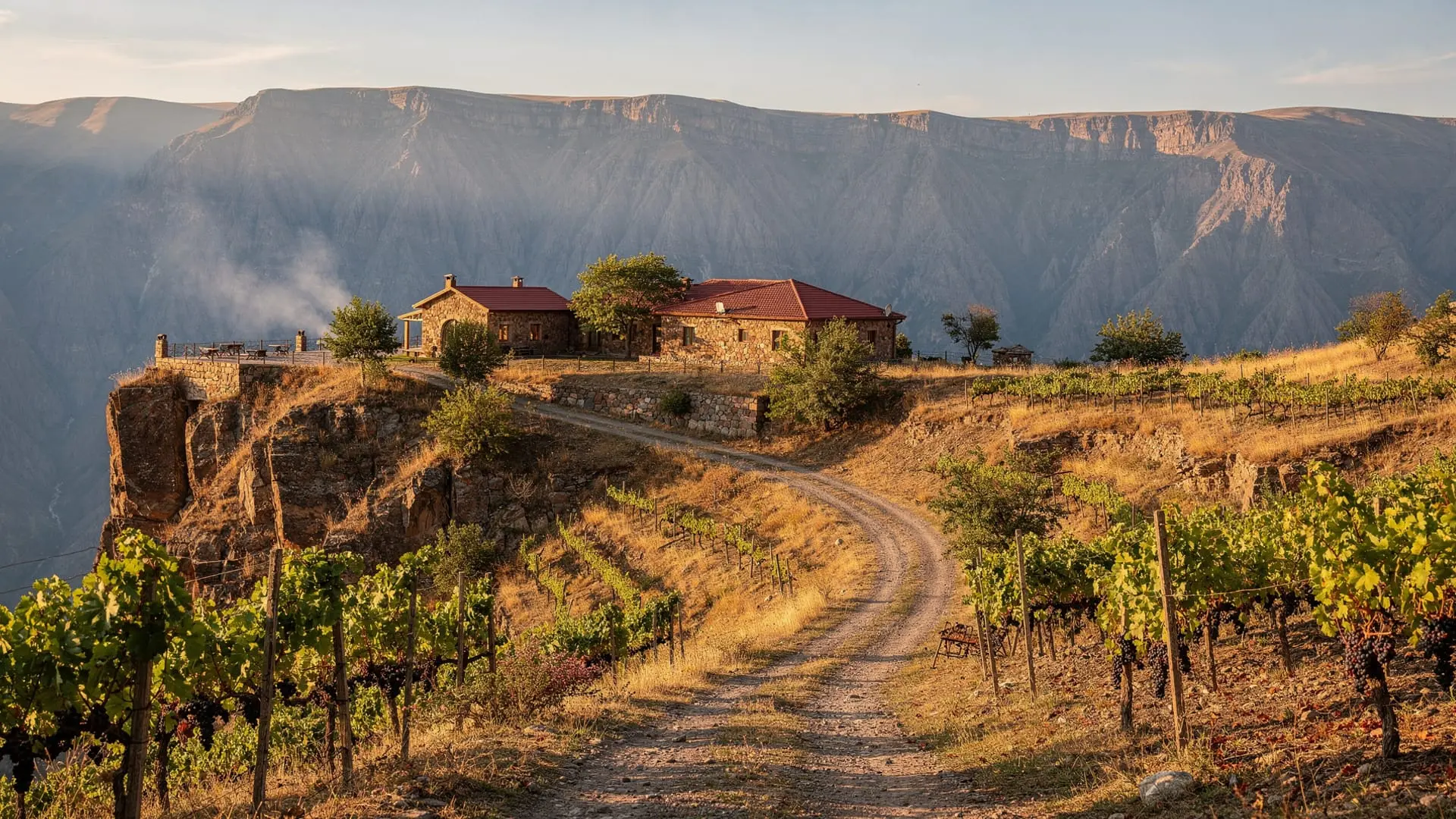
A hilltop winery with panoramic credentials
About 4 km north of Areni village, the road climbs steeply above the Arpa River gorge and delivers you to a flat terrace where Trinity Canyon Vineyards occupies one of the most commanding positions in Vayots Dzor. The winery building — stone-faced, low-profile, designed to sit harmoniously in the landscape — looks out over a series of basalt-walled canyons dropping sharply to the river below, with vineyard terraces cut into the slopes on both sides.
Trinity Canyon was founded in 2012 by three Armenian-American brothers with a clear ambition: to make world-class wine from Vayots Dzor’s indigenous varieties and to present Armenian winemaking to international visitors in a format they would recognise from Napa Valley or Burgundy — a polished tasting room, multilingual staff, structured flights, and wines that could hold their own in global competition. A decade and a half on, that ambition has been largely realised. Trinity Canyon Areni Noir regularly earns medals at international competitions, and the winery has developed a following among serious wine tourists visiting Armenia.
This guide covers what to expect, which wines to prioritise, and how to plan your visit.
| Where | 4 km north of Areni village, Vayots Dzor, ~120 km from Yerevan |
| Cost | Tasting flights ~4,000–12,000 AMD; bottles from ~5,000 AMD |
| Time needed | 1–1.5 hours for a standard tasting |
| Getting there | Self-drive (2h from Yerevan) or organised wine tour |
| Best time | Open daily April–October; book ahead September–October (harvest) |
The vineyards
Trinity Canyon farms approximately 15 hectares of vineyards spread across the terraced hillsides of Vayots Dzor, at elevations ranging from 1,100 to 1,600 metres above sea level. The soils are a complex mix of volcanic basalt, limestone, and alluvial material deposited by ancient flooding of the Arpa River — a combination that gives the wines their characteristic mineral backbone.
The primary varieties planted are Areni Noir (around 60% of total area), Voskeat (20%), and smaller parcels of Karmrahyut, Khndoghni (Sireni), and Kakhet. All farming is done by hand on the steep terraces, which are too narrow for machinery. Harvest typically runs from late August (Voskeat, white varieties) through mid-October (the latest Areni Noir parcels at the highest altitudes).
The estate does not currently hold organic or biodynamic certification, but the management approach is broadly sustainable — cover crops between vine rows, minimal chemical inputs, and water management using the natural drainage of the hillsides.
The wines
Trinity Canyon’s portfolio is built around three tiers: entry-level (labeled simply by variety), reserve, and a small production prestige cuvée that appears in the best vintages.
Areni Noir
Entry-level Areni Noir is aged for ten to twelve months in a combination of French oak and large-format wooden vessels. The result is a wine of immediate appeal: pomegranate and dried cranberry on the nose, a supple mid-palate, and a clean finish with moderate tannin. Very food-friendly. Retails at the winery for approximately 5,000 AMD (12 EUR).
Reserve Areni Noir receives eighteen months in new and second-fill French barriques. The nose is more complex — dried rose, dried herbs, and a deeper volcanic mineral quality alongside the fruit. The palate is structured, with silky tannins and a long, slightly bitter finish that integrates beautifully with age. This is the wine that has drawn critical attention. Winery price approximately 9,000 to 12,000 AMD (22 to 29 EUR).
The prestige cuvée (not produced every year) is a single-vineyard, low-yield expression from the estate’s highest-altitude Areni Noir parcels. When available, it typically commands 18,000 to 25,000 AMD (44 to 61 EUR) per bottle.
Voskeat
Trinity Canyon’s Voskeat is one of the most polished expressions of this indigenous white variety currently produced in Armenia. The wine is fermented in temperature-controlled stainless steel to preserve freshness, then aged briefly in large-format oak vessels to add texture. Notes of quince, beeswax, dried apricot, and the characteristic bitter almond finish. Excellent with Areni’s grilled river trout. Winery price approximately 7,000 AMD (17 EUR).
Other varieties
Karmrahyut is produced when yields permit as a varietal wine — dense, inky, blackberry-dominated. Worth trying if it is available.
Khndoghni (Sireni) is produced in small quantities: a delicate, aromatic red with fresh cherry and dried rose. Ideal chilled slightly in summer.
Kakhet-based skin-contact white appears occasionally under an experimental label. Ask the tasting room staff what is available on the day.
The tasting experience
The tasting room at Trinity Canyon is the most deliberately designed in the Areni area. Floor-to-ceiling windows frame the gorge view; a long bar runs the width of the room with the entire current range displayed behind it. Seating is at elevated bar stools or at low tables in a separate lounge area.
Standard tasting flight (three wines): approximately 4,000 AMD (10 EUR). A good introduction for visitors with limited time.
Premium tasting flight (five to six wines, including reserve and prestige cuvées when available): approximately 8,000 AMD (20 EUR). Recommended for serious wine enthusiasts.
Food pairing tasting (five wines with local food — cheese, cured meats, dried fruits, fresh bread): approximately 12,000 AMD (29 EUR). Requires advance booking and is offered on specific days only; check with the winery when making your reservation.
All flights are presented with tasting notes in English and Armenian. Staff are trained to discuss the history of Areni Noir, the role of the Areni-1 cave in establishing Armenia’s wine credentials, and the differences between terroirs within Vayots Dzor.
Opening hours and booking
Open daily 10:00 to 19:00 from April through October. November through March: open by appointment only.
Walk-in visitors are welcome during the April-to-October season, but pre-booking is strongly recommended in September and October (harvest season) and during the Areni Wine Festival (first Saturday of October). Groups of six or more should always book in advance.
Reservations can be made through the winery’s website or by calling the Yeghegnadzor tourist information office. The winery does not currently appear directly on online booking platforms.
Combining a visit with the Vayots Dzor wine route
For visitors who want more than a single winery stop, Trinity Canyon works naturally as one leg of a broader Vayots Dzor wine day. A sensible sequence starting from Yerevan: Areni-1 cave first (the archaeological context for everything that follows), then Hin Areni or a roadside tasting for the rustic reference point, then Trinity Canyon for the polished, internationally minded expression of the same grapes, finishing with lunch in Areni village before continuing to Noravank for the afternoon light on the red cliffs. This sequence takes a full day but avoids rushing any single stop, and it gives a genuine before-and-after sense of how far Vayots Dzor winemaking has developed in commercial ambition while staying rooted in the same indigenous varieties.
Getting there
From Yerevan by car: 120 km via the M2 highway south toward Goris. At Areni village, follow the road north toward Yeghegnadzor for approximately 4 km. The winery is signposted on the right. Total driving time approximately 2 hours.
From Areni village: a ten-minute drive or a 40-minute walk along the road.
By organised tour: multiple day tours from Yerevan include Trinity Canyon as a stop. The Vayots Dzor wine route day tour visits multiple wineries including Trinity Canyon and departs daily from Yerevan.
Combining Trinity Canyon with neighbouring sites
Trinity Canyon sits in the heart of the Areni wine cluster, making it easy to combine with other experiences in a single day.
Hin Areni winery (4 km south in the village) is the natural first stop, providing a different style reference for comparison with Trinity Canyon’s more structured approach. See the Hin Areni guide.
Areni-1 cave (a few minutes’ drive from the village) is the archaeological origin of Armenian winemaking and an unmissable stop in context. See the Areni-1 cave guide.
Noravank monastery (12 km south of Areni via a spectacular canyon road) is one of Armenia’s most photographed sites. The 13th-century complex of red-stone churches sits in a vertical-walled gorge that is extraordinary at any time of day but especially at late afternoon when the cliffs glow orange-red. See /destinations/noravank-monastery/.
Zorah and Yacoubian-Hobbs represent the pinnacle of Vayots Dzor wine ambition, growing their vines at over 1,700 metres in the mountains above Rind village. Both require appointments — details in the Zorah and Yacoubian-Hobbs guide.
For a full one- and two-day Vayots Dzor itinerary incorporating all these stops, see the Vayots Dzor wine route guide.
Wine to take home
The winery shop stocks the full range at prices below Yerevan retail. Trinity Canyon also sells a small selection of Armenian-made accessories — wine openers, tasting glasses, and locally produced food products. International shipping is not offered directly; pack bottles securely in checked luggage for the journey home.
The reserve Areni Noir and the Voskeat are the two wines most worth taking home as gifts. Both are available in the 750ml standard format; some prestige cuvées are available in magnums (1.5L) in the best vintages.
What makes Trinity Canyon different from other Areni producers
The Armenian wine scene in Vayots Dzor spans a wide range of styles and production philosophies. Trinity Canyon sits at the more technically polished end: French barrique ageing, temperature-controlled fermentation, a systematic approach to vineyard management. This is a strength for consistent quality and for communicating with international wine critics, though some visitors prefer the more rustic character of smaller family producers like Maran or the minimalist approach of Zorah.
If you are tasting broadly across Vayots Dzor, Trinity Canyon makes a useful reference point for what Areni Noir can achieve with conventional winemaking tools. Zorah (clay amphora, biodynamic) and Maran (traditional, small-scale, minimal intervention) offer the counter-perspectives. All three styles deserve exploration.
Frequently asked questions about Trinity Canyon Vineyards
Are vegetarian or vegan wines available?
Trinity Canyon does not currently publish information about fining agents used in production. If this is important to you, ask the tasting room staff directly; they can clarify which wines are unfined or fined with vegan-compatible agents.
Is the tasting room suitable for people with reduced mobility?
The winery building is accessible at ground level, and the main tasting room does not require steps. The terrace outside involves a small step down from the tasting room. For specific accessibility requirements, contact the winery before your visit.
Can I visit Trinity Canyon and Zorah in the same day?
It is possible but requires careful timing. Zorah requires a prior appointment and is located near Rind village, approximately 30 km from Trinity Canyon. A logistics-friendly order would be: Trinity Canyon tasting (morning), lunch in Areni, drive to Rind for a Zorah appointment (afternoon). Allow at least three hours total travel between sites.
What is the best vintage of Trinity Canyon Areni Noir?
The winery considers 2019 and 2021 to be its strongest vintages for the reserve Areni Noir. Both years delivered excellent acidity and concentration in Vayots Dzor; the 2021 in particular is drinking well now and is expected to continue improving for eight to ten years.
Do they offer private guided tours for corporate groups?
Yes, Trinity Canyon can arrange customised tasting experiences and vineyard tours for corporate groups. Contact the winery directly with your group size, dates, and any specific interests.
Can I combine Trinity Canyon with a Tatev day trip?
It’s possible if you start early — Trinity Canyon sits close to the main M2 route south, so a brief tasting stop on the way to or from Tatev adds only 20–30 minutes of detour. However, on an already long Tatev day, keep the stop brief (standard flight only) to avoid adding pressure to the schedule.
Do I need to book in advance outside of harvest season?
Not usually. April through August, walk-in visitors are welcome during opening hours without a reservation. Advance booking becomes genuinely useful from September through the Areni Wine Festival weekend in early October, when both harvest activity and tourist numbers peak.
The Armenian-American founders and their winemaking philosophy
Trinity Canyon’s origin story is distinctively diasporic. The three brothers who founded the winery in 2012 were born and raised in the United States — their grandparents had left Armenia generations earlier, as part of the successive waves of emigration that followed the 1915 Genocide and the upheavals of the Soviet period. Returning to Vayots Dzor to make wine was a deliberate act of reconnection with a homeland they had experienced primarily through family stories and diaspora culture.
The decision to name the winery “Trinity Canyon” — using an English phrase that describes the triple gorge visible from the estate’s hilltop position — reflects that dual identity: rooted in Armenian geography and terroir, but shaped by American investment, ambition, and business culture. The winemaking approach is correspondingly hybrid: French viticulture techniques applied to indigenous Armenian varieties in a landscape that has been producing wine for over 6,100 years.
This background shapes the visitor experience in subtle but noticeable ways. The tasting room is designed to meet the expectations of wine tourists from California or Burgundy — professional, multilingual, structured — while the content is entirely Armenian: the varieties, the landscape, the history. It is an effective combination for international visitors who want Armenia’s wine story presented in a familiar format.
Areni Noir at high altitude: what the elevation does to the wine
Trinity Canyon’s highest-altitude vineyard parcels — above 1,600 metres — produce noticeably different fruit from the valley-floor plots. The longer growing season at elevation (typically two to three weeks later than the valley) means that sugars accumulate more slowly, acid retention is higher, and the grape develops aromatic complexity that shorter, hotter growing seasons cannot produce.
In practice, this translates to the differences between Trinity Canyon’s standard and reserve bottlings. The standard version draws on valley and mid-altitude fruit: accessible, fruit-forward, with ripe tannins. The reserve draws primarily on the high-altitude parcels: more austere in youth, with a tension between ripe fruit and refreshing acidity that resolves beautifully over three to five years of cellaring.
The very highest parcels — above 1,600 metres — go into the prestige cuvée in good years. This wine is harder to find (production is tiny) but is worth seeking out if you visit during harvest. The altitude creates a mineral quality that is distinct from everything below: iron-inflected, precise, long.
The Vayots Dzor landscape: what to notice when tasting
The view from Trinity Canyon’s terrace is a useful aid to understanding what you are tasting. The gorge below the estate drops sharply to the Arpa River, whose waters are fed by snowmelt from the mountains to the east. The soils on the steep terrace walls change visibly as you look: grey-black volcanic basalt at the top, lightening to limestone and pale alluvial deposits toward the river.
Each soil type gives different characteristics. Basalt retains heat and adds a mineral, almost smoky quality to the wine; limestone adds freshness and floral delicacy; alluvial deposits near the river produce rounder, richer fruit. Trinity Canyon farms across all three zones, and the art of the reserve blend is in proportioning each character to produce something greater than any single parcel.
The landscape also helps explain why Areni Noir and not an international variety is the right grape for this place. A thin-skinned, high-acid red needs warmth to ripen properly but benefits enormously from cool nights that preserve its aromatics. Vayots Dzor provides exactly that combination: hot summer days, cold nights, dramatic elevation changes within a few kilometres. No Cabernet Sauvignon or Pinot Noir has been grown here as long or grown as well.
How Trinity Canyon compares on value
Visitors tasting across several Areni-area wineries in one trip often ask where Trinity Canyon sits on price versus quality. A useful frame:
| Winery style | Typical tasting cost | What to expect |
|---|---|---|
| Roadside family tasting rooms (Areni village) | 800–1,500 AMD/bottle, informal tastes | Rustic, homemade, highly variable quality, genuine local character |
| Hin Areni | ~3,000–5,000 AMD flight | Visitor-ready, English-speaking, solid indigenous-variety introduction |
| Trinity Canyon | 4,000–12,000 AMD flight | Polished, structured, internationally competitive Areni Noir and Voskeat |
| Zorah / Yacoubian-Hobbs | Appointment required, premium pricing | High-altitude, biodynamic/amphora, the top tier of Vayots Dzor ambition |
For visitors with time for only one stop, Trinity Canyon is the most reliable choice for consistent quality and an English-language explanation of Armenian wine history. For a fuller picture of the range, pairing it with a roadside tasting or Hin Areni shows the contrast between polished and rustic styles within a few kilometres of each other.
Seasonal photography: the vineyard through the year
For visitors who also photograph:
Late October to November: harvest is complete, leaves are turning yellow-gold, the limestone cliffs catch low autumn light in spectacular fashion. The gorge below fills with morning mist.
April to May: bud break, vivid green growth on the terraces. Mount Aragats occasionally visible to the north with its snow-capped summits.
July to August: full green canopy, deep blue sky, and the sharp vertical lines of the basalt walls making strong geometric compositions.
December to March: the vineyards are bare canes on stone terraces — austere and beautiful in a different way, particularly after light snow.