Hovhannavank: above the Kasakh gorge
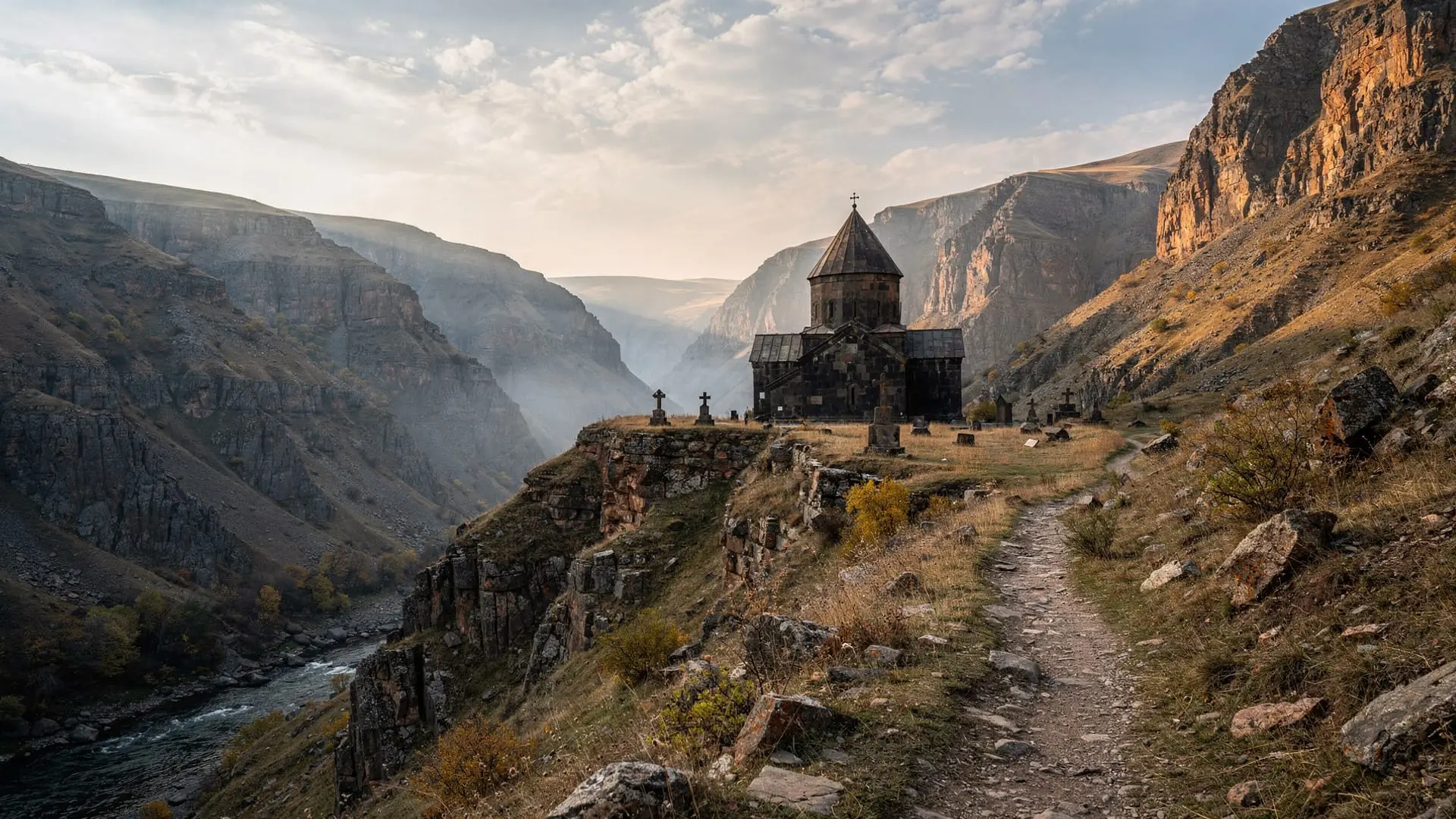
The lesser-known twin monastery above the Kasakh
Hovhannavank (the Monastery of St John the Baptist) occupies a promontory above the Kasakh river gorge in Aragatsotn province, 45 km northwest of Yerevan. It is the partner monastery of Saghmosavank, built by the same noble patron on the same canyon edge in the early 13th century. Despite sharing the same geological drama and medieval history as its sibling 5 km north, Hovhannavank is even less visited — a gap in the tourism circuit that benefits the genuinely curious traveller.
The monastery is in active liturgical use, a proper architectural complex rather than a ruin, and it stands against a canyon backdrop that would make it a signature attraction in almost any other country.
| Where | Ohanavan village, Aragatsotn, 45 km northwest of Yerevan |
| Cost | Free entry, donation appreciated |
| Time needed | 1–1.5 hours (3 hours combined with Saghmosavank) |
| Getting there | Car or taxi, around 45 minutes from Yerevan; no direct marshrutka |
| Best time | April–June and September–October, morning to early afternoon light |
Why this monastery matters
Hovhannavank was built under Prince Vache Vachutian of the Vachutian family — a noble house that administered Aragatsotn on behalf of the Zakarian princes of Georgia-Armenia in the early 13th century. The Zakarids created the conditions for one of the most productive periods of Armenian ecclesiastical architecture; their client nobility commissioned dozens of monasteries across northern and central Armenia in the period 1190–1260.
St John the Baptist (Surb Hovhannes Mkrtich) is one of the most venerated figures in the Armenian Apostolic tradition. Monasteries dedicated to him served not only as religious centres but as major pilgrimage destinations. The dedication tells us that Hovhannavank was intended for significant public use, not merely monastic contemplation.
The monastery belongs to the Armenian Apostolic Church, an Oriental Orthodox denomination. It is served by a small number of monks and receives visitors regularly.
History
- 4th–5th century (tradition): Local tradition holds that an early church existed on the site following Armenia’s Christianisation, though the present structures are medieval.
- Early 13th century: Prince Vache Vachutian builds the main cathedral and gavit in a single campaign — one of the most compressed building programmes in Armenian medieval architecture.
- 1216 AD: The Cathedral of St John (Surb Hovhannes) is completed. This date is carved in an inscription on the main church.
- 1221 AD: The gavit (narthex-hall) is added — the finest architectural element of the complex.
- Mid-13th century: Additional chapels and fortification walls built.
- 14th–17th centuries: Gradual decline and partial damage; the community survives but diminishes.
- 20th–21st centuries: Restoration work, renewed religious activity.
What to see at the site
Cathedral of St John (Surb Hovhannes, 1216): The main church, a domed basilica of dark basalt following the classical Armenian cross-dome plan. The exterior drum bears fine blind arcading. The entrance portal has a carved tympanum with the characteristic Zakarian-period interlace patterns.
The gavit (1221): The most architecturally significant element of the complex. The large vestibule-hall was built five years after the main church and shows a refinement of detail that suggests an accomplished atelier was working on the commission. The ceiling system — a series of interlocking arches rising to a central oculus — is executed with particular precision. Carved khachkars and funerary inscriptions line the interior walls.
Church of St Karapet (secondary chapel): A smaller chapel attached to the north side of the main church, probably 13th century. Simpler decoration, intimate in scale.
Defensive walls: The monastery is enclosed by thick walls that incorporate natural cliff edges on the canyon side. Walk the perimeter — the drop into the gorge below is steep and unguarded, providing a visceral sense of the monastery’s defensive and contemplative position.
Canyon views: The gorge below Hovhannavank drops about 150 metres to the Kasakh river. The basalt column formations in the gorge walls are distinctive — hexagonal volcanic columns, similar to those at Garni’s Symphony of Stones, visible from the monastery terrace.
How to get there
By car: From Yerevan, take the M1 northwest toward Gyumri. After about 40 km, follow signs to Ohanavan village (the Armenian rendering of “Hovhannavank”). The monastery is at the edge of the village, clearly visible on the canyon rim. Total time: approximately 45 minutes.
By tour: Hovhannavank is included in some Aragatsotn circuits.
Private tour to Amberd, Hovhannavank, and Saghmosavank From Yerevan: Kasakh Gorge TrekkingBy marshrutka (indirect): Marshrutkas from Yerevan toward Gyumri pass through the Kasakh valley area. Ask to be dropped at the Ohanavan turn; the village and monastery are a 10-minute walk from the main road.
Photography and best light
Hovhannavank faces south-southeast, meaning late morning to early afternoon light (10:00–14:00) hits the main church facade directly. The gorge behind and below the monastery is deeply shadowed in morning but catches diffused light through the day.
Autumn is the standout season: the scrub and small trees on the gorge walls turn amber and red, creating a natural frame for the dark monastery buildings. The basalt column formations in the gorge wall photograph well with a telephoto lens from the monastery terrace.
The interior of the gavit is well-proportioned and benefits from a wide-angle lens. The light entering through the west door in the afternoon is the best natural illumination.
Combining with other sites
Hovhannavank and Saghmosavank form a natural pair:
- Saghmosavank (5 km north): visit in the same half-day — see Saghmosavank: the psalm-monastery above the canyon
- Armenian Alphabet Monument (25 km northwest): roadside cultural stop
- Amberd fortress (40 km northwest): 7th-century hilltop fortress on Aragats slopes
- Mount Aragats (55 km northwest): full-day extension for hikers — see the Mount Aragats destination guide
- Kasakh gorge trekking: the gorge between Hovhannavank and Saghmosavank can be walked — see Kasakh gorge trekking guide
Practical visit info
Entry fee: Free. Donation appreciated.
Opening hours: Dawn to dusk. The main church may be locked on weekdays when monks are not present; the grounds and terrace are always accessible.
Dress code: Shoulders and knees covered; women cover heads.
Facilities: None on site. Ohanavan village has a small shop. Bring water and snacks.
Safety at the gorge edge: The canyon rim is unfenced in most places. Do not approach the edge casually — the drop is sheer and significant. Supervise children closely.
Best season: April–June and September–October. Winter is cold but accessible by car in most conditions.
The Zakarian period and the cultural context
Hovhannavank was built at the apex of the Zakarian cultural flourishing — the period between about 1190 and 1240 when Armenian noble families, operating under the protection of the Georgian crown, invested massively in ecclesiastical architecture across northern and central Armenia. The Vachutian family, who built both Hovhannavank and Saghmosavank, were part of this broader network.
Prince Vache Vachutian administered the Kasakh valley. His decision to build two major monasteries on the canyon walls — dedicated to different saints, serving different but complementary functions — reflects both personal piety and the strategic use of religious patronage as political display. Medieval Armenian nobility signalled their legitimacy and status through the quality of their church-building programmes; Hovhannavank and Saghmosavank together represented a substantial investment in the Vachutian family’s reputation.
The monastery belongs to the Armenian Apostolic Church, an Oriental Orthodox denomination — not Catholic and not Eastern Orthodox. The Armenian Apostolic Church separated from the wider Christian community at the Council of Chalcedon (451 AD) over Christological questions and has maintained its own theological and liturgical tradition since that date. The liturgical calendar, the musical tradition (sharakans), and the architectural conventions you see at Hovhannavank all reflect this specific heritage.
Aragatsotn’s landscape and the Kasakh river
The Kasakh river flows south from the Aragats massif, carving through a plateau of volcanic basalt before entering the Ararat plain. The gorge at Hovhannavank and Saghmosavank is one of the most dramatic natural features in central Armenia — not because the gorge is the deepest (it is not) but because of the extraordinary quality of the basalt formations. The cliff walls show hexagonal columnar jointing identical to the famous basalt columns at Garni’s Symphony of Stones — the same geological process, the same volcanic origin, but here on a canyon-wall scale rather than a valley-floor scale.
In spring, the gorge floor carries a strong torrent from Aragats snowmelt. By late summer, the river shrinks to a modest stream threading between boulders. In autumn, the scrub vegetation on the lower cliff ledges turns amber; in winter, icicles form on the cliff faces and the monastery roof accumulates snow.
Standing on the monastery’s western terrace and looking down into this gorge, with the dark water far below and the basalt walls rising on both sides, gives an immediate sense of why medieval monks chose this location. It is both beautiful and unnerving — the kind of place that sharpens attention.
Seasonal guide for visitors
April–May: The finest spring months. The Aragatsotn plateau turns green, wildflowers appear, and the gorge vegetation is vivid. Temperatures are mild (10–20°C) and the monastery is largely visitor-free on weekdays. This is also when Aragats is most dramatically snow-capped behind the monastery terrace.
June–July: Warm, increasingly dry. The plateau grasses yellow. The monastery is quiet but the midday sun is strong. Bring water; there is no source on site.
August: Hot and dusty. Hikers heading for Aragats summit may pass through Ohanavan village, but the monastery itself remains uncrowded. Early morning visits are most comfortable.
September–October: Optimal. The plateau air cools and clears. The gorge vegetation turns. The light is long and golden. October is the single best month to photograph Hovhannavank.
November–March: Cold and quiet. The approach to Ohanavan village is paved and accessible in most winter conditions. The monastery has a stark, contemplative quality in winter fog or snow that is quite different from the warm-season experience.
Budget and practicalities for independent visitors
Hovhannavank is one of the most cost-effective religious heritage destinations in Armenia — it is free to enter, requires no guide, and is reachable independently with minimal cost. A GG Taxi from Yerevan to Ohanavan and back costs approximately AMD 6,000–8,000 (EUR 15–20), or AMD 10,000–12,000 with a 1.5-hour wait at the monastery. Car hire from Yerevan at AMD 15,000–20,000 per day allows a full Aragatsotn circuit without the taxi complexity.
Petrol: fill up in Aparan or Yerevan before heading to the gorge. The nearest petrol station to Ohanavan village is in Aparan, about 15 km away.
The karst and basalt geology of the Kasakh gorge
The Kasakh gorge cuts through a plateau of Quaternary volcanic basalt — the same material that dominates northern and central Armenia. But the gorge at Hovhannavank and Saghmosavank shows something particular: regular hexagonal columnar jointing in the cliff walls, identical in formation to the famous basalt columns at the Symphony of Stones in the Azat gorge (near Garni, about 45 km southeast as the crow flies).
These columnar basalt formations develop when lava flows cool slowly. The cooling process creates contraction fractures in a regular hexagonal pattern — the most efficient geometry for packing stress across a flat surface. The result is cliff walls that look architecturally constructed: vertical columns of dark stone, side by side, as if placed by enormous hands.
Medieval Armenian builders understood this visual language. The dark volcanic tuff (a softer, more easily carved volcanic stone quarried from local deposits) used for Hovhannavank and Saghmosavank echoes the colour and texture of the natural gorge walls. The monasteries look grown from the landscape rather than placed on it — a formal choice that reflects centuries of building in volcanic stone.
Armenian monasteries as economic institutions
Hovhannavank and Saghmosavank were not purely contemplative communities. Medieval Armenian monasteries were complex economic entities: they owned land, collected rents from peasant farmers, operated mills and oil presses, maintained herds, produced wine and oil, managed road tolls at strategic canyon crossings, and traded with urban markets.
The size of the Hovhannavank gavit suggests a significant economic function. The vestibule was large enough to serve as a market space or assembly hall for the surrounding agricultural community; inscriptions record donations of land and water rights from noble patrons, confirming the monastery’s role as a local economic power.
This economic dimension helps explain why medieval Armenian nobles competed to fund monastery construction. A well-endowed monastery increased the prosperity of the surrounding territory, attracted pilgrims who spent money in the area, provided legal and scribal services to the population, and accumulated the kind of manuscript and relic collections that gave prestige. Hovhannavank was an investment in the Vachutian family’s long-term reputation and regional influence, not merely an act of personal piety.
The Aragatsotn wine tradition
Aragatsotn province is increasingly recognised as one of Armenia’s emerging wine regions. The vineyards of the Kasakh valley and the slopes of Aragats — at altitudes between 1,200 and 1,500 metres — produce grapes with high natural acidity and aromatic intensity. Voskevaz winery, the best-known producer from Aragatsotn, bottles wines from varieties including Kangun, Khatouni, and Haghtanak.
This wine connection adds a potential stop to an Aragatsotn day: Voskevaz winery (in the village of Voskevaz, about 30 km south of Hovhannavank) offers tours and tastings by appointment. Combining a morning at Hovhannavank and Saghmosavank with an afternoon at Voskevaz makes a productive day with real variety. See the Voskevaz winery guide.
Ohanavan village
Hovhannavank is at the edge of Ohanavan village — the Armenian rendering of “Hovhannes-avan,” village of John. It is a quiet agricultural village with a few hundred residents. The local economy depends on agriculture (particularly apricots, cherries, and walnuts in season) and small-scale livestock farming.
The village has no visitor infrastructure (no cafe, no guesthouse), but the local residents are generally helpful to tourists who treat the place with respect. In late summer, stalls along the road sometimes sell fresh walnuts and dried fruits — worth stopping for.
Frequently asked questions about Hovhannavank
How long should I spend at Hovhannavank?
Allow 1–1.5 hours to explore the complex thoroughly, including the gorge perimeter walk. Combined with Saghmosavank (another 1.5 hours, 5 km north), this makes a 3-hour half-day. Add driving from Yerevan (45 min each way) and you have a comfortable 5-hour morning.
Is Hovhannavank worth visiting if I have already seen the larger monasteries?
Yes. Hovhannavank is not Geghard or Tatev in scale, but it has something those sites do not: the gorge setting combined with an uncrowded, intimate atmosphere. The gavit is architecturally equal to the best in Armenia. If you are spending more than 5 days in Armenia and have already done the main circuit, Hovhannavank is a rewarding addition. See 12 monasteries as day trips from Yerevan for context on where it ranks.
What is the Kasakh gorge trek and is it difficult?
The Kasakh gorge can be walked on a rough path between Hovhannavank and Saghmosavank (approximately 5 km, 1.5–2 hours one way). The path is not marked but is generally followable. The terrain is moderate — steep in places, with some scrambling required. It is one of the best short hikes in central Armenia. See the Kasakh gorge trekking guide.
How do I get from Hovhannavank to Saghmosavank?
By car: 5 km on a paved road, 10 minutes. By foot through the gorge: 5 km on a rough path, 1.5–2 hours. The gorge walk is scenic and manageable in dry weather with proper footwear. By road is simpler for most visitors.
What is a gavit and why is Hovhannavank’s notable?
A gavit (also called zhamatun or narthex-hall) is a large vestibule structure attached to the west end of an Armenian church. It served as a congregation space, a burial place for noble patrons and bishops, and a meeting hall for the monastic community. Hovhannavank’s gavit (1221) is notable for the precision of its ceiling vault — a sequence of interlocking arches that creates a complex ribbed pattern without mortar, relying on careful stone geometry. This type of ceiling, common in Zakarian-period buildings, has no direct parallel in Western medieval architecture and represents one of the original contributions of Armenian medieval engineering.
Are there khachkars to see at Hovhannavank?
Yes. Several khachkars (decorated cross-stones) are embedded in the exterior walls of the monastery, and a few stand independently in the grounds. The khachkar tradition — carving ornamental crosses in stone — was central to Armenian religious practice for over a thousand years, and the examples at Hovhannavank include some fine 13th-century work. For the deepest engagement with the khachkar tradition in the region, the Noratus cemetery (on Lake Sevan) holds the largest single collection. See the Noratus khachkar cemetery guide.
Is Hovhannavank suitable for a self-drive itinerary without a guide?
Yes, and many independent visitors prefer it that way. The road from Yerevan is paved and well-signed, parking is informal and free at the village edge, and the monastery grounds carry enough interpretive information (plus this guide) to make sense of what you are looking at without a guide. A rented car or a GG Taxi with a return wait is the simplest independent option; see the renting a car in Armenia guide for the practicalities of self-drive touring in Aragatsotn.
What should I combine Hovhannavank with if I only have a half-day?
Saghmosavank is the obvious pairing — five minutes apart by car and built by the same patron, so the architectural comparison is immediate. If you prefer variety over repetition, swap Saghmosavank for the Armenian Alphabet Monument (a short roadside stop 25 km northwest) or extend toward Amberd fortress for a fuller Aragatsotn day. Drivers pressed for time should still budget the full 1–1.5 hours at Hovhannavank itself; rushing the gavit and the gorge-edge walk defeats the point of coming this far off the main tourist circuit.
Practical notes for photographers and quiet-seekers
Hovhannavank rewards visitors who are willing to wait rather than shoot and leave. The gavit especially benefits from patience: direct sun through the west door moves across the stone floor over roughly 20 minutes in the afternoon, and the best interior shots come from timing your visit to that window rather than arriving at a fixed hour. Tripods are not restricted but are rarely necessary given the available light.
Weekday mornings (Tuesday–Thursday, 9:00–11:00) are the quietest window at the site — Hovhannavank receives a fraction of Geghard’s or Garni’s visitor numbers even at peak season, and on an off-season weekday you may have the entire gorge-edge terrace to yourself. This solitude is arguably the monastery’s single greatest asset over its more famous rivals, and it is worth planning around if an uncrowded, contemplative visit matters to you more than ticking off Armenia’s best-known sites.