Saghmosavank: the psalm-monastery above the canyon
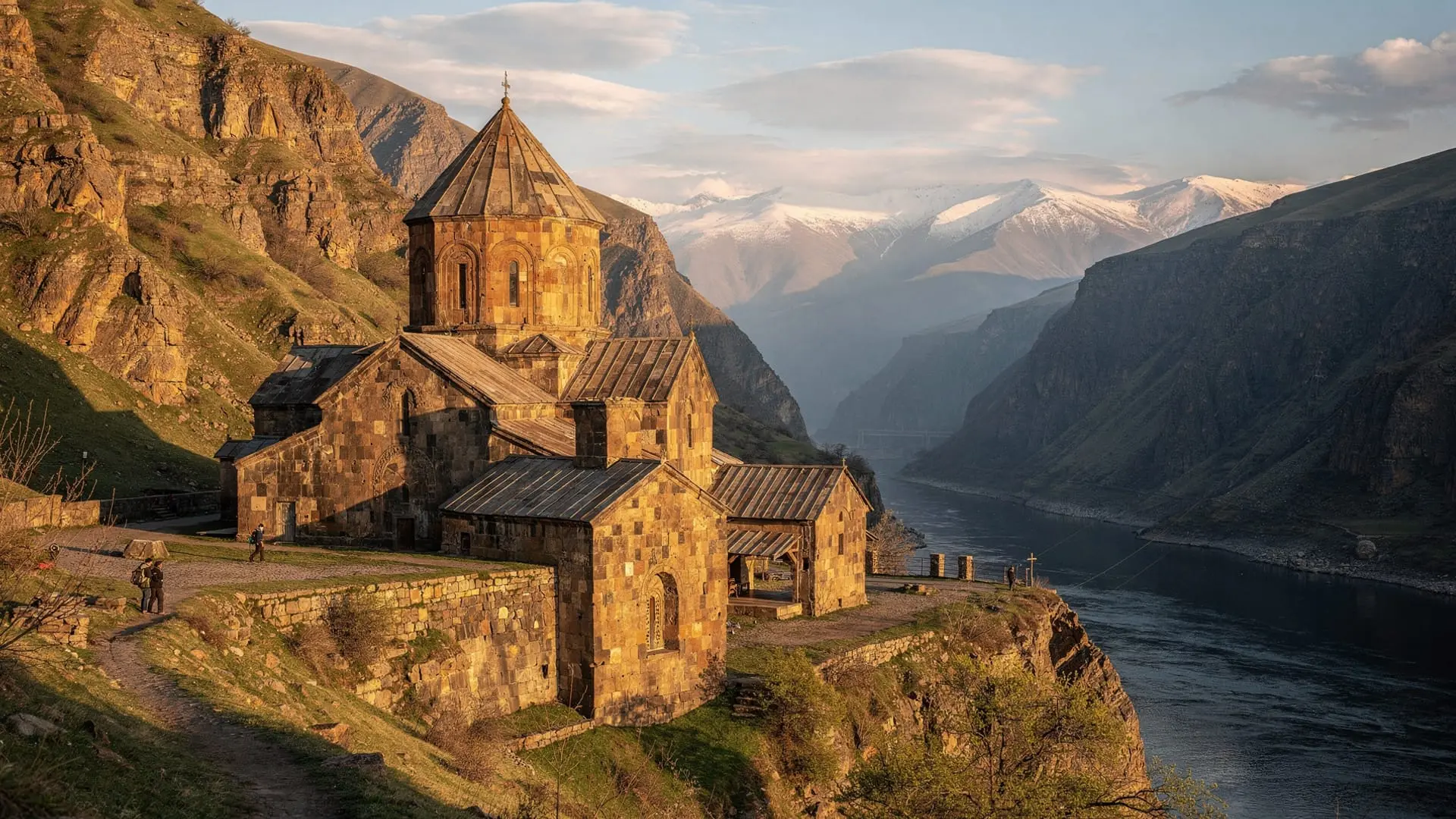
A monastery on the edge of the world
Saghmosavank — “psalm monastery” in Armenian, named for the liturgical singing that echoed through its halls — occupies a narrow ledge at the top of the Kasakh river gorge, 50 km northwest of Yerevan. The gorge here drops roughly 200 metres in sheer basalt walls; the monastery sits at the very edge, with the canyon opening behind it and the Aragatsotn plateau ahead. It is one of the most dramatically positioned monasteries in the South Caucasus, yet it appears on few standard tourist itineraries, which is simultaneously bewildering and a considerable advantage.
The monastery is a genuine medieval complex — not a ruin, not a reconstruction — with structures dating from the 13th century. It belongs to the Armenian Apostolic Church and remains in occasional liturgical use.
| Where | Saghmosavan village, Kasakh gorge, Aragatsotn, about 50km (50min) from Yerevan |
| Cost | Free entry (donation welcome) |
| Time needed | 1–1.5 hours; half a day combined with Hovhannavank |
| Getting there | Self-drive, marshrutka to Aparan + taxi, or an organised Aragatsotn tour |
| Best time | April–June or September–October; morning light (8–11am) for photography |
Why this monastery matters
Saghmosavank was built during the cultural flowering of the Zakarian period (early 13th century), the same patronage network that funded Haghpat, Sanahin, and the expansion of Geghard. Its name suggests that it functioned as a centre of liturgical music — psalm-singing (sharakans) was a central art form in Armenian monasticism, and monasteries that specialised in it were prestigious institutions.
The monastery’s location on the Kasakh gorge was deliberate. The gorge was a natural boundary and defensive feature; monastic communities often chose such sites for their combination of spiritual isolation and strategic visibility. The view from the terrace across the gorge to the mountains of Aragatsotn — with Mount Aragats’ four summits visible on clear days — would have been understood as a theological as well as an aesthetic statement.
Nearby Hovhannavank, just 5 km south, was built by the same patron (Prince Vache Vachutian) at roughly the same time. The two monasteries functioned as a complementary pair on the canyon walls.
History
- 4th century (tradition): A church is said to have been built on this site during Armenia’s early Christianisation, though no physical evidence survives.
- 1215–1235 AD: The main complex is built under Prince Vache Vachutian of the Vachutian noble house, a branch of the Zakarian client network.
- 1235: The Cathedral of the Dormition (Surb Astvatsatsin) is completed.
- Mid-13th century: Additional structures, gavit, and library built.
- 14th century and later: Partial damage from Mongol raids; gradual decline of the monastic community.
- 19th–20th centuries: Partial restoration.
What to see at the site
Cathedral of the Dormition (Surb Astvatsatsin, 1235): The main church, a domed basilica of dark volcanic tuff. The exterior carvings on the drum and drum windows are characteristic of late Zakarian stonework. The gavit (vestibule) attached to the west is nearly as large as the church itself, suggesting the monastery was used for large congregational gatherings.
The gavit: An unusual feature of Saghmosavank’s gavit is the carved ceiling, which incorporates both Armenian and Georgian decorative motifs — a reminder that the monastery operated within the broader Caucasian cultural sphere under the joint Armenian-Georgian Zakarian administration.
Church of St Zakaria (mid-13th century): A secondary church to the east, dedicated to the Zakarian patron saint. Smaller and more austere.
The gorge terrace: Walk to the western edge of the monastery grounds where the cliff drops away. The view into the Kasakh gorge is vertiginous and extraordinary — basalt columns, green river far below, and the opposite cliff wall in the same dark volcanic rock. This view alone justifies the detour.
Khachkars on the exterior walls: Several large carved khachkars are embedded in the outer walls. One attributed to the 13th century shows a particularly fine interlace border pattern.
Take your time at each of these — because so few visitors make it here, there is rarely any pressure to move quickly, and the site rewards a slower pace than the standard 20-minute stop typical of busier monasteries on a tight tour schedule.
How to get there
By car: From Yerevan, drive northwest on the M1 toward Gyumri, exit at Aparan, and follow roads to Saghmosavan village (approximately 50 km, 50 minutes). GPS to “Saghmosavank” works reliably. The final 3 km is a rough but passable road.
By tour: Saghmosavank is included in some Aragatsotn-focused tours from Yerevan, often combined with Hovhannavank, the Alphabet Monument, and sometimes Amberd fortress.
Mount Aragats, Saghmosavank monastery, and Alphabet Park day tour Private tour to Amberd, Hovhannavank, and SaghmosavankBy marshrutka (indirect): A marshrutka to Aparan (AMD 400, 1h) leaves from Yerevan’s Kilikia station. From Aparan, a shared taxi to Saghmosavan village costs AMD 1,000–1,500. Arrange a return pickup at the monastery.
Photography and best light
The monastery faces east, so morning light (08:00–11:00) is most direct. The gorge view from the west terrace is best in mid-morning when the sun illuminates the opposite cliff wall.
Autumn (October) is extraordinary here: the scrub vegetation in the gorge turns orange and red against the black basalt, and the plateau light is clear and golden. The combination of dark stone monastery, coloured gorge, and pale sky produces images that look saturated without being manipulated.
Combining with other sites
Saghmosavank anchors a productive Aragatsotn half-day:
- Hovhannavank (5 km south): the complementary monastery by the same patron — see Hovhannavank: above the Kasakh gorge
- Armenian Alphabet Monument (20 km northwest near Artashavan): the 2005 monument with 39 carved stone letters — popular, accessible, and photogenic
- Mount Aragats (50 km northwest): if combining with a full Aragatsotn day — see the Mount Aragats destination guide
- Amberd fortress (35 km northwest): medieval fortress on Aragats’s slopes — see the Amberd fortress guide
Practical visit info
Entry fee: Free. No donation box enforced, though a small contribution to monastery maintenance is welcome.
Opening hours: Dawn to dusk. The site is essentially always accessible. On weekdays, you may find the church locked; the grounds and gorge terrace are always open.
Dress code: Standard monastery modesty requirements apply. Shoulders and knees covered; women cover heads.
Facilities: None at the monastery itself. Bring water. The nearest facilities are in Aparan town (petrol, shops, cafes).
Road conditions: The approach road is unpaved for the final few kilometres and may be rutted after rain. Standard cars manage it in dry conditions; a higher-clearance vehicle is preferable after heavy rain.
Best season: April–June and September–October. The gorge is spectacular in autumn. Winter (November–February) is cold but the monastery is rarely inaccessible by road; snow on the plateau can make the approach difficult in January.
Reading the architecture at Saghmosavank
Saghmosavank’s Cathedral of the Dormition (1235) shows the Zakarian school in full maturity. Several specific features are worth identifying:
The drum and dome system: The dome rises on an octagonal drum set on a square base — the classic Armenian cruciform plan. The drum windows are paired, with thin stone tracery between the openings. The exterior of the drum shows blind arcading with carved moldings — decorative but structurally coherent.
The portal tympanum: Above the west portal, a carved semicircular tympanum shows interlace ornament with a central cross. The border molding is a double-bead-and-reel that echoes classical Armenian work from a century earlier, but with Zakarian-period elaboration.
The gavit ceiling: The large vestibule-hall attached to the west of the cathedral has a ceiling vault that shows both Armenian and Georgian decorative vocabularies. This mixed provenance reflects the Vachutian family’s position within the Zakarian network — a patronage system that incorporated both Armenian and Georgian noble traditions.
The khachkars: The most beautiful decorative element at Saghmosavank is not part of the main church at all but embedded in the outer south wall — a large 13th-century khachkar whose interlace border develops an unbroken knotwork pattern across the entire surface with no visible beginning or end. This is Zakarian-period stone carving at its finest: geometric logic, perfect craft, spiritual symbolism.
The Armenian Apostolic Church at Saghmosavank
Understanding the context of any Armenian monastery requires a brief note on the church that built and sustains these places. The Armenian Apostolic Church is an Oriental Orthodox denomination — it is not Roman Catholic and it is not Eastern Orthodox in the Greek or Russian sense. It separated from the mainstream Christian world at the Council of Chalcedon in 451 AD over a theological dispute about the nature of Christ, adopting a miaphysite position that Christ has one united divine-human nature. This places it in the same theological family as the Coptic Church of Egypt, the Ethiopian Orthodox Church, and the Syriac Orthodox Church.
At Saghmosavank, this identity is present in the architecture. The carved ornament — interlace khachkars, blind arcading, the stepped drum of the dome — is Armenian in tradition, not Byzantine and not Western Romanesque. The monastic community here served the local population and trained clergy in a distinctive Armenian liturgical and theological tradition. The sharakans (psalms and hymns) that gave the monastery its name were compositions in classical Armenian (Grabar), a literary language that the Armenian church preserved through centuries of political domination by Arab, Seljuk, Mongol, and Persian powers.
Aragatsotn: the province context
Saghmosavank sits in Aragatsotn province — named for Mount Aragats, the largest entirely-within-Armenia mountain, whose four summits (the highest at 4,090 metres) dominate the northern skyline from the Kasakh gorge edge. Aragatsotn is one of Armenia’s most historically significant provinces: it contains not only the Kasakh gorge monasteries but the Byurakan Observatory (one of the Soviet Union’s premier astrophysical research centres), the Alphabet Monument at Artashavan, Amberd fortress, and the summit of Mount Aragats itself.
The Kasakh river that carved the gorge below Saghmosavank flows south to join the Araks plain. Its valley was a significant agricultural and strategic corridor in antiquity and the medieval period, and the concentration of medieval monasteries along its rim reflects the prosperity of the communities it supported.
What the Zakarian patronage meant
The Zakarian dynasty — Armenian nobles who served the Georgian crown as generals and administrators in the 12th and 13th centuries — were the most important patrons of Armenian religious architecture between the fall of the Bagratid kingdom (1064) and the Mongol invasions (1220s–1240s). The period of Zakarian control, roughly 1190–1240, produced more major monastic building in Armenia than any other comparable period.
The Vachutian family, who built both Saghmosavank and Hovhannavank, were a junior branch of this network — nobles who administered the Kasakh valley on behalf of the Zakarids. Their investment in two monasteries on the same gorge rim was an act of dynastic prestige as much as religious devotion. Medieval Armenian nobles competed through church-building; the quality of a monastery’s carved ornament, the size of its gavit, and the prestige of the manuscripts it housed were measures of status.
This context matters for understanding the quality you see at Saghmosavank. The carved ceiling of the gavit, the blind arcading of the cathedral drum — these are not provincial work. They reflect the same high standards as the great Zakarian foundations further north (Haghpat, Sanahin), applied to a more modest commission. The builders were trained professionals working within a sophisticated architectural tradition.
Renting a car for the Kasakh gorge circuit
Because Saghmosavank and Hovhannavank sit outside the standard tour-bus routing, self-drive access genuinely changes the experience here more than it does at more heavily serviced sites. A rental car lets you time the visit for morning light, linger at the gorge terrace without a group’s schedule, and continue on to the Alphabet Monument or Amberd without waiting for a driver. The M1 route toward Aparan is in good condition, and the final unpaved stretch into Saghmosavan village is manageable for any standard compact car in dry weather. For visitors without a car, arranging a private driver for a half-day (rather than a fixed group tour) gives similar flexibility at a moderate premium, and is easy to arrange through most Yerevan guesthouses.
If self-driving is not an option, timing a group tour for its first stop of the day — rather than a late-afternoon addition — gives the best chance of quieter conditions and better light, since Saghmosavank faces east and the morning sun is genuinely more flattering here than the flat midday light most tour schedules default to.
Seasons at Saghmosavank
Spring (April–May): Wildflowers cover the Aragatsotn plateau and the gorge floor turns green. Snow may still cap Aragats. The monastery is empty of tourists; you may have it entirely to yourself on a weekday. April in particular is spectacular — temperatures mild, light clear and long.
Summer (June–August): Aragatsotn becomes hot and dry. The gorge scrub turns brown. The plateau grasses yellow. Hikers heading for Aragats pass through but few visit the monastery. July and August are the warmest months; the monastery provides shade but there is no water source on site. Bring two litres minimum.
Autumn (September–October): The finest season. The plateau air clears, the light drops in angle, and the low vegetation in the gorge turns gold and orange against the black basalt. October weekdays are perhaps the best single time to visit Saghmosavank — strong light, empty site, extraordinary colour.
Winter (November–March): The approach road can be treacherous after snowfall. The monastery itself is beautiful in snow — the dark basalt against white is striking — but verify road conditions before driving. Saghmosavank village is inhabited year-round; locals often have a sense of whether the final unpaved stretch is passable.
Saghmosavank vs the busier monastery circuit
Visitors planning a first trip to Armenia often default to the well-publicised southern loop — Khor Virap, Areni, Noravank — and never hear about Saghmosavank at all. That is a reasonable choice for a first, short visit, since those sites combine religious history with the Ararat view and wine tasting in a single efficient day. But for anyone with a second day to spend on monasteries, or anyone who found the southern loop’s crowds a little much, the Kasakh gorge circuit offers comparable architectural quality — Zakarian-period carving at the same standard as Haghpat and Sanahin — in a setting most tour buses skip entirely.
The practical trade-off is facilities: Saghmosavank has no café, no toilets, and no gift shop, while Khor Virap and Noravank both have basic visitor infrastructure. Anyone prioritising comfort over solitude should plan accordingly and bring their own water and snacks.
Amberd fortress, Saghmosavank monastery and Alphabet Monument tour from YerevanFrequently asked questions about Saghmosavank
What are the entry fees and opening hours for Saghmosavank?
Entry to Saghmosavank is free. No ticket, no donation box requirement — though a contribution to the maintenance fund is appreciated if you find a box near the entrance. The monastery grounds are accessible at all daylight hours; the main church may be locked on weekdays, but the exterior, the gorge terrace, and the khachkar wall are always accessible. No specific opening hours are enforced.
What should I bring for an independent visit to Saghmosavank?
Water (at least 1.5 litres — no water source on site), snacks (nearest café is in Aparan, 15 km), cash (no card payment, no ATM), a headscarf for women (required inside the church), comfortable shoes suitable for unpaved ground, and a phone with offline maps downloaded before leaving Yerevan. In summer: sunscreen and a hat — the monastery terrace is exposed. In spring or autumn: a light jacket for the gorge edge, which catches wind.
How does Saghmosavank compare to Hovhannavank?
The two monasteries were built by the same patron at approximately the same time and are visually similar in their dark volcanic tuff construction and Zakarian ornamental style. Hovhannavank is slightly more refined architecturally; Saghmosavank has the more dramatic natural position on the cliff edge. They work best as a pair — see Hovhannavank: above the Kasakh gorge for more detail.
Is Saghmosavank easily combined with Yerevan?
Yes — as a half-day excursion. The 50-minute drive from Yerevan, 1.5 hours at the monastery, and the return journey fits comfortably into a morning or afternoon. It works even better as part of a full Aragatsotn day combining Saghmosavank, Hovhannavank, and either the Alphabet Monument or Amberd. See the monasteries you can reach as day trips from Yerevan guide for a broader overview.
Are there other monasteries in the Kasakh gorge?
Yes. The Kasakh gorge contains Hovhannavank (5 km south) and the ruins of several smaller medieval chapels. The gorge is traversable on foot; a trekking route follows the river from Aparan to Saghmosavan — a half-day walk with excellent canyon views. See the Kasakh gorge trekking guide.
What should I know about the sharak tradition at Armenian monasteries?
Sharakans are liturgical hymns in Classical Armenian (Grabar), the oldest body of Christian hymnody in the Caucasus. The tradition was compiled and codified by Catholicos Sahak the Great and Mesrop Mashtots in the early 5th century, alongside the creation of the Armenian alphabet. Sharakans are still sung in Armenian Apostolic liturgies today; their haunting modal quality — quite unlike Western plainchant — is one of the most affecting sounds you can experience in an Armenian church. If you visit Saghmosavank during a service, the acoustic quality of the carved stone interior renders the singing unusually resonant.
How does visiting Saghmosavank fit into an Armenia itinerary?
For a 5-day trip to Armenia, Saghmosavank fits naturally into a day that also covers the Alphabet Monument and Amberd fortress — a concentrated Aragatsotn circuit that also allows a brief stop at Saghmosavan village for a local lunch. For a 7–10 day trip, it can be combined with Hovhannavank as an easy excursion from Yerevan en route to Gyumri. See the Armenia classic 7-day itinerary for suggested routing.
Is there anything to eat near Saghmosavank?
No restaurant operates at the monastery. Aparan (15 km) has basic cafes and a market. Saghmosavan village itself is small with no dedicated visitor facilities. The most practical approach is to bring provisions from Yerevan or to eat in Aparan before the monastery visit and in Yerevan on return. Some Aragatsotn day tour operators include a farm lunch in the area — worth asking your guide about this.
Can children visit Saghmosavank?
Yes, easily. The site has no particular physical challenges except the cliff edge, which must be approached with appropriate caution. Children tend to enjoy the dramatic gorge view and the stone carved khachkars; the quiet atmosphere of the monastery grounds is accessible to all ages. There is no staircase at this site, unlike Sevanavank, and no cave or narrow spaces like at Geghard — it is a straightforward monastery visit.
Is Saghmosavank a good alternative for visitors who want to avoid crowds?
Yes, decisively. Unlike Geghard, Khor Virap or Noravank, Saghmosavank rarely sees more than a handful of other visitors even on summer weekends, since it does not appear on most standard Yerevan day-tour itineraries. For travellers who have already done the “big three” southern monasteries and want an equally dramatic setting without the tour buses, Saghmosavank and its neighbour Hovhannavank are the honest recommendation.
Why is Saghmosavank less visited than other major monasteries?
Mostly geography and marketing momentum rather than merit — it sits north-west of Yerevan in a direction that fewer standard day tours cover, compared to the well-established southern circuit (Khor Virap, Areni, Noravank) or the Garni-Geghard route east of the city. Aragatsotn’s monasteries are just as significant architecturally, but the province’s day-trip identity has coalesced more around Mount Aragats and Amberd fortress than around Saghmosavank and Hovhannavank specifically.