Shaki Waterfall: Syunik's most accessible natural wonder
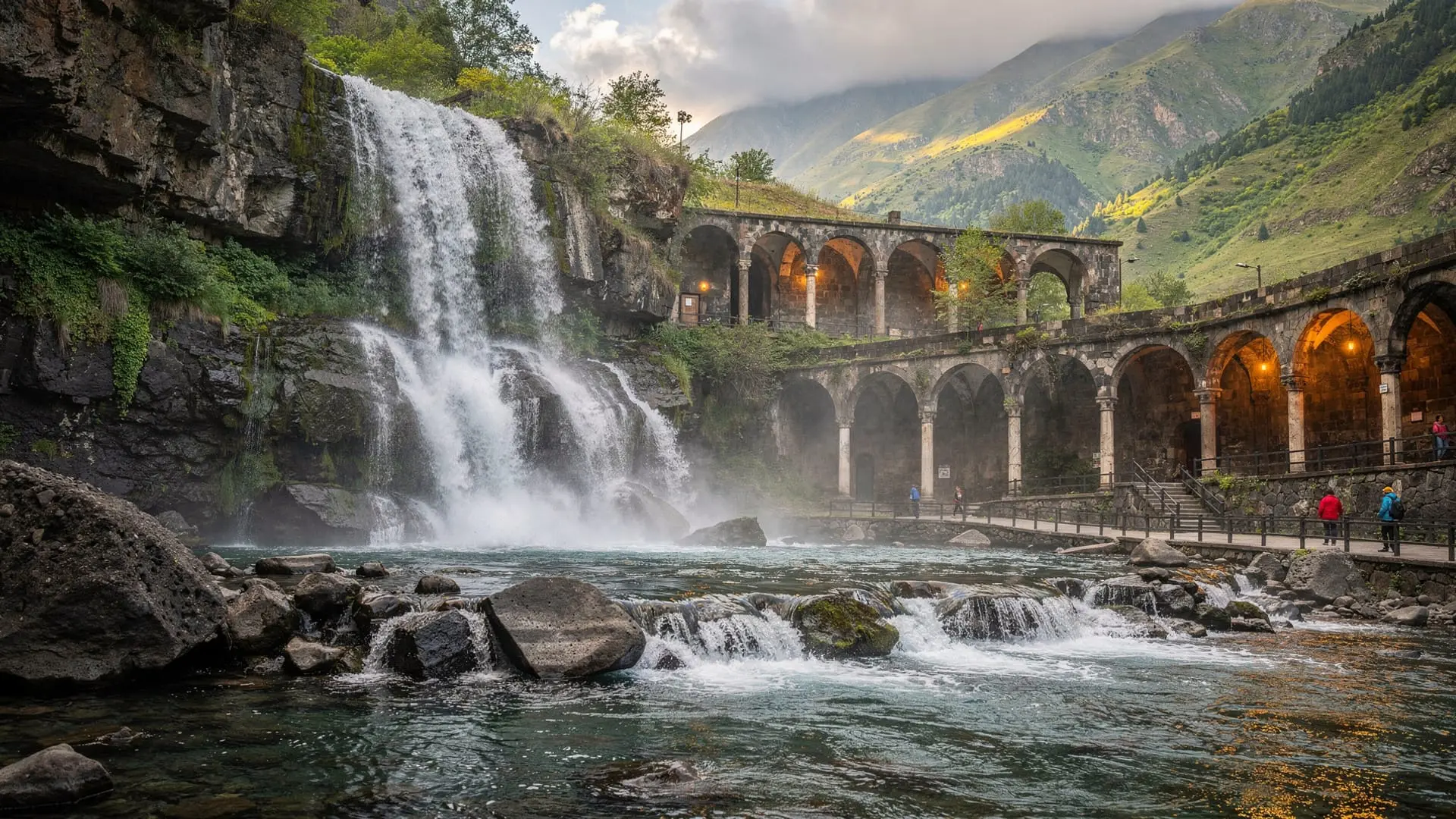
The waterfall that most visitors to southern Armenia miss
The standard southern Armenia day trip from Yerevan covers Khor Virap monastery, Areni wine cave, Noravank’s red cliffs, the Wings of Tatev cable car, and Tatev Monastery. Shaki Waterfall appears on almost none of these itineraries, which is both understandable (the day is already very full) and unfortunate, because Shaki is one of the most immediately beautiful natural sites in Syunik province — a genuine 18-metre cascade dropping over basalt columns into a narrow gorge, reached by a flat 200-metre path from the parking area.
The falls sit on a tributary of the Vorotan river, approximately 5 km northeast of Sisian on a paved road that deteriorates to gravel near the end. They appear in some organised tour itineraries — particularly tours marketed as including “Shaki Waterfall” as a bonus stop between Areni and Tatev — but travellers arriving independently often drive straight past the turnoff without knowing it is there.
The name comes from Armenian legend. Shaki was a princess — accounts vary on whether she was an ancient regional queen, a figure from the Bagratid era, or simply a local folk heroine — who either threw herself from the cliff in an act of defiance against an invader, or was pushed, or descended voluntarily to her fate. The falls bear her name, and the surrounding hillside has a particular kind of melancholy beauty in the Armenian tradition: a landscape that remembers something, even if nobody is certain what.
| Where | 5km north-east of Sisian, Syunik province, about 240km (4h) south of Yerevan |
| Cost | Free entry; informal parking |
| Time needed | 45 minutes for a standard visit; up to 2 hours for photography |
| Getting there | Self-drive from Yerevan, Goris or Tatev; no direct marshrutka |
| Best time | Late April–June for peak flow; September–October for light and quiet |
The waterfall itself
Shaki Waterfall drops approximately 18 metres in a single curtain fall over a basalt shelf into a pool at the base. At peak flow (late April–June), the volume is substantial — the falls are wide as well as tall, with multiple streams merging at the lip and a spray radius that reaches 10–15 metres. The sound carries to the parking area on quiet mornings.
The basalt formation at the top of the falls is a characteristic Syunik volcanic structure: horizontal columns of cooled lava that break cleanly at the lip, creating a straight edge across which the water slides before falling. Below the lip, the column faces are exposed in the gorge walls, showing the distinctive hexagonal cross-sections of basalt columnar jointing — similar in formation to the Symphony of Stones at Garni, though less celebrated. In late summer when the flow is reduced, these columns are visible even through the curtain of water.
The pool at the base is shallow — knee-deep at most — and cold even in summer. The surrounding gorge is narrow, and the walls rise 30–40 metres on each side. Vegetation in the gorge is dense: willow, ash, and wild herbs crowd the path to the base of the falls, and in spring the gorge smells of watermint and wet stone.
Approaching from the base versus the top
Most visitors view Shaki from the base. The 200-metre path from the parking area descends gently to a viewpoint platform and continues to the pool edge. The full frontal view — falls, gorge walls, basalt columns — is from the base. This is the standard photography position and requires no special effort.
What fewer visitors know is that the top of the falls is accessible from a different approach. Following the road past the parking area and taking a rough track uphill for approximately 400 metres brings you to the rim of the falls — to the exact point where the Vorotan tributary slides over the basalt shelf and becomes the waterfall. Standing here, with the falls dropping away beneath you and the Vorotan valley visible beyond, is a qualitatively different experience from the base view. The approach requires care: the rim is unfenced and the basalt is wet and slippery at the lip. Do not approach the edge without stable footing.
From the top, the photography is different: You are shooting down into the gorge, with the falls in the foreground and the pool and valley below. A wide-angle lens (16–24mm) captures the full drop. A telephoto from the top compresses the distance and makes the falls appear steeper. The rim view is most dramatic in spring when maximum flow creates a distinct roar at the lip.
The legend of Princess Shaki
The story attached to the waterfall is characteristic of Armenian landscape mythology — specific enough to feel rooted in history, vague enough to accommodate multiple interpretations.
The most widely repeated version tells of an Armenian princess named Shaki who, during one of the many invasions of the Armenian highlands (the historical period is unspecified), chose to leap from the cliff above the falls rather than be captured by a foreign commander. The falls bear her name as a memorial to her defiance.
A variant tells that Shaki was a queen of an ancient Syunik principality who was betrayed by a rival and fled to the gorge. Yet another version identifies her not as a noblewoman but as a village girl who drowned in the tributary after a failed love story, and whose spirit the falls commemorate.
None of these stories is documented in historical sources older than the 19th century. The name “Shaki” itself may derive from a pre-Armenian toponym, the name of a settlement (the village of Shaki, which exists nearby), or a personal name that became attached to the landscape at an unknown date. This ambiguity is normal for Armenian landscape folklore: the stories exist in the landscape whether or not they happened. Standing at the base of the falls, listening to the water and reading the gorge walls, the legend feels plausible regardless of its historical accuracy.
Getting there
From Yerevan: Drive south on the M2 highway toward Sisian (approximately 240 km, 4 hours). Pass through Sisian town centre; immediately after crossing the Vorotan river bridge (approximately 1 km east of the town centre), watch for a right turn signposted for “Shaki Waterfall.” The sign is in Armenian and sometimes in English. Follow this road for approximately 4 km; the last 1–2 km becomes gravel. Parking area at the end.
From Goris (south): Drive north on the M2 to Sisian (approximately 40 km), then follow the same directions above.
From Tatev: After visiting Tatev Monastery and riding the Wings of Tatev cable car, drive from Halidzor toward Goris and then north to Sisian. The total drive from Halidzor to Shaki Waterfall is approximately 60 km (1 hour 10 minutes). This makes Shaki a logical end-of-day stop on the return from Tatev toward Yerevan.
Road conditions: The main road from Sisian is paved as far as the last 1.5 km, which is gravel. Standard car is fine in dry conditions (May–October). In wet conditions or winter, the gravel section becomes muddy; a car with reasonable clearance is advisable. Snow on the access road is possible November–March.
Tatev, Shaki Waterfall, Noravank, Areni wine, Khor VirapBest time to visit
Late April–June (recommended): Peak snowmelt from the Syunik highlands. The falls are at maximum volume and the gorge vegetation is vivid green. Light mist from the falls is visible from the parking area on calm mornings. May is particularly excellent — the falls are powerful, wildflowers grow on the hillside approaches, and the weather is pleasant at Sisian’s altitude (1,390 metres).
July–August: Flow decreases noticeably from its spring peak, but the falls remain visually impressive. The basalt columns below the lip become more visible through the reduced water curtain. This is the most visited period because it coincides with Tatev peak season.
September–October: Flow has dropped further, but autumn colours in the gorge vegetation compensate. The gorge is golden in October, the falls still running, visitor numbers low. This is a personal favourite for photography — reduced crowds, good light, coloured leaves in the spray radius.
November–March: Access is uncertain. The gravel road may be icy or snow-covered. The falls themselves may partially freeze in very cold winters, creating an ice curtain effect that is stunning photographically — if you can reach the site safely. Check local conditions and do not attempt the gravel section in snow without suitable tyres.
Photography guide
Shaki Waterfall is one of Armenia’s most photogenic natural sites, with specific technical considerations:
Standard wide shot from the base viewpoint: Position yourself on the main viewing platform. A 16–24mm lens captures the full 18-metre drop with gorge walls on both sides. Include foreground vegetation (willow branches, herbs) for depth. In spring, the spray creates a natural haze around the lower pool that softens the light.
Long exposure for silky water: Set up a tripod on the viewpoint platform. Use a neutral density filter (6-stop or 10-stop) to extend exposure to 1–4 seconds. This renders the falling water as smooth silk against the sharp basalt columns. Early morning (before 09:00) or overcast days eliminate the need for ND filtration.
Polarising filter: Essential if shooting midday in summer. Reduces glare on the wet basalt and gorge pool, and increases colour saturation in the surrounding vegetation. Also useful for eliminating reflections from the pool surface if shooting from the lower viewpoint.
From the top: As described above, a wide-angle shot from the rim looking down into the gorge with the valley below. Use a low f-stop (f/2.8–f/4) to blur the valley background and keep the lip of the falls sharp. Bring a telephoto (70–200mm) to shoot the gorge pool from above, compressing the depth.
Best light direction: The gorge faces roughly south-southeast. Direct sunlight hits the falls from midmorning (from the east) through midday. The falls are in shadow in the late afternoon (which is cooler and more comfortable in summer but loses the dramatic light). Golden hour light in the morning (07:00–08:30 in May) from the east is the most photogenic — it lights the face of the falls while the gorge walls remain in shadow, creating a spotlight effect.
Can you swim at Shaki Waterfall?
The pool at the base of the falls is knee- to waist-deep and extremely cold — 8–12°C even in summer, fed by snowmelt from higher elevations. Swimming is technically possible (and a few visitors do wade in), but the cold is bracing for all but the most committed cold-water swimmers. The pool is not a warm spa experience in the way Devil’s Bridge thermal pools are — the water here is cold mountain runoff.
Paddling near the pool edge is comfortable. Standing under the spray is refreshing on a hot August day but genuinely cold. Children tend to enjoy the shallow edge; keep them away from the falls centre where the impact zone creates turbulence.
What makes Shaki different from Armenia’s other waterfalls
Armenia has a handful of accessible waterfalls, and each has a distinct character worth knowing before you decide how to spend limited time. Shaki’s particular appeal is the combination of a short, flat, easy approach with a genuinely dramatic 18-metre drop and minimal development — you get a serious natural spectacle without a long hike or a built-up tourist site. Trinity Canyon’s waterfalls, further north near Dilijan, require more walking and reward hikers rather than casual visitors.
Jermuk’s waterfall sits within a resort town with cafés and viewing galleries a short walk from the town centre — more convenient for families staying in Jermuk, less wild in atmosphere. For visitors who want maximum natural drama for minimum physical effort, Shaki is the clear pick among Armenia’s waterfalls, and its position directly on the main road between Yerevan and Tatev means it rarely requires a dedicated trip of its own.
Combining with Karahunj and Tatev
Shaki Waterfall sits geographically between Karahunj/Zorats Karer (2 km northwest of Sisian) and Tatev (65 km south). This makes it a natural linking stop on a southern Armenia circuit.
Recommended order (from Yerevan southbound): Drive to Sisian, begin with Shaki Waterfall in the morning (best light, low crowds), then Karahunj in late morning or midday, drive south to Goris for lunch, continue to Halidzor for the Wings of Tatev cable car in the afternoon, visit Tatev Monastery, return to Goris or Yerevan.
Alternative order: Many travellers arrive from Yerevan via Areni and Noravank (the M2 southern route), which deposits them south of Sisian near Goris. In this case, visit Tatev first (cable car opens at 10:00), then drive north to Sisian for Karahunj and Shaki in the afternoon before heading back toward Yerevan.
Khndzoresk cave village: 50 km south of Sisian near Goris, the abandoned cave-city with its suspension bridge over the canyon. If adding Khndzoresk to the circuit, the full day (Shaki + Karahunj + Tatev + Khndzoresk) is very demanding — better split over two days with an overnight in Goris or Sisian.
Yerevan: Tour of Tatev, Khndzoresk, Shaki Waterfall and AreniSisian as a base for the area
Sisian is the smallest and most authentic of southern Armenia’s overnight bases. There is no tourist infrastructure to speak of — a handful of simple family guesthouses, the town market, a history museum with Bronze Age finds from Karahunj, and the general tempo of a small Syunik regional centre. This is not a shortcoming for the self-sufficient traveller; it is part of what makes this part of Armenia feel genuinely off the well-worn path.
The local market on the main square sells dried fruit, churchkhela (walnut-grape sweet), local honey, and smoked meats that reflect Syunik’s produce culture. Prices are significantly lower than Yerevan. A basic dinner at a family guesthouse (khorovats, dolma, lavash, salad, homemade wine or vodka) costs 3,000–5,000 AMD per person (€7–12), negotiated with the host. Booking a guesthouse a day or two ahead in peak summer is sensible, since Sisian’s small supply of rooms can fill up when tour groups pass through in clusters.
Goris, 40 km south, offers considerably better accommodation (Mirhav Hotel, Hotel Anahit Tatev nearby) and is the preferred base for travellers combining Tatev, Khndzoresk, and Shaki in a two-day programme. The drive between Sisian and Goris is pleasant, following the M2 through the Vorotan river valley.
The Vorotan river and its landscape
Shaki Waterfall is a small tributary in the broader Vorotan river system. The Vorotan drains a large section of the Syunik highlands and is one of the principal rivers of southern Armenia, eventually joining the Araxes near the Iranian border. Its gorge — deepening progressively from Sisian southward past Goris and Tatev toward Kapan — forms the backbone of the most dramatic landscape in the province.
The basalt geology of the Vorotan watershed is responsible for both Shaki’s particular character (the clean fall over basalt columns) and the Devil’s Bridge thermal pools further south (where geothermal activity in the same basalt produces warm mineral springs). The Symphony of Stones at Garni in Kotayk province is a more famous example of the same columnar basalt formation, but the Vorotan valley examples are less visited and equally impressive in their own smaller way.
Should you visit independently or on a tour?
Shaki rewards independent visitors more than most southern Armenia sites, precisely because it is easy to reach by road and does not require any specialist local knowledge to enjoy — unlike, say, the technical navigation needed on Khustup’s upper track. A rental car or a private driver lets you time the visit for morning light and linger at the top rim without a tour schedule pulling you back to the vehicle. That said, if Shaki is genuinely a minor stop on your itinerary rather than a dedicated destination, a tour that bundles it with Tatev, Khndzoresk and Areni removes the planning overhead of an already long southern-loop day, and the marginal time lost to a group schedule matters less for a 45-minute stop than it would for a longer, more contemplative visit.
Camping and overnighting near the falls
Informal camping happens occasionally on the grassy hillside near the parking area, though there are no designated pitches, facilities, or official permission process. Most visitors treat Shaki as a stop rather than a base, staying instead in Sisian or Goris and driving out for sunrise or a quiet evening visit. For anyone determined to camp, the usual leave-no-trace principles apply strictly: pack out everything, avoid lighting fires near the dry summer hillside vegetation, and be aware that livestock sometimes graze the surrounding pasture at dawn and dusk.
Practical details for visitors
Entry fee: None. The site is freely accessible.
Opening hours: No restricted hours. The parking area is accessible from dawn to dusk; the access path is clear and usable without artificial light in daylight hours.
Parking: A small informal parking area at the end of the gravel road, capacity for 10–15 cars. In peak summer (July–August), this can fill up by mid-morning on weekends. Arrive before 10:00 or after 16:00 to avoid competition for space.
Facilities: A basic toilet (condition variable) has been installed at the parking area. No food, no water, no accommodation.
Path to the base: 200 metres, flat, well-worn, takes approximately 5 minutes each way. Suitable for older children and most adults. Not wheelchair accessible (the path surface is uneven and partly rocky).
Mobile signal: Reasonable near the parking area (Viva-MTS and Ucom), weak or absent at the base of the gorge. Download offline maps before arrival.
Nearby fuel and supplies: Sisian town, 5km back toward the M2, has petrol stations, a market, and small shops — the last reliable place to stock up before heading further into the Syunik highlands toward Goris or Kapan.
What to bring: Water, snacks, sun protection (the open hillside approach is exposed), a towel if planning to wade at the pool base, and a jacket for the gorge (even in summer, the shaded gorge is noticeably cooler than the open hillside).
Frequently asked questions about Shaki Waterfall
Is Shaki Waterfall wheelchair accessible?
Not fully. The gravel access road and the informal parking area present challenges for wheelchairs. The 200-metre path to the base viewpoint is on uneven terrain and has no accessible surface. The lower viewpoint platform has wooden boards but is reached by steps. Independent wheelchair users should arrange assistance. The upper rim approach is not accessible.
Can you picnic at Shaki Waterfall?
Yes, and many Armenian families do. The hillside around the parking area has flat grass sections suitable for picnicking. The base of the falls has rocks and small flat areas. There are no picnic tables. Take all rubbish with you — the site is not cleaned regularly and litter is an increasing problem.
Is Shaki Waterfall on most organised tour itineraries?
It appears on some. Tours marketed specifically as covering Tatev, Khndzoresk, and southern Syunik often include a brief Shaki stop. Generic “south Armenia” day tours from Yerevan that focus on the main circuit (Khor Virap, Areni, Noravank, Tatev) often skip Shaki for time reasons. If Shaki is important to you, check the specific itinerary before booking, or visit independently.
How long should I spend at Shaki Waterfall?
For a standard visit — walk to the viewpoint, photograph the falls, walk to the pool edge, return — allow 45 minutes. For photography enthusiasts with a tripod and ND filters, allow 2 hours. For families with children exploring the pool edge, allow 1.5 hours. Add 30 minutes if visiting the top of the falls via the upper approach.
Can I combine Shaki Waterfall with Tatev in one day from Yerevan?
Yes. This is a long day (approximately 13–14 hours including driving), but it is the structure of several organised tours. The drive from Yerevan to Shaki is about 4 hours; add 1 hour at Shaki, 1 hour driving to Tatev, 2.5 hours at Tatev (cable car + monastery), and 4–5 hours back to Yerevan. Starting by 07:00 is essential for this to be comfortable. An overnight in Goris transforms this from a march into a genuine trip.
What other waterfalls exist near Shaki?
The Syunik highlands have several smaller waterfalls accessible on foot from village paths, but none as convenient as Shaki. Jermuk Waterfall, 100 km north of Sisian near the Vayots Dzor border, is a larger and more developed waterfall site with full facilities — a different kind of visit but worth including on a multi-day southern Armenia circuit. The Shaki and Jermuk waterfalls cover the two ends of the accessible waterfall spectrum in the region: raw and minimalist versus landscaped and touristy.
Is Shaki Waterfall accessible in winter?
With preparation, yes. The access road is paved to within 1.5 km of the parking area and is generally passable in mild winter conditions. After significant snowfall, the gravel section may be blocked. In cold winters (January–February), the falls partially freeze — ice columns form around the edges of the curtain while the central stream continues flowing. This is photogenic and unusual, but access requires winter tyres or chains. Do not attempt in heavy snowfall without appropriate preparation.
Is Shaki Waterfall worth a detour if I’m short on time in southern Armenia?
If your itinerary is already packed with Tatev, Noravank and Khor Virap, Shaki is a genuinely optional add-on rather than a must-see — skipping it does not diminish a southern Armenia trip. But if your route already passes through Sisian, as most do en route to Goris and Tatev, the detour costs perhaps 20–30 minutes off the main road for a site that is free, easy to reach, and rewarding, which makes it hard to justify skipping on pure logistics grounds.
How does Shaki compare to Jermuk Waterfall?
Shaki is raw and minimally developed — a short flat walk, no facilities beyond a basic toilet, and a genuinely wild feel. Jermuk Waterfall is larger and set within a proper resort town with viewing galleries, cafés and easy access. Visitors who want an unspoiled natural site should prioritise Shaki; those who want a fuller day out with spa town amenities attached should lean toward Jermuk. Doing both on a longer southern Armenia trip shows the range of the region’s waterfall landscapes.