4-day Armenia escape: direct flight from Europe
Who this itinerary is for
Direct flights from Europe to Yerevan have been expanding steadily — as of 2026, you can fly non-stop from Vienna, Paris CDG, Rome FCO, Athens, Frankfurt, Amsterdam, and several other European cities. With a Thursday or Friday evening departure, you can have 3.5 effective days in Armenia and be back at your desk Monday morning. This is not a tourist trap or a rushed compromise — done well, a 4-day Armenian break is genuinely satisfying and entirely different from anything else Europe offers at comparable flight prices.
This itinerary is specifically designed around the direct flight constraint. The days are busy but not frantic. You will leave with a real sense of Yerevan, two of Armenia’s greatest day trips, and a specific appetite to return for the longer version.
Who it is not for: travellers hoping to reach Tatev or the Lori monasteries (too far for a 4-day trip without exhausting yourself), and travellers who prefer slow travel (this itinerary does move with intent).
No car needed: all day trips use guided tours from Yerevan.
| Where | Yerevan, Garni, Geghard, Lake Sevan, Etchmiadzin, Khor Virap |
| Cost | Around 660-1,000 EUR mid-range for 4 days, excluding flights |
| Time needed | 4 days, arriving on a Thursday or Friday evening flight |
| Getting there | Direct flight to Zvartnots (EVN) from most major European hubs |
| Best time | April-June or September-October for mild weather and clear Ararat views |
Quick overview
| Day | Theme | Key stops |
|---|---|---|
| Day 1 | Arrival + Yerevan evening | Republic Square, Cascade walk, first dinner |
| Day 2 | Garni + Geghard + Sevan | Garni temple, Symphony, Geghard cave, Lake Sevan |
| Day 3 | Etchmiadzin + Khor Virap | UNESCO cathedral, Zvartnots, Khor Virap with Ararat |
| Day 4 | Yerevan deep dive + departure | Matenadaran, Erebuni, Vernissage, airport |
Day 1: Arrival — first evening in Yerevan
Flight timing and arrival
Most European direct flights to Yerevan (EVN, Zvartnots International) arrive in the late evening or overnight — Vienna to Yerevan takes about 3.5 hours; Paris CDG is 4.5 hours; Frankfurt is 4 hours. Aim for a flight that arrives no later than 23:00 to get a decent night’s sleep before Day 2’s early start.
Transfer from Zvartnots Airport to central Yerevan: 12 km, 20 minutes. Use GG Taxi (the Armenian ride-hailing app, download before landing — it works the moment you connect to local data) or pre-book a hotel transfer. Unmetered taxi touts at arrivals can be aggressive — stick to the app.
A local eSIM or a physical SIM bought at the arrivals hall (Ucom and Viva-MTS both have kiosks) gets you connected within minutes and is worth doing before you clear the terminal — GG Taxi, hotel confirmations, and offline maps all work far better with a local data connection than relying on airport wifi, which is patchy in the arrivals area.
Check into your hotel (the Republica Hotel Yerevan is recommended for a 4-day break — central, well-staffed, comfortable, good breakfast).
Evening orientation
If you arrive before 22:00 with energy to spare: walk to Republic Square (10-15 min from most central hotels). The square at night, with the buildings illuminated and the fountain synchronised to music (most evenings in summer from 21:00), is an excellent introduction to the city’s scale and ambition.
The singing fountains spectacle last 30-45 minutes. After that, the bars around Pushkin Street and Tumanyan Street have an active evening scene. First Armenian beer or wine before bed — Kilikia beer (the local lager) or an Areni Noir from the wine bars on Saryan Street.
Day 2: Garni, Geghard and Lake Sevan
The classic day trip
This is the most important single day of the 4-day trip. Book a guided group tour before you depart Europe (GYG has several options that combine Garni, Geghard, and Lake Sevan in 9-10 hours). Tours typically depart Yerevan at 09:00-09:30.
Garni temple (40 min from Yerevan): the 1st-century CE Hellenistic temple is Armenia’s only surviving pre-Christian monument. The gorge below — the Symphony of Stones, basalt organ-pipe columns in the river canyon — adds a geological spectacle to the archaeology. Allow 90 minutes for both.
Group Tour: Garni, Geghard, Lavash baking, Lake SevanGeghard Monastery (15 min from Garni): cave churches carved from the cliff face — the 13th-century inner chambers are some of the most atmospheric interiors in Armenia. The spring inside was already sacred before the first stone was laid. Allow 90 minutes.
Many group tours include a lavash baking demonstration in a village near Garni — 45-60 minutes of watching and participating in the making of this UNESCO-listed flatbread. Kids love it; adults love eating the result.
Lake Sevan (65 km from Yerevan, 1h15): the high-altitude inland sea at 1,900m. Sevanavank monastery on the peninsula gives the classic blue-water-and-stone photograph. The drive along the lake’s western shore in the late afternoon is beautiful.
Garni, Geghard & Lake Sevan Day TripReturn to Yerevan by 18:00-18:30. Dinner at Sherep or Lavash restaurant.
Day 3: Etchmiadzin UNESCO + Khor Virap
Morning: Etchmiadzin
Etchmiadzin (25 km west of Yerevan, 30 min) is the world’s oldest purpose-built national cathedral in continuous use — founded 301-303 CE at the moment Armenia adopted Christianity. It is also the headquarters of the Armenian Apostolic Church (the seat of the Catholicos of All Armenians) and a UNESCO World Heritage site.
The cathedral complex includes the main church (4th century foundations, 17th-century additions), the Treasury Museum (extraordinary relics including the Lance of Longinus, Noah’s Ark timber fragment, and jewelled reliquaries), and several adjacent UNESCO churches (St Hripsime, 618 CE; St Gayane, 630 CE).
Book a guided tour that includes the Treasury — many group tours skip it due to time constraints, but it’s worth planning around.
From Yerevan: Echmiadzin Mother Cathedral and Zvartnots TourZvartnots Cathedral ruins (5 min from Etchmiadzin): the most ambitious 7th-century cathedral in the Armenian world, now roofless and partially collapsed but still impressive in its circular footprint. A UNESCO site adjacent to Etchmiadzin — pair them in the same morning.
Afternoon: Khor Virap
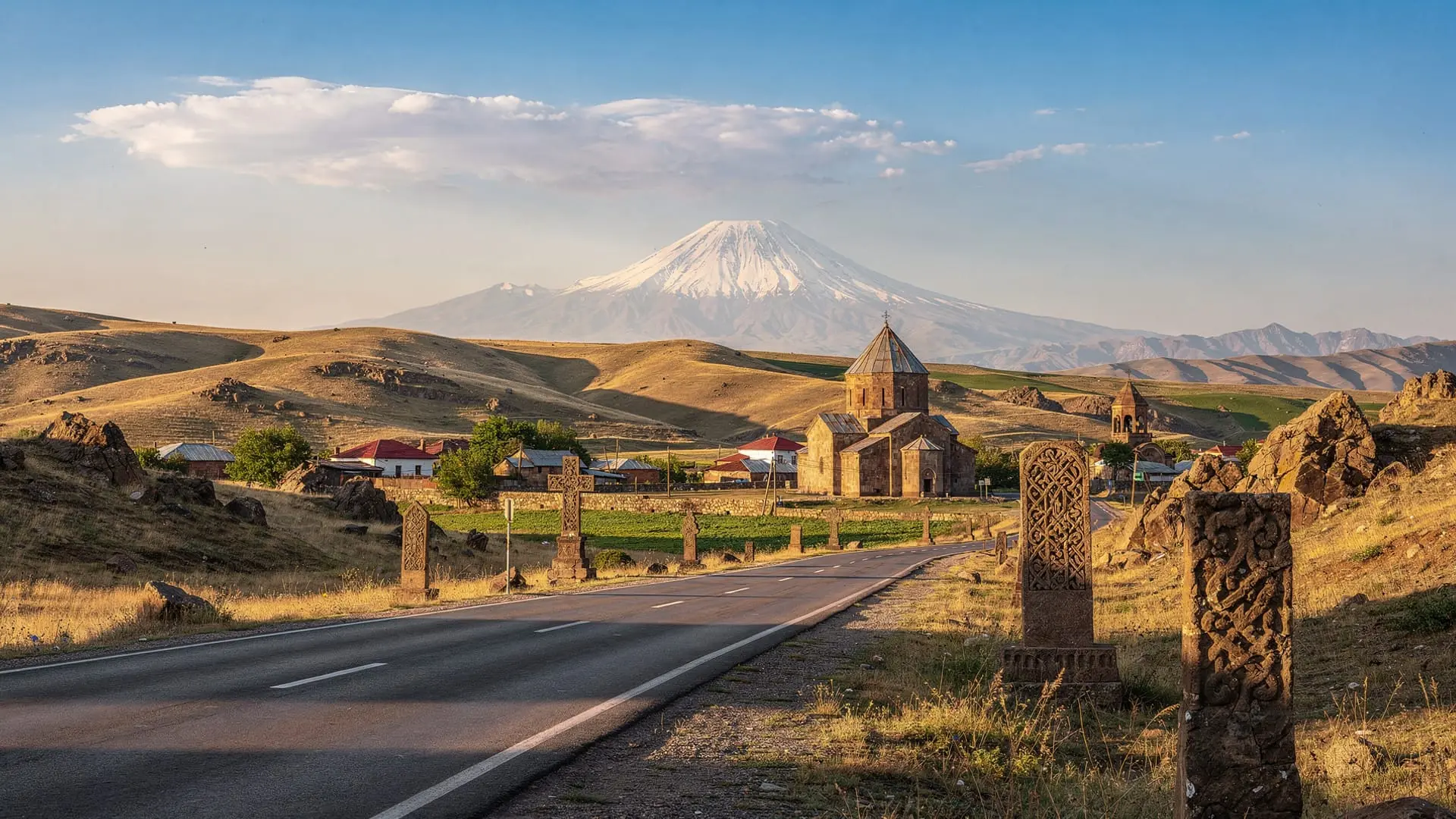
Khor Virap (35 km south of Yerevan, 50 min from Etchmiadzin) is the site of Gregory the Illuminator’s 13-year imprisonment before the conversion. The monastery’s pit dungeon is accessible by ladder — a vertigo-inducing descent into a small underground chamber. Mount Ararat fills the southern horizon on clear days.
This double UNESCO-Khor Virap circuit (Etchmiadzin in the morning, Khor Virap in the afternoon) is a logical geographical loop and covers both the spiritual founding moment of Armenian Christianity and its most famous physical symbol.
Return to Yerevan by 17:30. Evening free — the Cascade Complex at sunset for the view, then dinner at Gusto or a wine bar on Saryan Street.
Day 4: Yerevan in depth + departure
Morning: Matenadaran and Erebuni
The final morning in Yerevan is for the sites you haven’t seen yet.
The Matenadaran (Mashtots Institute of Ancient Manuscripts, Mashtots Avenue): one of the world’s great repositories of illuminated manuscripts — 14,000 ancient manuscripts spanning 1,600 years of Armenian literary culture. The highlights of the permanent exhibition can be seen in 60-90 minutes. The 5th-century Armenian alphabet (Mesrop Mashtots’s invention, displayed in the entrance hall) frames the visit well.
Erebuni Museum and Fortress (3 km east of central Yerevan, Erebuni district): the 8th-century BCE Urartu fortress that gave Yerevan its name. The museum (10 min walk from the fortress) has excellent archaeological displays from the excavations. Allow 60-75 minutes for both. Not crowded, well-curated.
Midday: Vernissage and the GUM market
Vernissage flea market (Aram Street, open Saturdays and Sundays): the outdoor market is the best place to buy Armenian craft souvenirs — miniature khachkars, lacework, traditional embroidery, Soviet-era memorabilia, and (with caution) antiques. A 30-40 minute browse is sufficient.
One warning: the “Ararat cognac” bottles sold by some Vernissage vendors are frequently counterfeit. Buy brandy at the Yerevan Brandy Company shop (15 min from the market) or at SAS/Yerevan City supermarkets.
GUM market (indoor market, Tpagrichner Street): dried apricots, spice mixes, churchkhela (walnut-grape juice rolls), and excellent local honey. The best food souvenirs to take home — they pass customs easily and represent Armenia’s agricultural heritage.
Afternoon departure
Flight timings: most European flights from Yerevan depart in the afternoon (14:00-19:00) or evening. Allow 70-80 minutes from central Yerevan to clear check-in and security at Zvartnots (the airport is efficient but can be busy in peak season).
Buy a final bag of dried apricots and a bottle of Ararat brandy at the airport duty-free before boarding. The apricots are Armenia’s national fruit; the brandy is the country’s most famous export. Both are better bought in Armenia than in your home airport.
Making the most of a short direct flight
Direct routes to Yerevan change seasonally, so it is worth checking your specific city’s schedule a few months ahead rather than assuming last year’s timetable holds. Several routes (Vienna, Paris CDG, Athens) run several times a week year-round, while others (some Frankfurt and Amsterdam connections) are seasonal or reduced in winter. Booking the outbound flight for the latest reasonable Thursday or Friday departure — rather than a Saturday — is what makes this itinerary work as a genuine 4-day trip rather than a 3-day one with two travel days attached.
Jet lag is not a factor on this route (Armenia is only 2-4 hours ahead of most European departure points, depending on daylight saving), but the overnight arrival still costs you part of Day 1 if your flight lands after midnight. If your only available flight arrives very late, consider adjusting the itinerary to start Day 2’s Garni-Geghard tour slightly later (10:00 instead of 09:00) to allow a proper night’s sleep — the tour operators are generally flexible on pickup time if you contact them in advance.
Combining the airport transfer with the return
Because Zvartnots is only 12 km from central Yerevan, some travellers on a genuinely tight 4-day window use the final morning (before an afternoon flight) for one last quick outing rather than treating Day 4 purely as a wind-down day. The Cascade Complex sculpture garden or a final coffee on Saryan Street both work well as a low-effort finale that doesn’t risk missing the flight — save anything requiring a guided tour or a drive out of the city for a trip with more slack.
Zvartnots airport transfer, hotel to airportWhere to stay
| Night | Hotel | Price |
|---|---|---|
| 1-4 | Republica Hotel Yerevan | 90-130 EUR |
| 1-4 (budget) | Envoy Hostel or budget guesthouse, Abovyan area | 20-40 EUR |
| 1-4 (upgrade) | Tufenkian Historic Yerevan | 170-240 EUR |
Keeping one hotel for all 4 nights is the right approach for a short break — no energy wasted on packing and moving.
Total budget estimate
| Category | Budget/day | Mid-range/day | Luxury/day |
|---|---|---|---|
| Accommodation | 20-40 EUR | 80-110 EUR | 160-220 EUR |
| Meals | 12-18 EUR | 30-50 EUR | 65-120 EUR |
| Tours | 30-45 EUR | 45-70 EUR | 100-180 EUR |
| Transport | 5-10 EUR | 10-20 EUR | 25-50 EUR |
| Daily total | 67-113 EUR | 165-250 EUR | 350-570 EUR |
| 4-day total | 268-452 EUR | 660-1000 EUR | 1400-2280 EUR |
Excluding international flights, which for European departures typically run 150-350 EUR return depending on origin city and timing.
Variations
Day 3 alternative — wine country loop: Replace the Etchmiadzin + Khor Virap day with the Khor Virap + Noravank + Areni wine tasting loop. It’s a longer day (about 10h) but covers the most scenic southern route and includes Armenian wine tasting at the source.
Day 2 alternative — Sevan + Dilijan only: For travellers who prioritise nature over archaeology, replace the Garni/Geghard focus with a full day on the Sevan-Dilijan corridor — lake, forest, medieval monastery, and the restored Old Town of Dilijan. More relaxed pace, equally rewarding.
5-day extension: Add a train day — take the morning train from Yerevan to Gyumri (3h, depart ~08:00), spend 4-5 hours in Armenia’s second city (Kumayri historic district, Aslamazyan Museum, excellent coffee), return by afternoon train or marshrutka. Perfect extension for Day 5 before a late flight home.
Booking tips and GYG tours
For a 4-day trip, pre-booking the Day 2 day trip (Garni/Geghard/Sevan) and the Day 3 Etchmiadzin tour are the essential advance reservations. Day 4 activities can be done independently without booking.
The Etchmiadzin private tour is worth booking for the Treasury Museum access — confirm whether the Treasury visit is included before booking.
Frequently asked questions about this itinerary
Which European cities have direct flights to Yerevan?
As of 2026, direct (non-stop) flights operate from Vienna (Austrian Airlines), Paris CDG (Air France), Rome FCO (ITA Airways, Armavia), Athens (Aegean, Armenia Airways), Frankfurt (Lufthansa, Flydubai), Amsterdam (Transavia), and several other European cities. Flight time is 3.5-5 hours depending on origin. Check current routes with your preferred airline or comparison site — the route map changes seasonally.
Is 4 days in Armenia worth it?
Absolutely. Armenia has an extraordinary concentration of significant sites within a small area — the combination of ancient Christian architecture, volcanic mountain landscapes, exceptional food, and genuine hospitality creates a very high-quality experience even in a short window. Four days gives you Yerevan plus two of the country’s greatest excursions — you will leave wanting more, which is the best possible outcome for a first trip.
What should I avoid on a 4-day trip?
Trying to do too much. Tatev (250 km from Yerevan, 4h each way) is not feasible in 4 days without a very long, tiring day that leaves you exhausted for the rest of the trip. Stick to the sites within 90 minutes of Yerevan — you will see an excellent amount without rushing.
Do I need to exchange money before I go?
No. ATMs at Zvartnots Airport dispense Armenian dram (AMD) immediately. The exchange rate at airport ATMs is slightly worse than in-city bank ATMs (Ameriabank, Inecobank), so take out only enough for the taxi and first day expenses at the airport, then use city ATMs for the rest.
Is public transport possible for the day trips?
Partially. The marshrutka from Kilikia bus station to Garni runs irregularly and doesn’t go on to Geghard (different vehicle). Marshrutkas to Etchmiadzin are straightforward (depart from Yerevan’s Sasunazi metro station). For a 4-day trip, the convenience of a guided group tour outweighs the marginal cost saving of using marshrutkas — the group tours handle all the logistics and include a guide.
What is the time difference from European cities?
Armenia is UTC+4 year-round (Armenia does not observe daylight saving time). From Central Europe (UTC+1 in winter, UTC+2 in summer): the difference is +3h in winter (Nov-Mar) and +2h in summer (Apr-Oct). From UK (UTC+0/+1): +4h in winter, +3h in summer.
What language do people speak in Armenia?
Armenian (Hayeren) is the national language — written in the unique Armenian script (Mesrop Mashtots alphabet, 405 CE). English is widely spoken in Yerevan’s tourist areas, hotels, restaurants, and tour operators. Russian is also widely understood, especially by older Armenians. French, Spanish, and Arabic are spoken within diaspora communities. You will not struggle to communicate in English in any of the tourist sites or Yerevan restaurants.
What is the Armenian attitude toward tourists?
Armenia has a strong hospitality tradition — visitors are generally treated with genuine warmth rather than transactional efficiency. It’s common to be offered coffee or tea in shops, to be stopped by strangers asking where you’re from, and to be invited to share food. This can feel unusual if you’re accustomed to more reserved European travel cultures, but it’s authentic. Tipping is expected in restaurants (10% is standard; more in higher-end places) but not in taxis if you agree on a fare in advance.
Is it easy to find vegetarian food in Armenia?
More so than you might expect. Armenian cuisine has strong vegetarian traditions in the meze culture: hummus, muttabal (smoky eggplant), stuffed peppers and tomatoes, fresh herb platters, legume soups, and excellent dairy products (matsun yoghurt, various cheeses). The bread culture (lavash, matnakash) means you are never without filling carbohydrates. Fully vegan options are limited outside Yerevan, but vegetarian eating is straightforward across the country. The Cascade area in Yerevan has several restaurants with explicit vegetarian menus.
What should I buy as a souvenir in Armenia?
Several items represent genuine quality and are worth the luggage space. Armenian brandy: buy at the Yerevan Brandy Company shop or at SAS/Yerevan City supermarkets, not at tourist markets where counterfeits are common. Dried apricots: the national fruit, incomparably better than anything sold in Western supermarkets — buy in bulk at the GUM market or airport. Churchkhela: walnut-stuffed grape juice rolls — colourful, tasty, and easy to pack. Khachkar carvings: small carved stone cross-stones from reputable craft shops (avoid mass-produced tourist versions; look for handmade individual pieces). Armenian coffee: sold in small packets at the market. Ceramics: the pottery from Dilijan workshops is particularly well-made. Music: if you have encountered the Armenian duduk (double-reed wind instrument) and want to bring home recordings, the Yeritasardakan music shops in Yerevan have a good selection of traditional and contemporary recordings.
Can I buy wine at Armenian wineries to take home?
Yes. Wineries in Areni and Aragatsotn all have bottle shops where you can buy directly. Most bottles are wine-label printed and seal-wrapped for travel. EU customs allow 4 litres of still wine (or 2 litres of wine + 1 litre of spirits) per adult passenger without declaration — check current UK post-Brexit rules if applicable. The wines that travel best and are most likely to impress recipients at home: Zorah Karasi Areni Noir, Hin Areni Reserve, and Trinity Canyon Vineyards Areni. All three are also available at the Yerevan wine shops on Saryan Street and at the airport duty-free.
Which direct flight departure day works best for a 4-day trip?
A Thursday or Friday evening departure from Europe is the best fit. It gets you into Yerevan late that night, gives you four largely intact days (Friday/Saturday through Monday, adjusted to your specific dates), and a Monday or Tuesday afternoon return flight home. A Saturday departure effectively compresses this to a 3-day trip once travel time is subtracted.
Is it worth doing anything on arrival night if my flight lands very late?
Generally no — if your flight lands after midnight, go straight to the hotel and sleep. Day 2’s early tour start is more valuable than an hour or two of tired late-night wandering around Republic Square. If you land before 22:00 with energy left, the short walk to the square is worthwhile, but don’t force it on minimal sleep.