A summer stroll through Dilijan, the "Armenian Switzerland"
| Where | Dilijan, Tavush province, ~95km / 2hrs from Yerevan by marshrutka |
| Cost | Marshrutka around 1,500 AMD one way; guesthouse doubles from ~25,000–35,000 AMD |
| Time needed | A full day for the old town and Lake Parz; two days with the monasteries |
| Getting there | Marshrutka from Kilikia station, or a private transfer/tour |
| Best time | June–September for the forest walks; cooler than Yerevan year-round |
Does the comparison hold up?
“Armenian Switzerland” is a phrase that appears in every piece of writing about Dilijan, including in the official tourist literature, in old Soviet-era travel guides, and now in every Instagram caption I have ever seen about the place. The comparison invites interrogation.
What Dilijan has: mountains, forests (primarily oak and beech, with hornbeam and ash, dense enough to be actually forest-like), clean air, a small river, a well-managed national park, and a general sense of being somewhere where the altitude has done something beneficial to the quality of everything. It is, by Armenian standards, emphatically green — which is meaningful in a country that is mostly ochre and grey and volcanic brown.
What Dilijan doesn’t have: the Alps, cheese that evolved in a specific valley, cuckoo clocks, excessive skiing infrastructure, or a per-capita GDP that places it in any relationship to Switzerland whatsoever. The comparison is an old Soviet marketing shorthand — “the Georgian military highway is the Georgian Chamonix, Dilijan is the Armenian Switzerland” — that got repeated until it became a fact.
I say all this affectionately. Dilijan is genuinely beautiful. The comparison isn’t why.
The old town in the morning
I arrived by marshrutka from Yerevan — 95 kilometres, about two hours with the tunnel that cuts through the Sevan ridge — in the early morning. The marshrutka leaves from Kilikia bus station and drops you at the entrance to Dilijan town. From the main road, the town looks like a Soviet-era mountain resort: slightly dated, the Soviet sanatorium buildings visible on the hillside, a functional main street. This is accurate and also not the whole picture.
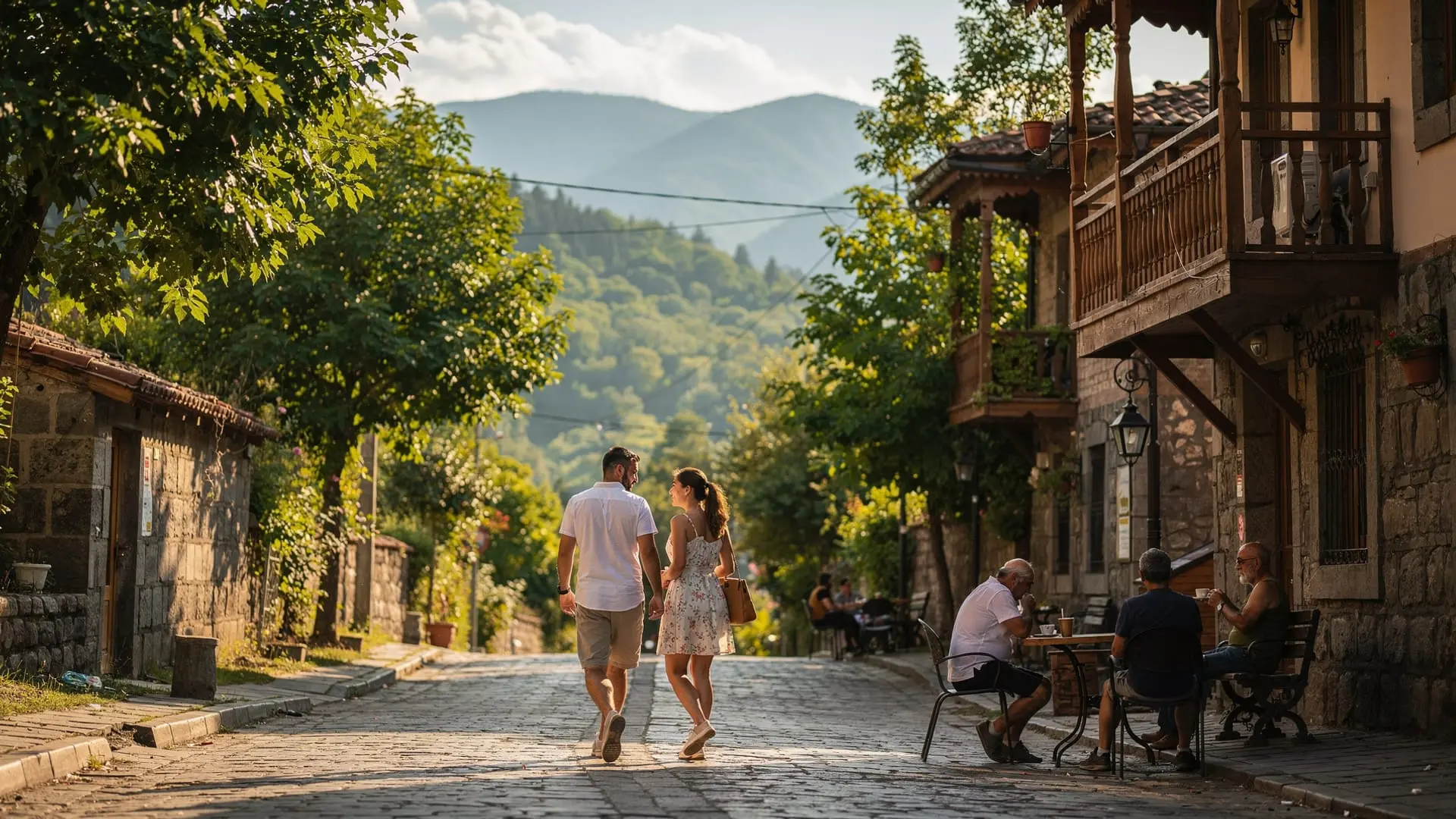
The old town quarter — Sharambeyan Street specifically — is a different place. A short walk from the main road through a small square leads into a cobbled street of 19th-century merchant houses that have been carefully restored over the past decade. The restoration was funded partly by the Dilijan Initiative, an NGO connected to the IDeA Foundation, and the results are unusually good: the buildings are genuine, the stonework is real, and the shops and craft studios that occupy them — a carpet workshop, a ceramics studio, a khachkar carver, a few small cafés — have an authentic rather than performed character.
I had coffee at a small café whose owner, a woman in her thirties named Ani, made it in the Armenian manner over a gas flame, watching it as it heated. She told me she’d grown up in Dilijan, left for Yerevan for ten years, and come back three years ago. “There’s something here now,” she said, gesturing vaguely toward the street. “It’s starting to be worth being here.”
Walking to Lake Parz
After coffee I set out on foot for Lake Parz — “clear lake” in Armenian, which is accurate — about 8 kilometres from the town centre through Dilijan National Park. The trail is well-marked, passes through the kind of deciduous forest that Dilijan is known for, and takes about two hours at a comfortable pace.
In June, the forest is doing what northern deciduous forests do at their best: multiple shades of green, dappled light through the canopy, birds audible and occasionally visible. The path runs alongside streams for part of the route, crosses wooden bridges, and climbs gently before arriving at the lake. The lake itself is small — you can walk the perimeter in twenty minutes — and perfectly clear, as promised. A wooden walkway leads over the water to a small island.
I passed about fifteen people on the trail in two hours: a few local families out for a walk, a couple with a dog, a pair of young hikers with serious rucksacks who were clearly doing something longer and harder than my stroll. The park has proper long-distance trails if you want them — Dilijan is the starting point for several routes into the Transcaucasian Trail network — but the Lake Parz walk is accessible to anyone who can walk a moderate forest path.
The lake has a small café and boating facility. I rented a rowing boat for 1,000 AMD and spent forty-five minutes on the water, which felt like an appropriate ratio of activity to contemplation. The reflections of the forest in the still lake were very good.
The monasteries in the forest
The Dilijan area has two significant monasteries — Haghartsin and Goshavank — both in the forested hills above the town. I visited both the following morning. Haghartsin, 18 kilometres from Dilijan by a forest road, is one of the best-preserved medieval complexes in Armenia: three churches and a refectory from the 12th and 13th centuries in a clearing in the forest, with almost nothing modern visible. The monastery was restored in 2012 with funding from the UAE’s Sheikh Khalifa bin Zayed Al Nahyan, and the restoration has been criticised by some architectural historians for being too clean — some of the patina of age was removed. I understand the criticism but found the monastery beautiful regardless.
Goshavank, 18 kilometres in the other direction, was founded by the 12th-century jurist and scholar Mkhitar Gosh, who wrote the first Armenian civil code here and is buried in the monastery grounds. The carved khachkars at Goshavank are among the finest examples of the form: complex, deeply cut, the stone absorbing the forest light in a way that photographs fail to capture.
For a detailed comparison of the two, the Dilijan national park hikes guide addresses the routes and what you’ll find at each.
The Ijevan extension
Twenty-five kilometres northeast of Dilijan, along a road that follows the Aghstev River through increasingly forested hills, is Ijevan — the second town of Tavush province and a place with a slightly different character than Dilijan. Where Dilijan has invested in its old town and national park infrastructure, Ijevan is less polished but perhaps more genuinely functional as a place: a working town with a winery (the Ijevan Wine and Brandy Factory), a good market, and the Vitasar off-road park nearby for those who want something more active than a forest stroll.
The Ijevan winery is worth stopping at if you’re in the area. The facility is not beautiful — Soviet-era industrial, updated with modern equipment but not architecturally transformed — but the tastings are serious and the wines, particularly the rosé from local grape varieties, are better than the surroundings suggest. A guide in Russian or Armenian (English possible with advance notice) takes you through the fermentation facility and into the cellar. The price of a tasting is very reasonable.
More interesting is the drive between Dilijan and Ijevan itself: the Aghstev gorge narrows in places to a few hundred metres wide, the road running beside the river through forest. In June, when I drove it, the light through the trees was the specific Tavush green that justifies the “Armenian Switzerland” comparison more than the town centres do. Two ravens were doing something aerobatic above the river. I stopped the car and watched for ten minutes.
The question of accommodation
I stayed at the Hotel Old Dilijan Complex — one of the restored 19th-century buildings converted into guesthouse accommodation, with rooms that open onto a courtyard of fruit trees. The rooms are stone-walled, simply furnished, and extremely comfortable. The price was around 30,000 AMD per night for a double, which was very good value for what was offered.
There is also a significant number of guesthouses and homestays in and around Dilijan, plus a few resort-hotel options on the outskirts. For a summer trip, the smaller accommodation options give you better access to the town life — the evening walks on Sharambeyan Street, the café culture, the sense of being in a working small town rather than a resort.
Dilijan is also the base for day trips into the Tavush region: Ijevan (25 kilometres northeast) and Yenokavan with the Yell Extreme zipline park are easy half-day excursions. The Tavush province guide has the full rundown.
The coffee culture that’s developed
Dilijan has, somewhat unexpectedly, become one of the better places in Armenia to drink specialty coffee. The combination of Yerevan-trained baristas who moved here for cheaper rents and a small but growing community of tech workers (there’s a significant cluster of IT companies based in Dilijan, attracted by the climate and the tax incentives) has produced a café culture that would have been unrecognisable five years ago.
The café I liked best was on a side street off Sharambeyan — a small room with six tables, locally roasted Armenian coffee, and a window looking out onto the courtyard of a restored Kumayri-style house. The owner, who had done barista training in Yerevan and spent a year in Tbilisi, pulled espresso from an Armenian-grown Arabica that had a fruit-forward sweetness I hadn’t expected from a domestic coffee. We talked about the coffee scene in Yerevan (which he described as “exploding”) and in Dilijan (which he described as “beginning”).
Armenian specialty coffee is a newer phenomenon than the wine story, but it’s following a similar arc: domestic producers, careful processing, a small community of enthusiasts building something from scratch. The Yerevan café culture guide covers the capital end of this; Dilijan is the provincial extension of the same trend.
What the “Armenian Switzerland” actually means
After two days in Dilijan, my conclusion on the comparison: it’s a shorthand for “the greenest, most forested, most temperate place in Armenia.” In a country where the dominant landscape is highland steppe and mountain rock, Dilijan is genuinely different — it has the ecological character of somewhere several latitudes further north. The forests are real forests. The air has a quality that Yerevan’s summer heat, in particular, makes you appreciate with urgency.
Whether you need to invoke Switzerland to communicate this is another question. I’d rather say: Dilijan is a forest town in the Tavush hills with good monasteries, an improving old town, a national park with proper trails, and a specific quality of summer coolness that makes it the best possible answer to August in Yerevan. You don’t need an Alpine comparison to make that compelling.
The marshrutka back to Yerevan left at 2 p.m. and arrived in the city, which was 10 degrees warmer than where I’d just been, at 4 p.m. I was immediately glad I’d gone.
Combining Dilijan with the rest of Tavush
If you have more than a weekend, Dilijan works well as a base for a slower loop through the region rather than a single overnight stop. A cultural day around Dilijan and Ijevan can be extended with a hike further into the national park, and if lake time appeals more than forest time, Lake Sevan is close enough for a half-day detour before or after Dilijan on the Yerevan road. Travellers coming from or heading to Georgia sometimes route through Tavush entirely, since it sits on one of the quieter roads north.
What I’d do differently
Two days felt slightly short. If I went again, I’d give Lake Parz a full morning rather than a brisk two hours each way, and I’d add a night in Ijevan itself rather than treating it as a day trip — the Aghstev gorge drive is good enough to do slowly, in both directions, with stops. I’d also book the old town guesthouse further ahead; the restored Sharambeyan Street rooms are limited in number and fill up on summer weekends.
Dilijan and Ijevan forest and monasteries day tripFrequently asked questions
Is Dilijan doable as a day trip from Yerevan? Yes, though it’s tight — the old town and a short Lake Parz walk fit into a long day, but you’ll miss the monasteries and the slower pace that makes Dilijan worth visiting. An overnight lets you actually feel the “Armenian Switzerland” cooling-off effect rather than just glimpsing it.
Do I need a car to see Haghartsin and Goshavank? Not necessarily — both are reachable by taxi or a day tour from Dilijan, and many guesthouses can arrange transport. A private vehicle gives more flexibility for stops along the forest roads, but it isn’t required.