Discovering Armenia for the first time: a 2018 trip report
| Trip length | 14 days |
| Base | Yerevan, with day trips and one overnight south |
| Getting around | GG Taxi app in the city; small-group tours and a rental car for day trips |
| Best time | April — mild in Yerevan, colder at elevation (Tatev, Sevan) |
| Budget note | Skip Republic Square restaurants for the backstreets behind Abovyan — same quality, lower prices |
Landing in the pink city
The flight from Vienna landed at Zvartnots at half past midnight. I had done the usual pre-trip research — monastery photos, Wikipedia tabs, one forum thread that called Armenia “the most underrated country in Europe,” which is technically wrong (it’s the Caucasus) but emotionally accurate. What I had not prepared for was stepping outside the terminal into mild April air and feeling, immediately, that I was somewhere genuinely different.
My taxi driver — no meter, naturally, but the price we’d agreed via text was fair — drove me down the highway into Yerevan at 1 a.m. The city was more awake than I expected. The Cascade was lit from below, its terraced granite stairway glowing white against the dark hill behind it. I had my nose pressed to the window like a teenager.
The hotel I’d booked was on a side street near Republic Square. In the morning, when I pulled back the curtains, I understood why everyone talks about the stone. Yerevan is built in tuff — a volcanic rock that ranges from pale cream to deep rose depending on the quarry and the light. In April morning sun, the street below me was genuinely pink. Not the Instagram-filter pink of a travel blog, but the warm, dusty, slightly worn pink of a city that has been building in this material for a century. I stood at the window longer than I meant to.
Republic Square and the first disorientation
I walked to Republic Square before breakfast, which is easy to do when everything is within fifteen minutes of everything else. The square is large — Soviet large, designed to make you feel appropriately small — but the surrounding buildings, clad in tuff, soften what might otherwise feel oppressive. The National Gallery anchors one side. The fountains weren’t running yet in mid-April, which was mildly disappointing but also meant I had the square largely to myself.
I sat on a bench and tried to get my bearings. The Armenian script on the café signs was completely opaque to me, which was humbling in a useful way. I speak four languages; none of them is remotely helpful here. A man selling flowers from a wooden cart near the square noticed my tourist bewilderment and said, simply, “You need coffee?” He pointed to a café. I followed his advice. The coffee was Armenian, which is to say strong, unfiltered, and served in a small cup with no apologies. A good beginning.
That first morning, I wandered without a plan. Abovyan Street, the pedestrian artery that leads from Republic Square up toward the Cascade, is lined with cafés and bookshops. The Matenadaran — the great manuscript library that sits at the top of Mashtots Avenue, visible from much of the city — kept appearing at the end of streets. I made a note to go inside and then, characteristically, didn’t make it until day four.
The Cascade, unhurried
I climbed the Cascade on my second evening. The Cascade is simultaneously a massive outdoor stairway (500-odd steps) and an art museum spread across multiple galleries built into the hillside. You can go up by foot or by escalator — I walked up, took the escalator down, and felt no shame about this.
The outdoor sculptures on each level are an unpredictable mix: a Fernando Botero bronze cat, a Colombian-born artist’s monumental figures scattered on the terraces, felt both surprising and completely at home. At the top, the city spreads out below you, all that tuff and Soviet concrete and Soviet modernist towers, with Mount Ararat floating on the horizon — visible that evening because a north wind had scoured the haze. The mountain is technically in Turkey. From here, it looks like it belongs to the city. I understand why Armenians feel that way.
There’s a bar at the top of the escalator where you can drink a glass of local wine and watch the sun set behind Ararat. I did this. It is, I can confirm, one of the better things I have ever done in a city.
Garni and the pagan temple I wasn’t expecting
On day three I joined a small group tour out to Garni and Geghard. The drive south from Yerevan takes you through the Ararat valley and then up into the gorge country of Kotayk. The landscape shifts quickly from flat vineyards to rocky escarpments, and the road climbs in a way that makes the engine work.
Garni was the surprise of the trip so far. I had, I admit, filed it as “also a temple” in my mental hierarchy of Armenian sites — something to check off on the way to the monastery. That was wrong. The Hellenistic temple at Garni is the only surviving pagan temple in the South Caucasus. It sits on a basalt promontory above a deep gorge, perfectly framed against the cliffs. It was built in the first century AD, almost certainly by the Armenian king Tiridates I, and it survived — just barely, in fragments — and was reconstructed in the 1970s. The archaeology here is interesting and the restoration story is worth knowing before you visit.
I stood in front of the temple for twenty minutes longer than the group, ignoring the tour leader’s pointed glance at her watch. The columns are the right height. The stonework is Caucasian basalt, dark and precise. Down in the gorge, you can see the Symphony of Stones — hexagonal basalt columns formed by ancient lava flows, the geology creating something that looks almost too deliberate. I hiked down to look at them while the rest of the group ate lavash at the outdoor café above.
Geghard Monastery, carved partly into the living rock of the gorge, was extraordinary in a different register — dimmer, more mysterious, the kind of place that reminds you that “atmosphere” is a real thing and not a marketing term.
Tatev and the cable car
I saved Tatev for day eight, by which point I had already visited Khor Virap, Lake Sevan, and Etchmiadzin. The drive from Yerevan to Goris takes about four hours on the southern highway — a long straight shot through the Ararat valley, then climbing through increasingly dramatic mountain country into Syunik province. From Goris, the road to the cable car station at Halidzor winds through more gorge country.
The Wings of Tatev opened in 2010 and held the record for the world’s longest non-stop double-track cable car for several years. The numbers: 5.7 kilometres, a 320-metre descent into the Vorotan gorge, about twelve minutes of crossing. I went early to avoid the worst of the queue. In September peak season, I gather the wait can be over an hour; in mid-April, there were maybe thirty people ahead of me.
Riding it, you understand why the numbers matter less than the experience. The gorge below is vertiginous. The monastery appears at first as a cluster of dark stone rooftops on a plateau, then grows as you descend. The valley walls are striped in greys and ochres. At one point the cable drops through a cloud of swallows. I had been warned that it was “not for the nervous,” and I can confirm the first five minutes require a certain reconciliation with the situation.
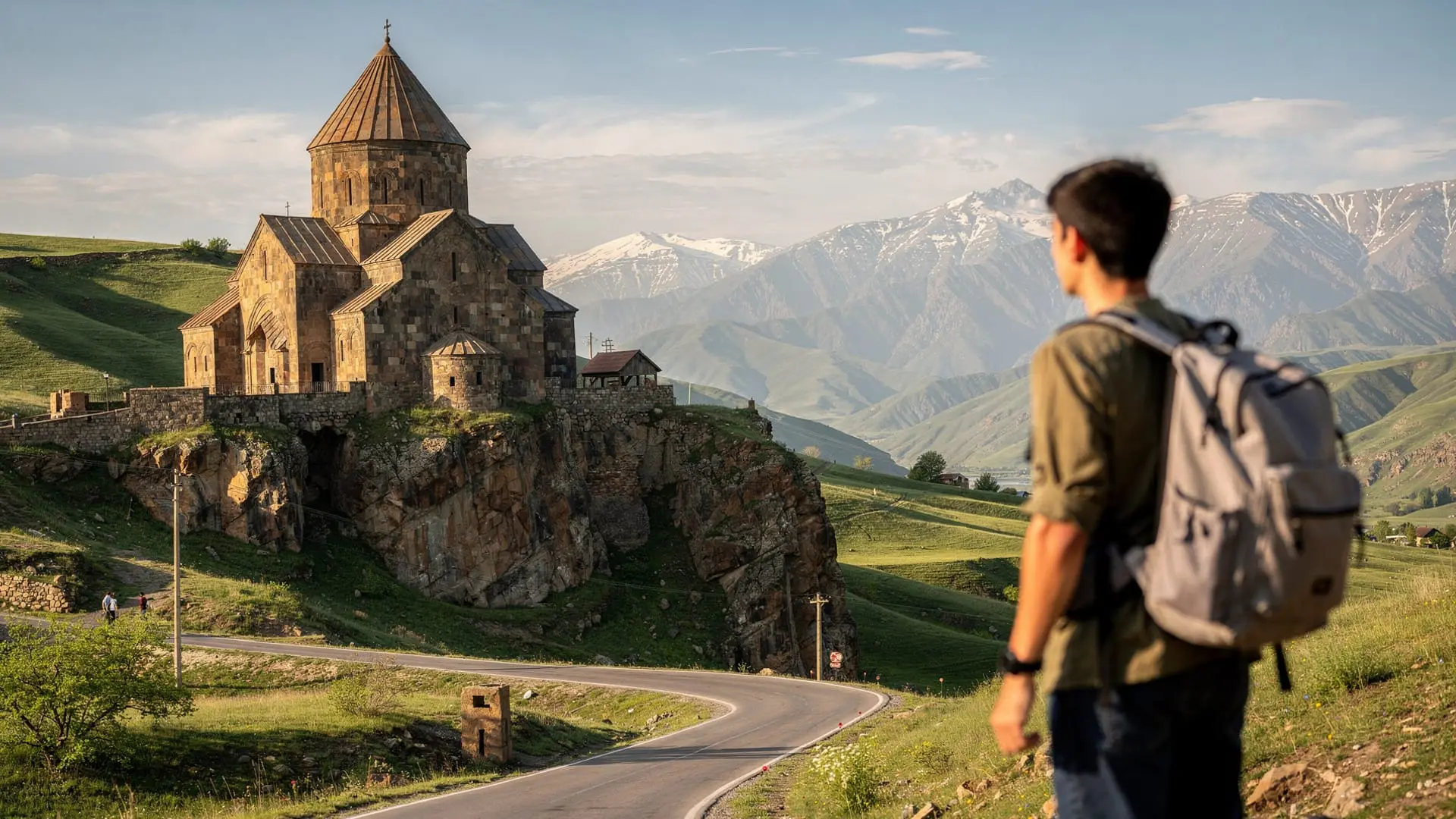
Tatev Monastery itself is vast — a complex of churches, gavits, an oil press, and a famous swinging pillar called Gavazan that served as a seismic indicator. I spent three hours inside and around it. The monastery dates mostly from the ninth century, though there are earlier foundations. The setting — the gorge, the plateau, the distant mountains — is one of the most dramatic in a country that specialises in dramatic monastery settings.
For the practical side of visiting Tatev, the Tatev destination guide has everything you need on logistics, tickets, and timing.
What first-timers usually get wrong
I’ll be honest about my mistakes, since trip reports are more useful when they include them.
I underestimated distances. Armenia is small on a map — roughly the size of Belgium — but the roads are mountain roads, and a 250-kilometre drive to Tatev takes four hours, not two. Plan accordingly.
I also underestimated the heat variation. April in Yerevan is pleasant, around 15-18°C. April in Tatev, at elevation, was noticeably colder, and I was underdressed for the walk up the hill from the cable car station. Pack a layer even if Yerevan feels warm.
The other mistake was spending too much time in Yerevan restaurants around Republic Square. The food was fine; the prices were not. The restaurants on the back streets behind Abovyan — Lavash, Sherep, Sayat-Nova — were better in every way and a fraction of the cost. Ask your hotel; they’ll know.
For getting around, I mostly used GG Taxi on my phone. There is no Uber in Armenia, but GG works well and prices are transparent. For day trips further out, I booked small group tours for the longer distances (Tatev, Khor Virap) and rented a car for the middle-distance ones (Sevan, Dilijan). Both approaches worked.
Coming back
I left Armenia after fourteen days with the sense that I had scratched the surface. There are monasteries in Lori I didn’t reach, the wine country around Areni deserves more than a day, and I want to walk a proper section of the Transcaucasian Trail in the Tavush forests. Armenia is the sort of place where you arrive a tourist and leave making plans to return.
The pink tuff streets of Yerevan, the pagan columns at Garni silhouetted against the gorge, the silence inside Geghard, the twelve minutes of descent into the Vorotan gorge — these are things I had not found on other trips in the region, and I was not expecting to find them here. That is, in the end, the best advertisement for going somewhere without being entirely sure what you’re in for.
If I planned it again
Fourteen days let me go slowly, but a first trip doesn’t need that long to hit the highlights. A tighter week would cover Yerevan, Garni and Geghard, Khor Virap, and one longer day south to Tatev — the 7 vs 10 vs 14 day guide lays out how the extra days change what’s realistic. If I had it to do again, I’d also build in a proper night in Dilijan rather than treating the north as an afterthought — the forest towns are a genuinely different Armenia from the Ararat valley monasteries.
What I’d tell a first-timer today
Book the Wings of Tatev cable car crossing in advance if you’re travelling in peak season (June–September); April queues were short, but summer waits can run over an hour. Bring layers regardless of how warm Yerevan feels — Sevan, Dilijan and Tatev are all noticeably colder at elevation. And don’t over-plan Yerevan itself: the city rewards wandering without an agenda more than any single museum does, though the Cascade’s art collection is worth the climb on a clear day for the Ararat view alone.
Full-day Tatev Monastery and Wings of Tatev cable car tourFrequently asked questions
Is two weeks too long for a first trip to Armenia? Not if you want to go slowly, but most first-timers get a satisfying trip in 7–10 days covering Yerevan, Garni-Geghard, Khor Virap, Sevan or Dilijan, and one longer day to Tatev. Two weeks lets you add Gyumri, the wine country, and less-visited corners without rushing.
What’s the single biggest first-timer mistake? Underestimating driving distances. Armenia looks small on a map, but mountain roads mean a 250km drive can take four hours — build in buffer time rather than stacking too many sites into one day.