Tbilisi to Armenia day trips: the realistic options
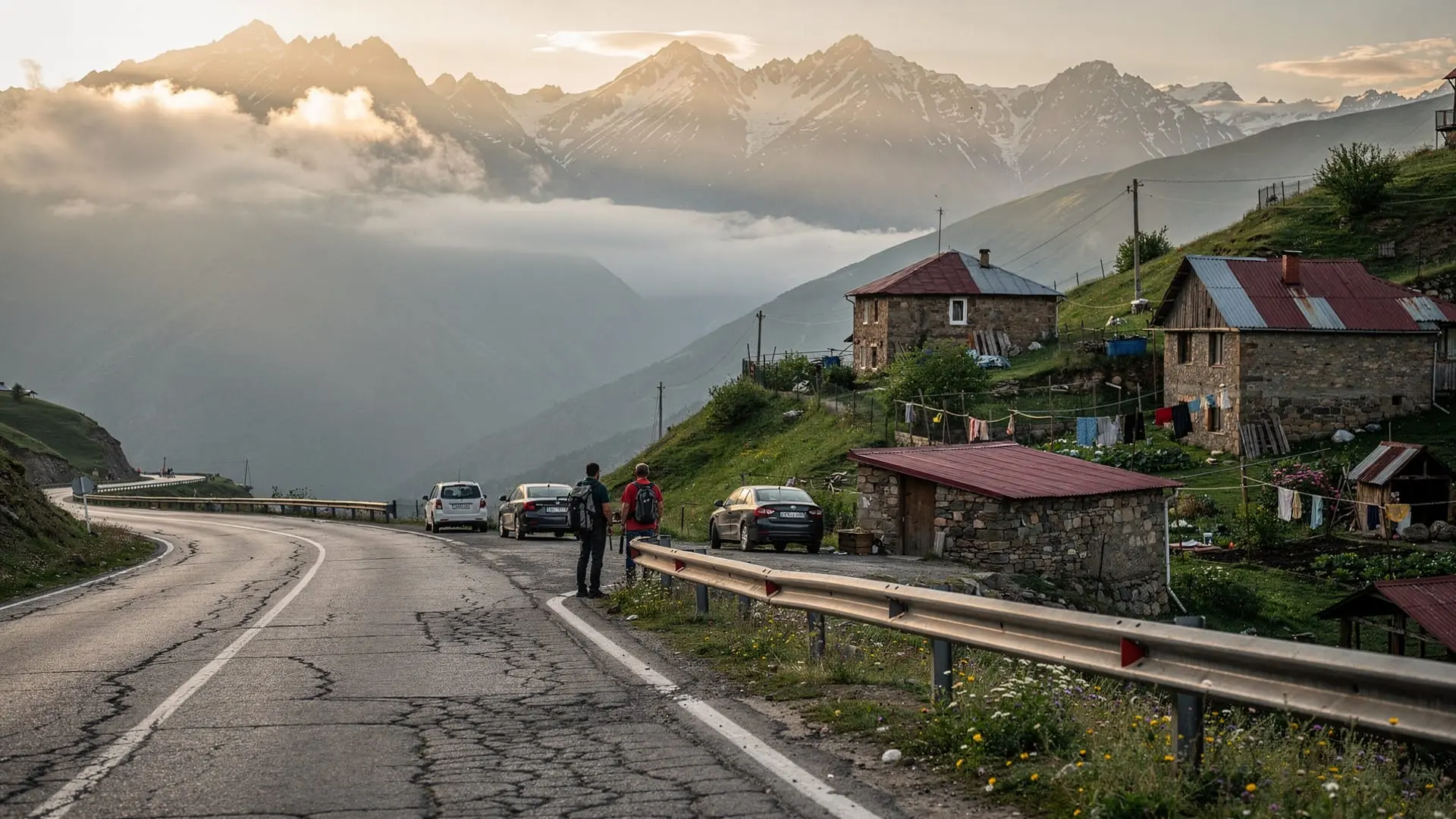
Tbilisi to Armenia is a journey that many Georgia-based travellers consider and many tour operators advertise — but the reality of what’s achievable in a single day is narrower than the marketing sometimes suggests. This guide gives you the honest picture: what can be done well in a day from Tbilisi, what cannot, and which combination of sites gives you the most rewarding cross-border experience.
| Where | Haghpat, Sanahin & Akhtala monasteries, Debed canyon, Lori province |
| Cost | Free entry (Haghpat/Sanahin); small fee at Akhtala; group tours from ~40 EUR/person |
| Time needed | 9–11 hours round trip from Tbilisi |
| Getting there | Self-drive, private taxi, or organised day tour via Bagratashen border |
| Best time | Year-round; cross early to beat border traffic |
The geography problem
Tbilisi to the Bagratashen–Sadakhlo border takes approximately 3 hours by car in good conditions. Once across the border, the first significant sights in Armenia are:
- Haghpat monastery: 15 km from the border, 3 hours 15 minutes from Tbilisi
- Sanahin monastery: 20 km from the border, 3 hours 30 minutes from Tbilisi
- Akhtala monastery: 35 km from the border, 3 hours 45 minutes from Tbilisi
- Alaverdi: The nearby town, 20 km from the border
- Yerevan: 200 km from the border — 6 hours from Tbilisi
This is the defining constraint: everything in the Debed canyon (the deep northern gorge where Haghpat, Sanahin, and Akhtala are located) is feasible as a day trip from Tbilisi. The Armenian capital is not. A day trip to Yerevan from Tbilisi would mean 12 hours of driving for 1–2 hours in the city — not worth it.
What the Debed canyon day trip actually covers
The Debed canyon (Lori province) contains some of the finest examples of medieval Armenian architecture outside of Yerevan — and they are dramatically located, perched above a dark volcanic gorge that runs north to south between the Armenian highlands and the Georgian plains.
Haghpat monastery (UNESCO World Heritage)
Haghpat monastery was founded in the 10th century and expanded through the 13th. The complex includes a large main church (Surb Nshan), a gavit (narthex), several smaller chapels, and an extensive collection of khachkars (Armenian cross-stones). The monastery sits on a forested ridge above the Debed canyon, with views across the gorge.
Allow 60–90 minutes. Entry is free.
What makes Haghpat distinctive: The sculpted details on the main church facade — animals, biblical scenes, and intricate geometric patterns — show the full flowering of late Bagratid Armenian art. The monastery feels lived-in (a small monastic community remains) and is rarely overcrowded.
Book a full-day Armenia tour from Tbilisi including Alaverdi
Sanahin monastery (UNESCO World Heritage)
Sanahin is 5 km from Haghpat, across the gorge in the town of Alaverdi. Founded in the 10th century alongside Haghpat, Sanahin served as a major medieval intellectual centre — the “Academy of Sanahin” produced scholars and scientists who influenced the entire Armenian world. The monastery complex is more spread out than Haghpat and includes the Church of the Holy Redeemer, the gavit, a library building, and a 10th-century belltower.
Allow 60 minutes. Entry is free.
Haghpat vs Sanahin: Most visitors who see both prefer Haghpat for atmosphere and visual drama; Sanahin has more architectural variety. See the Haghpat & Sanahin guide for a detailed comparison.
Akhtala monastery
Akhtala is 35 km north of Alaverdi (closer to the border, actually), a remarkable 13th-century Georgian-Armenian fortress-monastery with surviving Byzantine-style frescoes covering the interior walls. The frescoes are the reason to come — richly coloured, detailed biblical scenes that are among the finest surviving examples of medieval fresco painting in the region.
Allow 45 minutes. Small entry fee applies.
Adding Akhtala to the day requires passing it on the way from the border to Haghpat — it sits between the two, making the sequence Akhtala → Haghpat → Sanahin the most logical order.
Book a Tbilisi to Armenia day trip with homemade lunch
What tour operators actually offer from Tbilisi
Several Tbilisi-based tour operators run Armenia day trips that cover one of two routes:
Route A (Northern monasteries): Tbilisi → Akhtala → Haghpat → Sanahin → Tbilisi. Pure UNESCO heritage. About 9–10 hours including driving and stops. Very popular and genuinely excellent.
Route B (Northern Armenia + Lake Sevan): Tbilisi → border → Haghpat → Dilijan → Lake Sevan → Tbilisi. This stretches the day to 13–15 hours and involves a lot of driving. Ambitious but it does show both the monastic north and the lake country.
Route C (Tbilisi → Yerevan): Some operators advertise this but it is not a day trip — it is a transfer with stops. You’d arrive in Yerevan at 7–8pm and need to stay the night. Don’t book this expecting to “visit Yerevan” in a day.
The border crossing: what to expect
The Bagratashen–Sadakhlo crossing (see the full border guide) is open 24/7. For a day trip from Tbilisi:
- Cross early (8–9am from Tbilisi means arriving at the border around 11am, with lighter traffic).
- Allow 30–60 minutes for the crossing in normal conditions.
- Return crossing in the early evening (3–4pm return from the monasteries means crossing back around 7pm) is typically less congested than the morning tourist rush.
Visa: Citizens of EU, USA, Canada, UK, Australia, and most other Western countries are visa-free in Armenia for 180 days per year. No advance visa needed.
Suggested one-day itinerary from Tbilisi
| Time | Location |
|---|---|
| 8:00am | Depart Tbilisi |
| 10:30am | Akhtala monastery (45 min) |
| 11:30am | Haghpat monastery (90 min) |
| 1:15pm | Lunch in Alaverdi or nearby (1 h) |
| 2:30pm | Sanahin monastery (60 min) |
| 3:45pm | Depart for Tbilisi |
| 7:00pm | Arrive Tbilisi |
This is a full but manageable day (11 hours). You get both UNESCO World Heritage monastery complexes and the finest medieval fresco painting in the region.
For those extending to Lake Sevan, add 1.5 hours of driving and 1 hour at Sevanavank — arriving back in Tbilisi around 9pm.
What you are missing (and why it matters)
A Tbilisi-Armenia day trip cannot cover:
- Yerevan (too far)
- Garni and Geghard (south of Yerevan — roughly 7 hours from Tbilisi)
- Khor Virap and Noravank (south Armenia — 8+ hours from Tbilisi)
- Tatev (9+ hours from Tbilisi — practically requires 2 nights in Armenia)
For most travellers who are primarily based in Georgia but want a proper Armenia experience, the day trip is a gateway — a taste that inspires a return visit to Armenia proper. Full Armenia coverage requires 4–7 days in the country. See the combined Armenia & Georgia itinerary for how to structure both.
For all things Georgia — Tbilisi, Kazbegi, Kakheti, Vardzia, and practical travel information — visit our partner site georgia-spirit.com.
The Alaverdi copper works: industrial history in the canyon
An unusual sidelight to the Haghpat–Sanahin day trip: the town of Alaverdi in the bottom of the Debed canyon has a copper smelting works that has operated in various forms since the 19th century. A Soviet-era copper processing plant still dominates the canyon floor, visible from the Sanahin monastery ridge above in a striking juxtaposition of medieval and Soviet industrial.
The plant is not a tourist attraction — it is a working industrial facility — but the visual contrast it creates (a 10th-century UNESCO monastery on a forested ridge directly above Soviet smokestacks in the canyon) is distinctly Armenian in its compression of historical layers.
Georgian perspective: why Armenians in Georgia matters
For Georgia-based travellers, understanding the Armenian sites near the border has an additional cultural layer: northern Armenia was historically part of a shared Caucasian cultural zone where Armenian and Georgian civilisations overlapped, traded, intermarried, and built monasteries within a few kilometres of each other.
The Lori province of Armenia bordering Georgia was part of the medieval Kingdom of Georgia during several periods — the famous Georgian queen Tamar (12th–13th century) ruled a realm that included much of what is now northern Armenia. Some of the monasteries you visit on this day trip were built under Georgian patronage or with Georgian architectural influence.
This shared history is part of why the Armenia–Georgia combined trip is so rewarding. The day trip from Tbilisi to the northern Armenian monasteries is not visiting a foreign country — it is exploring the other side of a civilisation you already started understanding in Tbilisi.
The Debed canyon: understanding the landscape
The Debed canyon is the geographical corridor connecting Georgia and northern Armenia — the deep gorge cut by the Debed river through the Bazum range creates the most dramatic scenery on the entire Armenia–Georgia overland route.
From the Georgian border at Bagratashen, the road descends through increasingly vertical canyon walls of dark basalt and tuff. The canyon floor is narrow — in places only a few hundred metres wide — while the ridges above rise to 1 000–1 500 metres. The Haghpat and Sanahin monasteries are built on these ridges, visible as tiny white and grey clusters above the dark canyon walls.
For travellers arriving from the relatively flat Georgian plains south of Tbilisi, the entry into the Debed canyon is an immediate geographic signal that Armenia is a different kind of landscape: enclosed, vertical, volcanic. This contrast is part of what makes the day trip rewarding beyond the monasteries themselves.
The canyon is also an important ecological corridor — bear, wolf, and lynx are present in the forested hills above (not visible to casual visitors but notable for the area’s biodiversity).
What to pack and prepare for the crossing
A few practical notes specific to a same-day Georgia-to-Armenia border crossing:
- Passport, not just an ID card: Border officials on both sides require a passport for non-CIS travellers; a national ID card is not sufficient at Bagratashen–Sadakhlo.
- Rental car paperwork: If driving a Georgian rental car, check the rental agreement explicitly permits cross-border travel into Armenia — most Tbilisi agencies allow it with advance notice, but not all, and driving across without permission can void insurance.
- Small AMD cash reserve: Withdraw a modest amount of Armenian dram at Alaverdi or Haghpat rather than relying on cards, since rural card acceptance is inconsistent.
- A full tank of fuel before crossing: Fuel prices and station density differ between the two countries; filling up in Georgia before the border avoids any uncertainty.
- Comfortable layered clothing: The Debed canyon can be several degrees cooler than Tbilisi given the altitude and the shaded gorge setting, especially at Sanahin and Akhtala.
- Modest dress for the monasteries: All three sites are active or semi-active religious buildings; shoulders and knees covered is the expected minimum, and a light scarf is useful for women wanting to cover their head inside the churches.
After the monasteries: where to go in northern Armenia
If the northern monastery day trip leaves you wanting more Armenia, the region has several additional sites within reasonable driving distance:
Lori province: The broader Lori province has monasteries, river gorges, and mountain landscapes that see very few tourists. Stepanavan (the province capital) and the Dendropark forest are pleasant afternoon stops.
Dilijan and Lake Sevan: These are 1.5–2 hours south of the monastery area and can be combined with the northern Armenia day to make a longer loop — drive from Tbilisi through Haghpat/Sanahin, continue to Dilijan, Lake Sevan, and Yerevan (spending the night there before continuing to Georgia or flying home). This is a full 2-day southern loop, not a day trip, but it’s one of the finest Caucasus drives available.
See the combined Armenia & Georgia planner for the full 14-day framework, or visit georgia-spirit.com for Georgia-side itinerary planning.
Frequently asked questions about Tbilisi to Armenia day trips
Is it worth doing a day trip from Tbilisi to see just monasteries?
Strongly yes, if you’re interested in medieval Christian architecture. Haghpat and Sanahin are UNESCO World Heritage Sites of genuine international significance and are unlike anything in Georgia. The Akhtala frescoes add a third major site. Three top-tier monuments in one day is excellent value.
Can I do this trip without a tour guide?
Yes, by rental car or private taxi from Tbilisi. All three monasteries are clearly signed from the main Yerevan highway and accessible to independent travellers. A Tbilisi-based car rental (crossing the border requires checking your rental terms — some prohibit it, most allow it with advance notice) or a private taxi hired in Tbilisi are both viable.
Do I need Georgian lari in Armenia?
No — the Armenian dram is the local currency. Exchange EUR or USD to AMD at Alaverdi or Haghpat; rates are reasonable at local banks. Cards are accepted at the main tour sites but cash is advisable in rural areas.
How is the scenery on the drive from Tbilisi to the Debed canyon?
Excellent. The approach from Georgia descends through increasingly dramatic landscape — the Georgian plain giving way to the Debed gorge, with dark volcanic cliffs rising on both sides. The monasteries appear above on forested ridges. The visual transition from Georgia to Armenia is very clear.
Can I take a marshrutka from Tbilisi to Haghpat?
With difficulty. Marshrutkas from Tbilisi’s Didube bus station run to Alaverdi (the nearby town in Armenia) — the journey is 3–4 hours. From Alaverdi, a local taxi reaches Haghpat in 15 minutes. Return marshrutkas back to Tbilisi run in the afternoon. It works but has limited scheduling and requires more research into current timetables.
Do I need travel insurance that covers both Georgia and Armenia?
It’s worth checking your policy explicitly covers Armenia, not just Georgia, since a day trip across the border technically takes you outside standard Georgia-only coverage for those hours. Most annual multi-country or worldwide policies cover this without issue, but single-country Georgia policies may not.
Is the Bagratashen border crossing open on public holidays?
Yes, the crossing operates 24/7 year-round, including on Georgian and Armenian public holidays, though queues can be longer around major holidays on either side. See the full border crossing guide for current details.