Armenia reopens: what travel looked like in summer 2020
The context
This piece is written in late August 2020, so I’ll try to be specific about what the situation was at the time rather than speaking in the general present tense that travel writing often defaults to. The situation was, and is, changing; by the time you read this, conditions may be different. What I can offer is an honest description of what travel in Armenia actually looked like in summer 2020.
| When | August 2020, weeks after phased reopening |
| Entry | Negative PCR (72hrs) or on-arrival test + quarantine until results |
| Prices | Hotels roughly 30% below normal rate |
| Sites | Geghard, Khor Virap, Noravank, Haghartsin — essentially empty |
| Status now | Historical dispatch; see current visa requirements |
Armenia went into lockdown in March 2020, closed its borders to tourists, and began a phased reopening from July. By mid-August, the borders were open with conditions: international arrivals needed either proof of a negative PCR test taken within 72 hours of departure, or they would be tested on arrival at Zvartnots Airport and would need to quarantine until results came back (typically 24-48 hours). Hotels in Yerevan were open, operating at reduced occupancy due to social distancing requirements. Restaurants were open with table limits.
I arrived in mid-August, with a PCR test I’d had done three days before departure. At the airport, the process was orderly: declaration form, document check, temperature scan, and then through to the arrivals hall. The whole thing added about twenty minutes to the normal arrival process. The airport was quiet — most of the flights were still suspended, and the handful of routes operating (Vienna, Moscow, Dubai, Paris) were running at reduced frequency.
The entry process in detail
At Zvartnots Airport, the arrival process in August 2020 worked as follows. You filled out a health declaration form on the plane or at the arrival gate. At passport control, documents were checked — passport, declaration form, PCR test certificate. A temperature scan was conducted. Those without a negative PCR test were directed to a separate area for on-site testing and instructed to proceed to designated hotels to await results.
The PCR test requirement meant having a test done within 72 hours of departure. The turnaround time in most European countries at that point was 24-48 hours, so booking a test immediately on deciding to travel and arranging results in advance was the practical approach. I had mine done 48 hours before departure and emailed the results to myself so I had them available in multiple formats.
At customs, nothing unusual. The airport itself was operating at perhaps 15-20 percent of normal passenger volume. The baggage hall was quiet, which was disorienting given what Zvartnots looks like at normal capacity. I walked to the taxi rank, negotiated a price to the city (3,000 AMD at that time), and was in Yerevan within thirty minutes.
Yerevan, quieter than usual
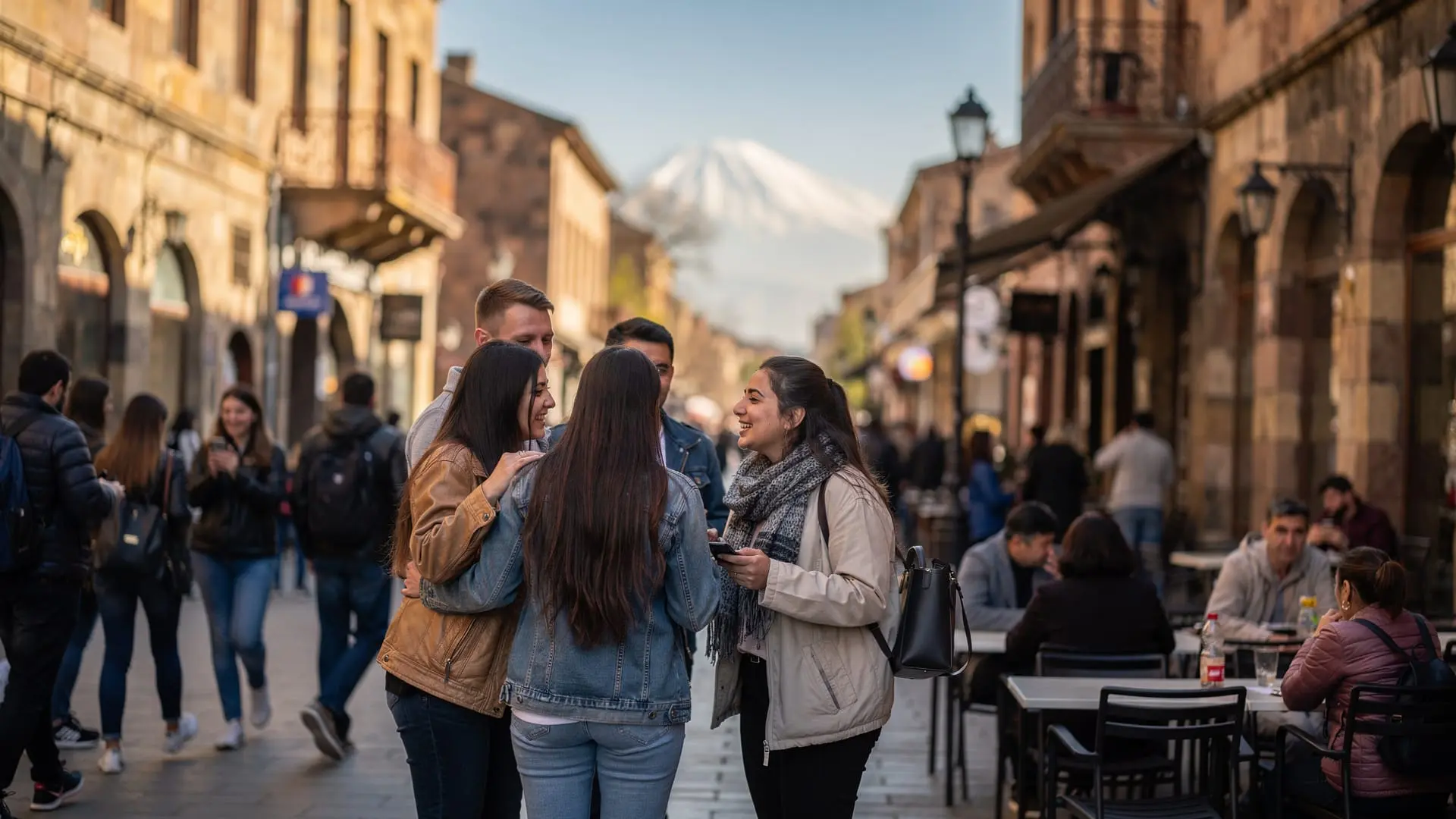
Yerevan in August is normally at its peak summer energy. The city is hot and the streets fill late into the evening with people avoiding the heat in cafés and restaurants. The 2020 version of this was muted. The open-air terraces were operating, tables spaced further apart than usual. Staff were wearing masks. Some streets in the centre were less crowded than a normal August; others were surprisingly busy, the Armenians who hadn’t been able to travel abroad and the diaspora who couldn’t get back yet creating a domestic tourism surge.
The prices were noticeably down. The hotel I normally pay around 60-70 EUR for was available for 45 EUR. Restaurants that had been fully booked in previous Augusts had tables available. A taxi driver I spoke with on the second day said, in rough English, that business was maybe 40 percent of normal. He wasn’t complaining exactly, but the numbers were in his voice.
The outdoor life of the city — Abovyan Street, the Cascade terraces, the parks around the Opera House — was more populated than the indoor venues, which was predictable and also rather pleasant. People were spending more time outside than usual, which suited the weather.
The monasteries were almost empty
This is the part that I suspect many people reading this will find most interesting: the sites outside Yerevan were essentially deserted. The normal summer crowds at Geghard, Garni, Khor Virap, and other major sites had largely evaporated. The tour groups — both the large international ones and the domestic Armenian groups — were either absent or reduced to small fractions.
I visited Geghard on a Saturday morning. On any normal August Saturday, Geghard would have hundreds of visitors by 10 a.m. That morning, I counted perhaps fifteen people at the site over the two hours I spent there. I sat inside the main cave church for thirty minutes in complete silence and heard the acoustic character of the space — the echo of the rock walls, the sound of spring water in the channel — in a way that summer crowds normally make impossible.
Khor Virap was similarly quiet. I arrived at 8 a.m., which is always early enough to be ahead of the first tour buses; in August 2020, those buses were mostly absent and 8 a.m. meant I had the monastery to myself for nearly an hour. The view of Ararat in the morning light, with no other tourists and complete silence from the plain, was one of the more affecting experiences I had on the trip.
This was not exploitation of a situation. The sites were open, the staff were working, the monastery caretakers were there. Visiting them was a normal thing to do that happened to be very uncrowded. It was, in the specific context, a window of experience that I’m unlikely to have again, and I spent the time accordingly.
The Noravank situation
Noravank was the same: a Monday afternoon visit found three other visitors and a monk who seemed pleased to have company. The gorge was its usual dramatic self — the red tuff cliffs, the two-storey church clinging to the rock face, the Darichay River below — and the quality of attention that solitude allows made the architecture more legible. I stayed two hours.
One thing I noticed at each of the major sites: the souvenir vendors, usually a ring of stalls outside the entrance, were either absent or present in reduced numbers. The ones who were there seemed genuinely glad for sales. I bought a hand-painted miniature at Noravank from a man who told me his family had been selling here for fifteen years. His inventory was the same; his customers were, temporarily, not.
What the hotels were like
I stayed in two hotels: one in Yerevan and one in Goris. Both were operating under visible protocols — masks required in common areas, hand sanitiser at all entrances, reduced breakfast buffets replaced by individual service. Neither felt unsafe. The cleaning standards I observed were, if anything, more visible than normal.
The Goris hotel had rooms available at about 30 percent below their normal rate. The restaurant, which would normally be full of travellers passing through to Tatev, was serving maybe a third of its usual tables. The owner, sitting at the bar one evening, told me that the domestic tourism from Yerevan families had kept them from closing but hadn’t replaced the international visitors. She expected things to “go back next year,” which was a hope rather than a prediction but felt reasonable at the time.
Should you have come in summer 2020?
This is worth answering directly, since I’m aware of the ethical complexity of travelling during a pandemic. My thinking: Armenia was open, the entry requirements were clear, the travel was conducted under the same conditions as any other public activity. The economic benefit to the tourism businesses I patronised was real — the hotel in Goris explicitly needed the business. The uncrowded monasteries weren’t an accident of darkness; they were the result of people making the same calculation I was making.
I was careful about masks, about distances, about when and where to be indoors. I didn’t go to crowded venues. This is the version of travel that the 2020 situation required, and it was, in its own way, more attentive than the normal mode. You notice things more when there are fewer people and you’re paying more attention to the environment you’re in.
The practical situation changed substantially from August 2020 onward. The Armenia visa and entry guide has current requirements. This article is a historical document of a specific moment, not a guide to present conditions.
The Dilijan detour
On day five I drove up to Dilijan — the forested mountain town in Tavush province, 95 kilometres from Yerevan, that functions as the country’s main summer escape from city heat. In August, with the usual tourists absent, Dilijan was in an interesting liminal state: the restoration project in the old town was continuing, the new cafés on Sharambeyan Street were open and quiet, and the national park trails were completely empty.
I walked to Lake Parz and back — a two-hour forest trail — and passed four people. The forest in August has a fullness to it that the winter months strip back, and walking in it without the usual background presence of other hikers produced the specific pleasure of having a good place temporarily to oneself.
Haghartsin Monastery, 18 kilometres from Dilijan, was the same: the complex completely empty when I arrived, one monk visible across the courtyard, no vehicles in the car park. I spent two hours there and ate my packed lunch on the grass inside the outer wall. It was, in the circumstances, a better monastery visit than many I’ve had with thirty other tourists present.
The implication of all this is something I should state carefully: the empty sites of summer 2020 were not an argument for avoiding tourists, because the people who run these places — the taxi drivers, the café owners, the monastery shop keepers, the guesthouse operators — need visitors to survive. The emptiness of 2020 was an economic emergency for many of them, not a blessing. I am noting what it was like to visit, not what it should be like.
The one non-tourism thing I noticed
On the morning of August 27, 2020, I was in a café in Yerevan reading the news when I saw reports of fighting in Nagorno-Karabakh. Artillery exchanges. This would escalate in September into the Second Karabakh War. I had no premonition of this at the time — it seemed like another round of the low-level tension that had been present for decades. When I left Armenia a few days later, the sky over Yerevan was clear. What came after was not.
I mention this only because any honest account of Armenia in 2020 needs to acknowledge that the year contained more than the pandemic. The political and military events of autumn 2020 changed the country in ways that are still being processed. For travelers visiting now, the practical safety guide addresses what this means for travel.
Reading this in 2026
I’m leaving this dispatch essentially as written, because its value now is as an honest record of a specific moment rather than as practical advice — Armenia’s entry requirements, prices, and site crowd levels have long since returned to (and in most cases exceeded) their pre-2020 baseline. If you’re researching a trip today, none of the PCR or quarantine details above apply; go straight to the current visa and entry guide for what’s actually required now. What does hold up is the underlying observation: uncrowded monasteries make for a genuinely different, often better, experience of these sites, and that’s worth remembering even in a normal, busier year — the early-morning strategy that worked in August 2020 (arrive at Khor Virap by 8 a.m., get to Geghard before the tour buses) still beats the crowds today, just not to nearly the same degree.
FAQ
Do the entry requirements described in this article still apply? No. This is a historical dispatch from August 2020. Armenia’s pandemic-era entry requirements were lifted long ago; for current, accurate entry rules, use the Armenia visa requirements guide rather than anything in this piece.
Is there any lasting lesson from 2020 for travelers today? Mainly the value of an early start. The nearly empty monasteries of August 2020 were an extreme version of what a normal early-morning visit still achieves today — arriving at Geghard or Khor Virap before 9 a.m. gets you meaningfully ahead of the tour bus crowds, even in a fully recovered tourism year.