Yerevan restaurant scene 2026: what's changed
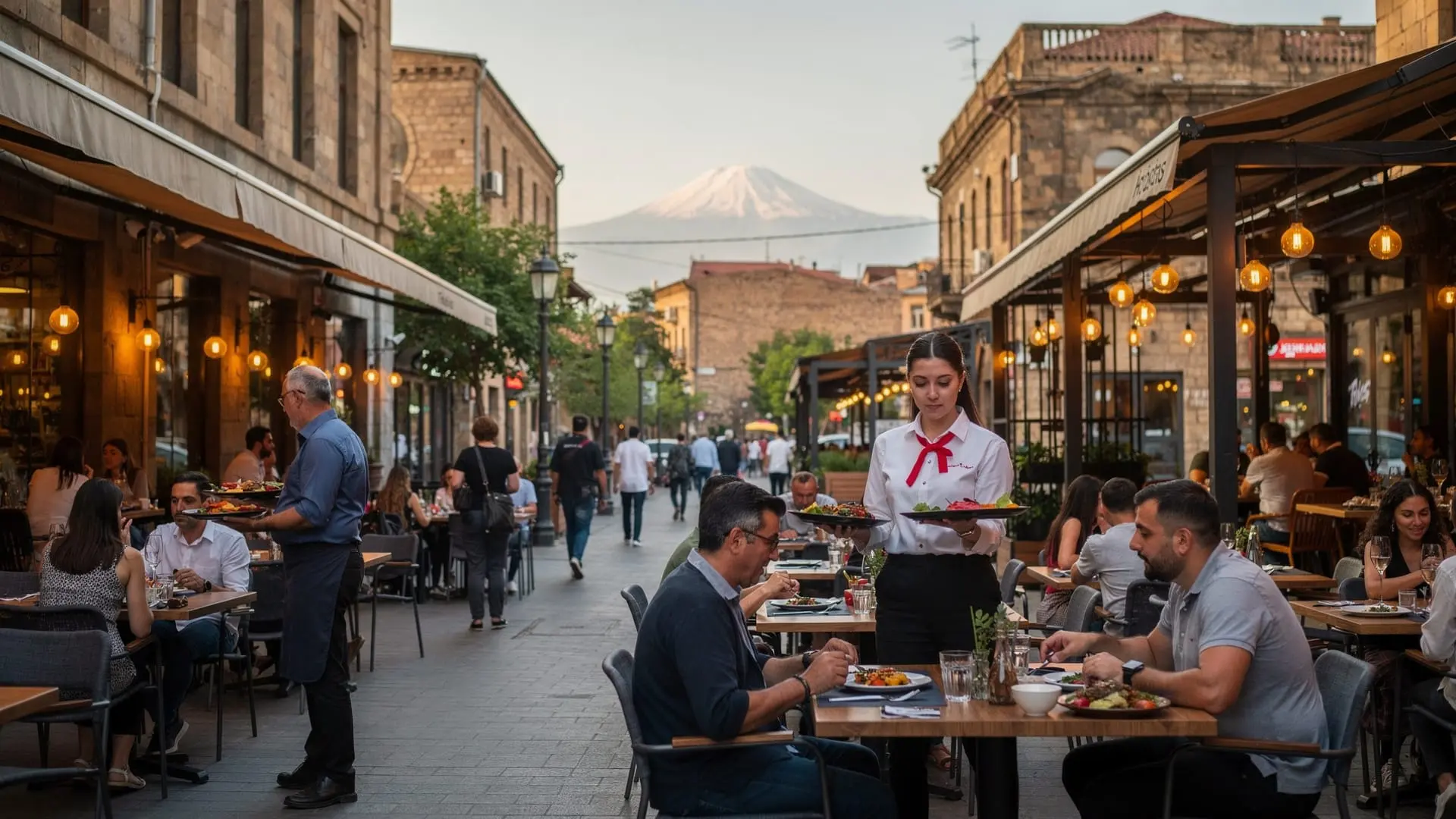
An on-the-ground update on where Yerevan is eating in 2026 — new openings worth the trip, closures to strike off a list, honest pricing, and how the reservation culture has changed.
| Budget meal | around 2,000-3,500 AMD (5-9 EUR) |
| Mid-range dinner | around 10,000-18,000 AMD (25-44 EUR) per person |
| Fine dining | around 30,000-60,000 AMD (73-146 EUR) with wine pairing |
| Reservations | now essential at the top tier; walk-ins still fine casually |
| Where | Saryan Street, Abovyan Street, the Cascade district |
The dining scene is moving faster than the guidebooks
Anyone who ate their way through Yerevan in 2022 or 2023 and returns in 2026 will notice the change immediately. The restaurant scene in the Armenian capital has accelerated. New openings are coming fast — some serious, some trend-chasing — and a handful of long-established names have closed or contracted. The baseline quality across the mid-range has risen. And a new generation of Yerevan-born chefs (many trained or staged abroad) is doing things with Armenian ingredients that would have been dismissed as pretentious five years ago.
This is not a stable situation. Restaurant guides age quickly in Yerevan in 2026. What follows is accurate as of May 2026; treat specific addresses as leads to verify rather than guaranteed reservations.
What’s new in 2026
Fine dining and creative Armenian
Lavash (the Saryan Street flagship, not to be confused with the bread) continues its evolution as the benchmark for high-end Armenian cuisine. The 2025–2026 menu has leaned further into fermentation and wild herbs — specifically ingredients from Tavush and Syunik that most restaurants still treat as peasant food. The lavash bread itself is made daily from heritage wheat; the lamb saddle from Syunik highland is the dish that explains the price. Reservations now fill 5–7 days ahead on weekends. Mains run 12,000–22,000 AMD (30–55 EUR).
Aramo is the new-in-late-2025 entry in the Cascade district that has attracted attention it partly deserves. The concept is Caucasian cross-border — Armenian, Georgian, and Iranian ingredients on the same menu — executed by a chef who worked in Lyon. The mushroom dolma with Sevan trout roe is genuinely good. The location (ground floor of a new hotel adjacent to the Cascade steps) means the tourist flow is constant, which keeps service stretched. Book ahead; prices match the ambition at 10,000–20,000 AMD for mains.
Tigran’s Table (opened March 2026, Northern Avenue adjacent) is a counter-dining concept — 12 seats, six-course tasting menu only, Wednesday through Saturday. Tigran Manukyan previously worked at a Michelin-starred restaurant in Barcelona and returned to Yerevan with serious technique and a genuine project around Armenian pre-Christian festival foods. The menu changes monthly. Price is 35,000 AMD per person (roughly 85 EUR) all-in without wine. This is ambitious by Yerevan standards and largely delivers. Book several weeks ahead.
Casual and everyday excellence
Poloz Mukuch (reopened in a larger space on Abovyan Street in late 2025) remains the best place for traditional Armenian lunch food — manti (tiny Armenian dumplings baked and served with matsun yoghurt), harissa on Sundays, tolma all week. The new location has a proper dining room rather than the previous hole-in-the-wall quality. Prices are resolutely local: 2,500–5,000 AMD for a full lunch.
Kotayk Kitchen (opened January 2026, Mashtots Avenue) is a fast-casual concept built around khorovats — specifically wood-fired grilled meats. The charcoal grill is visible from the dining room. The pork neck khorovats is the best available in the city in the casual category. No reservations; 5,000–8,000 AMD for a full meat-and-salad meal.
Café Vanq (new in 2025, near the Matenadaran) specialises in monastery-style food — the vegetarian and grain-based cooking of Armenian monastic tradition, adapted for a secular dining room. The red bean soup with dried apricot, the wheat grain salad with pomegranate, the herb lahmacun — all better than expected. Excellent for vegetarians. 3,000–6,000 AMD per person.
Ethnic and international
Yerevan’s international restaurant scene has matured. The Italian contingent has grown with two new solid pizza-and-pasta spots near the Opera House district (both operated by actual Italians, which matters). A Korean restaurant opened on Pushkin Street that the local Korean expat community endorses, which is the only endorsement that counts for ethnic cooking. Indian remains difficult in Yerevan — the long-standing establishments have not improved.
Cafés and coffee
The coffee shop proliferation continues. Single Origin (Saryan Street) now has a second location on Abovyan. Jazzve — the Armenian-style coffee specialist with its characteristic copper pots and cardamom — has added branches across the city while maintaining quality. The specialty coffee-to-beer pivot (cafés that are also natural wine and craft beer bars by evening) is now a genre unto itself on Saryan Street and the adjacent blocks. Karma and Coffeehouse both do this well.
What’s closed — or diminished
Notable closures since 2024
Pandok Yerevan (the Old Yerevan dining complex on Buzand Street) has reduced to a single functioning restaurant from what was previously a multi-venue compound. Two of its constituent restaurants closed in 2024; the remaining spot is still operating but not at the former standard. The value-to-cost ratio that made it a reliable recommendation has eroded.
The second Sayat-Nova branch (the Abovyan Street location that opened in 2022) closed in early 2025. The original Sayat-Nova on Sayat-Nova Avenue remains operating. The brand overextended; the original is still good for traditional Armenian atmosphere and solid cooking at 6,000–12,000 AMD per person.
Soorj U Mas (the coffee-and-cheese bar on Tumanyan Street that was briefly a darling of the food internet in 2023) closed in autumn 2024. Rent increases in the Tumanyan/Abovyan corridor have pushed out several small-format independent cafés.
Club Restaurant Ararat (the Republic Square hotel dining room) was reconceived and relaunched in early 2026 as a more accessible bistro format. The old version — expensive, formal, mediocre food — deserved to close. The new version has not yet established itself as worth seeking out.
Declined but surviving
The cluster of white-tablecloth tourist restaurants along Republic Square itself (the ones visible from the singing fountains) has not improved. They are expensive relative to quality, aim squarely at the package-tour market, and do not represent contemporary Yerevan cooking. This was true in 2022 and remains true in 2026. The CLAUDE.md puts it plainly: Republic Square nappes blanches — avoid.
Pricing realities in 2026
Yerevan restaurant prices have risen significantly since 2020, driven by post-pandemic recovery, a large influx of Russian and Ukrainian residents (2022–2023), and general economic pressure. What was cheap by European standards is now merely affordable. Context:
- Budget local meal (lahmacun, shawarma, tolma at a cafeteria): 2,000–3,500 AMD (5–9 EUR)
- Mid-range lunch (soup, main, salad, tea): 5,000–9,000 AMD (12–22 EUR) per person
- Mid-range dinner with drinks: 10,000–18,000 AMD (25–44 EUR) per person
- Fine dining dinner with wine pairing: 30,000–60,000 AMD (73–146 EUR) per person
- Bottle of Armenian wine in a restaurant: 8,000–20,000 AMD (20–50 EUR) depending on producer
- Glass of wine at a wine bar: 2,500–5,000 AMD (6–12 EUR)
- Brandy shot (Ararat 10-year): 3,500–6,000 AMD (8–15 EUR) at reputable bars
Reservation culture changes
Until about 2023, Yerevan restaurants operated almost entirely on walk-in culture — you showed up, and you sat. This has changed at the upper and mid-upper levels. Lavash, Sherep, Gusto, and Tigran’s Table now require advance reservations on weekends, and Lavash fills on weekdays as well during peak tourist season (June–September). The shift has been abrupt enough that travellers accustomed to Yerevan’s old casualness get caught out.
Practical approach: for any restaurant in the 15,000+ AMD/person category, book at least 48 hours ahead if visiting June–September, 24 hours ahead otherwise. For casual spots (Poloz Mukuch, Kotayk Kitchen, the Saryan Street terraces), walk-in still works. For Friday and Saturday dinner at the top tier, book a week ahead or accept that you will not get your first choice.
Most Yerevan restaurants now have Instagram pages where you can DM a reservation request in addition to phone booking. WhatsApp works too. English is reliably understood at all establishments in this price bracket.
Best by category
Armenian traditional
Lavash: the technically accomplished, contemporary-ingredient version. Best for a special occasion dinner or when you want to understand what Armenian cuisine can be at its ceiling. Saryan Street.
Sherep: warm, hospitable, serious about heritage recipes — the dolma, the harissa, the khorovats. More relaxed than Lavash; similar price territory. Good for groups. Mashtots Avenue.
Tavern Yerevan: in the basement of a 19th-century building in the Old Yerevan district. Proper Armenian village cooking — large portions, good brandy selection, live duduk music on weekend evenings. Buzand Street.
Poloz Mukuch: the lunch institution. Manti, harissa, genuinely Armenian atmosphere without tourist artifice. Abovyan Street.
Caucasian fusion and creative
Gusto: the best Caucasian cross-regional cooking in the city. Shares flavour logic across Armenian, Georgian, and Azeri cuisines (the latter without acknowledgement, for obvious political reasons, but the dolma and the walnut sauce belong to the same tradition). Northern Avenue.
Aramo: new in 2025, ambitious, worth trying if you can get a table. Cascade district.
Vegetarian and plant-forward
Café Vanq: monastery-inspired, entirely plant-based except for the dairy options. Best vegetarian food in Yerevan with cultural depth rather than health-food vapidity.
The Green Bean (Abovyan Street): an established vegetarian-friendly café that predates the trend. Reliable, light, good for breakfast or lunch.
Brunch
Yerevan brunch culture is real and improving. Single Origin (Saryan Street) does the best specialty coffee in the city with solid food to match. The Republica Hotel rooftop brunch (weekends, reservation strongly recommended) offers a panoramic Ararat-facing table with a spread of Armenian and continental options at 18,000–25,000 AMD per person including drinks.
Late night
The kitchen hours in Yerevan have expanded. Several Saryan Street restaurants serve until midnight. Malkhas Jazz Club serves food until the last set (around 1–2 a.m.) and the combination of jazz, wine, and mezze at 11 p.m. is one of the better late-night dining experiences in the city. See the Malkhas Jazz Club guide.
Hidden gems still worth seeking out
Cherkezi Dzor (in the Shengavit district, accessible by GG Taxi): a semi-rural restaurant outside the tourist corridor, built around a functioning farm. The trout is from their own pond. The vegetables are from their garden. The setting is quiet and Armenian in a way that the central restaurant strip is not. No English menu; point at things with confidence. Worth the detour.
Achajour (Pushkin Street): the reliable neighbourhood Armenian with no tourist pricing. The khinkali are legitimately good, the khorovats comes to the table still sizzling, and the house wine is drinkable at 1,500 AMD per glass. A useful standard for calibrating your AMD spend.
Wine Republic (Saryan Street): not a restaurant but a wine bar with food — specifically the best selection of natural and small-producer Armenian wines in the city, with knowledgeable staff who can pour a progression from Voskehat white through Areni Noir aged through small-producer brandy. The cheese and meat board is the right companion. Go at 7 p.m. before the evening rush.
Republica (the hotel lobby bar, Northern Avenue): counterintuitive because hotel bars in Yerevan are usually overpriced tourist traps, but the Republica has assembled a serious cocktail programme using Armenian spirits and local herbs. The brandy sour made with Ararat 10-year and pomegranate is the signature. Good for a pre-dinner drink without committing to a full meal.
The neighbourhood shift
The restaurant centre of gravity in Yerevan has been shifting for several years. In 2020, Saryan Street was the clear focal point — the pedestrian and semi-pedestrian strip of wine bars, cafes, and restaurant terraces that comes alive in warm months. That is still true, but the action is expanding in two directions.
Abovyan Street (running north from Republic Square toward Cascade) has absorbed several of the new mid-range openings, including Poloz Mukuch, the second Single Origin, and a cluster of cafés that cater to the large remote-working community in the city. It is quieter and less tourist-visible than Saryan; the food is often better for it.
Tumanyan Street (parallel to Saryan, one block east) has seen both gains and losses. The rent increases that closed Soorj U Mas have also claimed two other small independents since 2024. What survives tends to be either well-capitalized (the Wine Republic outpost) or resilient classics (the Achajour original). New openings on Tumanyan are running slower than on Saryan and Abovyan.
The Cascade district has gentrified into a restaurant zone of its own. The proximity to the Cafesjian contemporary art museum and the higher-end hotels in the district means this is where you find the aspirational openings — Aramo, a new Japanese-adjacent restaurant that opened in 2026 and will either become an institution or close within 18 months (the fate of most ambitious Yerevan concepts), and several café-galleries in converted buildings.
The Kond old quarter — Yerevan’s surviving pre-Soviet residential district, a warren of traditional buildings on the hill between the opera house and the Hrazdan gorge — has seen one or two restaurant experiments. These tend to feel authentic because they are run by Kond residents rather than restaurateurs, which means erratic hours and cash only, but also genuinely home-cooked food. Worth exploring with low expectations on opening times and high expectations on the food itself.
Choosing a neighbourhood for the evening
| Neighbourhood | Character | Best for |
|---|---|---|
| Saryan Street | Wine bars, cafes, terrace culture | A drink-and-graze evening, warm months |
| Abovyan Street | Quieter, mid-range, remote-worker cafes | Reliable food without the tourist premium |
| Tumanyan Street | Independent, thinning out, some resilient classics | Achajour and a few survivors, low key |
| Cascade district | Aspirational, gentrifying, new openings | Ambitious dinners, art-museum pairing |
| Republic Square | Formal, tourist-facing, white tablecloths | Skip — pricing does not match quality |
Tipping and service in 2026
Tipping culture has firmed up alongside the reservation shift. At mid-range and fine-dining restaurants, 10% is now the expected norm rather than a generous gesture, and some higher-end places (Lavash, Tigran’s Table) have started adding a discretionary service charge to the bill that you can adjust but rarely see removed entirely. At casual and traditional spots — Poloz Mukuch, Kotayk Kitchen, the neighbourhood places on Tumanyan — rounding up or leaving small change is still the norm, and nobody will chase you for more. Card payment is near-universal now in Yerevan restaurants, including tip-by-card at most of the upper tier, which has removed the old awkwardness of needing small AMD notes for a tip. The full breakdown of expected tipping across Armenia, including restaurants outside the capital where cash tipping still dominates, is in the Armenian tipping customs guide.
Getting a table without overpaying
A few practical habits separate a good Yerevan meal in 2026 from an overpriced one. First, book directly by phone or Instagram DM rather than through a third-party app where one exists — several restaurants quietly hold their best tables for direct bookings. Second, lunch menus at the fine-dining names (Lavash, Aramo) sometimes run 30-40% below the dinner tasting price for a shorter format, a good way to sample the cooking without the full spend. Third, the Yerevan Brandy Company tour is worth pairing with a Republic Square-adjacent dinner if you want context for the brandy on the menu, since most restaurant wine lists assume you already know what you’re drinking.
Timing also matters more than it used to. Yerevan restaurants are busiest between 8 and 10 p.m., and a 7 p.m. reservation at even the most in-demand names is usually achievable with a day or two’s notice, since Armenians themselves tend to eat later. If a place says it’s fully booked for the evening you want, ask specifically about an early slot before assuming there’s nothing available — hosts don’t always volunteer it. Large groups (six or more) should call rather than message, since most restaurants handle group seating manually rather than through whatever booking system they use for smaller tables.
A note on vegetarian and dietary restrictions in 2026
The vegetarian situation in Yerevan has improved materially. The 2022–2023 influx of Russian and European residents included a significant vegetarian and vegan contingent that created demand the market has partially met. Café Vanq, The Green Bean, and several café-bakeries now produce credible all-day vegetarian menus.
The challenge is the provinces. Outside Yerevan, Armenian traditional cooking is built on meat, and communicating dietary restrictions requires patience and repetition. Vegetarian travellers should eat well in Yerevan and pack their expectations loosely for provincial meals. The mezze tradition (salads, cheese, eggplant, lavash) is broadly plant-based and will appear everywhere; it just may be the entire vegetarian option, not a prelude to a vegetarian main.
Gluten-free is effectively impossible to manage in most Armenian restaurants outside of dedicated Yerevan establishments. Dairy-free is somewhat easier — specifying “without matsun or madzoon” (the yoghurt that appears in many sauces) gets you partway there.
For a deeper guide to Yerevan’s full restaurant landscape with specific dish recommendations, see Yerevan best restaurants 2026. For combining dining with a cooking class, the Armenian traditional cooking class is a good half-day addition to any food-focused itinerary. For the food touring angle, see Armenian essential dishes guide and Armenian brandy complete guide.
For wine-focused visitors, the Armenia wine country overview and Areni Noir grape guide provide context that makes the restaurant wine list far more readable. For evening entertainment beyond dining, Yerevan nightlife guide covers the bar scene, live music venues, and the jazz club circuit. If you are visiting Yerevan primarily for the food culture, the Yerevan cafe culture guide maps the coffee shop scene that precedes and follows every Yerevan dining experience.
The Yerevan private walking food tour with six tastings is the most efficient way to hit the best street food and market stalls with a local who knows what’s worth stopping for. The Yerevan Brandy Company tasting — essential context for understanding Armenian brandy, and a counterpoint to the restaurant bar scene. Book ahead in summer.