Armenian food: 22 essential dishes to try
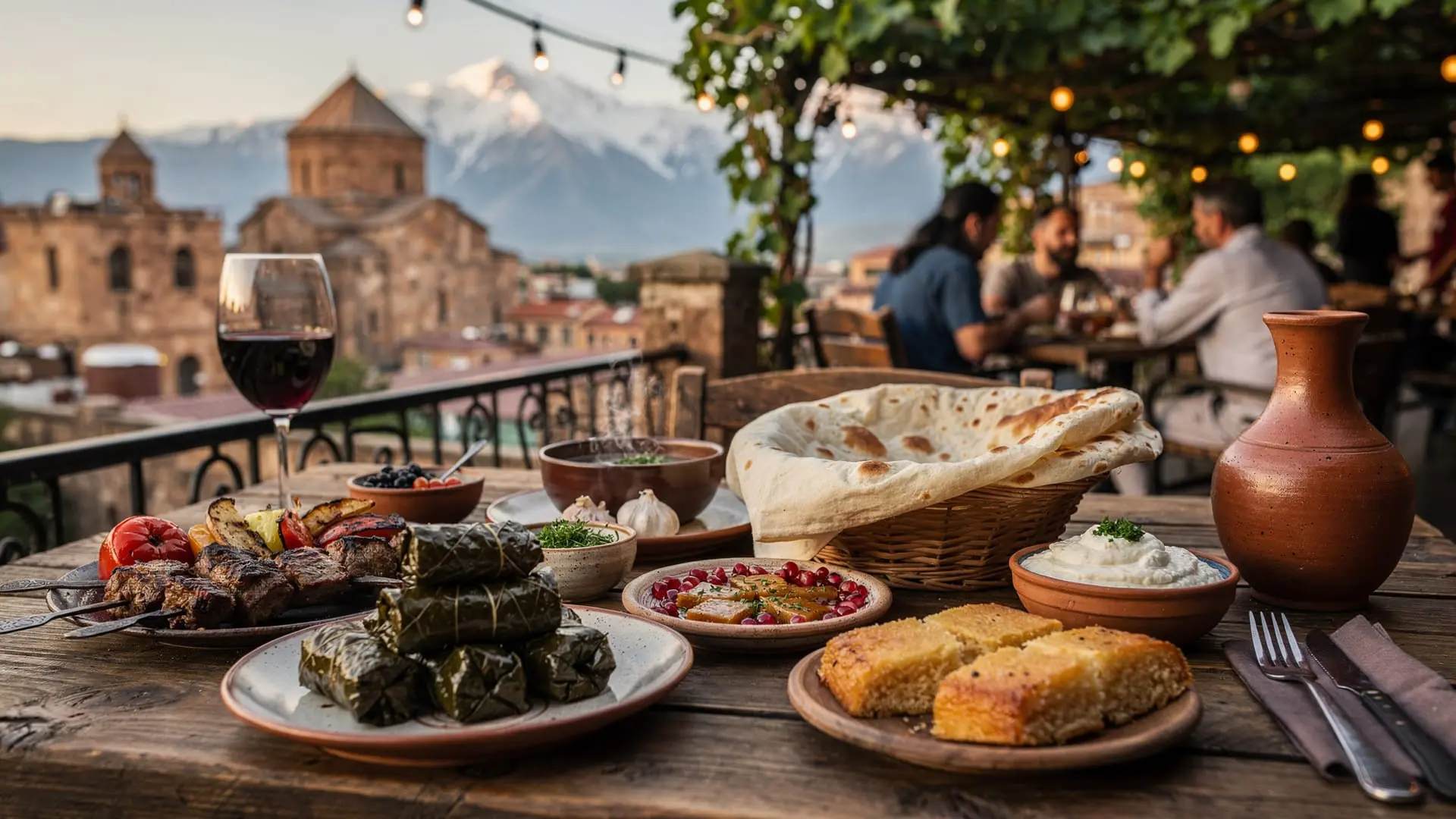
A cuisine older than its restaurants
Armenian food does not shout. It earns respect through depth: a manti broth that has been simmering since morning, a lavash still warm from the tonir, a khorovats whose smoke carries the fragrance of dried grape vine. The cuisine is shaped by a landlocked mountain country with ancient trading routes — wheat and lamb from the highlands, apricots from the Ararat valley, herbs from every roadside. What you get on the plate is honest and precise.
Yerevan’s dining scene has transformed since 2018. New restaurants now do fine-dining interpretations of grandmother recipes alongside traditional taverns where a lamb shank has not changed since the Soviet era. This guide covers the 22 dishes you genuinely need to try, where to find them, and what separates the real version from the tourist approximation.
| Where | Yerevan restaurants, GUM market, and lokants city-wide |
| Cost | 2,000–4,000 AMD budget; 8,000–15,000 AMD mid-range; 25,000–50,000 AMD fine dining |
| Must-try | Khorovats, dolma, khash (winter only), lavash, gata |
| Best for vegetarians | Pasuts dolma, spas, jingalov hats, meze |
| Avoid | Restaurants immediately ringing Republic Square (2–3x standard prices) |
Breads and starters that define the table
1. Lavash
The flatbread that Armenia persuaded UNESCO to list as Intangible Cultural Heritage in 2014. Paper-thin, baked in seconds on the walls of a clay tonir oven, lavash is the table’s constant companion. It wraps khorovats, scoops dips, and is used in place of cutlery at informal meals. Stale lavash is crumbled into soups or re-hydrated with a sprinkle of water. No other bread in Armenian life even comes close. See our dedicated lavash baking guide for the full story and where to try baking it yourself near Garni.
2. Matnakash
A leavened, oval bread with a distinctive pulled pattern on top. Heavier than lavash, slightly chewy, with a crust that cracks satisfyingly. Sold in every bakery; best eaten the day it is baked.
3. Jingalov hats
A flatbread stuffed with 20+ wild herbs — nettles, sorrel, spinach, fenugreek — then dry-griddled. Originally from Artsakh, it is now popular across Armenia. Lumen Coffee Roasters on Saryan Street does a reliable version; the GUM market sometimes has a vendor. Eat it hot.
4. Meze platter (aghandzov shapat)
Armenian mezze typically includes: eggplant with walnuts and garlic (badrijani), herb-stuffed cheese (paneer), pickled vegetables (ttvaser), and taramosalata-like fish roe spreads in restaurants near Lake Sevan. Order meze before anything else — it sets the register for the meal.
5. Hummus and basterma toast
Armenian hummus differs from its Lebanese counterpart: denser, earthier, often topped with fried basterma (cured and spiced beef). Sherep restaurant and Tavern Yerevan both do excellent versions.
Soups and porridges
6. Spas (yoghurt soup)
Hot yoghurt, wheat berries, dried herbs. Sounds improbable; tastes restorative. Spas is a summer soup served warm or cold, and its sourness is the point. The dried herb fragrance — usually coriander and tarragon — makes it unlike anything in neighbouring cuisines.
7. Khash
Armenia’s most notorious dish: a slow-cooked tripe and foot soup eaten at breakfast, doused with garlic and dried lavash. Khash is a winter ritual (October–April only), an event more than a meal. Groups gather early in the morning; a bottle of vodka is considered traditional. Locals insist you cannot understand Armenia until you have eaten khash at 9 am. Tavern Yerevan and Achajour both serve it in season; ask the evening before so they can prepare.
8. Harissa
Wheat porridge slow-cooked with chicken until both become a single inseparable mass — thick, golden, comforting. Harissa is eaten at the feast of the Transfiguration (Vartavar), at Genocide memorial gatherings, and at funerals. It carries a ceremonial weight few foods manage. Order it at Lavash restaurant or Sayat-Nova for the best versions in Yerevan.
9. Ttar (sour borscht variant)
A tangy beet and lamb soup that bears comparison to Georgian but is distinctly Armenian in its seasoning. Found in home kitchens more than restaurants; ask at a traditional tavern.
Main dishes
10. Khorovats
The undisputed centrepiece of Armenian food culture. Pork, lamb, and chicken (often all three) grilled over an open fire fed by grapevine cuttings. The smoke from the vine wood is not incidental — it is the flavour. Served with lavash, sliced raw tomatoes and onions, fresh tarragon (tarkhun), and basil. See our full khorovats guide for the ritual, the cuts, and where to eat it. Note: Armenians are Christian and pork dominates despite the fact — handle that observation gently with local hosts.
11. Dolma and tolma
Two words for the same concept, different execution. Dolma refers specifically to grape leaf rolls stuffed with seasoned lamb and rice; tolma covers stuffed vegetables — peppers, tomatoes, eggplants, quinces. Both words derive from the same Turkic root (doldurmak, to fill), though Armenians rightly point out the practice predates the Ottoman era. The dolma and tolma guide goes deep on the distinction. Dolmama restaurant (named for the dish) is the Yerevan classic.
12. Manti (baked dumplings)
Small open-topped dumplings baked in a wood oven until the meat caramelises at the top, then served swimming in yoghurt and tomato broth with melted butter and dried sumac. Manti is fiddly to make and the best versions take hours — which is why the restaurant version is worth seeking out rather than skipping. Gusto Yerevan and Dolmama do strong renditions.
13. Ghapama (stuffed pumpkin)
A festive dish: a whole pumpkin stuffed with rice, dried fruits (apricots, raisins, plums), nuts, and honey, baked until the flesh is tender. Cooked for New Year and weddings. Rarely on restaurant menus; look at Sherep for seasonal appearances in autumn. It also occasionally appears on tables during Armenian Christmas week, alongside the anushabur pudding and gata that define that specific holiday table.
14. Pasuts dolma (Lenten dolma)
The meatless winter version: grape leaves stuffed with a mixture of dried beans, lentils, rice, and dried apricots. Eaten during the 48-day Great Lent. A genuinely different dish from its meat counterpart — the fruit-and-legume sweetness is unexpected and memorable.
15. Zhngalov (roast chestnuts or herb patties)
Depending on context, this word covers both roasted chestnuts (sold as winter street food) and herb patties in some regional traditions. In Yerevan’s centre, street vendors sell paper bags of roasted chestnuts from October onward — eat them immediately, on the spot.
Grilled and cured meats
16. Lule khorovats
Minced lamb mixed with onion, parsley, and red pepper, pressed onto flat skewers and grilled. The meat is fattier than a typical kebab and benefits from charring. Usually served alongside regular khorovats at any proper barbecue spread.
17. Basterma and sujukh
Basterma is cured beef rubbed with a paste of fenugreek, garlic, and dried chilli — a preserved meat tradition shared with neighbouring cuisines but with an Armenian character. Sujukh (soudjouk) is a dried spiced sausage, similar in spicing. Both appear on charcuterie boards; Tavern Yerevan serves a fine platter. Supermarkets (SAS, Yerevan City) sell vacuum-packed versions for picnics.
Cheese and dairy
18. Lori cheese and chanakh
Armenia produces dozens of regional cheeses. Lori — from the northern province — is a brined semi-hard cheese, salty and springy, often served grilled. Chanakh is a softer Georgian-adjacent brine cheese common in Tavush. At the GUM market, the cheese section (upstairs level) lets you taste before buying; bring a small cool bag if you plan to carry cheese for more than two hours. See our GUM market guide.
19. Matsun
Armenian strained yoghurt — thicker than Greek yoghurt, sharper, used as a condiment, dip, and sauce base across almost every meal. Order plain matsun as a side dish with bread and it will disappear fast.
Sweets and pastries
20. Gata
The sweet bread of Armenian celebrations. A yeasted dough filled with khoriz — a mixture of flour, sugar, and butter — coiled or folded before baking. The Geghard monastery variety (small rings sold at the entrance) is the most famous; the Yerevan café version is richer and larger. See our full gata guide.
21. Pakhlava (Armenian baklava)
Similar to its Greek and Turkish relations but with an Armenian signature: walnut-and-honey dominant, less sweet than some regional versions, often cut into diamond shapes. Found in every pastry shop; the version at Nor Zovq patisserie on Mashtots Avenue is consistently excellent.
22. Churchkhela
A string of walnuts or hazelnuts dipped repeatedly in a grape-must paste (doshab) until they form a sausage shape, then dried. Churchkhela is technically a Georgian-Armenian shared tradition; both countries make it. The Armenian version often uses more walnut and a thicker doshab. Sold at GUM market and Vernissage; buy from vendors with recent batches (fresh churchkhela bends; stale churchkhela snaps and tastes of dust).
Where to eat Armenian food in Yerevan: practical guide
Budget meals (2,000–4,000 AMD / 5–10 €) The GUM market’s basement food hall serves ready-made dishes by the plate. Lokants (canteen-style spots) around Mashtots and Abovyan serve soup, salad, and a main for under 3,500 AMD. Pizza Republic is the local go-to for casual cheap eating — not Armenian but useful when everyone is tired of deciding.
Mid-range (8,000–15,000 AMD / 20–37 €) Lavash Restaurant (Tumanyan Street) is the benchmark for traditional Armenian food done elegantly. Sayat-Nova near the Opera is an institution — dark wood, live folk music on weekends, reliable manti and khorovats. Achajour on Pushkin Street excels at breakfast and lunch; its Armenian brunch is among the city’s best. Tavern Yerevan is a crowd-pleaser with reliable khorovats and cold beer.
Fine dining (25,000–50,000 AMD / 60–120 €) Sherep is the flagship of modern Armenian cuisine — chef Hamlet Petrosyan’s interpretations of traditional dishes are worth the splurge. Dolmama (Pushkin Street) pioneered upscale Armenian dining and remains excellent. Charles (French-influenced, Abovyan area) is for when you want a break from Armenian food without leaving quality behind.
Tourist-trap warning: The restaurants immediately ringing Republic Square with white tablecloths and printed photos on the menu charge two to three times Yerevan standard prices for average food. Walk one block in any direction and the quality-to-price ratio improves dramatically.
| Price tier | Range (AMD) | Range ($) | Where |
|---|---|---|---|
| Budget | 2,000–4,000 | $5–10 | GUM market food hall, lokants around Mashtots/Abovyan |
| Mid-range | 8,000–15,000 | $20–37 | Lavash Restaurant, Sayat-Nova, Achajour, Tavern Yerevan |
| Fine dining | 25,000–50,000 | $60–120 | Sherep, Dolmama, Charles |
Several traditional restaurants also double as evening entertainment — Malkhas Jazz Club pairs food with live jazz and traditional music, a good option if you want dinner and an evening out combined rather than two separate stops.
Drinks to pair with Armenian food
Oghi (mulberry vodka) — the national spirit before brandy took the throne. Clear, powerful, and surprisingly smooth when made well. Order a small glass as a digestif rather than drinking it in quantity.
Armenian brandy (konyak) — what everyone calls it, regardless of the EU’s geographical indication law. Ararat 3-star is the standard; Ararat Akhtamar (10 years) is the classic gift. See our Armenian brandy guide for a full tasting overview.
Armenian wine — the country that arguably invented wine (the Areni-1 cave dates winemaking to 6,100 years ago) produces some outstanding bottles. Areni Noir is the flagship red. For a guided tasting, the Yerevan brandy and wine experiences page lists your options.
Soorj (Armenian coffee) — unfiltered, cooked in a cezve. See our dedicated Armenian coffee guide for the political sensitivities (never call it Turkish in Armenia) and the best cafés.
Food, music, and hospitality together
Armenian meals are rarely just food. Weddings and family celebrations built around a khorovats spread are almost always accompanied by live music — see the Armenian duduk music guide for the instrument most likely to be playing in the background at a traditional restaurant with weekend folk music, such as Sayat-Nova. Understanding the toasting tradition matters too: at a proper Armenian meal, a tamada (toastmaster) leads a structured sequence of toasts — to the table, to family, to guests — and brandy or wine accompanies each one. Arriving with some awareness of this rhythm, rather than treating dinner as a purely transactional meal, changes how the evening unfolds, particularly if you’re hosted by an Armenian family rather than eating alone in a restaurant.
What not to buy at Vernissage
The Vernissage flea market is an excellent source for carpets, khachkar carvings, and jewellery, but it is not a reliable source for food or drink souvenirs. Churchkhela sold there is often stale (it should bend, not snap), and bottled spirits — including brandy sold at suspiciously low prices — are frequently counterfeit. Buy edible souvenirs from GUM market or SAS and Yerevan City supermarkets instead, where supply chains are traceable and quality is consistent.
Planning your Armenian food trip
The Yerevan best restaurants guide for 2026 gives a curated shortlist with booking tips. For a structured food walk, the Yerevan café culture guide covers breakfast and coffee. If you want to go beyond Yerevan, the Garni gastro tour pairs temple visiting with a lavash-baking experience.
For the full market experience, our GUM market food guide walks you through every stall worth stopping at.
Frequently asked questions about Armenian food
Is Armenian food spicy?
Not typically. Armenian cuisine relies on herbs (tarragon, coriander, basil, mint), dried spices (fenugreek, cumin, sumac), and acidity from yoghurt and pomegranate rather than chilli heat. Basterma and sujukh contain chilli paste but even these are warming rather than burning.
Is there vegetarian food in Armenia?
More than most visitors expect. Pasuts dolma (Lenten stuffed grape leaves), spas, jingalov hats, meze, matsun, pakhlava, and most bread-and-cheese spreads are meat-free. During the Orthodox fasting periods (Great Lent, before Christmas), restaurants expand their vegetarian options considerably.
What is the cheapest way to eat well in Yerevan?
The GUM market and lokants (canteen restaurants) in the centre deliver the best value. A two-course meal with bread, soup, salad, and a main costs 2,500–4,000 AMD (6–10 €). For street food, look for jingalov hats vendors and churchkhela sellers at GUM.
Where can I buy Armenian food to take home?
GUM market is the answer for dried goods: vacuum-packed basterma, churchkhela, dried apricots, walnut-stuffed figs, lavash, and jarred cherry preserves. For brandy and wine, the Yerevan Brandy Company shop and SAS supermarkets are reliable — avoid the ornate souvenir bottles at Vernissage, which are frequently counterfeit.
Can I join a cooking class in Yerevan?
Yes. The traditional Armenian cooking class involves making lavash, dolma, and manti with a local host family in their home kitchen — a worthwhile 3 hours if you want to understand the food rather than just consume it.
What’s the difference between Armenian and Georgian cuisine?
The cuisines overlap — shared dishes include khinkali/manti, churchkhela, and grilled meats — but the flavour profiles differ. Armenian food uses more wheat-based preparations, more slow-cooked dishes, and a distinctly different herb palette (tarragon features more prominently than in Georgian cooking). Georgian food tends toward walnut sauces and fenugreek; Armenian food toward yoghurt and fruit-acidity.
Are restaurants open during Armenian Orthodox fasting periods?
Most are, but menus shift. During Great Lent (48 days before Easter), traditional restaurants add Lenten options prominently. Armenian Christmas falls on January 6 rather than December 25 — restaurants are busy on January 5–6 evenings.
Is Yerevan’s nightlife food-focused or more about bars and clubs?
Both coexist comfortably. Many evenings start with a khorovats dinner and continue into the city’s bar and club scene — see the Yerevan nightlife guide for where to go after the table is cleared, whether that’s a wine bar, a jazz club, or something livelier.