Armenia vs Georgia: which Caucasus country to visit?
Two countries, one ancient crossroads
Armenia and Georgia sit side by side in the South Caucasus — two small nations with outsized histories, extraordinary landscapes, and ancient Christian traditions that predate most of Europe’s. They are neighbours separated by a land border you can walk across, yet distinctly different in character.
Travellers with limited time sometimes ask which one to choose. The honest answer is that they complement each other rather than compete. But if you can only do one, the choice comes down to what you want from a trip.
| Countries | Armenia (currency: dram, AMD) and Georgia (currency: lari, GEL) — separate currencies, no shared border union |
| Time needed | 7–10 days minimum each; 14 days to combine both comfortably |
| Crossing the border | Bagratashen–Sadakhlo, around 1.5–2hrs by car from Yerevan or Tbilisi |
| Getting between capitals | Night train, marshrutka (around 6 hours), or private transfer |
| Best time | April–May or September–October for both countries |
The case for Georgia first
Georgia (population 4 million) is the more widely visited of the two, and for good reasons. Tbilisi is one of the most photogenic capitals in the region — its Old Town of balconied wooden houses, sulphur bath houses, and the hillside Narikala fortress delivers the kind of scenes that travel photography is made for.
What Georgia does better:
Nightlife and urban scene. Tbilisi has one of the best electronic music and bar scenes in Eastern Europe. Fabrika, the former sewing factory turned creative hub, and the clubs of Gudiasvili Square attract visitors from across the continent. Yerevan has a strong café and bar culture but nothing approaching Tbilisi’s after-midnight scene.
The beach option. Batumi on the Black Sea coast gives Georgia a coastal dimension Armenia simply does not have. In July and August, when Yerevan reaches 35°C, Georgian visitors can escape to the sea.
Variety within a smaller footprint. Kakheti wine country (60 km from Tbilisi), the dramatic Kazbegi mountains (2.5 hours by shared taxi), the cave city of Vardzia in the south, and the Svaneti highlands all offer different textures within a country the size of Ireland.
International gateway. Tbilisi International Airport has better direct flight connections to European hubs than Yerevan’s Zvartnots, making Georgia a natural first entry point for a Caucasus trip.
For more on Georgia, see georgia-spirit.com.
The case for Armenia first
Armenia (population 3 million) is less visited but arguably more rewarding for travellers who care about depth over polish.
What Armenia does better:
Religious heritage without the crowds. Armenia was the first nation to adopt Christianity as a state religion in 301 AD, and this heritage is woven into its landscape in ways that Georgia, despite its own extraordinary churches, cannot quite match. Tatev monastery in its gorge, Geghard carved into volcanic rock, Noravank beneath red limestone cliffs — these sites are, on a typical weekday, visited by dozens rather than hundreds. The wing-less feeling of standing in these places is not diluted by selfie sticks.
More authentic day-to-day experience. Armenia receives around 1.5–2 million tourists per year versus Georgia’s 7–8 million. This smaller tourist volume means less tourist infrastructure (a real benefit for some: fewer souvenir shops, lower prices, more genuine interactions) and more sense of discovery.
Wine with a deeper story. Both countries claim wine heritage — Georgia with its qvevri clay-pot tradition, Armenia with the Areni-1 cave where 6,000-year-old winemaking equipment was found (making it arguably the world’s oldest wine site). Neither country wins definitively, but Armenia’s wine scene around Areni has a scholarly dimension and fewer commercial tour groups.
The diaspora dimension. For visitors of Armenian descent — and there are 8–10 million Armenians worldwide in the diaspora — Armenia carries an emotional weight that no other destination can replicate. The Tsitsernakaberd Genocide Memorial in Yerevan and the ancient churches of Etchmiadzin have profound significance for this audience.
Budget. Armenia is slightly cheaper than Georgia for comparable accommodation and food, particularly outside Yerevan.
Head-to-head comparison
| Factor | Armenia | Georgia |
|---|---|---|
| Nightlife | Mid-level (Yerevan bar scene) | Excellent (Tbilisi clubs) |
| Religious sites | World-class (oldest Christian country) | Excellent |
| Wine | Outstanding (world’s oldest wine region) | Outstanding (qvevri tradition) |
| Mountain scenery | Exceptional (Aragats, Syunik) | Exceptional (Kazbegi, Svaneti) |
| Beach | None | Yes (Batumi, Black Sea) |
| Crowds | Low | Moderate–High |
| Budget | Slightly lower | Slightly higher |
| Flight connections | Good (EVN) | Better (TBS) |
| Safety | Very safe | Very safe |
| English spoken | Moderate | Good |
| Best season | Apr–May, Sep–Oct | May, Sep–Oct |
The 14-day Caucasus combination
The most satisfying answer to the Armenia vs Georgia question is to do both. A 14-day Caucasus trip typically runs:
Option A: Armenia-focused
- Days 1–3: Yerevan (including Geghard, Garni, Khor Virap day trips)
- Days 4–5: Dilijan and the north (Haghpat, Sanahin)
- Days 6–7: Tatev and Syunik
- Days 8–9: Cross to Tbilisi (via overnight train or marshrutka)
- Days 10–11: Tbilisi
- Days 12–14: Kakheti wine country or Kazbegi
Option B: Georgia-focused with Armenia dip Start in Tbilisi, day-trip to northern Armenia (Haghpat/Alaverdi is 2 hours from Tbilisi), then transfer to Yerevan for days 5–14.
The Yerevan to Tbilisi overland guide covers every option for crossing the border — train, marshrutka, private transfer, and the 14-day combo itinerary plan.
Private one-way transfer: Yerevan to Tbilisi
Highlights you would miss by visiting only one country
If you visit only Georgia:
- You miss the Wings of Tatev cable car over the Vorotan gorge — one of the most dramatic rides in the Caucasus.
- You miss the ancient wine culture at Areni-1 cave (4000 BCE winemaking evidence).
- You miss the emotional weight of Tsitsernakaberd, one of the most moving memorial sites in the world.
- You miss the quiet, uncrowded beauty of Noravank monastery against its red limestone cliffs.
- You miss the Armenian Apostolic Church tradition — distinct from both Orthodox Christianity and Catholicism, one of the oldest Christian denominations.
If you visit only Armenia:
- You miss Tbilisi’s extraordinary Old Town, arguably the most beautiful capital in the South Caucasus.
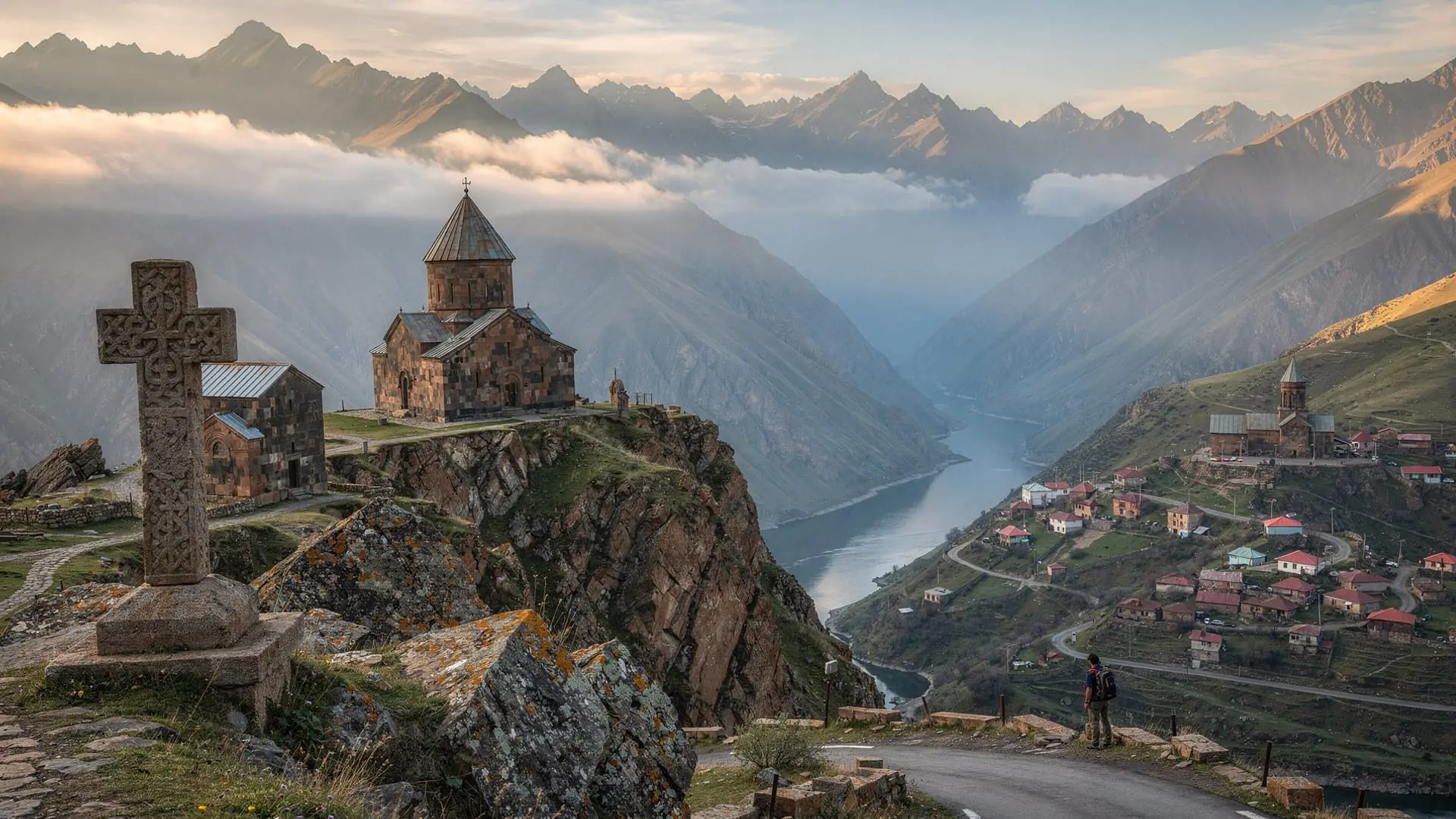
- You miss the Kazbegi mountains — the panoramic view of Mount Kazbek from Gergeti Trinity Church is a bucket-list image.
- You miss the Black Sea coast at Batumi.
- You miss Georgia’s qvevri wine tradition and the amber wines that have become internationally celebrated.
- You miss the variety of Georgian landscapes — subtropical Adjara in the west versus the high Caucasus in the north.
The 14-day combination addresses all of this. For those with under 10 days, Armenia-only or Georgia-only is correct — do not try to rush both into less than a week each. Our Armenia and Georgia combined trip guide walks through how to split the days, and the 14-day Caucasus itinerary gives a full day-by-day plan for travellers who decide both countries deserve the time.
Visa, currency, and entry requirements compared
Both countries are straightforward for most Western passport holders, but the details differ enough to plan around.
Armenia: Visa-free for 180 days for EU, US, UK, Canadian, and most other Western passports. Currency is the Armenian dram (AMD); ATMs are widespread in Yerevan and easy to find in Dilijan, Gyumri, and Tatev, scarcer in smaller villages. Card payments are common in Yerevan restaurants and hotels, less reliable outside the capital — carry cash for marchroutkas, small guesthouses, and rural sites.
Georgia: Visa-free for up to 365 days for most Western passports (one of the most generous visa policies globally), which is part of why Georgia sees more long-stay digital nomads. Currency is the Georgian lari (GEL). Card acceptance is broader than in Armenia, even in smaller towns.
Neither country requires pre-arranged visas for a standard tourist trip, and crossing the land border does not require anything beyond a valid passport for most nationalities — no separate paperwork for the Armenia–Georgia crossing itself.
Language, connectivity, and getting around
Language: Armenian uses its own 39-letter alphabet (see the Armenian alphabet monument guide for the cultural context) and Georgian uses Georgian script — neither is mutually intelligible with the other, and neither resembles Latin or Cyrillic. English is spoken reasonably well in Yerevan’s tourist-facing businesses and hotels but drops off quickly outside the capital; Georgia’s tourism industry is larger and English is marginally more common in Tbilisi and Batumi. Russian remains a practical second language for older generations in both countries.
SIM cards and connectivity: Both countries have inexpensive, easy-to-buy tourist SIM cards available at the airport or in the city centre (Ucom, Viva-MTS, and Team in Armenia; Magti, Geocell, and Beeline in Georgia). Wifi is reliable in hotels and cafés in both capitals.
Getting around within each country: Armenia relies heavily on marchroutka minibuses and taxis outside Yerevan, with car rental increasingly popular for flexibility around Sevan, Dilijan, and the south. Georgia has a broader mix of trains (a genuinely good rail network to Batumi and Kutaisi), marshrutkas, and ride-hailing apps that work well in Tbilisi. Renting a car is worthwhile in both countries if your itinerary includes remote monasteries or mountain villages — the hiking Armenia vs Georgia guide is a useful companion if trekking is a priority on either side of the border, and the overnight Caucasus train is worth booking ahead if you want the classic cross-border rail experience rather than a road transfer.
Which country is better for first-time Caucasus visitors?
Go to Georgia first if:
- You are new to the Caucasus and want a gentler, more international city feel as a base.
- Nightlife is important to you.
- You want a beach day option.
- You are flying into Tbilisi anyway.
Go to Armenia first if:
- Ancient history and religious heritage are your primary interests.
- You want fewer tourists and a more authentic atmosphere.
- You are of Armenian descent on a heritage trip.
- You are flying into Yerevan.
Do both if you have 10–14 days, which is the recommendation for any serious Caucasus trip.
Practical logistics
Getting between Armenia and Georgia:
- Night train Yerevan–Tbilisi: departs ~21:30, arrives ~07:30 (alternate days). The most comfortable option.
- Marshrutka from Kilikia terminal to Tbilisi: ~9,000 AMD, 6 hours.
- Private transfer: 50–120 EUR, most comfortable for groups.
Border crossings (Armenia–Georgia): Three main crossings: Bagratashen–Sadakhlo (main road, busy), Bavra–Ninotsminda (northern route via Shirak), Gogavan–Guguti (near Ijevan, used for Tbilisi-Dilijan routes). All open for tourist travel.
Note on borders: The Armenia–Turkey border has been closed since 1993. The Armenia–Azerbaijan border has been closed since 1991. The only land crossing options are Georgia (north) and Iran (south). Always cross into Georgia or plan around these closed borders.
Tbilisi to Yerevan transfer with Haghpat and Sanahin stops
Food, wine, and daily budget compared
Armenian cuisine is built on lavash flatbread (UNESCO Intangible Heritage), the khorovats barbecue tradition, vine-leaf tolma, fresh herb salads, and lamb preparations that go back millennia. Pomegranate and apricot — Armenia’s national fruit — appear in both savoury and sweet contexts. Yerevan’s restaurant scene (Lavash, Sherep, Sayat-Nova, Achajour, Gusto, Tavern Yerevan) has improved dramatically and now holds its own against any Caucasus city.
Georgian cuisine is better known internationally — khinkali dumplings, khachapuri cheese bread, mtsvadi skewers, and walnut-heavy sauces. Tbilisi’s dining scene is larger and more internationally diverse, with a stronger café culture.
Wine: Both countries are world-class, different in style. Armenia’s Areni Noir grape from Vayots Dzor produces dark, tannic wines with an ancient lineage (the Areni-1 cave documents 6,000-year-old winemaking). Georgia’s qvevri clay-pot winemaking is UNESCO-listed; amber wines are a Georgian specialty increasingly collected by natural wine enthusiasts. Try both countries’ wines — they reward comparison.
Daily budget (April 2026 approximate):
- Armenia backpacker: 25–35 EUR/day (hostels, marshrutkas, local eateries)
- Georgia backpacker: 30–40 EUR/day
- Armenia mid-range: 60–90 EUR/day (3-star hotels, taxis, good restaurants)
- Georgia mid-range: 70–100 EUR/day
- Armenia comfort: 120–200 EUR/day
- Georgia comfort: 130–200 EUR/day
Armenia edges it slightly on budget at every level, particularly outside the capitals.
Frequently asked questions about visiting Armenia vs Georgia
Should I visit Armenia or Georgia first?
See the quickAnswer above — it depends on what you are optimising for. Georgia is a slightly easier first Caucasus destination. Armenia rewards travellers with deeper cultural interests. Most travellers who visit both say they regret not spending longer in Armenia.
Can I visit Armenia and Georgia in one trip?
Absolutely. The countries share a 250 km border with three active crossing points. Many travellers do a 7–14 day loop from Tbilisi: Georgia → northern Armenia → Yerevan → southern Armenia → back to Tbilisi, or vice versa.
Is Armenia cheaper than Georgia?
Armenia is slightly cheaper overall for a comparable standard of accommodation and food, particularly outside Yerevan. Budget: approximately 25–35 EUR/day in Armenia vs. 30–45 EUR/day in Georgia for a backpacker. Mid-range travel is roughly comparable.
Which country has better monasteries?
Both have extraordinary monasteries. Armenia’s are older (some 5th–7th century), more remote, and less visited by large groups. Georgia has the spectacular Jvari, Svetitskhoveli (in Mtskheta, 20 km from Tbilisi), and the cave monastery of Vardzia. It is not a competition — see both.
Is it safe to travel between Armenia and Georgia independently?
Yes. Both countries have excellent safety records for tourists. The Bagratashen–Sadakhlo border crossing is well established and straightforward for EU, US, UK, and most other Western passports (both countries are visa-free for 30+ days).
Which country has better food?
Georgian cuisine (khinkali dumplings, khachapuri bread-boat, churchkhela) is slightly better known internationally. Armenian cuisine is equally distinctive: khorovats (barbecue), lavash bread, dolma, fresh herbs, and lamb preparations that differ meaningfully from Georgian cooking. Wine lovers should try both countries’ wine.
Where can I find more information about Georgia?
For Georgia travel planning, see georgia-spirit.com — our sister site covering the country with the same depth as this site covers Armenia.