Armenian women shaping the country's tourism
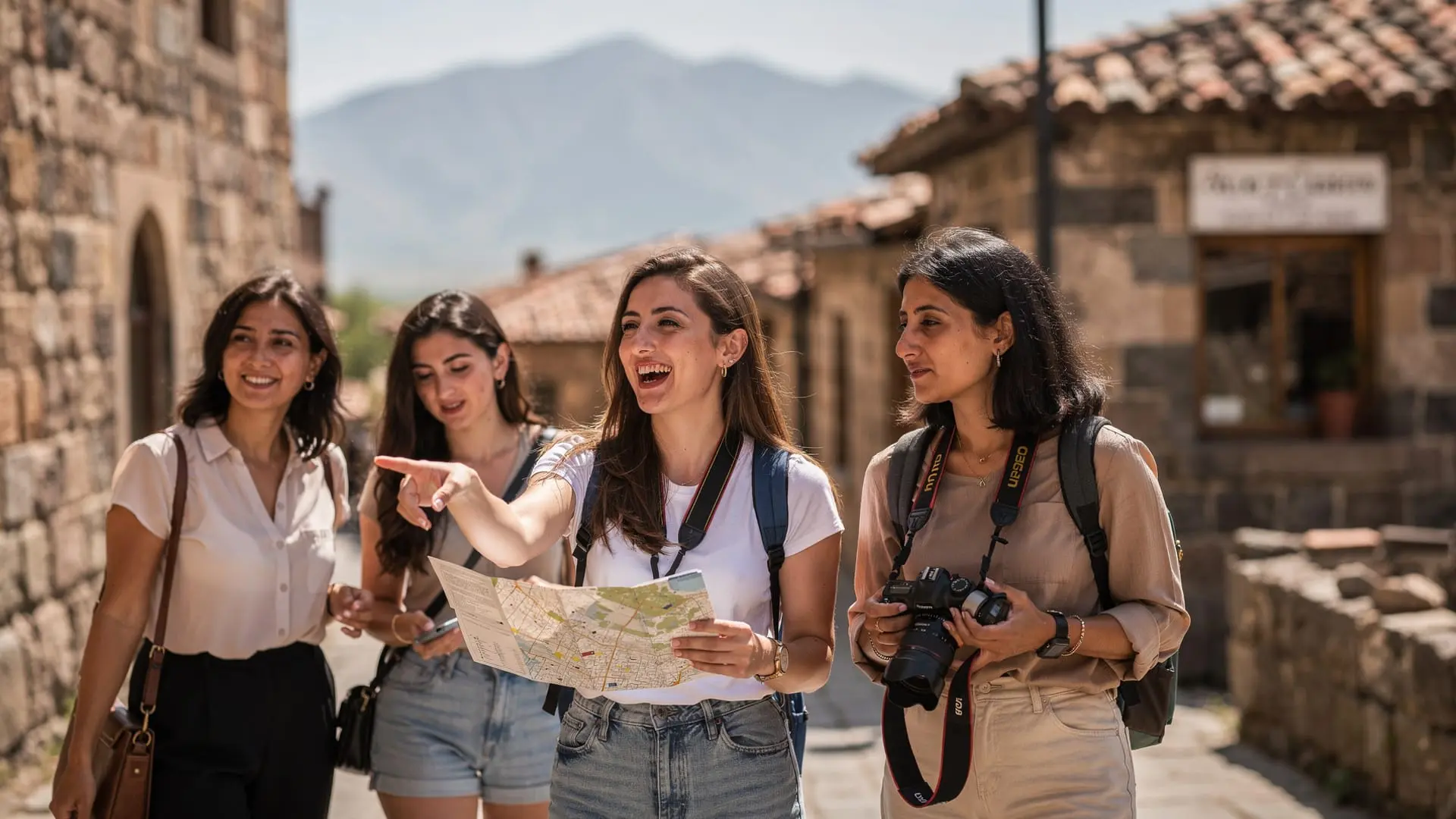
| Where to look | Guesthouses in Syunik, wineries in Vayots Dzor, food tours in Yerevan |
| How to find them | Ask for named recommendations, not the first booking-platform result |
| Cost | No premium — same range as standard tours and stays |
| Best for | Travellers wanting depth over a monument checklist |
| Booking | Small operators often book up — a few days’ notice helps |
A different Armenia tourism story
Most travel writing about Armenia focuses on the monuments: the monasteries, the mountain peaks, the ancient cave sites. This is understandable — those things are extraordinary. But the travel experience of Armenia is increasingly shaped by a set of people who don’t appear on the conventional highlight reel, and on International Women’s Day 2025, I want to write about some of them.
Women are not a footnote in Armenian tourism. They are running guesthouses in Syunik, guiding climbing expeditions on Aragats, producing the wines that have put Vayots Dzor on the global map, and cooking the food that visitors write about most rapturously when they come home. The industry that presents Armenia to the world is, in significant ways, driven by them.
This is not a survey — I haven’t done a statistical analysis of who holds what role. It’s a series of portraits drawn from conversations and observations over the past several years, anchored in the present moment of March 2025.
Tourism as a sector in transition
Before getting to the specific profiles, it’s worth noting the broader shift in how Armenian tourism is structured. For most of its post-Soviet history, Armenian tourism has been organised around a small number of large tour operators based in Yerevan, a handful of international hotels, and a network of informal arrangements in the regions. The model was heavily top-down: tours designed and sold in the capital, with regional operators serving as subcontractors.
What has been changing over the past several years is the emergence of a more distributed model, with smaller and often female-led operators positioning themselves as specialists in specific regions, experiences, or visitor profiles. The growth of platforms like Airbnb and booking.com created infrastructure for guesthouse operators to reach international visitors directly; the rise of specialty travel — food tourism, wine tourism, hiking, heritage — created demand for guides with deep specific knowledge rather than generalist tour expertise.
Women, who have historically been more present in the hospitality and domestic economy sectors than in the formal tourism industry, have been well positioned to take advantage of this structural shift. The guesthouse economy, the culinary experience market, and the specialist guide sector have all grown in ways that have created opportunities that weren’t previously formalised.
The guides who shape the first impression
A visitor’s understanding of Armenia is filtered, more than they often realise, through the person standing at the front of the minibus explaining what they’re looking at. Among the most highly regarded guides working in Armenia today, women are well represented — and they bring a perspective on the country that adds dimensions a standard tour script doesn’t cover.
Anahit, who has been guiding in Syunik province for twelve years, has a particular ability to explain the contemporary situation of the region — the realities of life in a border province, the resilience of the communities around Goris and Kapan, the way ordinary people are navigating extraordinary circumstances — in a way that is informative without being political. Her guests consistently describe their understanding of Syunik as richer than anything they could have assembled from news headlines.
Lilit, who specialises in archaeological and religious heritage, is one of the few English-speaking guides in Armenia who can explain the theological context of Armenian Apostolic Christianity to visitors in a way that makes the monastery visits deeply meaningful rather than aesthetically pleasant but contextually opaque. Her tours of Tatev and Geghard are oversubscribed.
The winemakers of Vayots Dzor
The Armenian wine revival has a specific geography — Vayots Dzor province and its Areni Noir grape — and a specific cultural character, which is that the people making the most interesting wine are often not the large industrial producers but small-scale farmers and winemakers experimenting with minimal-intervention methods and indigenous varieties.
Among these, women winemakers are a significant presence. At several of the boutique producers I visited in 2024 around Areni and Yeghegnadzor, the winemaking decisions — varietal selection, harvest timing, fermentation methods, the choice to use clay kvevri versus stainless steel — were being made by women. Some of these operations are formal enough to appear in international wine press; others are family cellars selling at the gate.
What strikes me about the women winemakers I’ve spoken with is a consistent combination of technical knowledge and willingness to deviate from received practice. The Armenian wine revival is young enough that there is no established orthodoxy to rebel against — you can try the ancestral clay-vessel method alongside the modern stainless tanks and decide based on what the wine tells you. The women doing this work seem particularly comfortable with that kind of empirical openness.
The Vayots Dzor wine route — meet the producers shaping Armenian wineWomen-run guesthouses and cooperatives in Syunik
Some of the most genuinely hospitable accommodation experiences in Armenia come from guesthouses run by women in Syunik, a region that has faced significant pressure over the past several years but remains one of the most culturally interesting provinces in the country.
Several cooperatives in the Goris area and in smaller Syunik villages are women-led: they coordinate homestay bookings, offer cooking experiences (learning to make lavash, tolma, or gata with the family), organise craft workshops in embroidery and carpet weaving, and package these into tourism offers that provide income to households that might not otherwise benefit from visitor spending.
These cooperatives represent something important: an approach to tourism that distributes economic benefit to communities rather than concentrating it in Yerevan-based agencies or large hotels. Visitors who participate in a homestay through one of these networks contribute directly to a household’s income and to the viability of a community that has reasons to stay in a border region.
The chefs redefining Armenian food’s reputation
Yerevan’s food scene has changed significantly in the past decade, and some of the change has been led by women chefs who are rethinking what “Armenian food” means in a fine-dining context — not by abandoning the tradition but by working from within it.
Lavash restaurant on Tumanyan Street — one of the most celebrated restaurants in Yerevan — has female leadership in its kitchen team. The food is Armenian in its vocabulary (the herbs, the sourness, the stone-fruit preparations, the grain dishes) but the precision and presentation belong to a contemporary idiom. It is not fusion; it is depth.
At the less formal end, the female-run small restaurants and bakeries that produce the best bread, the best gata pastry, and the best homemade madzoon in Yerevan are mostly not written about because they’re not on tourist maps. They are in residential neighbourhoods, operating for local customers. Finding them is a matter of asking Yerevantsees where they actually go to eat rather than where they send visitors.
The chefs and bakers making food meaningful
Food is central to how Armenia presents itself to visitors, and the people doing the most interesting food work in the country are often not in the spotlight that the celebrated restaurant kitchens attract.
In the villages around Garni and in the tonir communities of Armavir province, women are the keepers of lavash baking — the UNESCO-recognised tradition of preparing the thin flatbread in a clay tonir oven sunk into the ground. The knowledge is transmitted mother to daughter, and some of the most memorable food experiences in Armenia involve watching a woman in her sixties pull a sheet of dough across a cushion-shaped press and slap it onto the interior wall of a glowing clay pit, then extract it thirty seconds later as a warm, slightly blistered sheet that belongs to no cuisine but this one.
Several tour operators now offer lavash baking experiences as part of day trips. The quality of these varies considerably — some are genuine family interactions, others are choreographed demonstrations for camera. The difference is usually visible in how the family behaves: real lavash bakers have been doing this since they were children and their movements are economical and confident. If your host demonstrates the bread-making while maintaining eye contact with you rather than with the bread, you’re probably in the performative version.
The best gata pastry I’ve eaten in Armenia came from a woman running a home bakery in a residential neighbourhood of Yerevan, in an area that no tourist map shows. She baked twice a week and sold from her kitchen window to the neighbours. Finding this kind of place requires either a local contact or significant time in one place — more than a typical visitor has. But it’s worth knowing these places exist and that the formal food tourism infrastructure is only part of the picture.
The diaspora connection
International Women’s Day has a particular resonance in the Armenian context because of the diaspora dimension. Many of the Armenian women shaping contemporary tourism have roots in the diaspora — in France, in Lebanon, in the United States, in Argentina — and are bringing back not only capital and external connections but a particular kind of perspective that comes from being able to see the country from both inside and outside simultaneously.
The women-run cultural organisations in Yerevan — several of which work at the intersection of tourism, craft preservation, and women’s employment — often have this dual perspective at their core. They know what international visitors are looking for, because in some cases they were international visitors before they were residents. And they know what Armenian traditions are worth preserving and presenting, because their own family histories have been threaded through those traditions even when lived at a distance.
This is not an abstract point. When a tour operator in Yerevan is run by a diaspora-Armenian woman who grew up in Beirut and came back to build something, the tours she designs reflect a double awareness: what’s worth seeing and why, explained by someone who had to ask the same questions before they could give the answers.
What this means for visiting Armenia
None of what I’ve described changes the practical logistics of visiting Armenia. The itineraries, the distances, the seasonal considerations — all the same. What it might change is where you direct your attention and your spending.
If you’re hiring a guide, ask for personal recommendations from people who’ve used specific guides rather than taking the first name that appears on a booking platform. If you’re visiting wineries in Vayots Dzor, ask which of the producers are locally and independently run rather than owned by Yerevan or outside capital. If you’re looking for somewhere to stay in Syunik, investigate the cooperative guesthouse networks before defaulting to the hotel chain in Goris.
The people most responsible for making Armenia a meaningful rather than merely scenic travel experience are often exactly the ones you’d miss if you relied on standard travel infrastructure. Many of them are women.
The Armenia guide overview and our Syunik province page have information on the cooperative guesthouse networks. The Vayots Dzor wine route guide covers the boutique producers. The lavash baking experience guide explains what to look for in the authentic experience versus the commercial version.
How to actually book these experiences
Most of the operators described here don’t have large marketing budgets, so they’re easy to miss on generic search results. A few practical routes: wine-route day trips out of Yerevan often stop at boutique, women-run cellars alongside the bigger names — worth asking your operator specifically who is pouring. Cooking classes and lavash-baking sessions billed as “traditional” or “local family” experiences are more likely to be the real thing than ones staged inside a hotel restaurant. And walking food tours in Yerevan, led by a local guide rather than a driver reciting a script, are one of the more reliable ways to end up eating where residents actually eat.
Garni gastronomic and cultural tour with a local hostWhere this fits in a wider Armenia trip
None of this requires restructuring a standard itinerary. If your route already includes Garni and Geghard, ask whether the lunch stop is a family-run tonir kitchen rather than a tour-bus canteen. If you’re heading toward Tatev, the guesthouses around Goris are a better base than a chain hotel and often the more memorable part of the trip. And a Yerevan café culture afternoon is as good a place as any to notice how much of the city’s food and hospitality scene is run by women, once you start paying attention.
Frequently asked questions
Are these women-run businesses harder to book than standard tours? Not usually — most are listed on the same booking platforms as everyone else, though the smaller cooperatives may respond more slowly than an agency. Booking a few days ahead, rather than the same day, gives the best results.
Do women-run guesthouses and tours cost more than standard options? No — pricing tends to sit in the same range as comparable stays and tours. The difference is in the depth of the experience, not the price bracket.