New Year in Yerevan: what to expect
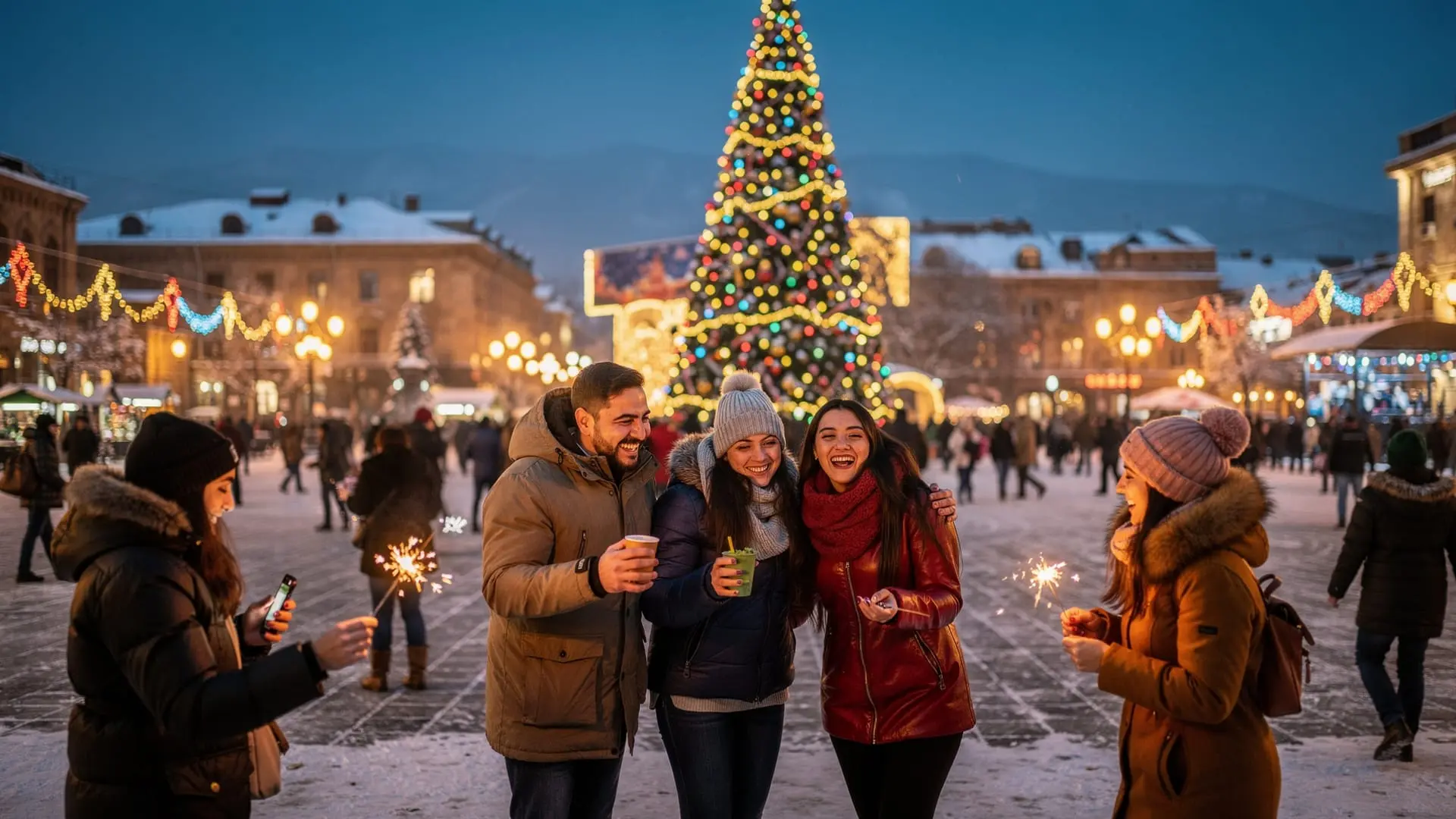
Based on two New Year’s spent in Yerevan, this is what a visitor should actually expect: the fireworks, the family table, what’s open, and how the whole thing differs from what “New Year” means at home.
| Where | Republic Square at midnight; family tables elsewhere |
| Closed period | roughly January 1-2, reduced hours through January 7 |
| Best time to arrive | from around December 26, before peak hotel rates lock in |
| Typical hotel premium | central Kentron hotels run peak rates December 26 - January 3 |
| Combine with | a Tsaghkadzor ski add-on, ~80km north |
Not Armenian Christmas — something else
Let me start with the thing that confuses visitors most: Armenia celebrates New Year on January 1st, the same as most of the world. But the Armenian Apostolic Christmas falls on January 6th, and the weeks around the turn of the year are collectively the country’s most important holiday season — running roughly from December 25th (which passes quietly here) through to around January 13th, when New Year is celebrated again in the old Julian calendar tradition.
This distinction matters practically. The fireworks, the crowds, the decorated trees, the midnight toast, the weeks of heightened festivity — this is all New Year, not Christmas. Armenian Christmas on January 6th is a solemn religious observance, observed in church and in the home, quite different in character from the street celebrations of January 1st.
For a visitor arriving in Yerevan in late December, the city is already in full New Year mode from around December 20th: lights strung between the buildings on Northern Avenue, the large Christmas-style tree on Republic Square, a slight electricity in the air that gets more pronounced as January 1st approaches.
New Year’s Eve at Republic Square
The main public event in Yerevan is the midnight celebrations at Republic Square — the enormous travertine-and-basalt plaza at the heart of the city, surrounded by the National History Museum, the government buildings, and the hotels. On December 31st, the fountains are turned off (it’s too cold for the famous dancing fountains show), but the square fills from around 10:00 p.m. with families, couples, groups of young people, and in recent years a significant number of tourists who’ve figured out that this is one of the more genuinely festive New Year’s events in the region.
A stage is set up for live music — typically a mix of Armenian pop and more recognisable international fare — and at midnight there are fireworks, the tree on the square illuminated, and the sound of the city collectively toasting. I’ve been there twice: once in 2019, once for the transition into 2025. Both times the crowd was enormous and notably good-spirited. It doesn’t feel like an event put on for tourists; it feels like a city’s genuine celebration, with visitors invited in.
The crowd is dense enough that pickpocketing, while not common in Armenia generally, becomes a slightly elevated concern. Keep phones and wallets in inside pockets. Beyond that, the safety situation is benign — Armenian public celebrations are not known for the aggressive drunkenness that marks some European equivalents.
The family meal
The more important New Year tradition for most Armenians is private: the family meal. This is the occasion on which extended families gather, tables are loaded beyond capacity, and the eating and drinking continues for hours. The specific dishes vary by family and region but the Armenian New Year table typically includes: herbed rice with dried fruits and nuts, khorovats if the weather allows grilling, dolma, multiple salads, fresh herbs, fruit, and lavash in quantities that suggest the family has not eaten for a week.
The drinking follows the toasting tradition: the eldest or most respected person at the table offers the first toast, and subsequent toasts address family members, the coming year, people who have died, people who are far away. Wine and brandy are more common than spirits in most households; the tone is celebratory but not chaotic.
Visitors who have Armenian friends in Yerevan and are fortunate enough to be invited to a New Year dinner will experience something that no restaurant can approximate: the specific warmth of an Armenian family table at its most generous.
Yerevan city tour covering the main sights — plan your days around the holiday scheduleWhat’s open and closed, January 1-7
This is the practical information that matters most for visitors: January 1st through approximately January 7th is a national holiday period, and much of the country runs on holiday hours or closes entirely.
Government offices, banks, most businesses, and many restaurants are closed or operating reduced hours on January 1st and 2nd. By January 3rd, things begin to reopen. Restaurants and cafes in the tourist areas of Yerevan (Northern Avenue, Abovyan Street, around the Cascade) tend to be open throughout — they specifically cater to people who are out and about. Supermarkets (SAS, Yerevan City) operate on holiday schedules but are generally open.
Museums mostly close January 1st and reopen January 2nd or 3rd — the Matenadaran, the Erebuni Museum, the History Museum, the Cascade complex all have reduced holiday schedules. Check individual websites before planning a day around them.
The big day trips from Yerevan — Garni, Geghard, Khor Virap, Etchmiadzin — are accessible throughout the holiday period, though some of the smaller cafe operations at the sites may be closed. The Wings of Tatev cable car and Tatev Monastery operate on normal winter schedules.
Armenian Christmas on January 6th is a day when churches hold special services and the atmosphere around religious sites is noticeably different. If you’re in Yerevan on January 6th, the services at Surp Sarkis and Surp Grigor Lusavorich (St. Gregory the Illuminator cathedral) are worth attending — the liturgy is in Classical Armenian (Grabar), haunting and ancient-sounding, and visitors are respectfully welcome.
The tree and the Soviet inheritance
The New Year tree — a decorated conifer or artificial equivalent, placed in the main public square and in homes across the country — is a tradition that Armenia shares with most of the former Soviet space and, in a different form, with most of the world. In the Soviet context, the Christmas tree (which in the USSR was officially secular and called the New Year tree) became the primary winter holiday symbol at a time when religious celebrations were suppressed. The tradition of decorating a tree for the New Year rather than for Christmas persisted in Armenia after 1991, partly because it is genuinely beloved and partly because the Armenian Apostolic Christmas is on January 6th rather than December 25th — making the New Year tree the correct vehicle for the main celebration in any case.
What this means in practice: Yerevan does New Year trees, not Christmas trees, and it does them enthusiastically. The large tree on Republic Square is lit with ceremony, usually around December 20th, and draws a crowd. Smaller trees appear in apartment windows, shop fronts, and hotel lobbies. The whole city takes on a lit-from-within quality in the December evenings.
The Soviet root of the tradition is occasionally commented on by Armenians who have thought about it, sometimes with mild irony — this is a secular celebration in a deeply religious country, observed with as much enthusiasm as any sacred holiday. The paradox is not uncomfortable; it has been domesticated over decades into something that simply is Armenian rather than feeling borrowed.
The decorations and atmosphere in December
Walking around Yerevan in the second half of December, you encounter several layers of festivity that compound as you get closer to January 1st. Northern Avenue — the pedestrian boulevard connecting the Opera building to Republic Square — is decorated with lights strung between the trees and along the building facades. The large New Year tree, a Soviet-inherited tradition, stands in the square from about December 20th, decorated in silver and lit at night.
The underground shopping passages below Republic Square and Northern Avenue are transformed into markets in December, selling ornaments, toys, smoked fish, dried fruit, churchkhela, and other things that get given as small gifts. The atmosphere is genuinely warm — the winter cold, the decorations, the smell of grilled meats from the food stalls, and the mixture of Armenians doing their New Year shopping alongside tourists who’ve discovered that Yerevan in December is quietly one of the best European winter city-break destinations almost nobody talks about.
The Matenadaran — the institute housing Armenia’s famous collection of ancient manuscripts — does a special exhibition in December that focuses on illustrated medieval manuscripts featuring winter or religious imagery. Worth an hour even for visitors not especially interested in manuscripts; the building itself, with its imposing colonnaded facade above the city, is more beautiful than usual against winter skies.
The New Year vs Christmas distinction revisited
One thing worth understanding for any visitor: Armenians do celebrate Christmas, but on January 6th, not December 25th. The Armenian Apostolic Church follows a calculation based on the early Christian calendar tradition, in which Epiphany and the Nativity were observed on the same date. December 25th is essentially a regular day in Armenia — perhaps a few acknowledgements of the global holiday, but not a meaningful celebration in Armenian terms.
January 6th is observed solemnly: church services, family gatherings at home, a quiet atmosphere. It is not a second New Year’s. The Armenian Christmas guide covers what the day involves and where to experience the liturgy, which is worth seeking out for its musical tradition (the Armenian liturgical music, particularly the sharakans, is extraordinary and not widely known outside the church).
For visitors arriving in late December planning to celebrate a “western Christmas,” it’s worth knowing that Yerevan’s December 25th is understated. The city’s festive energy is concentrated around January 1st.
Accommodation and prices in late December
Late December through early January is a popular period for Yerevan visits, and hotel prices in the city centre reflect this. The Marriott, Republica, and the other central hotels charge peak rates from roughly December 26th through January 3rd. Booking three to four months in advance is advisable for the most central accommodation.
Budget accommodation is less affected by the pricing surge — guesthouses in the Kond neighbourhood and the Avan area have lower baseline rates. The tradeoff is walking distance to the Republic Square celebrations, which is worth thinking about if New Year’s Eve at the square is a priority.
The city’s restaurants are mostly open through the holiday period, though some of the smaller and more local places close December 31st to celebrate with their own families. The tourist-oriented restaurants on and near Northern Avenue are reliably open.
Why visit in this period
The obvious reasons: Yerevan in winter has a particular beauty — the pink tuff buildings against the grey winter sky, the mountains visible when the air is clear, the warmth of the indoor culture in contrast to the outdoor cold. The prices outside the peak accommodation rates are reasonable, the city has real festive energy, and the New Year celebrations are genuine rather than manufactured for tourism.
The less obvious reason: visiting Yerevan over New Year gives you a different kind of access to the city’s social life. You’re not watching Armenia from the outside; you’re sharing a holiday with it. The conversations at the café table, the brief interactions at the New Year market, the midnight crowd at Republic Square — these are encounters with how a city actually is, not how it presents itself.
The Yerevan destination guide covers all the practical details for a winter visit. The Armenian public holidays calendar lists the full holiday period with museum opening notes. If you’re combining a winter city break with skiing, Tsaghkadzor is about 80 kilometres north and a perfectly feasible overnight addition to a Yerevan New Year trip.
What the streets actually feel like
Walking Kentron in the days before New Year is the part that photographs don’t quite capture. It’s the smell — grilled corn and roasted chestnuts from street vendors, the sugary smell of gata from bakery windows, cold air carrying woodsmoke from somewhere. It’s the sound of a city that doesn’t quieten down after dark the way it does in summer; instead the opposite happens, and Northern Avenue at 9 p.m. in late December is busier than at 9 p.m. in July. Shop windows compete with increasingly elaborate lighting displays, and there’s a specific, low-key competitiveness among neighbouring cafes about whose facade looks best. None of this is staged for tourists. It’s simply what a city with real winter festive culture looks like when you happen to be walking through it.
If you’re travelling solo or without local contacts
Not every visitor has Armenian friends to invite them to a family table, and that’s fine — Republic Square at midnight works well solo, and the crowd is friendly enough that striking up a conversation with the group next to you is entirely normal on New Year’s Eve. Several restaurants around Northern Avenue and Abovyan Street run set New Year’s Eve menus for walk-ins and small groups, a reasonable substitute for the family meal you won’t be attending. Booking a table for the evening of the 31st is worth doing a few days ahead even for casual places, since capacity is genuinely tighter than a normal night. For January 6th, showing up at Surp Grigor Lusavorich cathedral for the evening service is open to anyone and needs no invitation or advance arrangement.