Armenia travel guide: everything you need to plan your trip
What Armenia actually is — and why it surprises people
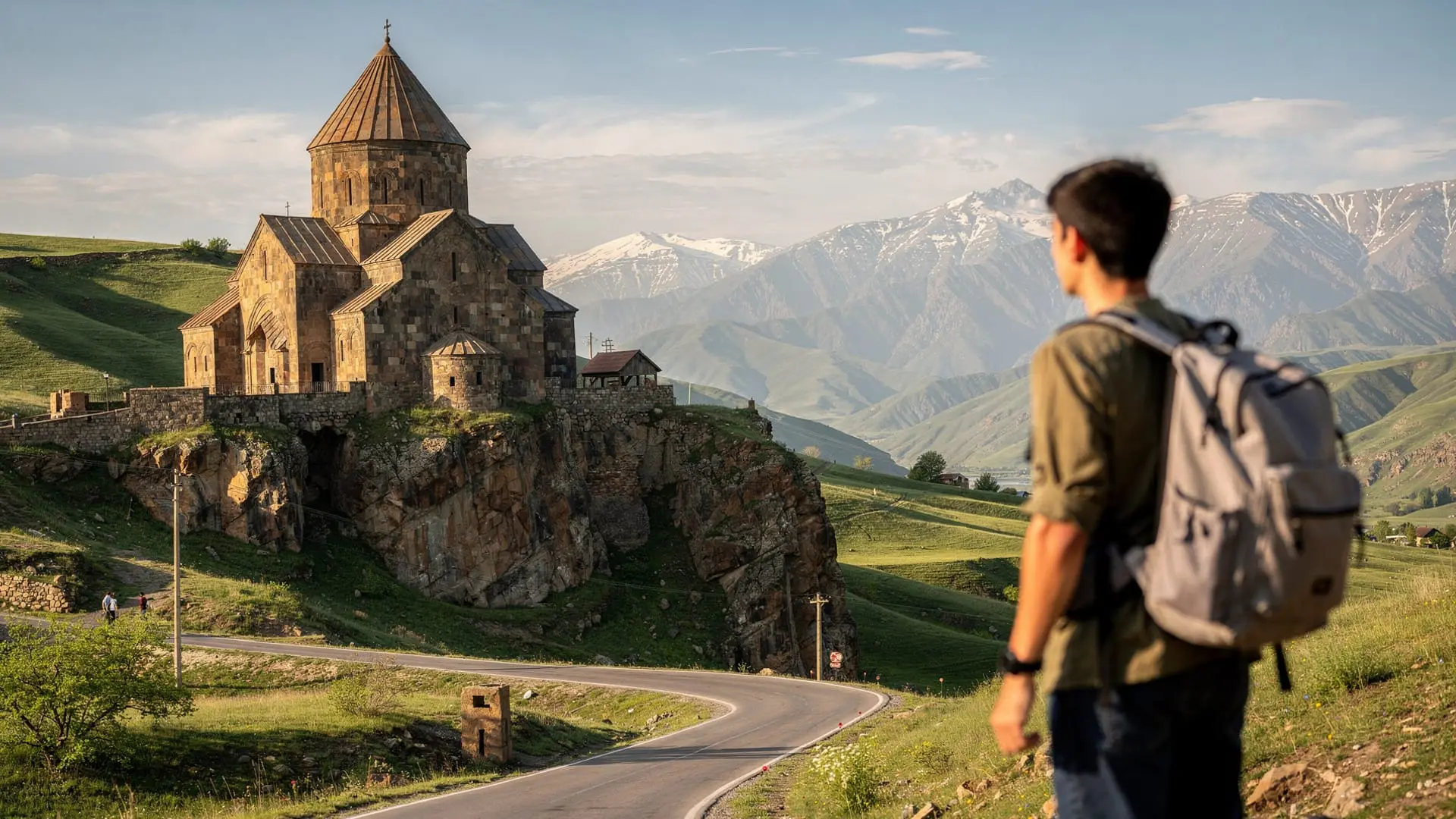
Armenia sits in the South Caucasus, wedged between Georgia to the north, Iran to the south, and two closed borders — Turkey to the west, Azerbaijan to the east. It is a landlocked country roughly the size of Belgium, home to about three million people and an Armenian diaspora spread across the world that is three times that number. It has been Christian since 301 AD, making it the first country to adopt Christianity as a state religion — a fact that explains much of the landscape, which is dotted with stone monasteries that predate Westminster Abbey by six centuries.
What most people discover, once they actually land in Yerevan, is that Armenia is nothing like its neighbours in the travel imagination. It is not a post-Soviet ruin tour. It is not merely a religious heritage circuit. It is a compact, walkable country where you can eat grilled river trout by a lake in the morning, drink Areni Noir at a winery carved into a volcanic gorge in the afternoon, and be back in a city with excellent cocktail bars by evening. The monasteries are extraordinary. The food is excellent. The brandy is real. And the mountains — Mount Aragats reaching 4,090 metres, the Gegham volcanic highlands, the forested Tavush ridges — are accessible, beautiful, and almost entirely uncrowded.
This guide covers everything you need to plan a trip, whether you have three days or three weeks.
| Best time to visit | April–May or September–October |
| Currency | Armenian Dram (AMD), around 410 AMD = 1 EUR |
| Visa | Visa-free for EU/US/UK/Canada/Australia up to 180 days |
| Getting there | Zvartnots International Airport (EVN), Yerevan |
| Days needed | 5–7 for a first visit; 10–14 for full coverage |
Why Armenia rewards independent travellers
Armenia is not difficult to travel. Yerevan is a functioning European-standard capital with good restaurants, reliable Wi-Fi, ATMs that work, and a taxi app (GG Taxi) that eliminates the haggling that plagues many developing destinations. English is widely spoken by anyone under 40 in the capital.
Outside Yerevan, the country rewards the curious. Most monasteries are free to enter. The landscapes are varied and extreme in their beauty — from the high alpine plateau of Aragats to the subtropical forests of Tavush, all within a few hours of each other. The people are genuinely hospitable in a way that does not feel transactional.
What makes Armenia particularly interesting to the informed traveller is its combination of historical depth, natural drama, and complete absence of the tourist-trap machinery that has eroded similar experiences elsewhere. There are no selfie-stick vendors at Geghard. There are no trinket shops crowding the path to Tatev. The monasteries are still functioning religious sites, and the silence inside them is real.
The three honest caveats: road conditions outside main highways can be rough (essential context for road trippers — see the road trip guide); the Yerevan summer is genuinely hot (35°C+); and the political context — closed borders with Turkey and Azerbaijan, the Nagorno-Karabakh situation — requires reading before you go. None of these are dealbreakers; they are simply the honest print that most glowing “hidden gem” articles about Armenia skip over.
When to visit Armenia
The two best periods are April–May and September–October.
April–May brings wildflowers to the Aragats plateau, mild temperatures (15–23°C in Yerevan, cooler at altitude), and monasteries in their spring light. The snow is melting on the high peaks. The apricot trees — national symbol — bloom pink across the Ararat valley. Crowds are light.
September–October is arguably the finest season. The vendanges (grape harvest) happen in early October in the Areni valley — see Areni and the Vayots Dzor wine route — the Tavush forests go golden and red, and the air has the particular clarity of the dry season. Temperatures remain warm (20–30°C) into late September. This is the time to visit Tatev, to hike, to drink new wine.
June–August is peak season: Yerevan is hot and lively, Lake Sevan is crowded with Armenian families, and the Wings of Tatev cable car requires advance booking (or very early arrival). The mountains — Aragats, the Gegham range, Dilijan national park — are cooler and excellent for hiking. The upside is that everything is open and functioning.
Winter (December–March) has its own logic: Tsaghkadzor ski resort is good value, monasteries in snow are extraordinarily beautiful and completely quiet, and Tatev is accessible via cable car year-round. Yerevan restaurants and bars are full and atmospheric. The downside is that some mountain roads (Geghard in deep winter, some Aragats approaches) can be icy or closed.
For the complete month-by-month breakdown with packing suggestions, see Armenia’s best season to visit and the spring travel guide.
How to get to Armenia
By air: Zvartnots International Airport (EVN) is 12 km west of central Yerevan. Direct flights operate from Vienna (Austrian), Paris CDG (Air France), Rome Fiumicino (ITA Airways), Athens (Aegean), Frankfurt (Lufthansa, Condor), Amsterdam (KLM), and multiple Russian and Middle Eastern cities. Budget options include Wizz Air from various European hubs. Flying time from Paris is approximately 4.5 hours. From the airport, take a taxi (fixed rate to centre ~3,000–4,000 AMD, approximately 7–10 EUR) or pre-book an airport transfer for a stress-free arrival.
From Georgia (most common overland route): Three border crossings link Armenia to Georgia. The principal crossing is Bagratashen-Sadakhlo, on the main road between Tbilisi and Yerevan (approximately 270 km, 5–6 hours by shared taxi or marshrutka). Daily shared taxis depart from Yerevan’s Kilikia bus station; marshrutkas are cheaper but slower. The overnight train (Yerevan–Tbilisi, approximately 10 hours, twice weekly) is romantic and recommended for those who want to arrive rested — see Yerevan to Tbilisi overland guide.
From Iran (southern route): The Meghri-Norduz crossing is open but primarily used by regional travellers and overlanders. This route is not recommended for most Western tourists due to complexity of Iranian visa requirements; it is mentioned here for completeness.
From Turkey or Azerbaijan: Both borders have been closed since the early 1990s. There is no road, rail, or air connection between Armenia and these countries.
Visa and entry requirements
Citizens of the European Union, United States, Canada, United Kingdom, Australia, Switzerland, Japan, and South Korea can enter Armenia without a visa for stays up to 180 days within a 365-day period. No pre-approval is needed — you receive a stamp at the airport or border crossing.
For approximately 39 other nationalities, an electronic visa (e-Visa) is available through the official Armenian Ministry of Foreign Affairs portal at evisa.mfa.am. Processing takes 2–3 business days; fees are nominal. This covers most other nationalities who wish to visit.
Russian and CIS citizens can enter using a national ID card rather than a passport. This group represents the single largest tourist segment.
For the complete visa matrix with entry requirements by nationality, processing times, and border crossing logistics, see the Armenia visa requirements 2026 guide.
Budget planning
Armenia is excellent value by Western European and North American standards. In 2026, the exchange rate sits around 410 AMD = 1 EUR (approximately 375 AMD = 1 USD at time of writing — always check current rates).
Backpacker budget (25–35 EUR/day): Hostel dormitories in Yerevan run 8,000–12,000 AMD (20–30 EUR) for a dorm bed. Cheap local meals (lahmacun, dolma, khash) cost 1,500–2,500 AMD. Marshrutkas between cities are 500–1,500 AMD. Monastery admission is typically free. This budget is realistic for someone using marshrutkas, eating local, and staying in hostels.
Mid-range budget (60–90 EUR/day): A double room in a good Yerevan guesthouse or 3-star hotel runs 25,000–40,000 AMD (60–100 EUR). Restaurant dinners at places like Lavash, Sherep, or Sayat-Nova cost 6,000–12,000 AMD per person for a full meal with wine. Hiring a shared taxi or joining a tour day trip adds 15,000–25,000 AMD. This is comfortable and sustainable.
Comfort/premium travel (120–200+ EUR/day): The Tufenkian-managed properties (Avan Dzoraget in Lori, Toon Armeni in Goris, Agulis Retreat in Jermuk), Republica Hotel and Ani Plaza in Yerevan, and boutique properties in Dilijan all run 50,000–120,000 AMD per night. Private driver hire for the day runs 30,000–50,000 AMD. Fine dining exists in Yerevan (Gusto, Sherep, Lavash tasting menu level).
For full breakdown with specific prices across all budget categories, see Armenia budget travel guide and Armenia currency guide (AMD). Whichever budget tier you land in, Armenia consistently delivers more for the money than its Western European price comparisons would suggest — a private guided day trip that would cost 150+ EUR in Italy or France is typically 40–60 EUR here.
Top destinations
Yerevan
The capital is where most trips begin and end. Yerevan is a pink tuf stone city with a Soviet-era grid overlaid with cafes, wine bars, and a serious contemporary restaurant scene. The essential sights: Republic Square and the singing fountains (evenings), the Cascade complex and the Cafesjian Museum of contemporary art, the Matenadaran manuscript repository, Tsitsernakaberd genocide memorial, Erebuni fortress museum (Urartian Bronze Age), and the Vernissage market on weekends. Nightlife on Saryan Street is excellent May–October.
Most visitors spend 2–3 days in the city — enough to cover the main sights and eat well. Do not miss the Yerevan Brandy Company tour; do not skip Lavash restaurant for high-end Armenian cuisine; and do not eat at the expensive tourist restaurants on Republic Square. For restaurant guidance see Yerevan best restaurants 2026.
Garni and Geghard
Twenty-eight km east of Yerevan, Garni temple is the only surviving Greco-Roman pagan temple in the former Soviet Union — a first-century Hellenistic structure built for the sun god Mihr that survived because it was repurposed as a royal summer residence after Christianisation. Nine kilometres further into the Azat canyon, Geghard monastery is carved partially into the living rock and contains the lance (geghard means “lance” in Armenian) said to have pierced Christ at the Crucifixion. Both sites are about 40 minutes from Yerevan by car. The basalt Symphony of Stones formation below the canyon is usually combined in the same visit.
Khor Virap
The most photographed image of Armenia: a white monastery on a volcanic hill, Mount Ararat visible behind it, 35 km south of Yerevan. Khor Virap was the prison of Gregory the Illuminator (held here for 13 years before converting King Tiridates to Christianity in 301 AD). The monastery itself is medieval; the view of Ararat is magnificent on clear mornings. Note honestly: Ararat is in Turkey, not Armenia, and is often obscured by haze in summer. Go early (before 10 a.m.) for the clearest views.
Lake Sevan
Lake Sevan is one of the largest high-altitude lakes in the world, at 1,900 metres above sea level, covering 1,400 square kilometres. The Sevanavank monastery sits on a former peninsula (now a promontory after decades of water level lowering). The lake is Armenia’s summer resort: beaches, fresh ishkhan trout, windsurfing. Noratus cemetery nearby has the largest collection of khachkars (Armenian cross-stones) in the world. See the Lake Sevan complete guide.
Tatev and the Wings of Tatev
Tatev monastery in Syunik province, 250 km south of Yerevan, is the most dramatically sited religious building in Armenia — perched on a basalt plateau above the Vorotan gorge. To reach it, you take the Wings of Tatev cable car (5.7 km long, the world’s longest non-stop double-track cable car), which descends from Halidzor village. The monastery dates from the 9th century; the views are vertiginous. Allow a full day from Yerevan — 4 hours by car each way. See Tatev monastery complete guide and Tatev day trip planning.
Dilijan and the Tavush forests
Dilijan is often called “Armenia’s Switzerland” — a mountain resort town at 1,500 metres in a forested valley, 95 km north of Yerevan (1h45 via the Sevan-Dilijan tunnel). The old town has been attractively restored; Haghartsin monastery is nearby in the forest; Lake Parz is a short walk away. Cooler than Yerevan in summer and brilliant in autumn foliage. See Lake Parz and Dilijan getaway guide.
Areni and Noravank
Areni village is the heart of Armenian wine country, where the Areni Noir grape has been grown for 6,000 years (the Areni-1 cave winery is the world’s oldest known winery). Hin Areni and Trinity Canyon Vineyards are the leading producers. Noravank monastery — 12 km from Areni — is one of the most beautiful in the country, built from red sandstone into a sheer cliff face with an exterior staircase that has no railing. See Noravank complete guide and Vayots Dzor wine route.
Gyumri
Armenia’s second city (population ~120,000) and cultural capital, 120 km northwest of Yerevan. Gyumri has never fully recovered from the 1988 earthquake but has a distinctive, melancholic beauty — 19th-century Russian-era stonework, a lively arts community, and the best khinkali (Georgian-style dumplings) outside Tbilisi. The Black Fortress and the Kumayri historic district are the main draws. Reachable by direct train from Yerevan (3 hours, recommended) or by car (2 hours). See Gyumri guide.
Mount Aragats and the volcanic highlands
Mount Aragats, Armenia’s highest peak at 4,090 metres, dominates the plateau northwest of Yerevan. Its four-peak crater rim is a serious hiking objective for experienced trekkers, but the lower slopes are accessible to any visitor: Amberd fortress sits at 2,300 metres with views across the Ararat Valley, and Lake Kari, a small alpine lake at the trailhead, makes an easy half-day trip from Yerevan. The Armenian Alphabet Monument, a field of stone letters commemorating the invention of the Armenian script, sits on the approach road and is a popular photo stop. See the Aragats four peaks hiking guide.
Goris and Khndzoresk
South of Tatev, Goris is Syunik’s low-key regional capital, a 19th-century town of tree-lined streets that makes the natural overnight base for the southern circuit. A few kilometres away, Khndzoresk has a dramatic cave village abandoned only in the mid-20th century, connected by a swinging pedestrian bridge across a gorge — a genuinely memorable half-day stop that most first-time visitors miss entirely because it sits slightly off the standard Tatev day-trip route.
Itinerary options
Armenia is compact enough to cover significant ground in a short time, but rewards slow travel. Here are honest frameworks based on time available:
3 days (minimum viable Armenia): Day 1 Yerevan city (Cascade, Matenadaran, Republic Square, dinner on Saryan Street); Day 2 Garni–Geghard–Khor Virap loop; Day 3 Lake Sevan and Sevanavank. This hits the icons without exhaustion. See weekend Yerevan 3-day itinerary.
5 days: Add Etchmiadzin (UNESCO cathedral complex, 30 min from Yerevan) on Day 3 and swap Day 4 for the Areni–Noravank wine circuit. Day 5 Sevan–Dilijan. See Armenia classic 5-day itinerary.
7 days: The complete southern circuit. Days 1–2 Yerevan; Day 3 Garni/Geghard; Day 4 Khor Virap/Etchmiadzin; Day 5 Areni/Noravank overnight in Goris; Day 6 Tatev/Wings of Tatev (overnight or drive back); Day 7 Sevan/Dilijan. See Armenia classic 7-day itinerary.
10 days: Add the Lori monastery circuit (Haghpat, Sanahin, Akhtala) in the north, with an overnight in Alaverdi or at Tufenkian Avan Dzoraget. Gives the full north-south sweep. See Armenia comprehensive 10-day itinerary.
14 days: Complete country coverage including Gyumri, the Aragats massif, the Transcaucasian Trail sections, and a cross-border extension to Tbilisi. See Caucasus Armenia-Georgia 14-day itinerary.
For help choosing: how to choose between 7, 10, and 14 days in Armenia.
North vs south: which region first?
If time forces a choice between Armenia’s north (Dilijan, Lori, Haghpat/Sanahin) and south (Areni, Noravank, Tatev, Goris), the trade-off is genuinely different in character rather than one being “better”. The north is forest, monasteries, and mountain-town charm — Dilijan’s old town, Haghartsin’s forest setting, the Debed gorge’s UNESCO monasteries — and suits travellers who want green landscapes and a slower pace.
The south is dramatic canyon and volcanic scenery — Noravank’s red cliffs, the Areni wine valley, the Wings of Tatev cable car over the Vorotan gorge — and suits travellers prioritising single “wow” moments and wine. First-time visitors with 5–7 days should lean south, since Tatev and Noravank are harder to skip than Dilijan; travellers on a second visit or with 10+ days should add the north for balance. Both regions pair naturally with a Lake Sevan stop, since Sevan sits roughly between them.
A realistic week: sample day-by-day
For travellers who want a single concrete reference rather than choosing between the frameworks above, here is a realistic 7-day pace that avoids overpacking any single day:
- Day 1: Arrive, settle into Yerevan, evening walk to Republic Square fountains
- Day 2: Yerevan city — Cascade, Matenadaran, Vernissage if Saturday
- Day 3: Garni, Geghard, Symphony of Stones (single loop, back to Yerevan by evening)
- Day 4: Khor Virap (early, for Ararat visibility) and Etchmiadzin
- Day 5: Areni and Noravank, overnight in Goris
- Day 6: Tatev and the Wings of Tatev cable car, drive back to Yerevan or Sevan
- Day 7: Lake Sevan and Sevanavank, return to Yerevan for departure
This pace keeps each day to one or two major stops rather than three or four, which is where most rushed Armenia itineraries go wrong.
Food, wine, and brandy
Armenian cuisine is one of the most sophisticated and underrated in the region. It shares ingredients and techniques with the broader Caucasian tradition but has its own distinct emphases.
What to eat: Khorovats (Armenian barbecue — lamb, pork, or chicken, marinated and grilled over charcoal) is the national dish and a serious subject. Lavash (flatbread baked on the walls of a clay tonir) accompanies everything and is worth eating fresh when you encounter a bakery. Dolma (grape leaves stuffed with rice and minced meat) appear on every menu and are genuinely good when house-made. Harissa (slow-cooked wheat porridge with chicken, eaten on Sundays and at festivals) is worth seeking out. Ghapama (pumpkin stuffed with rice and dried fruits, a festive dish) appears in autumn. The cold mezze spread — hummus, mashed eggplant, white cheese, olives, fresh herbs — is excellent.
For full guidance on dishes, see Armenian essential dishes guide.
Armenian wine: The Areni Noir grape is ancient and genuinely interesting — dark, structured, with dried cherry and mineral notes from volcanic soils. The best producers are Hin Areni, Trinity Canyon Vineyards, Zorah (Karasi label), and Voskevaz (Aragatsotn). The wine country is Vayots Dzor and, increasingly, Aragatsotn. See Armenia wine country overview and Areni Noir grape guide.
Armenian brandy: The Ararat range from the Yerevan Brandy Company is the best-known internationally. The 10-year Akhtamar and the 20-year Nairi are worth the price. Small-producer brandies from Vayots Dzor often offer better value. Avoid buying “Ararat” brandy at the Vernissage market — counterfeits exist. Buy at the Yerevan Brandy Company directly or at SAS/Yerevan City supermarkets. See Armenian brandy complete guide.
Where to eat in Yerevan: For Armenian traditional food — Lavash (North Armenian), Sherep, Tavern Yerevan. For Caucasian fusion — Gusto. For budget local — Achajour. For atmosphere — Sayat-Nova. For a wine-led evening — Wine Republic. For jazz and mezze — Malkhas Jazz Club.
Coffee culture: Armenian coffee (soorj) — thick, unfiltered, brewed in a small copper pot — is a genuine cultural institution, not just a caffeine stop. Yerevan’s café scene has exploded in the past decade, blending traditional soorj service with a serious specialty coffee movement. See the Armenian coffee tradition guide and the Yerevan cafe culture guide for where to go.
Practical information
Currency: Armenian Dram (AMD). €1 = approximately 410 AMD (May 2026; always check current rate). ATMs are plentiful in Yerevan and provincial capitals; in mountain villages, carry cash. Ameriabank and ACBA ATMs have the most reasonable fees.
Credit cards: Accepted in Yerevan restaurants, hotels, and shops. Unreliable outside the capital — carry AMD in cash for monastery gift shops, village guesthouses, and fuel.
Language: Armenian (Eastern dialect). The alphabet has 38 letters and is completely unique; you will not read it on arrival. However, English is widely spoken by younger Armenians in Yerevan. In the provinces, Russian is more useful than English. A few phrases in Armenian are appreciated: barev (hello), shnorhakalutyun (thank you), lav (good). See essential Armenian phrases.
Getting around: GG Taxi (the Armenian equivalent of Uber) covers Yerevan and can be dispatched to most provincial destinations. Marshrutkas (minibuses) run between major towns from Kilikia bus station in Yerevan; no reservations, buy on the day. Renting a car is the most flexible option for reaching remote monasteries and mountain roads — see renting a car in Armenia. Uber does not operate here. No Bolt either.
Mobile data: Armenian SIM cards (Viva-MTS, Ucom, Team) are available at the airport for approximately 5,000–8,000 AMD for 10–20 GB. Alternatively, an Armenia eSIM data plan can be activated before arrival for immediate connectivity on landing.
Safety: Armenia is among the safest countries in the Caucasus. Crime rates are low; violent crime against tourists is extremely rare. Road safety is the primary practical concern — local driving standards can be aggressive on highways. The political situation (closed borders, regional tensions with Azerbaijan) is real but does not affect tourism in the areas visitors go. See Armenia safety and travel tips.
Electricity: 220V, 50Hz, Type C (European round pin) and Type F (Schuko) sockets. Standard European chargers and adapters work without converters. See Armenia electrical guide.
Tipping: Not mandatory but expected in sit-down restaurants (10% is standard) and for tour guides (20,000–30,000 AMD per day for a private guide is appropriate). See Armenia tipping customs guide.
eSIM and connectivity: Most of the country has 4G coverage in populated areas. Mountain hiking routes (Aragats, Khustup) have patchy signal. Download offline maps (Maps.me or OsmAnd) before leaving Yerevan.
Packing: Layers matter more than any single item — Yerevan’s valley heat and the cool mountain sites (Aragats, Tatev, Dilijan) can differ by 15°C or more on the same day. Monastery visits require covered shoulders and knees. A packable rain shell earns its place in April and October. See the full Armenia packing list by season.
Diaspora and heritage travel
Armenia sees a significant volume of diaspora tourism — visitors of Armenian descent from France, the United States, Lebanon, Syria, Russia, and elsewhere returning to explore family heritage, sometimes for the first time. This shapes the travel experience in specific ways: genealogy resources exist through the National Archives and church record offices, some tour operators specialise in heritage-focused itineraries, and repatriation programmes exist for those considering a longer stay or move. If ancestral connection is part of your reason for visiting, the meeting relatives in Armenia guide, the Armenia heritage trip for diaspora guide, and the repat Armenia resources guide are worth reading before you go — they cover practical steps beyond what a standard tourist itinerary needs.
Cultural and ethical context
The Genocide Memorial and diaspora significance
The Tsitsernakaberd memorial in Yerevan commemorates the Armenian Genocide of 1915, in which Ottoman authorities killed between 600,000 and 1.5 million Armenians. April 24 is the national day of remembrance. The memorial and museum are serious, dignified, and important to understand before visiting. Armenia receives significant diaspora tourism — from France, the United States, Lebanon, Syria, and elsewhere — and this connection to historic memory is central to many visitors’ experience. See Tsitsernakaberd genocide memorial guide.
Nagorno-Karabakh — current status
Nagorno-Karabakh (Artsakh) — the ethnically Armenian enclave within Azerbaijan — is no longer accessible to tourists. In September 2023, Azerbaijan took military control of the region and essentially all its Armenian population fled to Armenia. The area is now under Azerbaijani administration and closed to independent visitors. References to it in this guide are historical only; no tour operators currently offer access.
Religious context
The Armenian Apostolic Church is an Oriental Orthodox denomination — separate from both Roman Catholicism and Eastern Orthodoxy (Russian, Greek, Georgian) since the Council of Chalcedon in 451 AD. When visiting monasteries, standard modesty applies: covered shoulders and knees for both genders; women cover their heads. Liturgies are held in Classical Armenian (Grabar), not the modern spoken language. This gives the church services an unusual, archaic atmosphere.
Frontier closures
The borders with Turkey (closed since 1993) and Azerbaijan (closed since 1991) are not open to tourism in any form. There is no road, rail, or pedestrian crossing. Do not attempt to approach these borders. The border with Georgia and the border with Iran are open.
Frequently asked questions about Armenia travel guide
How many days do I need in Armenia?
Five to seven days is the sweet spot for a first visit — enough to cover Yerevan, the main day trips (Garni/Geghard, Khor Virap, Areni/Noravank), and Lake Sevan or Dilijan. Ten days allows you to add Tatev and the Lori monasteries. Fourteen days is a complete country survey. Even three days gives a strong first impression if you focus.
Is Armenia safe for solo travellers, including women?
Yes. Armenia has a low crime rate and a culture that is respectful of guests. Solo women travellers report very little harassment. The main practical considerations are road safety (hire a driver rather than driving solo on mountain roads if you are uncomfortable) and the absence of Uber (use GG Taxi, which has a driver rating system). Yerevan is safe to walk at night.
What language do people speak, and will English work?
Armenian (Eastern dialect). In Yerevan, English is reliable for anyone under 40 and works in all hotels, restaurants, and tour companies. Outside Yerevan, Russian is more useful. In remote villages, neither language may work — and this is part of the adventure. Download Google Translate with Armenian offline capability before you leave.
Do I need a car, or can I use public transport?
Public transport (marshrutkas) connects Yerevan to all provincial capitals and major tourist towns. It is sufficient for Sevan, Dilijan, Gyumri, Goris (for Tatev). It is insufficient for visiting remote monasteries, mountain hiking trailheads, or combining multiple stops in one day. For maximum flexibility — particularly for Tatev, Noravank, Haghpat/Sanahin/Akhtala — rent a car or join a guided tour. Day tours from Yerevan are good value and save driving stress.
Is the food vegetarian-friendly?
More than you might expect. The Armenian mezze tradition is largely plant-based. Salads, roasted vegetables, cheese, eggplant preparations, hummus, and lavash are staples at every restaurant. The challenge is that meat (khorovats) is the centrepiece of traditional meals, and some soups (khash, specifically) are deeply animal-based. Yerevan has several explicitly vegetarian and vegan restaurants. In the provinces, communicating dietary restrictions requires patience.
What currency should I bring, and can I use cards?
Bring euros or US dollars to exchange in Yerevan (airport exchange rates are fair; in-city rates are better). Armenian Dram (AMD) is the only currency accepted at most businesses. Cards work reliably in Yerevan and at most hotels; carry cash outside the capital. Do not rely on card payment at monasteries, village guesthouses, or roadside fuel stations.
When is the best time to visit for wine tourism?
September and early October — the harvest period. The Areni wine festival typically takes place in the first weekend of October. Wineries offer tastings year-round; the new vintage release and harvest activity concentrate in autumn. See Armenian wine festivals guide for festival dates.
Can I combine Armenia with Georgia in one trip?
Yes, and it is an excellent combination. The standard route is Yerevan → Tbilisi overland (6 hours) or by overnight train (10 hours, twice weekly). Most travellers do 5–7 days each. The border crossing is straightforward for most nationalities. The Armenia-Georgia combined trip guide and the 14-day Caucasus itinerary cover this in detail.
What’s the single biggest mistake first-time visitors make?
Underestimating driving times and trying to cram too many sites into one day. Armenia looks compact on a map, but mountain roads mean 100 km can take 2–2.5 hours, not the 1 hour a flat European road would suggest. Build in fewer stops per day than instinct suggests, especially for the Tatev and Lori circuits — see the 7 vs 10 vs 14 day guide for realistic pacing.
Is Armenia expensive compared to Georgia?
Broadly similar, with Armenia often slightly more affordable at the budget end and comparable at the mid-range. Both countries offer excellent value against Western Europe. See the Armenia budget travel guide for specific price comparisons, and the Armenia vs Georgia guide if you are deciding between the two rather than combining them.